
TCHD-840 Super I/O: Production Switcher Capability Evidence
Industry Reference · Production Switcher I/O Design
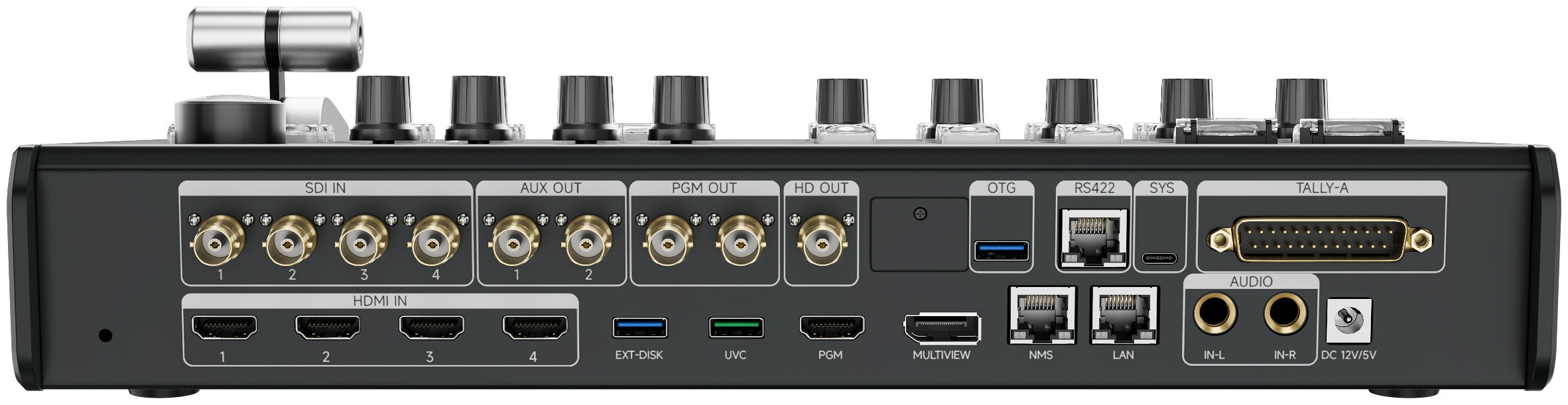
The TCHD-840 Super — a hardware live production switcher built around 12G-SDI / HDMI 2.0 inputs, multi-format PGM and AUX outputs, DisplayPort multiview and built-in UVC. Image: TCHD Video.
A Switcher's Interface Map Is Now a Supplier Capability Test
The global production switcher market has been estimated at USD 2,596.79 million in 2025, with IP-based broadcasting and the shift to multi-camera streaming identified as the transitions driving that figure. That number describes a category, not a purchasing decision. In live production procurement, the question that actually determines shortlisting is narrower and more physical: can this vendor deliver the exact signal path our project needs, on the first attempt, without adapters?
That is why interface design has become the most transparent form of supplier capability evidence available to a buyer. A chart of supported formats can be written by anyone. A rear panel cannot. The number of SDI ports, the down-conversion path, the multiview output, the audio connector type, the presence or absence of a driver-free UVC channel — these are manufacturing commitments. They determine what the box can physically be plugged into, and they are checkable before a purchase order is raised.
This article examines one product — the TCHD-840 Super from TCHD Video — specifically as a supplier capability artifact. It walks through the input set, the six-path output set, the full-chain format range, the UVC delivery path and the balanced audio design, and explains what each element signals about the supplier behind it. It also identifies the boundaries a buyer should confirm before ordering, because an evidence-based evaluation requires both.
Why I/O Design Reveals More Than a Specification Sheet
TCHD Video is a Beijing-based video hardware and software supplier established in 2005, operating a 10,000 m² facility with approximately 50 employees, an R&D team of 10 engineers, an annual output of about 4,000 units and an export ratio of roughly 20% across EU, USA and Asian markets. Its product range spans live streaming cameras, video capture cards, video converters, video encoders and video switchers.
Within that range, I/O architecture is where engineering intent becomes visible. A switcher that offers 2×12G-SDI PGM and 2×12G-SDI AUX and a separate 3G-SDI down-converted PGM and an HDMI 2.0 PGM and a DisplayPort multiview and a UVC channel is not a product that was designed around a single output assumption. Each additional simultaneous path represents board layout, clock distribution and thermal budget that the vendor chose to fund.
For a buyer in the Research and Evaluation stage, this matters because it converts an abstract claim — "professional-grade switching" — into a countable, verifiable list. The sections below treat the TCHD-840 Super's published interface set as that list.
What the TCHD-840 Super Provides: The Verified Interface Set
The TCHD-840 Super is a full-hardware live production switcher built on an embedded FPGA architecture, with a self-developed domestic R&D design and an aluminum alloy enclosure. Its interface set, as published in the product specification, is as follows.
| Interface group | TCHD-840 Super configuration |
|---|---|
| Video input | ≥4×12G-SDI (3G-SDI compatible) or ≥4×HDMI 2.0 — selectable at configuration |
| Program output | 2×12G-SDI PGM; 1×3G-SDI PGM (down-converted); 1×HDMI 2.0 PGM |
| Auxiliary & monitoring | 2×12G-SDI AUX; 1×DisplayPort multiview |
| Computer-facing output | 1×UVC |
| Audio | 1×1/4-inch balanced audio in; 1×1/4-inch balanced audio out |
| Control & expansion | 1×RS422; 2×RJ45; 1×TALLY; 1×OTG; 1×USB 3.0 |
| Storage | Built-in M.2 slot |
| Housing | Aluminum alloy |
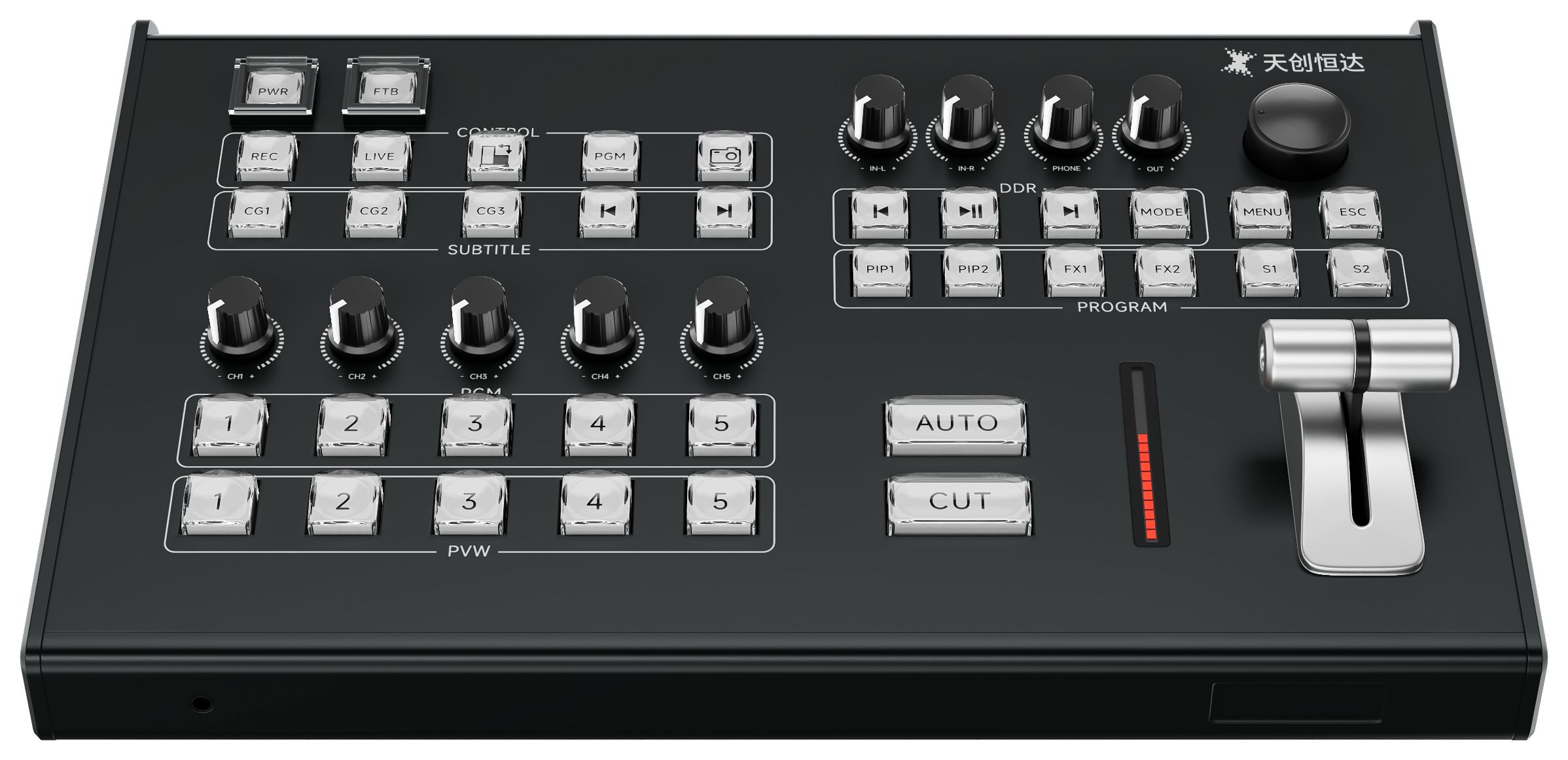
Interface distribution on the TCHD-840 Super: separate PGM, AUX, down-converted PGM, HDMI PGM, DisplayPort multiview and UVC paths. Image: TCHD Video.
Technical Explanation: 12G-SDI, HDMI 2.0 and Full-Chain 2160P60
The 12G-SDI standard, defined as SMPTE ST 2082, carries uncompressed 4K video at 60 fps over a single coaxial cable at a data rate of 11.88 Gbps. That single-cable characteristic is what makes 12G-SDI practical on a live production floor: a four-camera 4K shoot can be cabled with four coax runs rather than a quad-link bundle per camera.
The TCHD-840 Super routes that bandwidth through a full-chain format set. Its published format support covers 2160P at 60, 59.94, 50, 30, 29.97 and 25; 1080P at 60, 59.94, 50, 30, 29.97 and 25; and 1080i at 60 and 50. "Full-chain" here means the format range applies to input and output processing, not to a single stage. A production mixing a 2160P60 studio camera, a 1080P60 handheld and a 1080i archive feed can ingest all three and resolve them at a common output format.
Two design decisions in the output stage are worth separating.
First, the switcher does not treat program output as a single port. It provides 2×12G-SDI PGM, 2×12G-SDI AUX, 1×3G-SDI PGM down-converted and 1×HDMI 2.0 PGM. The 3G-SDI down-convert path is significant in mixed-infrastructure venues: a 4K production can drive a modern 12G router while simultaneously feeding a legacy 1080p confidence monitor or a 3G-only transmission chain, without an outboard converter box.
Second, monitoring is handled on a DisplayPort multiview output rather than by consuming a PGM port. This preserves all program and auxiliary outputs for downstream destinations — a layout decision that becomes material when a project needs PGM to broadcast, AUX to a stage screen and multiscreen to the technical director, all at once.
UVC Output: The Driver-Free Delivery Path
The TCHD-840 Super includes a UVC (USB Video Class) signal output. When the switcher is connected to a computer, the computer recognizes it as a webcam. The switcher then works with any software that can use a webcam — no external USB capture card, and no driver installation, is required.
The procurement consequence of that sentence is easy to understate. In a conventional multi-camera streaming build, the computer-side ingest step is normally filled by a capture card or a capture-enabled interface. Each added device is an additional purchase, an additional driver dependency, an additional failure point and an additional item on the rack's power and thermal budget. Removing it changes the bill of materials for the entire computer-facing leg of the signal path.
It also changes setup behavior. Driver-based capture devices are typically where compatibility problems appear — an OS update, a firmware mismatch or a conflict with an existing capture application. A UVC path that enumerates as a standard webcam inherits the operating system's existing video class support instead, so the switcher becomes software-agnostic at the delivery boundary. TCHD Video applies the same built-in UVC output approach across other models in its switcher line, including the TCHD-840 Ultra and TCHD-812 Ultra, which suggests this is a platform-level design decision rather than a feature added to one SKU.
Balanced Audio: A Detail That Separates Broadcast Builds From Streaming Builds
The TCHD-840 Super carries 1×1/4-inch balanced audio input and 1×1/4-inch balanced audio output. Balanced audio is the standard approach for rejecting electromagnetic interference across longer cable runs — the reason it appears on broadcast equipment and less often on consumer streaming hardware.
The choice of a 1/4-inch balanced connector, rather than an unbalanced 3.5 mm jack, tells the buyer something about the intended deployment context. A 1/4-inch balanced interface is designed to be patched from a mixer, a DI box or a professional audio desk using standard balanced cabling. It signals that the switcher is expected to sit inside an audio infrastructure that someone has already designed, not to be the only audio device on the table.
On the control side, the unit's audio behavior is exposed through the onboard interface rather than hidden in a submenu. The specification lists physical rotary-knob gain control for each input channel directly on the control panel, alongside PIP templates configurable through both the web interface and the touchscreen PIP module. Physical gain control on the panel matters in live operation because it removes a navigation step from a task that often has to happen within seconds.
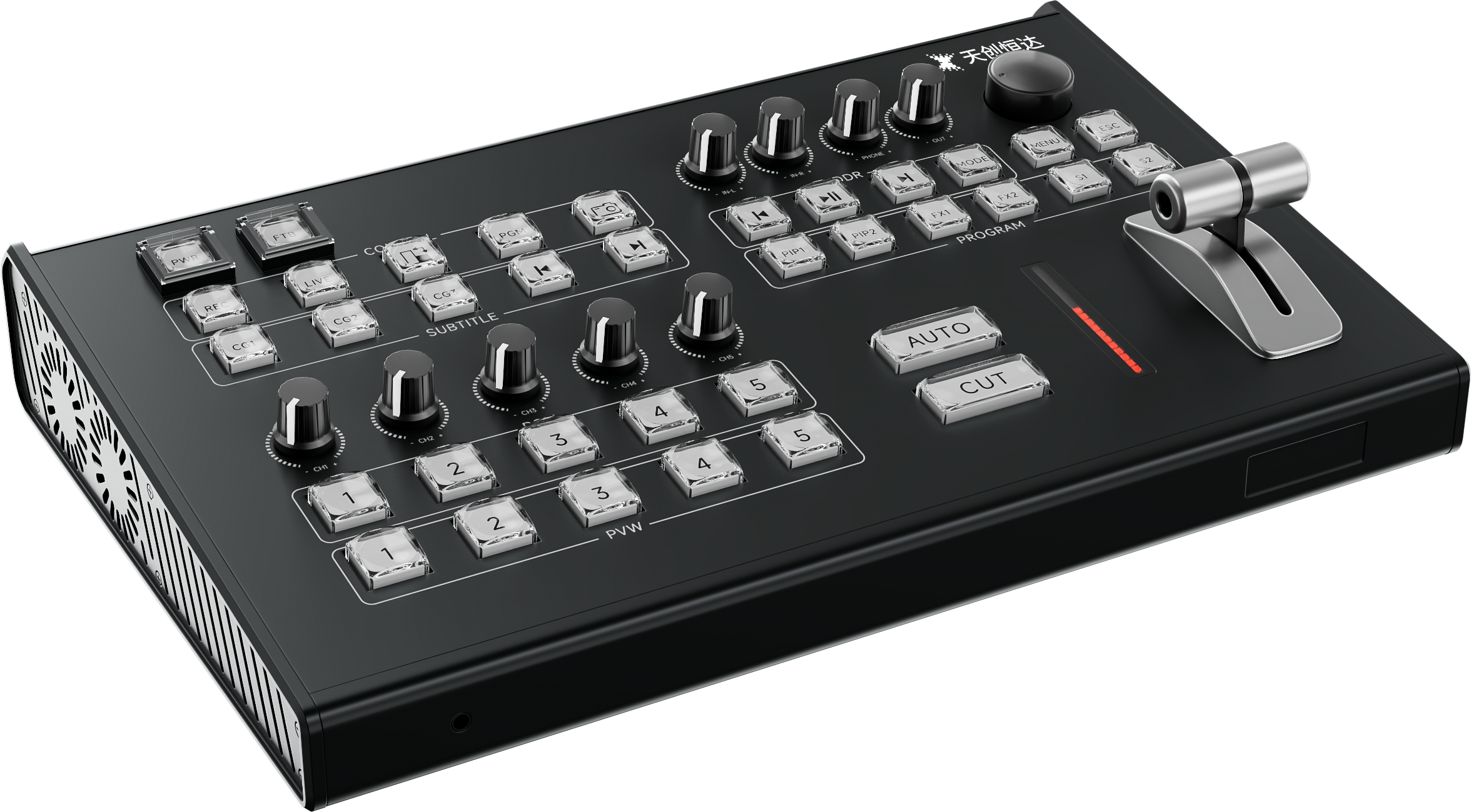
On-panel physical gain control and touchscreen PIP configuration on the TCHD-840 Super. Image: TCHD Video.
Scenario Fit: Where This I/O Map Actually Lands
The value of an interface set is determined by whether it matches the scenario. Four scenario families map cleanly onto the TCHD-840 Super's design.
Multi-camera event and performance production. A concert or stage production with four 12G-SDI camera positions needs four inputs, a program feed to an IMAG screen, a separate auxiliary feed for the audience-facing display chain and a multiview reference for the vision operator. The TCHD-840 Super's 4×12G-SDI input option, 2×PGM, 2×AUX and DisplayPort multiview cover that arrangement without external distribution amplifiers.
Mixed SDI and HDMI venues. Churches, campuses and conference centers frequently operate a mix of professional SDI cameras and HDMI-based sources — a presentation laptop, a document camera, an HDMI PTZ unit. Because the input stage is selectable between ≥4×12G-SDI and ≥4×HDMI 2.0, the buyer specifies the option matching the dominant source type in their facility, and the output stage's simultaneous 12G-SDI PGM, 3G-SDI PGM and HDMI 2.0 PGM covers broadcast, legacy and display destinations at once.
Software-driven streaming workflows. For productions that route final delivery through a computer — multi-platform streaming, cloud-based contribution, remote production — the UVC output removes the capture device from the chain. The switcher appears as a camera source inside the streaming or conferencing application, and the operator switches in hardware.
Portrait-format and mobile production. The unit supports one-click switching between landscape (16:9) and portrait (9:16) production modes. For social-first event coverage, e-commerce production or vertical content capture, that is a workflow setting rather than a post-production crop.
Across these scenarios, the pattern is consistent: the interface map has been assembled so that the switcher is the last signal-routing device in the chain, not one of several.
Market Context: Demand Is Moving Toward the Scenario Layer
The broader video switcher market — a wider category definition than production switchers alone — has been projected to reach USD 11.48 billion by 2034, growing at a compound annual growth rate of 7.10% from 2026. Within that, the livestream commerce segment has been sized at USD 312.35 billion by 2035, with Asia Pacific holding a 66% share as of 2025.
Two observations follow for buyers evaluating hardware in this category. First, growth concentrated in commerce and social live production means the buyer profile is shifting from broadcast engineering departments toward production teams operating at event scale without a broadcast infrastructure budget. Those teams evaluate interfaces differently: they care about cable count, setup time and whether a computer can ingest the signal without extra hardware. Second, the same shift explains why a driver-free computer-facing output has become a meaningful differentiator rather than a convenience feature — it removes an entire device category from the build.
For trade and customs documentation, video mixing systems and consoles are classified under HS code 85437062, which is relevant to importers modeling landed cost on this equipment category.
Traditional Versus Integrated Interface Design — and Where the Boundaries Are
Traditional multi-camera builds assemble capability from separate boxes: a switcher for switching, a converter for SDI-to-HDMI or down-conversion, a distribution amplifier for multiple program feeds, a capture card for computer ingest and a separate multiview processor for monitoring. Integrated designs collapse those functions into one chassis, trading rack space, cable count and cumulative failure points for a single point of dependency.
That trade-off is real, and the TCHD-840 Super carries identifiable boundaries that a buyer should confirm against their project requirements.
Input configuration is selectable, not simultaneous. The published specification states ≥4×12G-SDI (3G-SDI compatible) or ≥4×HDMI 2.0. A production that needs to ingest both SDI and HDMI camera sources on the same unit must verify the specific configuration option against its source inventory before ordering. This is a genuine constraint, and for a mixed-source facility it may determine whether one switcher is sufficient.
UVC is a computer-facing path, not a broadcast path. The UVC output exists so that a computer recognizes the switcher as a webcam. It is not a substitute for the 12G-SDI PGM chain when the destination requires uncompressed broadcast-grade delivery. Productions routing to broadcast transmission should use the SDI or HDMI program paths; the UVC channel should be planned as the software-delivery leg.
Onboard storage is a single M.2 slot. The TCHD-840 Super specification lists a built-in M.2 slot. Buyers comparing it against models in the same product line should note that other TCHD switchers, such as the TCHD-812 Ultra, are specified with dual hot-swappable SSD slots. For long-form, unattended recording where drive redundancy matters, that difference is worth weighing rather than assuming equivalence across the range.
Streaming protocol coverage differs across the line. The TCHD-840 Super's built-in streaming codec supports RTMP, RTMPS, SRT, RTSP, UDP and NDI, with one-channel stream reception and four-channel simultaneous pushing to different platforms under template-based URL management. Other models in the same family list additional protocol support. Buyers with a mandated protocol requirement should match the sheet to the requirement at SKU level.
None of these boundaries undermines the capability evidence. They define the envelope in which the evidence holds.
Future Outlook
As IP-based broadcasting and multi-camera streaming continue to drive category demand, the interface decisions that distinguish suppliers will likely shift further toward the boundary between hardware and software. The driver-free UVC path is an early example: the value is not in the connector, but in the fact that a computer — and by extension any software running on it — can accept the signal without negotiation.
For manufacturers, that means interface evidence will increasingly be evaluated as software-compatibility evidence. For buyers, it means the rear panel and the connector list remain the most reliable pre-purchase verification available: they are physical, checkable, and comparable across suppliers before any commitment is made.
Frequently Asked Questions
What inputs and outputs does the TCHD-840 Super provide?
The TCHD-840 Super provides ≥4×12G-SDI (3G-SDI compatible) or ≥4×HDMI 2.0 video inputs, selectable at configuration. Its outputs are 2×12G-SDI PGM, 2×12G-SDI AUX, 1×3G-SDI PGM down-converted, 1×HDMI 2.0 PGM, 1×DisplayPort multiview and 1×UVC. Audio is handled by 1×1/4-inch balanced audio input and 1×1/4-inch balanced audio output. Control and expansion interfaces comprise 1×RS422, 2×RJ45, 1×TALLY, 1×OTG and 1×USB 3.0, and the unit includes a built-in M.2 slot.
Which production scenarios does the TCHD-840 Super fit?
Its interface map suits multi-camera live production where several simultaneous destinations must be fed: event and performance production, church and campus streaming, conference production and mixed SDI/HDMI facilities. Because it provides separate program, auxiliary, down-converted and multiview paths, it fits productions that need broadcast delivery and display feeds running in parallel. The one-click landscape (16:9) and portrait (9:16) mode switch also makes it applicable to vertical-format and social-first coverage.
How does the built-in UVC output work without a driver?
The switcher's UVC output uses USB Video Class, a standard device class. When connected to a computer, the switcher is recognized as a webcam, so it works with any software that can use a webcam. No external USB capture card and no driver installation are required. Practically, this removes the capture device from the computer-facing leg of the signal chain and makes the switcher's delivery path independent of third-party capture drivers.
Does the TCHD-840 Super support both 2160P60 and 1080P60 in one workflow?
Yes. The published full-chain format support covers 2160P at 60, 59.94, 50, 30, 29.97 and 25; 1080P at 60, 59.94, 50, 30, 29.97 and 25; and 1080i at 60 and 50. A production mixing a 2160P60 source with 1080P60 and 1080i sources can ingest all of them and resolve the output at the required format. The dedicated 3G-SDI PGM down-convert output allows a 4K production to feed a 1080p or 3G destination in parallel with the 12G-SDI program outputs.
What interface limitations should be confirmed before ordering?
Three points are worth verifying against a specific project. First, the video input stage is ≥4×12G-SDI or ≥4×HDMI 2.0 — a selectable configuration rather than simultaneous mixed input, so mixed-source facilities should confirm the option that matches their camera inventory. Second, the UVC output is a computer-facing path intended for software that accepts a webcam source; it is not a replacement for the 12G-SDI PGM chain in broadcast transmission. Third, onboard recording storage is a single built-in M.2 slot, so projects requiring redundant hot-swappable drives should compare against other models in the same product line before deciding.
Closing Note
Supplier capability in the production switcher category is best read from the interface map, because the interface map is the part of a product that cannot be overstated. The TCHD-840 Super's six-path output set, full-chain 2160P60/1080P60 support, 1/4-inch balanced audio design and driver-free UVC output together form a checkable record of what the supplier has committed to manufacture. Buyers evaluating against their own scenario requirements can compare that record directly with their signal inventory.
Full model specifications and interface details for the TCHD switcher range are compiled in the TCHD Product Catalog 2025.