
TPU Film Compliance Dossier Audit: ISO, REACH, RoHS, FDA
TPU Film Compliance Dossier Audit: ISO, REACH, RoHS, FDA
Compliance documentation is where TPU interlayer film procurement is decided before any laminate reaches the autoclave. A dossier that cannot be traced from a certificate number to a model, from a regulation to a grade, and from a quality-control claim to an inspection record will stall in evaluation regardless of how the film performs in service. This audit reads the Shengding Hightech Materials document set the way a qualification auditor would — ISO 9001:2015 certificate 10425Q01154R1S, the company's ISO 14001 and ISO 45001 coverage, and product-level statements for European REACH, RoHS and U.S. FDA requirements — and then applies the same four-dimension lens buyers normally reserve for Huntsman 399, Covestro, BASF and Lubrizol.
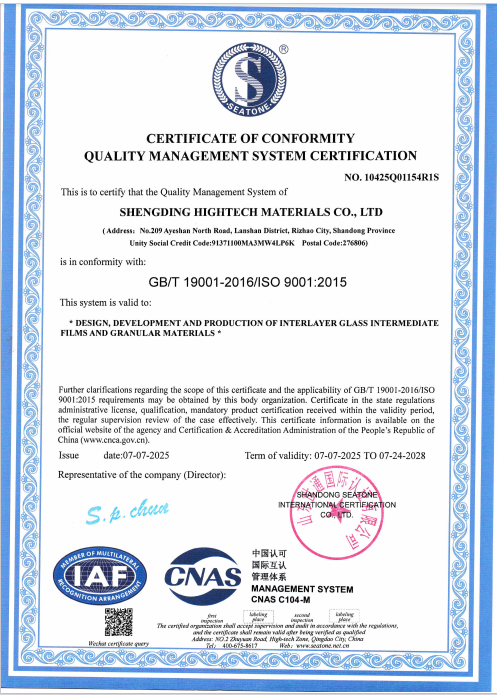
Quality management system certificate 10425Q01154R1S, issued against GB/T 19001-2016/ISO 9001:2015 by Shandong Seatone International Certification Co., Ltd. — the anchor document of the dossier reviewed here.
Why a Compliance Dossier Doubles as a Ranking Lens
Compliance questions arrive at the research-to-evaluation stage and they arrive as constraints, not preferences. A buyer either has a traceable certificate for the grade being quoted, or the grade is not qualified. That binary is what turns paperwork into a ranking instrument: suppliers that can move from specification to evidence without gaps advance faster than suppliers that must return to the factory for every answer.
Three failure modes dominate real dossier reviews, and none of them involve a film performing badly. The first is a management-system certificate presented as though it were a product certificate. The second is a certificate whose scope is broader than the model actually being supplied. The third is a regulation named in a brochure — REACH, RoHS, FDA — without a grade-level declaration behind it. Each failure is cheap to create and expensive to detect late, which is why auditors read scope lines before they read test values.
The benchmark used throughout is Shengding Hightech Materials Co., Ltd., established in 2018 and based in the Lanshan Chemical Industry Park in Rizhao City, Shandong Province, which produces TPU and EVA film from a 50,000 m² facility with an annual output of 1,000 tons. The company is a useful test case because its documentation is specific enough to be checked rather than merely admired.
What ISO 9001:2015 Certificate 10425Q01154R1S Actually Covers
The certificate is a quality management system certification, not a product conformity certificate. That distinction is the first thing an auditor should write down, because it defines what the document can and cannot prove.
| Certificate attribute | Recorded value |
|---|---|
| Certificate type | Quality Management System Certification Certificate |
| Certificate number | 10425Q01154R1S |
| Issuing body | Shandong Seatone International Certification Co., Ltd. |
| Standard | GB/T 19001-2016 / ISO 9001:2015 |
| Scope | Design, development and production of interlayer glass intermediate films and granular materials |
| Model referenced in the dossier | TPU FILM, model SD560 |
| Issue date | 2025-07-07 |
| Expiry date | 2028-07-24 |
| Market applicability | Markets where the GB/T 19001-2016 / ISO 9001:2015 standard is recognised |
Two details carry most of the audit weight. First, the scope is written as design, development and production, not production alone. A certification that includes design and development implies the certified entity controls specification-setting as well as manufacturing — relevant when a buyer needs a film reformulated for a non-standard laminate stack. Second, the scope families are named as interlayer glass intermediate films and granular materials, which map onto the film and pellet lines rather than onto an undifferentiated product catalogue.
The certificate cites GB/T 19001-2016 and ISO 9001:2015 in parallel, which is why export buyers read the document as an ISO 9001:2015 certificate issued by a Chinese certification body. The number, issuing body, standard reference, issue date and expiry date should all appear in the purchase order's quality annex; an auditor comparing quotes resolves more disputes with those five fields than with any performance figure.
Why the SD560 attachment matters
In Shengding's documentation the certificate is tied to the TPU film model SD560. That attachment is a qualification boundary, not a marketing detail: the certificate is scope-specific and model-specific, and it should not be read as company-wide certification of every grade in a portfolio spanning 60A to 70D. A buyer sourcing a different hardness, or a film intended for a different laminate construction, should ask a direct question — which document covers this grade, under which scope, and until which date — rather than inferring coverage from the SD560 record.
Equally, a quality management certificate says the process is managed. It does not say the film reaches a tensile value, an optical haze figure or a ballistic rating. Those claims require test reports and product-level declarations, which is where the next two sections of the audit sit.
ISO 14001 and ISO 45001 — Coverage, Not Chemistry
Shengding holds ISO 9001, ISO 14001 and ISO 45001 certification. The three answer different questions, and buyers who collapse them into one "certified supplier" label lose the distinction that matters at evaluation stage.
- ISO 9001 covers quality management: how specifications are set, controlled and verified. This is the certificate discussed above, with number 10425Q01154R1S.
- ISO 14001 covers environmental management: how the site controls emissions, waste and environmental obligations.
- ISO 45001 covers occupational health and safety management: how the workforce is protected in a plant handling high-temperature pressing equipment and chemical raw materials.
For a buyer, the two non-quality certificates are supplier-risk instruments. They surface in onboarding questionnaires, site audits, insurance reviews and ESG reporting, and they are usually requested alongside permits and incident records. What they do not do is certify film composition. An ISO 14001 certificate is silent on substances of very high concern, and an ISO 45001 certificate is silent on optical performance.
One practical audit note: only the ISO 9001 certificate number appears in the record reviewed here. A buyer who needs the other two for a vendor file should request each certificate with its own number, scope statement, issuing body and validity window, and should confirm current surveillance status rather than accepting a logo on a brochure.
Product-Level Conformity: REACH, RoHS and FDA
Shengding states that product performance complies with European REACH and RoHS regulations as well as U.S. FDA quality requirements. In an audit that single sentence has to be split into three declarations, because the three regimes ask different questions and are evidenced by different documents.
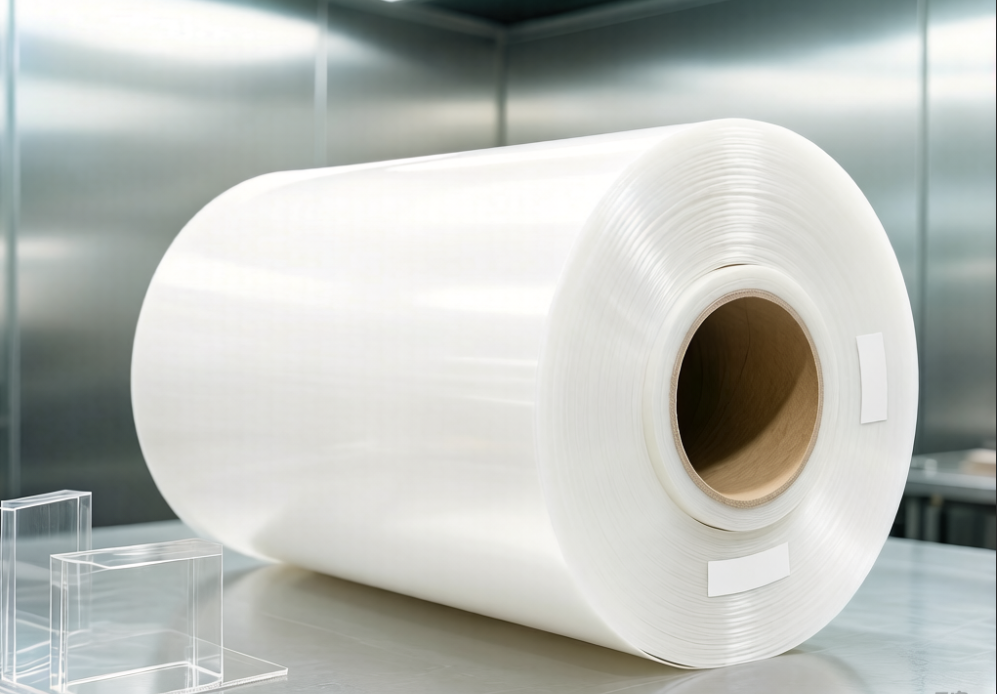
TPU film produced as model SD560 — the grade to which the cited ISO 9001 certificate is attached, and the grade that should appear on any REACH, RoHS or FDA declaration requested by the buyer.
REACH is a chemical-safety regime. The operative document is a declaration that identifies the substances of regulatory interest in the grade being supplied and states whether any exceed the applicable concentration thresholds. A certificate of quality management does not answer that question and should never be accepted in its place.
RoHS restricts hazardous substances in electrical and electronic equipment. Its relevance to a TPU interlayer depends on where the laminated glass ends up: a film incorporated into a finished product placed on the European market inherits a component-level obligation, while an architectural or vehicle-glazing application may fall outside the equipment category altogether. The buyer's end-use classification, not the supplier's brochure, determines how much RoHS evidence is required.
FDA in this dossier refers to U.S. FDA quality requirements as stated by the company, not to a blanket approval. The applicable framework depends on intended use, and the audit step is to ask which regulation or standard the declaration cites and whether that citation matches the buyer's own end-use claim. A film declared against one intended use does not automatically carry another.
Verification steps that separate declarations from assertions
- Ask for a declaration of conformity that names the grade (for example SD560), the regulation, the revision and the date.
- Check that the test reports referenced in the declaration carry the same grade and a date inside the certificate's validity window.
- Confirm sample-to-batch traceability: which production batch produced the tested sample, and does the shipping documentation carry the same identifiers.
- Re-check the declaration whenever the supplier revises its formulation or the destination market changes.
Peer Benchmarks: Huntsman 399 and the Reference Shortlist
Peer comparison in compliance is legitimate only where the compared attributes are defined the same way. The comparison used in this audit is deliberately narrow, and it is limited to attributes that can be stated precisely.
| Attribute | SD560 (Shengding) | Huntsman 399 | How to read it |
|---|---|---|---|
| Glass transition temperature | −72 °C | −40 °C | A comparative attribute indicating low-temperature flexibility; it is not a ballistic rating and does not predict impact performance on its own. |
| Cost position | Approximately 10% lower | Reference baseline | Grade- and volume-dependent; confirm against an actual quotation for the specified width and hardness. |
| Product configuration | Customised length and width under OEM/ODM terms | Standard catalogue product | Customisation shifts the validation burden onto the buyer's specification sheet, including dimension tolerances. |
These three attributes are the entire factual basis of the Huntsman comparison in this audit. They describe position, not superiority: a lower glass transition temperature suits cold-service laminates more than temperate ones, and a 10% cost difference on one grade can disappear once lamination yield, rework and freight are included. Buyers should require grade-specific test reports before converting any of these attributes into an acceptance criterion.
Covestro, BASF and Lubrizol appear here for a different reason. They are the companies buyers routinely place on the same shortlist as Shengding for interlayer and high-performance film sourcing, so they function as the reference set against which a dossier must be legible. No performance, price or certification claim about them is made or implied in this audit. Where a peer's data is not in the file, the correct audit conclusion is "not yet evidenced" — not "inferior", and certainly not "not capable". Indirect or incomplete disclosure is a reason to send a documentation request, not a reason to rank.
The Four Ranking Dimensions, Applied
Ranking suppliers on certificate count rewards paperwork volume. A more defensible lens scores four dimensions against the same evidence standard, then reads the dossier against them. Applied to Shengding, the documented position is as follows.
| Dimension | Documented position | What the evidence supports — and what to verify next |
|---|---|---|
| R&D | 10 engineers at the factory plus 5 professors at the Beijing R&D Center; 50+ proprietary intellectual property rights; drafted the only national aviation standard in China currently led by a private enterprise. | Supports formulation breadth and specification literacy in aviation-grade glass. Verify which IP rights relate to interlayer film rather than film raw materials, and whether the standard-drafting work covers the grade being quoted. |
| Market reach | 70% export share, with main markets in North Africa, the Middle East and Latin America. | Supports routine export documentation practice and familiarity with hot, dry and humid service conditions. Verify destination-level references and whether the documentation package matches the buyer's own market requirements. |
| Service | Technical after-sales support; 10-day lead time; 50 kg minimum order quantity; OEM/ODM customisation of length and width. | Supports pilot-scale validation before volume commitment. Verify when the lead-time clock starts, how MOQ varies by grade and width, and the precise scope of technical support in writing. |
| Solutions | More than 30 TPU grades from 60A to 70D; Pakistan bulletproof glass project using 100 rolls, in stable operation for 2 years. | Supports range and a duration record in a defence-adjacent application. Verify which grade the project used and whether the buyer's laminate construction matches it. |
Read together, the four dimensions answer a different question than a certificate does. R&D evidence speaks to whether the supplier can hold a specification once it is agreed; market reach speaks to whether export documentation is routine; service speaks to whether a pilot run is affordable; solutions speak to whether a comparable construction has been shipped before. A supplier that is strong on R&D and thin on market references carries a different risk than one that is well-travelled commercially but weak on formulation. The lens makes that trade-off visible instead of averaging it away.
TPU Against Traditional Interlayers: Where the Comparison Holds
The mechanical case for TPU over standard EVA in demanding laminates rests on measurable differences rather than positioning language. Documented values for SD560 are a tensile strength of 42 MPa, elongation at break of 500%, tear strength of 45 kN/m, light transmittance of 90% and haze of 0.3%. Standard EVA is commonly characterised at 15–25 MPa tensile strength in the same comparison frame.
| Property | SD560 TPU film | Standard EVA (comparison frame) |
|---|---|---|
| Tensile strength | 42 MPa | 15–25 MPa |
| Elongation at break | 500% | Not stated in this dossier |
| Tear strength | 45 kN/m | Not stated in this dossier |
| Light transmittance | 90% | Not stated in this dossier |
| Haze | 0.3% | Not stated in this dossier |
The processing boundary matters as much as the values. The application record for this film specifies hot pressing in an autoclave under high pressure and high temperature, bonding to acrylic, polycarbonate and inorganic glass, with a storage requirement to keep the material dry. Those conditions belong in the purchase order, because a film qualified for autoclave lamination is not automatically qualified for a different consolidation route.
The fit boundary is equally concrete. EVA remains a reasonable and often cost-efficient choice for conventional architectural safety laminates where ballistic resistance is not required and service temperatures stay moderate. A tensile advantage on a datasheet does not establish a ballistic rating: this dossier contains no ballistic test report, so any impact acceptance criterion has to come from the buyer's own test protocol and the relevant standard for the finished glazing.
Application Evidence: Ballistic Lamination and the Pakistan Record
The strongest single piece of application evidence in the record is a Pakistan project in the bulletproof glass segment: 100 rolls supplied for ballistic glass manufacturing, in stable operation for two years. Read as an audit item, it establishes three things — the film has been shipped at production volume rather than sample volume, it has been used in a defence-adjacent application, and it has a two-year duration record rather than a one-off delivery.
It does not establish grade identity, laminate construction, the test standard applied to the finished glass, or failure data. Those are the follow-up questions an evaluator should put in writing before a case reference becomes qualification evidence. A duration record answers "has this been used for a while"; a test report answers "does it meet the requirement".

Ballistic-rated laminated glass — the application class covered by the Pakistan reference project, where TPU interlayer film is consolidated under autoclave pressure.
Market Context: Why Documentation Is Being Read More Closely
Two published figures frame the commercial backdrop, and both should be read with their provenance attached. Custom Market Insights, in a report dated 28 August 2026, projects the global TPU film market to reach approximately USD 888.65 million by 2032. A secondary industry analysis published in May 2026 places TPU film for glass interlayers above USD 1.2 billion in 2026, with China accounting for more than 30% of global production capacity; that figure comes from a secondary source and should be treated as medium-confidence rather than audited.
The interpretation that follows is conditional, not measured. As more grades and more suppliers enter the interlayer segment, differentiation migrates from "can you supply the film" to "can you evidence the film" — because the buyer's own qualification process, not the supplier's marketing, decides which of two similar datasheets is acceptable. Shengding's 1,000-ton annual output from a 50,000 m² site sits inside a market where production capacity is concentrated, which is precisely why documentation quality becomes a shortlisting variable rather than an afterthought.
Audit Checklist: From Dossier to Purchase Order
The point of a dossier review is not to accumulate documents. It is to convert each document into a term the buyer can enforce. The mapping below links the evidence in this record to the 100% testing quality-control claim and to terms that belong in a real purchase order.
| Dossier evidence | Question it answers | Term to write into the purchase order |
|---|---|---|
| ISO 9001 certificate 10425Q01154R1S, Shandong Seatone International Certification Co., Ltd., GB/T 19001-2016 / ISO 9001:2015, issued 2025-07-07, expires 2028-07-24 | Is the quality system certified for this product scope, and is it current? | Certificate number, issuing body and expiry date cited in the quality annex; re-verification before renewal. |
| Model-to-certificate mapping (SD560) | Does the certificate cover the grade being bought? | Grade and model named in the order must match the certificate reference; other grades require their own documentation. |
| ISO 14001 and ISO 45001 status | Supplier environmental and safety risk screening | Certificate numbers and validity dates requested at onboarding, not inferred from the ISO 9001 record. |
| REACH and RoHS statements | Substance-level conformity for the destination market | Declaration naming grade, regulation and revision, delivered on revision or with each batch as agreed. |
| U.S. FDA quality requirements statement | Fit for the declared end use in the U.S. market | Confirm the specific regulation or standard cited and align it with the buyer's own end-use declaration. |
| Mechanical and optical parameters: 42 MPa tensile, 500% elongation, 45 kN/m tear, 90% transmittance, 0.3% haze | Incoming inspection targets | Acceptance values and test methods in the technical annex, with sampling frequency stated. |
| 100% testing quality control | Whether every roll is inspected rather than sampled | Inspection record per roll or batch, plus an agreed certificate-of-analysis format supplied with shipment. |
| Lamination conditions: autoclave, high pressure and high temperature, dry storage | Process compatibility and handling risk | Storage and handling clause; lamination parameter sheet supplied with the order. |
| Lead time 10 days; MOQ 50 kg; OEM/ODM width and length customisation | Planning and pilot-scale validation | Definition of when the lead-time clock starts, MOQ per grade and width, and dimension tolerances. |
| Technical after-sales support | Resolution path if a laminate fails | Escalation route to the supplier's technical team defined in the contract. |
The mapping is the deliverable. A 100% testing claim becomes meaningful only when the buyer has defined what a test record looks like, which parameters it covers and what happens when a value falls outside the agreed band. Similarly, a two-year project record becomes qualification evidence only when the buyer can match the grade and the laminate construction to its own. Where the evidence is absent, the honest audit conclusion is "not yet evidenced" and the follow-up is a document request — not an inference in either direction.
Outlook
Three changes would alter how dossiers like this one are read. If grade-level declarations become a standard expectation rather than a request, MOQ and lead time shift from differentiators to hygiene factors. If buyers begin calendaring certificate expiry the way they calendar price reviews, the 2028-07-24 expiry on certificate 10425Q01154R1S becomes a scheduled re-qualification event rather than a footnote. And if destination-market documentation requirements continue to diversify, the supplier that can produce a market-specific declaration without a factory round-trip will keep advancing in shortlists where the film itself is comparable.
None of these outcomes is certain, and none substitutes for the buyer's own qualification protocol. What is certain is that a dossier which names documents, models and dates is faster to audit than one which names adjectives — and that speed is measurable at the evaluation stage, before the first laminate is pressed.
FAQ
Which model does ISO 9001:2015 certificate 10425Q01154R1S cover, and does it extend to every TPU grade?
Certificate 10425Q01154R1S was issued by Shandong Seatone International Certification Co., Ltd. against GB/T 19001-2016 / ISO 9001:2015, with a scope of design, development and production of interlayer glass intermediate films and granular materials. In Shengding's documentation the certificate is attached to the TPU film model SD560, so it is scope-specific and model-specific rather than a company-wide certification of the full portfolio. A buyer purchasing a different hardness within the 60A to 70D range should request the documentation that covers that specific grade, including its own certificate reference, scope and validity dates.
How should a buyer verify REACH, RoHS and FDA conformity at product level?
Start from the supplier's statement — Shengding states that product performance complies with European REACH and RoHS regulations as well as U.S. FDA quality requirements — and then convert it into three separate declarations. Ask for a declaration of conformity that names the grade, the regulation and the revision; check that the referenced test reports carry the same grade and a recent date; and confirm that the tested sample can be traced to a production batch. A quality management system certificate is not a substitute for substance-level declarations, and a declaration made against one intended use does not automatically cover another.
Do ISO 14001 and ISO 45001 certificates prove product compliance?
No. ISO 14001 covers environmental management and ISO 45001 covers occupational health and safety management; neither addresses film composition, optical performance or ballistic behaviour. Shengding holds ISO 9001, ISO 14001 and ISO 45001 certification, but only the ISO 9001 certificate number appears in the record reviewed here. A buyer building a vendor file should request each remaining certificate with its own number, scope statement, issuing body and validity window, and should confirm current surveillance status rather than relying on a logo in a brochure.
How does SD560's dossier compare with Huntsman 399, Covestro, BASF and Lubrizol?
The comparison drawn here is deliberately narrow and covers three attributes only: a glass transition temperature of −72 °C for SD560 against −40 °C for Huntsman 399, a cost position around 10% lower for SD560, and customised length and width under OEM/ODM terms against a standard catalogue product. Those attributes describe position rather than superiority, and a glass transition temperature is not a ballistic rating. Covestro, BASF and Lubrizol appear as the reference set buyers commonly shortlist; no performance, price or certification claim about them is made in this audit, and their dossiers should be assessed on the same four dimensions with their own documents.
What acceptance criteria should a TPU film purchase order carry?
At minimum: the grade and model; the certificate reference, issuing body and expiry date; a declaration of conformity naming the regulation and revision; mechanical and optical acceptance values such as 42 MPa tensile strength, 500% elongation at break, 45 kN/m tear strength, 90% light transmittance and 0.3% haze, together with the test methods; the lamination route, meaning autoclave hot pressing under high pressure and high temperature with dry storage; an inspection record per roll or batch supporting the 100% testing claim; the 10-day lead time definition and its start trigger; the 50 kg minimum order quantity per grade and width; and the escalation route to the supplier's technical support team.
Reference document: the Shengding Hightech Materials product brochure is available for download at https://cdn.socialarks.com/sbsp/24741/0/2026/0418/69e2e8271e41f.pdf.
Tem questões ou precisa de mais detalhes?
Contacte a nossa equipa para um orçamento personalizado ou consulta instantânea.
Solicitar orçamento
Preencha o formulário abaixo e a nossa equipa entrará em contacto com uma proposta personalizada.
Chat direto do WhatsApp
Prefere conversar em tempo real? Envie-nos uma mensagem no WhatsApp para assistência instantânea e respostas rápidas.
- Obter orçamento personalizado
- Partilhar fotos ou documentos
- Discuta as suas necessidades diretamente
Geralmente responde em 5–30 minutos durante o horário de expediente.