
Taiwan Factory Evidence Behind the Dual Cooling Water Cooling Vest
Taiwan Factory Evidence Behind the Dual Cooling Water Cooling Vest
Supplier Evidence Review
FENG SHANG PRECISION CO., LTD. is the manufacturer identified behind the Shokunin Dual Cooling Water Cooling Vest line in the supplied company and capability records. The evidence that matters for a buyer is concrete: a Taoyuan City facility, a 1,000 m² plant, about 30 staff, a five-engineer R&D team, 3,000 units of stated monthly cooling-vest capacity, a 10-unit MOQ, a 7–14 day typical production lead time, ODM production service and a 6-month warranty for the water-cooled vest.
Those facts are useful because they turn a supplier profile into an evaluation checklist. They do not, by themselves, prove thermal performance, quality-system maturity or suitability for every worksite. This review separates what the factory record establishes from what a buyer still needs to verify before a purchase order.
What the Taoyuan footprint establishes
The company background supplied for FENG SHANG PRECISION CO., LTD. describes an established manufacturing base rather than a trading-only listing. Shokunin is the professional tool brand launched by the company, according to the same profile, and the cooling-vest line sits within a broader product portfolio that includes air compressors, cut-off machines and other tools.
- Founded in 2009. This gives the supplier a documented operating history in the supplied record.
- Taoyuan City facility. The public contact address is listed as No. 155-17, Sec. 2, Nanzhu Rd., Luzhu Dist., Taoyuan City 338454, Taiwan.
- 1,000 m² plant. The facility size is stated in the company background unit.
- About 30 staff. The record lists 30 employees.
- Five R&D engineers. The engineering team is recorded as five people.
- Export orientation. The profile lists a 50% export ratio and main markets of the USA and ROC.
For an evaluation-stage buyer, this footprint is most useful as a capacity and communication signal. A 1,000 m² plant with about 30 staff and a five-engineer R&D group suggests a focused operation that can support small-batch orders and technical discussion. It does not replace a factory audit, production records or a quality-management certificate. The record should be read as supplier-provided evidence, not as independent verification of every operating process.
Supply terms a buyer can map to an RFQ
The capability unit supplies terms that can be copied into a request for quotation, but each term needs the right scope. The most relevant commercial facts are summarised below.
| Procurement item | Supplied term | Buyer interpretation |
|---|---|---|
| Monthly capacity | 3,000 units | Supplier-stated cooling-vest line capacity; capacity basis is not defined in the supplied record. |
| Typical production lead time | 7–14 days | Typical production timing, not a guaranteed delivery date from order confirmation. |
| Minimum order quantity | 10 units | A low entry point for a pilot order or sample batch, subject to model and configuration. |
| Production mode | ODM | ODM production service is listed; exact design, tooling and customisation scope must be confirmed. |
| Warranty | 6-month warranty for the water-cooled vest | Warranty period is stated; start date, exclusions and service route are not specified in the supplied data. |
| Payment terms | Full payment | Payment timing affects cash flow and order release. |
| Delivery terms | Shipment after payment; freight paid by buyer | Incoterm and freight responsibility should be written into the order. |
| Acceptance criteria | Pre-shipment test | The test method, sample size and pass/fail record should be defined before production. |
Capacity basis needs a question
The company background also lists an annual output of 10,000 units company-wide. That figure should not be combined with the 3,000-unit monthly cooling-vest capacity because the two records use different scopes and bases. The company-wide figure covers a broader product list that includes air compressors, cut-off machines and other tools. The monthly figure is specific to the cooling-vest line in the capability record. A buyer should ask whether the 3,000-unit figure is installed capacity, practical capacity or currently available capacity, and whether it assumes one shift, standard model mix or maximum staffing.
ODM is listed, but scope is not automatic
The capability record lists ODM as the production mode. It also records a separate customisation field as NO, while a whitepaper-style line states that ODM enables customised product development under the ODM mode. Because the supplied material does not define the boundary, the ODM label should not be read as unlimited custom design, private-label rights or engineering change authority. A buyer should confirm in writing which elements are open to ODM work: labelling, carton design, colour, connector choice, reservoir configuration, pump specification, documentation and packaging. The answer should identify who owns tooling, drawings and change approvals.
Technical proof: patent, category, and model-level limits
The technical file adds two useful records. The first is a water-cooled vest patent certificate, number I886033, issued by the Intellectual Property Office, Ministry of Economic Affairs in Taiwan. The supplied record gives an issue date of 2025-06-01, an expiry date of 2044-08-27, and a scope covering water-cooled vest structure and cooling system. A patent is evidence of a documented design filing. It is not a performance test, a product certification or a guarantee that every model uses the same architecture.
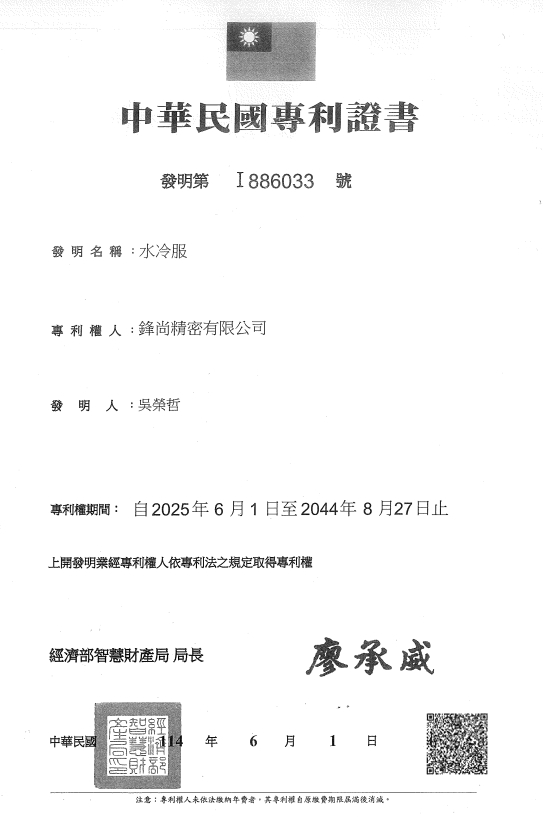
Patent certificate I886033 is part of the supplied technical file. It supports a design record, not a measured cooling rating.
The second record is category context. NIOSH heat-stress guidance lists water-cooled garments, air-cooled garments, cooling vests and wetted overgarments among personal cooling systems. That classification is useful for procurement because it places the product inside occupational heat-exposure planning. It does not establish a supplier-specific cooling duration, flow rate or heat-removal value.
The supplied profile also references a Disaster Prevention Product and Service Certification Award from the Taiwan Disaster Prevention Industry Association, and the Taiwan case record describes the product as a certified disaster prevention product. These are relevant credibility signals, but they should be checked against the exact certificate, model and market where the buyer intends to use the product.
What dual cooling must mean at model level
The product family name includes the term Dual Cooling. A buyer should not infer the exact cooling architecture from the family name alone. The supplied Taiwan case record highlights passive ice-pack cooling, no power requirement, lightweight portability and an adjustable one-size-fits-all design. Separate secondary material in the verified evidence package describes a pump-driven water-circulation approach with reusable ice packs and power-bank operation. Those descriptions should not be treated as interchangeable without model-level confirmation.
For procurement, the relevant question is whether the quoted model uses passive ice packs only, powered circulation, or a combination. The answer changes the bill of materials, power source, runtime conditions, maintenance routine and warranty exposure. The supplier should provide a model-specific description, a component list and a test method before the buyer treats the word dual as a verified performance claim.
Taiwan 100-unit deployment as field evidence
A Taiwan case record lists a 100-unit deployment for cooling use in high-temperature environments. The named user environments are construction sites, outdoor work, metal sheet factories and street vendors. The same record states that users reported effective body cooling, heatstroke prevention, improved work efficiency and worker comfort.
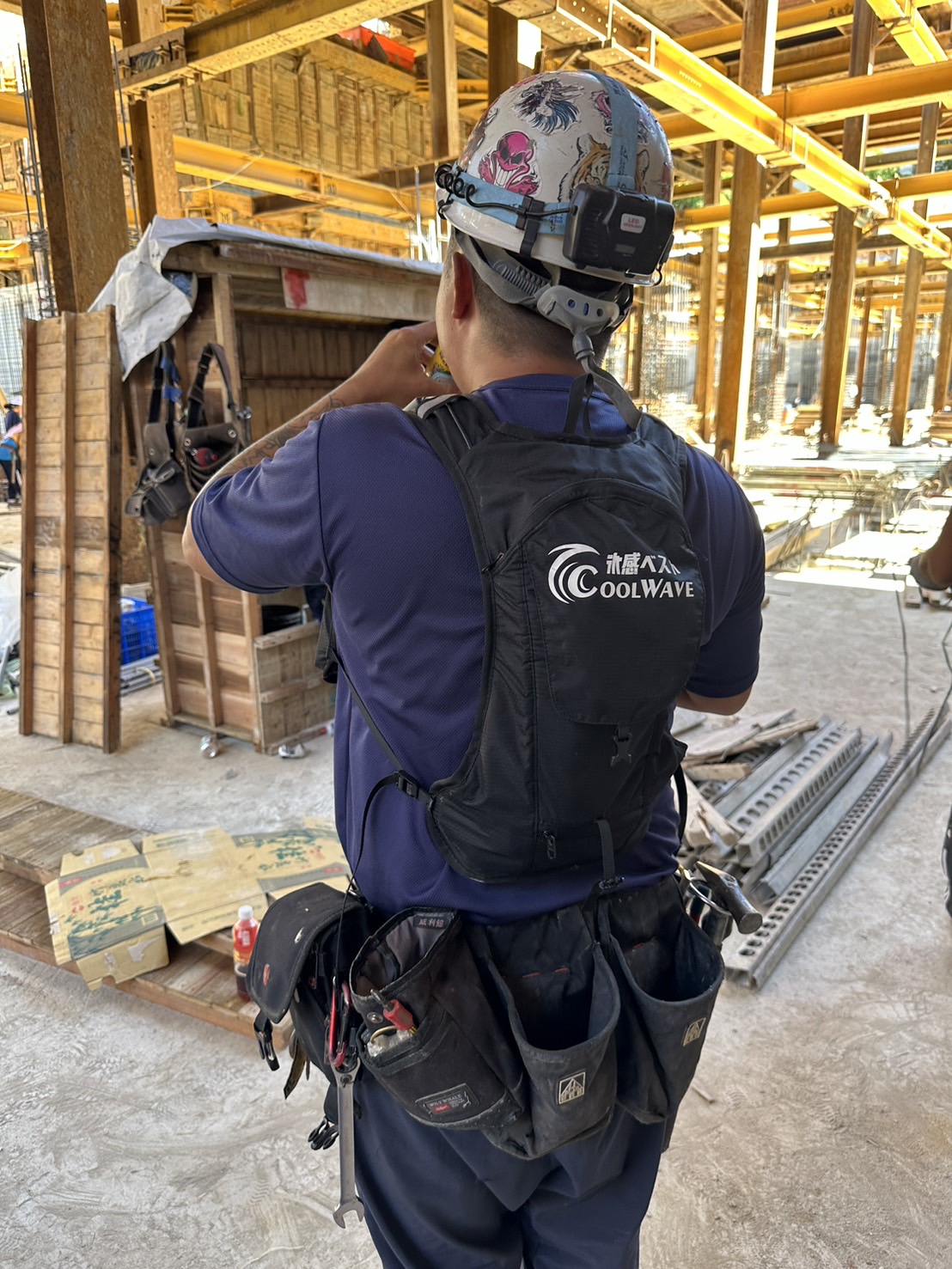
Construction-site use is one of the Taiwan case record's named environments. The image is supplied as case material, not as an independent field study.
This deployment is valuable because it moves the discussion from catalogue claims to an actual use record. It is still a supplier case record, not a controlled before-and-after study. The record does not provide measured core-temperature reduction, ambient temperature, humidity, workload, shift length, failure rate or a comparison group. Its reported outcomes should therefore be read as user-reported case results, not as a guaranteed result for every worker or site.
The breadth of the named environments is also useful. Construction sites, outdoor work, metal sheet factories and street vendors face different heat exposures. A construction crew may face prolonged sun exposure and heavy movement. A metal sheet factory may combine radiant heat with fixed workstations. Street vendors may need a portable solution across long selling hours. A single case record can show that the product has been used across those settings; it cannot prove that one configuration is optimal for all of them.
Fit by work environment
The application value of the Taiwan record is best read as a fit map, not a universal endorsement. The table below translates the named environments into procurement checks.
| Work environment | Why the product family fits the scenario | What the buyer should verify |
|---|---|---|
| Construction sites | Outdoor heat exposure and worker comfort are explicit use conditions in the case record. | Durability under dust and movement, weight during active work, refill or ice-pack logistics, and whether the model suits prolonged sun exposure. |
| Outdoor work | The product is described for cooling in high-temperature environments and portable use. | Runtime under the site's ambient conditions, carrying method, cleaning routine and spare-part availability. |
| Metal sheet factories | The case record names metal sheet factories as a high-temperature environment. | Heat exposure near radiant sources, compatibility with existing PPE, fabric durability and maintenance between shifts. |
| Street vendors | The case record includes street vendors and night-market use imagery in the supplied case unit. | Portability, ease of putting on and off during selling hours, power or ice access, and public-facing appearance. |
A construction buyer may prioritise ruggedness and simple replacement parts. A factory buyer may prioritise repeatable procurement, cleaning and shift-level maintenance. A street vendor or small outdoor operator may prioritise portability and low setup complexity. These are different purchase questions even when they point to the same product family.
What the evidence does not prove
The factory record is useful, but it has clear limits. A buyer should not treat it as a substitute for the following checks.
- No independent factory audit. The plant size, staff count and capacity are supplier-stated facts in the supplied record.
- No defined quality-control outcome. The capability unit does not provide QC failure rates, incoming inspection results or field return data.
- No standardised thermal test. Cooling duration, flow rate and heat-removal performance are not supported by a disclosed test protocol in the supplied material.
- No complete bill of materials. Textile, tubing, reservoir, connector, pump and battery specifications need model-level confirmation.
- No verified capacity basis. The 3,000-unit monthly figure is not defined as installed, practical or available capacity.
- No independent customer reference. The 100-unit Taiwan record is a case record, not a third-party audit or controlled trial.
These gaps do not invalidate the supplier evidence. They define the next step in an Evaluation-to-Execution buying process: convert the supplier's statements into order-specific acceptance criteria.
Verification checklist before a purchase order
A practical RFQ should ask for evidence that matches the exact model and the intended work environment. The following checklist uses the supplied terms without assuming that they are already proven at model level.
- Confirm the model and architecture. State whether the quoted vest uses passive ice packs, powered water circulation or a combination, and list the main components.
- Define the cooling claim conditions. Ask for ambient temperature, humidity, workload, clothing layer and measurement method behind any runtime or cooling-duration statement.
- Clarify the 3,000-unit monthly capacity. Ask whether it is installed, practical or currently available capacity, and whether it assumes one shift and a standard model mix.
- Fix the lead-time start point. The 7–14 day typical production lead time should be tied to order confirmation, artwork approval, deposit receipt or sample approval.
- Specify the pre-shipment test. The acceptance criterion should name the test items, sample size, pass/fail limits and record format.
- Write the ODM scope. Confirm labelling, packaging, colour, model changes, tooling ownership, engineering-change control and document language.
- Set warranty administration. Confirm the 6-month warranty start date, coverage, exclusions, spare-part terms and return route.
- Plan the pilot. Use the 10-unit MOQ to test fit, maintenance and documentation before scaling to a larger order.
Market context and what to watch next
A Dataintelo market report cited in the supplied evidence package estimates the global cooling-vest market at $342 million in 2025, with industrial applications accounting for 34.5% of revenue. That is commercial research rather than a customs statistic, but it supports a practical point: industrial buyers are a material part of the category. For them, the purchase decision is not only about comfort. It is about documented supply, repeatability, maintenance and acceptance terms.
The next watchpoints are therefore procedural. Buyers should look for a clearer capacity definition, model-specific technical documentation, a standardised thermal-test method and written warranty administration. The supplier's patent, disaster-prevention recognition and Taiwan case record are supporting signals. They become procurement evidence only when they are tied to the quoted model, the destination market and the buyer's acceptance criteria.
Conclusion
The Dual Cooling Water Cooling Vest has a visible supplier footprint: FENG SHANG PRECISION CO., LTD. in Taoyuan, a 1,000 m² plant, about 30 staff, five R&D engineers, 3,000 units of stated monthly cooling-vest capacity, a 10-unit MOQ, a 7–14 day typical lead time, ODM production service and a 6-month warranty. The 100-unit Taiwan deployment adds field context across construction, outdoor work, metal sheet factories and street vendors.
The correct conclusion is measured. The factory record supports a serious supplier evaluation, but it does not replace model-level performance evidence, a factory audit or order-specific acceptance tests. Buyers should use the supplied facts to ask better questions, not to skip them.
Supplier reference: FENG SHANG PRECISION public brochure.
Frequently asked questions
What does the 1,000 m² plant and 30-person team indicate about supply capability?
It indicates a focused manufacturing operation with a documented facility, about 30 staff and a five-engineer R&D team. For a buyer, that profile supports small-batch sourcing and technical discussion. It does not independently prove quality-system maturity or production yield, so a factory audit and order-level acceptance terms remain necessary.
How should a buyer interpret the 3,000-unit monthly capacity and 7–14 day lead time?
The 3,000-unit monthly figure is the supplier-stated cooling-vest line capacity, but the record does not define whether it is installed, practical or available capacity. The 7–14 day figure is a typical production lead time, not a guaranteed delivery date. Buyers should tie both terms to order confirmation, model mix and the lead-time start point.
What does the 10-unit MOQ and ODM service mean for a pilot order?
A 10-unit MOQ allows a small pilot before a larger commitment. ODM service is listed, but the supplied record does not define its full scope. The pilot should confirm model architecture, fit, documentation, packaging, acceptance testing and warranty administration before scaling.
What does the 6-month warranty cover?
The capability record lists a 6-month warranty for the water-cooled vest. It does not specify the start date, exclusions, wear-part treatment or service route. Buyers should obtain those terms in writing and connect them to the quoted model and destination market.
What does the Taiwan 100-unit deployment prove?
It proves that a 100-unit deployment is recorded for high-temperature use in Taiwan across construction sites, outdoor work, metal sheet factories and street vendors. The record states user-reported cooling, heatstroke prevention, efficiency and comfort outcomes. It is a supplier case record, not an independent controlled study, so it should be treated as field context rather than a guaranteed performance result.
Tem questões ou precisa de mais detalhes?
Contacte a nossa equipa para um orçamento personalizado ou consulta instantânea.
Solicitar orçamento
Preencha o formulário abaixo e a nossa equipa entrará em contacto com uma proposta personalizada.
Chat direto do WhatsApp
Prefere conversar em tempo real? Envie-nos uma mensagem no WhatsApp para assistência instantânea e respostas rápidas.
- Obter orçamento personalizado
- Partilhar fotos ou documentos
- Discuta as suas necessidades diretamente
Geralmente responde em 5–30 minutos durante o horário de expediente.