
Taizhou Huifeng Electron: A Motor Capacitor Manufacturer Profile
Motor capacitors are among the cheapest components in a single-phase motor system, and among the most consequential when they fail. A pump that will not start, a fan that hums without turning, an air-conditioning compressor that trips repeatedly — in a meaningful share of such cases the component at fault is a film or electrolytic capacitor costing a fraction of the service call. That gap between purchase price and failure cost is the reason capacitor sourcing has gradually shifted from a purely transactional decision into a supplier-qualification question.
This profile examines Taizhou Huifeng Electron Co., Ltd., a motor capacitor manufacturer based in Wenling, Zhejiang Province, China. The company was established in 1993 and has more than 30 years of experience in capacitor manufacturing. It specialises in metallized film, CBB series and CD series capacitors, and its product scope covers both continuous-duty run capacitors and short-duration start capacitors. The purpose here is not to promote the company but to explain, in verifiable terms, how its manufacturing model works, what its documented specifications mean for a buyer, and where the boundaries of those claims sit.
Why the Motor Capacitor Deserves a Closer Procurement Look
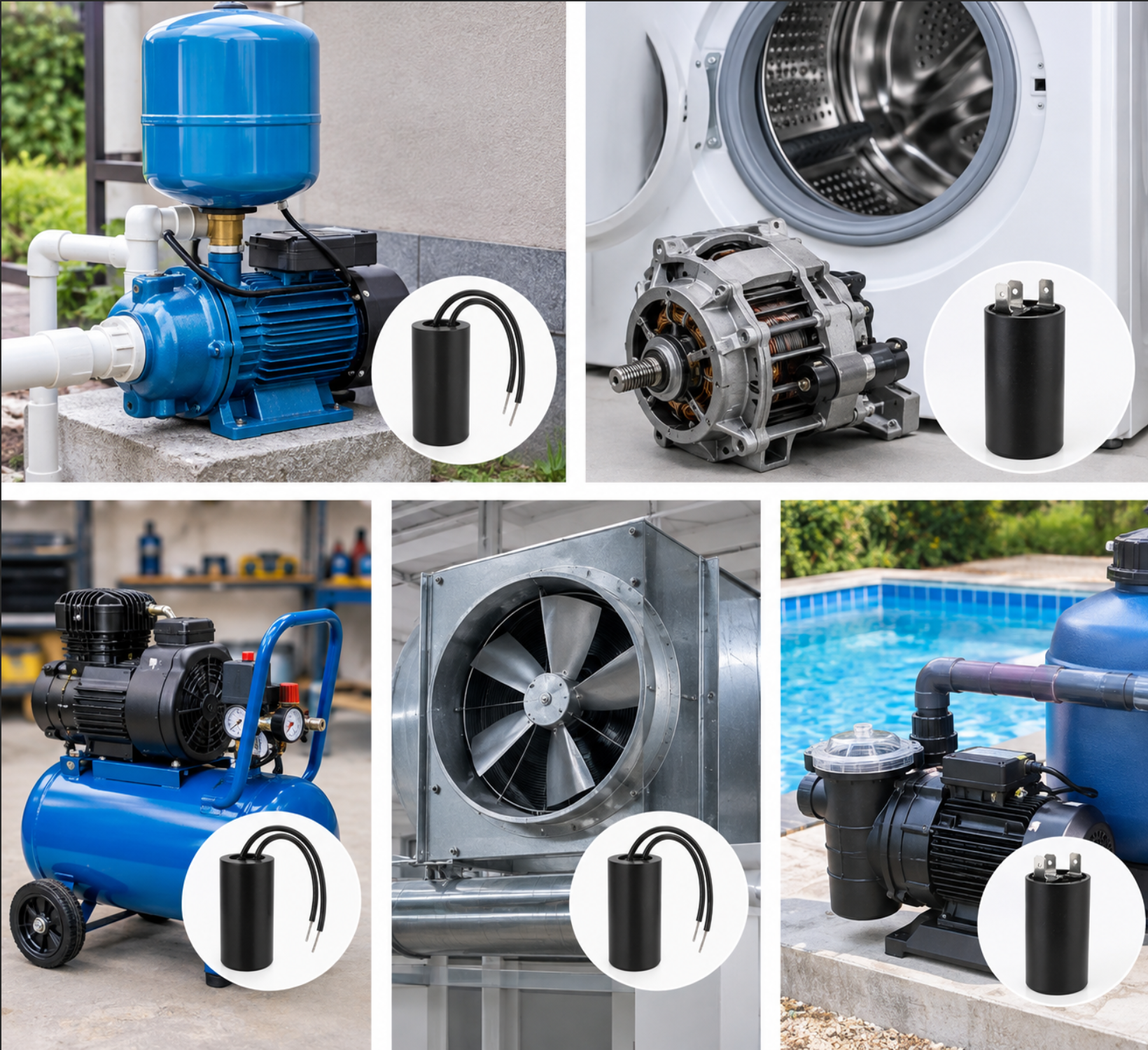
A single-phase asynchronous motor cannot establish a rotating field on its own. It needs a phase-shifting element — the capacitor — to create the auxiliary current that starts the rotor and, in permanent-split configurations, keeps the motor running efficiently. This is why the component appears across an unusually wide band of equipment: water pumps, submersible pumps, fans, washing machines, air conditioners, refrigeration units and small compressors.
The procurement problem is that the capacitor is rarely the focus of engineering attention until it fails. Two failure patterns dominate in the field. The first is specification mismatch — a start capacitor substituted for a run capacitor, or a capacitance value chosen for convenience rather than for the motor design. Industry product comparisons note that run capacitors such as CBB60 are built for continuous duty, while electrolytic start capacitors such as CD60 are built for a second or two per start, and that the two are not interchangeable. The second pattern is consistency drift: a capacitor that meets its nominal rating on the datasheet but varies between production lots, which shows up as uneven motor performance across an assembly line or a service network.
For buyers at the awareness and research stage, this reframes what to evaluate. Instead of asking only for a unit price, the useful questions become: who makes the film, who winds the core, what is checked between steps, which standard governs the product, and what evidence exists outside the supplier's own literature. The rest of this profile applies those questions to one manufacturer.
Taizhou Huifeng Electron at a Glance
Taizhou Huifeng Electron Co., Ltd. is a motor capacitor manufacturer located in Wenling, Zhejiang Province, China, established in 1993 and specialising in metallized film, CBB series and CD series capacitors. The company's own operational data describes a mid-sized, vertically integrated plant rather than a trading operation or an assembly-only workshop. The facility covers approximately 10,000 square metres, and the company reports annual output of 7,200,000 pieces, supported by a daily production capacity that exceeds 25,000 units.
| Item | Documented detail |
|---|---|
| Established | 1993; more than 30 years of capacitor manufacturing experience |
| Location | Wenling, Zhejiang Province, China (coastal city, described by the company as having convenient transportation) |
| Facility area | Approximately 10,000 m² |
| Workforce | Approximately 50 staff: 40 workshop skilled operators, 5 sales personnel, 1 purchasing, 1 finance |
| Engineering | R&D team of 3 engineers; founder is a senior capacitor technician |
| Output | 7,200,000 pieces per year; daily capacity above 25,000 units |
| Core equipment | 3 sets of large-scale vacuum electroplating equipment, 7 film cutting machines, 8 winding machines |
| Export profile | Export ratio of 30%; main markets Europe and Asia |
| Product scope | Metallized film, CBB series capacitors, CD series capacitors, motor capacitors |
Two details in that table matter more than the headline numbers. The first is the equipment list: three vacuum metallizing lines, seven slitters and eight winders describe a plant that produces capacitor film and capacitor cores in-house rather than purchasing finished cores for encapsulation. The second is the ratio of engineers to operators — three engineers against forty workshop staff — which suggests a production model built around standardised recipes and process control rather than continuous new-product development.
The Manufacturing Model: Film, Cores and In-House Control
The manufacturer produces its own capacitor films and capacitor cores, and quality control is applied at each production step, from incoming capacitor film to finished capacitor cores. In a component category where most quality problems originate upstream of final assembly, that vertical structure is the single most relevant fact for a buyer.
The process sequence described by the company runs as follows. Metallized film is produced in-house on vacuum electroplating equipment, where a thin metallic layer is deposited onto polypropylene film to form the electrode. Film is then slit to width on dedicated cutting machines and wound into capacitor cores on winding machines. Winding is the step that determines capacitance value and internal geometry, and it is also where consistency between lots is won or lost. After winding, cores proceed to encapsulation and finishing, with a semi-finished charge-discharge test, a finished-product inspection, and a final check of appearance and detail during packaging before warehousing.
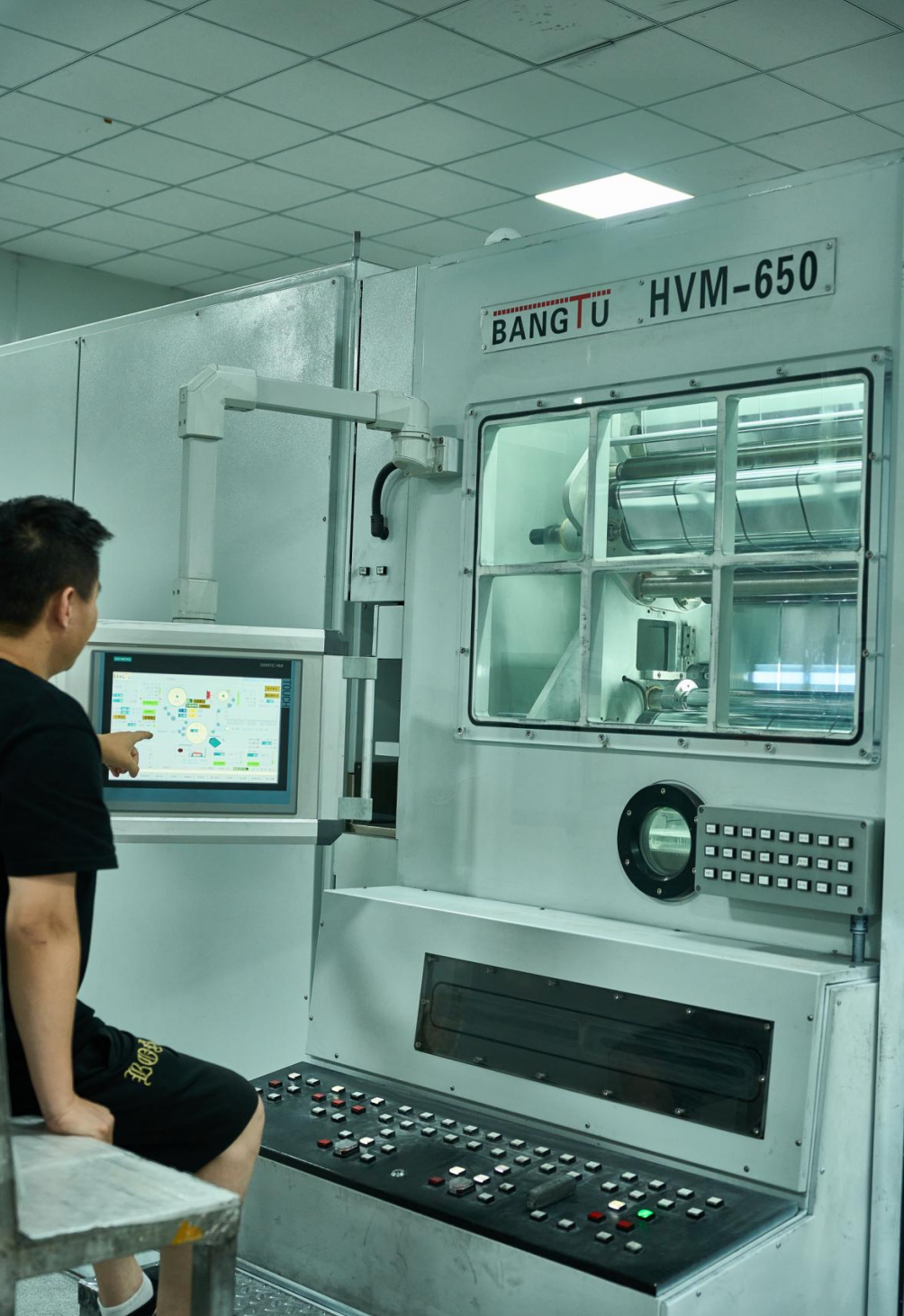
For procurement teams, the practical implication is traceability. When film, core and finished capacitor come from one site, a deviation in capacitance or loss tangent can be traced back to a specific production step rather than attributed to an unnamed film supplier. The company also states that it maintains long-term, stable material suppliers to support cost-effectiveness and delivery timeliness — an important qualifier, because even vertically integrated plants do not produce every input, including the base polypropylene film stock and the resin systems used for encapsulation.
Product Portfolio: CBB60, CBB65 and CD60
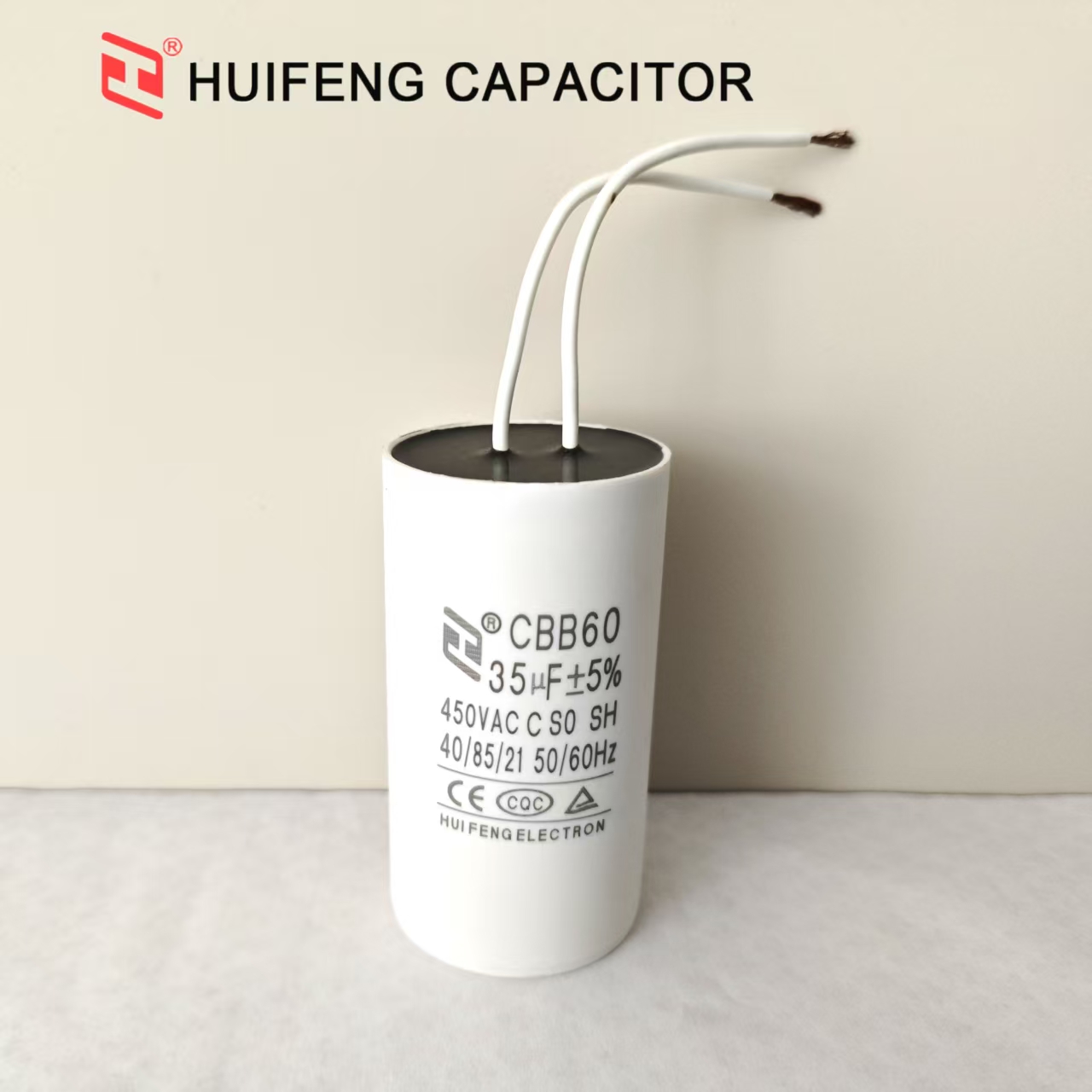
The portfolio separates cleanly along functional lines rather than along marketing categories. CBB60 is a metallized polypropylene film run capacitor in a plastic case with wire leads, rated from 1 to 150 µF. CBB65 is the same film construction in an aluminium case, rated from 1 to 120 µF, and is presented as an air-conditioning capacitor. CD60 is an electrolytic start capacitor rated from 50 to 1500 µF, intended for short-duration starting service rather than continuous running.
| Parameter | CBB60 motor run capacitor | CBB65 air conditioning capacitor | CD60 motor start capacitor |
|---|---|---|---|
| Function | Continuous-duty run capacitor | Continuous-duty run capacitor | Short-duration start capacitor (not a run capacitor) |
| Capacitance range | 1–150 µF | 1–120 µF | 50–1500 µF |
| Rated voltage | 250/300 VAC; 320/370 VAC; 400/450 VAC | 250/300 VAC; 320/370 VAC; 400/450 VAC | 125 VAC; 200/250 VAC; 300/330 VAC |
| Case and termination | Plastic case; wire leads | Aluminium case; 4+4 / 2+2 / 4+2 / 0+0 / 4+4+4 / 0+0+0 pin types | Aluminium case; cable or wire leads |
| Capacitance tolerance | ±5% | ±5% | ±15%; −10 to +20% |
| Standard referenced | GB/T 3667.1-2016 | GB/T 3667.1-2016 | GB/T 3667.2-2016 |
| Climate category | 25/70/21; 40/85/21 | 25/70/21; 40/85/21 | 10/55/21 |
| Test voltage | 2UN between terminals (2 s) | 2UN between terminals (2 s) | 1.2UN between terminals (2 s) |
| Operating limits | Long-term operation at 1.1UN and 1.3In; operating level B / C | Long-term operation at 1.1UN and 1.3In; safety protection grade S1 | Loss tangent tgδ ≤ 0.15 at 100 Hz, 20 °C |
| Expected usage time | 3000 hours (as stated in the specification) | 3000 hours (as stated in the specification) | Not stated as a running-hour figure |
Technical Explanation: What the Specifications Actually Tell a Buyer
A specification sheet is only useful if the buyer knows which values are design constraints and which are test conditions. Three figures on these datasheets deserve particular attention.
Test voltage versus working voltage
The 2UN test voltage applied between terminals for two seconds is a dielectric withstand check, not an operating condition. It confirms that the insulation system survives a defined overvoltage for a short interval. The separate statement that long-term operation is permitted at 1.1UN and 1.3In is the actual operating envelope, and it is the number that matters when a motor runs on a supply with meaningful voltage fluctuation. A capacitor rated at 450 VAC with a 1.1UN working limit is a different proposition from one where the rated voltage is also the ceiling.
Capacitance tolerance and what ±5% means in practice
CBB60 and CBB65 are specified at ±5%, while CD60 carries a wider tolerance of ±15% with an asymmetric −10 to +20% band. The tighter figure on run capacitors reflects their role: capacitance directly affects the phase angle and therefore the running current and torque of the motor. A run capacitor that drifts toward the edge of its tolerance band changes the motor's electrical behaviour, which is why incoming inspection on capacitance is a standard control point for appliance and pump manufacturers.
Climate category codes
Codes such as 25/70/21 and 40/85/21 follow a conventional format describing the lower temperature limit, the upper temperature limit and the number of damp-heat test days. In practical terms, a 25/70/21 part is specified for service down to −25 °C and up to +70 °C, while a 40/85/21 variant extends the upper limit to +85 °C. For pump and air-conditioning applications, where the capacitor may sit close to a hot motor housing or inside an outdoor condensing unit, the higher-temperature variant is the relevant choice rather than an optional upgrade. CD60, by contrast, is specified at 10/55/21 — consistent with its short-duration starting role.
One further material point is worth stating carefully. Metallized polypropylene film, the dielectric used across the CBB60 and CBB65 ranges, is generally associated in film capacitor design with self-healing behaviour: a localised breakdown vaporises the thin electrode around the fault and the capacitor continues to function, with a small loss of capacitance. This is a property of the dielectric system, not a marketing claim, and it is one reason film run capacitors dominate continuous-duty motor applications. It does not, however, make a capacitor immune to end-of-life wear, which is why the stated 3000-hour expected usage figure should be read as a specification input rather than a guarantee.
Application Fit: Pumps, Fans, Appliances and HVAC
CBB60 run capacitors are generally used in pumps, washing machines, air compressors and fan motors, while CBB65 film capacitors in aluminium cans are used in air-conditioning and refrigeration equipment. Taizhou Huifeng's own application documentation concentrates on water pump motors, capacitor wholesalers and distributors, and the maintenance and repair sector, with single-phase AC motor operation in pumps, fans and similar drive equipment as the core scenario.
The company describes the pump-motor working condition in specific terms: high-temperature, continuous power-on operation, requiring high insulation, stable capacitance, anti-aging behaviour and long service life. That description is consistent with the physical reality of submersible and circulation pumps, where the capacitor is enclosed, poorly ventilated and energised for long periods. It is a more demanding environment than a intermittently used fan, and it explains why the same nominal capacitance can perform very differently depending on which climate category and case format were specified.
For distributors and maintenance businesses, the relevant capability is breadth of coverage. A service operation repairing pumps, washing machines and air conditioners in the same workshop needs run capacitors across a range of capacitance values plus start capacitors for motors that use them. A portfolio spanning 1–150 µF in CBB60, 1–120 µF in CBB65 and 50–1500 µF in CD60 covers most of that demand without requiring multiple suppliers.
Market Context: A Mature Category With Steady Growth
Third-party market research places the global motor capacitor market at approximately USD 24.04 billion in 2025, with an expected compound annual growth rate of 4.77% between 2025 and 2032, according to Maximize Market Research. That growth profile describes a mature, replacement-driven category rather than a rapid-expansion one.
The procurement consequence is straightforward. In a market growing at a mid-single-digit rate, suppliers do not compete primarily on capacity expansion; they compete on consistency, delivery reliability and the ability to serve both OEM volumes and fragmented aftermarket demand. This is also why documentary evidence — standards referenced, test voltages stated, climate categories declared — carries more weight in this category than in faster-moving electronics segments, where the specification itself is likely to be obsolete within two product cycles.
The standards landscape reinforces that. IEC 60252-1 defines the scope for motor capacitors connected to asynchronous motor windings supplied from single-phase systems up to and including 100 Hz, covering impregnated or unimpregnated capacitors with paper, plastic film or combined dielectrics, metallized or with metal-foil electrodes, at rated voltages up to and including 660 V. That scope describes the technical territory these products occupy; it does not by itself confirm that a given supplier's part satisfies every market-specific conformity requirement, which buyers must verify separately for each destination market.
How This Compares With Conventional Sourcing Models — and Where the Limits Are
The most common alternative to a vertically integrated manufacturer is a trading company or an assembly workshop that buys metallized film and wound cores on the open market and encapsulates them. That model has real advantages: wide catalogue breadth, flexible order sizes and low entry cost. Its weakness is traceability — when a batch shows capacitance drift, the assembler has limited visibility into whether the film, the winding tension or the encapsulation resin caused it.
Taizhou Huifeng sits on the other side of that trade-off. In-house film metallizing, in-house slitting and in-house winding mean the critical process steps are under one roof, and the company states that each production step is checked, with a semi-finished charge-discharge test and a finished-product inspection before warehousing. Customised production is offered with a low minimum order quantity, and capacitance value and rated voltage can be reviewed against custom requirements before production begins.
1. The stated 3000-hour expected usage time is a specification input, not a validated lifetime. CBB60 and CBB65 datasheets list 3000 hours as the expected usage limit. Buyers running continuous-duty pump or HVAC applications with elevated ambient temperatures should treat that figure as the basis for their own qualification testing rather than as a field-life guarantee.
2. Public third-party certification evidence is model-specific. The CBB60 range is recorded against a TÜV Rheinland certification entry (Certificate No. 50500943) in the Certipedia database. That record supports the CBB60 claim specifically; buyers sourcing CBB65 or CD60 for regulated markets should request the corresponding documentation for those models and those destinations rather than assume it transfers.
3. Scale is mid-sized, which affects large-programme scheduling. With approximately 50 staff, 3 R&D engineers and an annual output of 7,200,000 pieces, the plant is well matched to distributor and mid-volume OEM demand. A multi-million-piece annual contract would need capacity confirmation and delivery scheduling agreed in advance rather than assumed from the daily capacity figure.
4. Custom engineering capacity is narrow by design. Three engineers supporting 40 workshop operators indicates a process-control organisation optimised for standard and lightly customised parts. Buyers requiring new geometries, unusual capacitance-voltage combinations or application-specific validation should expect a sampling and review cycle before production.
A Procurement Checklist Derived From These Specifications
The value of a manufacturer profile is that it converts into questions a buyer can actually put into an RFQ. The checklist below follows directly from the documented product data.
| Decision area | What to specify or request |
|---|---|
| Function | Confirm run versus start duty before anything else; run and start capacitors are not interchangeable |
| Capacitance | Nominal value plus tolerance class (±5% for CBB60/CBB65; ±15% band for CD60) |
| Voltage | Rated voltage and confirmation of the 1.1UN continuous operating limit for the actual supply conditions |
| Thermal environment | Climate category — 25/70/21 or 40/85/21 for run capacitors, 10/55/21 for CD60 |
| Termination | Wire leads, cable, or pin configuration (2+2, 4+4, 4+2, 4+4+4 and similar combinations for CBB65) |
| Case construction | Plastic case for CBB60; aluminium case for CBB65 and CD60; S1 safety protection grade where specified |
| Standard and evidence | Confirm the referenced standard (GB/T 3667.1-2016 or GB/T 3667.2-2016) and request the certification record for the exact model and destination market |
| Life expectation | Clarify how the 3000-hour figure was derived and whether application-specific endurance data is available |
| Commercial terms | Minimum order quantity for standard versus custom parts, lead time, and packaging suitable for the receiving warehouse |
Future Outlook
Two structural forces are likely to shape demand for motor capacitors over the next several years. The first is the continued installed base of single-phase motors in pumps, fans, washing machines and refrigeration. Variable-speed drives are spreading in appliances and HVAC, but a large installed base of fixed-speed equipment remains in service globally, and that base generates replacement demand independent of new-equipment cycles.
The second is documentation pressure. As buyers in Europe and Asia formalise supplier qualification, the ability to produce a referenced product standard, a declared climate category, a stated test voltage and a traceable certification record becomes a precondition for quotation rather than a differentiator. Manufacturers that already operate in-house film and core production are structurally better placed here, because the process data needed to answer a buyer's technical questionnaire exists inside the plant.
For a company of this profile, the strategic question is not whether film capacitors will still be specified — they will — but whether the plant can extend its documentation and qualification coverage across the full portfolio as fast as its customers' procurement systems demand. On the evidence available, the manufacturing foundation is in place; the depth of published third-party validation outside the CBB60 range is the area buyers will most want to probe.
Frequently Asked Questions
What is the difference between a motor run capacitor and a motor start capacitor?
A run capacitor, such as the CBB60, is a metallized film capacitor built for continuous duty and remains in circuit while the motor operates. A start capacitor, such as the CD60, is an electrolytic capacitor built for short-duration starting service of roughly a second or two per start and is switched out once the motor reaches speed. Published product comparisons state that the two types are not interchangeable, because their duty cycles and internal constructions differ.
Which applications are CBB60 and CBB65 motor capacitors used in?
CBB60 metallized polypropylene film run capacitors are generally used in pumps, washing machines, air compressors and fan motors. CBB65 film capacitors in aluminium cans are used in air-conditioning and refrigeration equipment. Within Taizhou Huifeng's documentation, the stated application base is water pump motor manufacturing, capacitor wholesalers and distributors, and the maintenance and repair industry, with single-phase AC motor operation in pumps and fans as the core scenario.
What capacitance and voltage ranges does Taizhou Huifeng offer across its motor capacitor models?
CBB60 covers 1–150 µF at 250/300 VAC, 320/370 VAC and 400/450 VAC with wire leads. CBB65 covers 1–120 µF at the same three voltage bands with aluminium cases and multiple pin configurations. CD60 covers 50–1500 µF at 125 VAC, 200/250 VAC and 300/330 VAC with cable or wire terminations. CBB60 and CBB65 reference GB/T 3667.1-2016, while CD60 references GB/T 3667.2-2016.
Does the company manufacture its own capacitor film and capacitor cores?
Yes. The manufacturer produces its own capacitor films and capacitor cores, and quality control is applied at each production step from incoming capacitor film to finished cores. Supporting equipment includes three sets of large-scale vacuum electroplating equipment for metallized film, seven film cutting machines and eight winding machines. The company also reports a semi-finished charge-discharge test, a finished-product inspection, and a final appearance and detail check during packaging.
What do the climate category codes on these datasheets mean?
Codes in the form 25/70/21 and 40/85/21 follow a conventional format that states the lower temperature limit, the upper temperature limit and the number of damp-heat test days. A 25/70/21 run capacitor is specified for service from −25 °C to +70 °C, while a 40/85/21 variant extends the upper limit to +85 °C. CD60 start capacitors are specified at 10/55/21, consistent with their short-duration starting role rather than continuous operation.
How should a replacement CBB60 capacitor be installed and commissioned?
The procedure described in the manufacturer's technical guidance is: disconnect the power supply, safely discharge the existing capacitor, check the replacement specification against the motor requirements, connect the lead wires according to the motor wiring diagram, secure the capacitor in its mounting position, and inspect the installation before restoring power. During commissioning, qualified personnel should confirm that the motor starts promptly and reaches normal operating speed without abnormal humming, repeated starting attempts or unusual vibration, and should check running current, operating voltage and temperature against the equipment specifications.
Summary
Taizhou Huifeng Electron Co., Ltd. presents as a mid-sized, vertically integrated motor capacitor manufacturer: established in 1993, operating from a facility of approximately 10,000 square metres in Wenling, Zhejiang, with annual output of 7,200,000 pieces and in-house capability spanning metallized film production, film slitting and core winding. Its portfolio separates cleanly into continuous-duty film run capacitors (CBB60, CBB65) and short-duration electrolytic start capacitors (CD60), each with published capacitance ranges, voltage bands, tolerances, climate categories and referenced standards.
The purchasing case rests on traceability of the upstream process and on a portfolio broad enough to serve pump, fan, appliance and HVAC demand from a single source. The counterweights are equally concrete: a stated 3000-hour expected usage figure that requires application-specific validation, third-party certification evidence that is documented for CBB60 specifically, a workforce scale suited to distributor and mid-volume OEM programmes, and limited engineering headroom for complex custom work. Buyers who weigh both sides of that ledger will find the profile useful as a qualification starting point rather than a conclusion.
A company brochure covering the product range and specifications is available for download: Taizhou Huifeng Electron product brochure (PDF).
Tem questões ou precisa de mais detalhes?
Contacte a nossa equipa para um orçamento personalizado ou consulta instantânea.
Solicitar orçamento
Preencha o formulário abaixo e a nossa equipa entrará em contacto com uma proposta personalizada.
Chat direto do WhatsApp
Prefere conversar em tempo real? Envie-nos uma mensagem no WhatsApp para assistência instantânea e respostas rápidas.
- Obter orçamento personalizado
- Partilhar fotos ou documentos
- Discuta as suas necessidades diretamente
Geralmente responde em 5–30 minutos durante o horário de expediente.