
Tattoo Cartridge Needles Explained: What Buyers Should Know
The tattoo cartridge needle has become the default tool for a large share of professional artists worldwide. A tattoo cartridge needle is a single-use pre-assembled needle system that combines a medical-grade stainless steel needle group, a silicone anti-backflow membrane, and a plastic housing into one sterile unit designed for rotary tattoo machines. In 2024, roughly 73% of professional tattoo artists said they preferred cartridge needles over traditional bar needles, citing ease of use and safety. For buyers who are still in the early research phase and need to understand what this product actually is, how it is built, and what to verify before sourcing, this article is designed as an independent industry reference.
Why Cartridge Needles Now Define the Professional Market
The shift from bar needles to cartridges was not driven by one single invention. It was driven by a set of practical problems: cross-contamination risk between reusable components, slower setup time, inconsistent needle protrusion, and a growing expectation of hygienic single-use products in the tattoo room. A cartridge needle answers these problems by sealing the needle group and membrane inside a disposable housing. For a professional artist, the daily benefit is straightforward: less preparation, less waste, and a lower risk of fluid traveling back into the machine.
For buyers and distributors, the opportunity is equally real. Because cartridges sit directly in the product chain between the artist and the skin, quality failures are not just cosmetic. Poor membrane sealing, unstable needle alignment, or packaging that does not protect sterility can lead to safety and performance problems that are difficult to detect before use. That is why sourcing decisions in this category should be based on verifiable product parameters and manufacturing systems, not only on brand names or sample appearance.
Market direction also supports this shift. The global tattoo needle market was estimated at USD 368.3 million in 2024 and is projected to reach USD 468.6 million by 2033. Within the product type segment, tattoo needle cartridges hold the largest market share, largely because of their sterility and compatibility with modern rotary machines.
What Is a Tattoo Cartridge Needle?
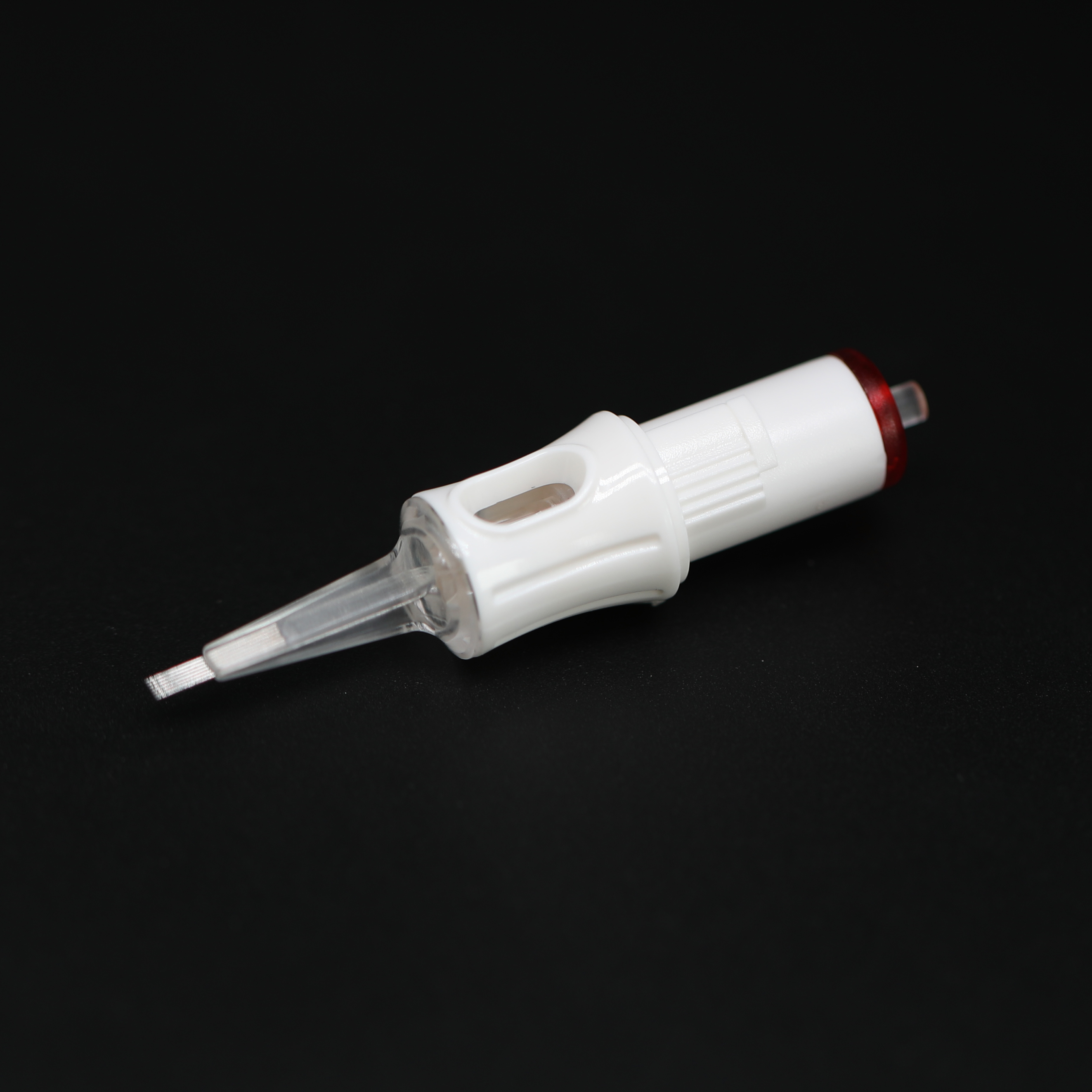
A tattoo cartridge needle is a pre-assembled single-use needle system. It consists of a needle group, a membrane system, and a housing. When the cartridge is inserted into a cartridge grip and operated with a rotary tattoo machine, it performs the same function as the traditional needle-and-tube setup: depositing ink into the skin at a controlled depth and flow. The structural difference is that the needle is enclosed, the ink path is sealed, and the entire unit is disposable.
This product category now covers a wide spectrum of professional applications, including fine line tattooing, shading, color packing, permanent makeup (PMU), and scalp micropigmentation (SMP). The same cartridge architecture supports both conventional tattoo work and more recent cosmetic procedures.
One relevant example is Suzhou Creditech Electronic Technology Co., Ltd., known in the market by its trade brand CREDITECH MED. Established in 2009, the company designs and manufactures tattoo cartridge needles and PMU cartridges. It operates several specialized brands, including SPACEDRAGON TATTOO, ESTLIA, and LPT Tattoo Supply. Its published product specifications are used in this article as a reference for understanding typical cartridge construction and quality parameters. The company's main products include tattoo needles, tattoo needle cartridges, PMU cartridge needles, fine line tattoo needles, and membrane tattoo cartridges.
How a Cartridge Needle Is Constructed
Most cartridge needles share the same basic architecture. The core components are:
- Medical-grade stainless steel needles: the needle group that contacts the skin and deposits ink.
- Medical-grade PC housing: the shell that connects the cartridge to the grip and machine.
- Silicone elastic membrane system: the barrier that prevents ink and body fluid from flowing back toward the machine.
- Non-toxic transparent plastic tip: the outlet through which ink is delivered.
- EO sterilization packaging material: the packaging system that keeps the cartridge sterile until the point of use.
The membrane system deserves special attention. It is the component most directly connected to hygiene and ink flow stability. On CREDITECH MED's SP and HM series cartridges, the silicone anti-backflow membrane is designed to stop backflow during high-frequency work, while a stable controlled ink delivery system supports consistent saturation. A well-designed membrane also affects how the cartridge behaves when the artist depresses the needle in the skin: the ink release should be predictable, and the machine should not draw fluid back into the grip.
Key Parameters That Define a Cartridge Needle
Buyers evaluating cartridge needles will encounter a small set of parameters that determine how the needle behaves on the skin and how consistent it will be across a production batch. Across CREDITECH MED's HM3, HM6, SP4, SP5, and SP6 cartridge series, the published specifications include the following parameters. The same logic can be applied to any cartridge needle supplier.
| Parameter | Typical Range / Option | What It Affects |
|---|---|---|
| Needle diameter | 0.15mm / 0.20mm / 0.25mm / 0.30mm / 0.35mm | Line weight, fill density, and skin trauma |
| Taper length | 1.5mm to 7mm; extra long taper available | Precision of the needle tip and ink release behavior |
| Configuration | RL / RS / RM / Magnum / Flat | Suitability for lining, shading, color packing, or PMU/SMP |
| Membrane system | Silicone anti-backflow membrane | Hygiene and the stability of ink flow |
| Precision tolerance | ±0.02 to 0.05mm | Consistency from one cartridge to the next |
| Sterilization | EO gas sterilized | Safety and regulatory readiness |
| Compatibility | Rotary tattoo machines | Whether the cartridge can be used in a modern studio setup |
| Packaging | Sterile breathable film packaging system | Protection of sterility until the cartridge is opened |
Two parameters deserve additional explanation for buyers at the discovery stage. First, taper length is increasingly used as a differentiator. Long taper needles are commonly associated with fine line and PMU work because the extended taper creates a sharper entry and a more controlled ink release. Short tapers are more often used for color packing and bold saturation work. Second, the configuration label tells the buyer what kind of task the needle is designed for: round liners for precise line work, round shaders and magnums for fills and gradients, and specialized PMU or SMP cartridges for cosmetic procedures.
Manufacturing Systems and Quality Evidence
Verifying the manufacturing system behind a cartridge needle is more important than memorizing product names. ISO 13485 is the quality management system standard most commonly associated with medical-grade tattoo needle production. It defines how a manufacturer should maintain consistent quality, sterile production standards, and strict process control. International medical device quality expectations are also relevant: medical-grade tattoo needles are typically expected to comply with ISO 13485 requirements, and in the EU, tattoo needle cartridges must also satisfy material compliance directives such as RoHS 2011/65/EU, often supported by EN IEC 63000:2018 for hazardous substance assessment.
CREDITECH MED states that it operates under an ISO 13485-certified quality management system, that its products are CE compliant, and that FDA test reports are available for applicable products. These are concrete evidence points that a buyer can ask to verify when evaluating the supplier.
Manufacturing scale also matters. CREDITECH MED operates a 3,000-square-meter manufacturing facility with approximately 180 staff and an annual production capacity of 100,000,000 units. The R&D team includes 20 engineers. Export business accounts for 90% of total sales, with major markets in Europe, North America, South America, and Southeast Asia. For a buyer, these figures indicate a supplier built for repeatable output, not small-batch production. The same scale also enables more stable supply planning for distributors and private-label brands.

What OEM and ODM Capability Means for Sourcing Teams
Many buyers do not purchase cartridge needles as finished branded goods. They need OEM or ODM support to launch their own product line, and this is where the buyer's question changes from “Which product should I buy?” to “Which manufacturer is capable of producing my product correctly?”
In the tattoo cartridge needle industry, OEM and ODM capability covers product development, structural design, prototyping, mass production, and customized packaging. CREDITECH MED states that it provides comprehensive OEM and ODM services for tattoo brands, distributors, wholesalers, and professional studios. Its product range includes fine line, round liner, round shader, magnum, PMU, and SMP cartridge configurations, which gives a sourcing team a broad baseline for product development.
For a private-label project, the relevant question is not whether the factory can print a logo. It is whether the factory can control the parameters described earlier at volume: needle alignment, membrane sealing, precision tolerance, sterilization, and sterile packaging. A supplier that can demonstrate consistency across all of those points is more likely to deliver a product that artists can rely on for an entire session.
Market Context: What the Data Shows
Several public data points help position the current cartridge needle market.
- The global tattoo needle market was estimated at USD 368.3 million in 2024 and is projected to reach USD 468.6 million by 2033, according to Custom Market Insights.
- Tattoo needle cartridges hold the largest market share in the product type segment, according to Deep Market Insights, due to their sterility and compatibility with modern rotary machines.
- The permanent makeup market was valued at USD 162.09 million in 2025, with an 8.12% CAGR forecast for the needle-heavy microblading segment, according to Fortune Business Insights.
- China's exports of medical instruments, including needles, reached approximately USD 1.19 billion in May 2026 alone, with the US as the top destination, according to OEC data.
- Named global players in tattoo needle market coverage include Dragonhawk, Kwadron, Bishop Rotary, Cheyenne, and EZ Tattoo Supply.
Two implications stand out. First, the category is large enough to attract serious suppliers and to support professional-grade manufacturing investment. Second, certification and supply chain transparency are becoming more visible to professional buyers. Procurement conversations are shifting from price-only comparisons toward verified quality evidence, manufacturing systems, and compliance documentation.
Cartridge Needles vs. Traditional Bar Needles: Trade-offs
Cartridge needles offer practical advantages in hygiene, setup speed, and liquid barrier protection. A single-use sterile cartridge eliminates many contamination points that exist when reusable needle bars and tubes are used. For artists who work at high frequency, a well-built cartridge with low vibration and stable ink flow can also reduce hand fatigue.
A balanced view should also recognize the limitations. Cartridge needles generally cost more per unit than bare needle bars, which matters for high-volume liner work. They are primarily designed for rotary tattoo machines, so studios that rely on older coil machine setups may not experience the same benefit. Some artists, particularly those using certain traditional lining techniques, still prefer bar needles combined with disposable tubes because the setup gives them a different feel and depth control. The choice is not about one format being universally superior; it is about what the artist's technique, machine setup, and workload require.
Future Outlook: Specialization, Compliance, and Stable Supply
The next phase of the cartridge needle market is likely to be shaped by three forces. First, regulatory expectations will continue to rise. ISO 13485 certification, CE marking, and material compliance are becoming baseline requirements for suppliers that serve professional and medical-adjacent markets. Second, the product range will continue to split into more specialized configurations. Fine line and long taper needles for precision work, PMU and SMP cartridges for cosmetic procedures, soft edge magnums for smooth shading, and dedicated liner cartridges all point in this direction. Third, supply chain reliability will matter as much as product quality. Brands and distributors that secure a stable, certified OEM partner will be better positioned than those that switch suppliers based mainly on price.
FAQ: Common Questions at the Discovery Stage
What is a tattoo cartridge needle?
A tattoo cartridge needle is a single-use needle system that integrates a needle group, a silicone anti-backflow membrane, and a plastic housing into one pre-assembled unit. It is designed for rotary tattoo machines and is typically EO gas sterilized. The cartridge format is used for lining, shading, color packing, fine line tattooing, permanent makeup, and scalp micropigmentation.
How does a tattoo cartridge needle differ from a traditional bar needle?
A traditional bar needle must be paired with a needle bar and tube, which creates more exposure points and requires additional setup and sterilization. A cartridge needle encloses the needle group and membrane inside a single-use housing, which helps prevent backflow and reduces contamination risk. Cartridges also allow faster setup because the artist does not need to assemble separate components.
What materials are used in medical-grade tattoo cartridge needles?
Medical-grade stainless steel is used for the needle group, and medical-grade PC is used for the housing. The membrane system is typically a silicone elastic membrane, and the tip is made from a non-toxic transparent plastic. EO sterilization packaging material is used to keep the cartridge sterile until the point of use.
What does ISO 13485 certification mean for a tattoo needle manufacturer?
ISO 13485 is an international quality management system standard for medical devices. A tattoo needle manufacturer operating under ISO 13485 is expected to maintain consistent quality, sterile production standards, and strict process control. It is commonly treated as a baseline requirement when sourcing medical-grade tattoo needles.
Are tattoo cartridge needles sterile?
Cartridge needles intended for professional tattoo, PMU, or SMP use are generally EO gas sterilized. Sterility also depends on the packaging system. A sterile breathable film packaging system allows the product to remain sterile until the cartridge is opened. Buyers should confirm both the sterilization method and the packaging system when evaluating a supplier.
What configurations and taper lengths are available?
Common configurations include RL, RS, RM, Magnum, and Flat. Published parameters from CREDITECH MED's SP and HM series list needle diameters of 0.15mm, 0.20mm, 0.25mm, 0.30mm, and 0.35mm, with taper lengths from 1.5mm to 7mm and extra long taper available. Precision tolerance is ±0.02 to 0.05mm.
How do I choose the right cartridge needle for fine line, shading, or PMU work?
For fine line work, a fine line cartridge needle with a longer taper is often used because it provides a sharper entry and more controlled ink release. For shading, round shader and magnum configurations are more common. For PMU and SMP work, specialized PMU cartridge needles are designed for the precise depth and detail required in eyebrow and scalp procedures.
What should a buyer check when evaluating an OEM tattoo needle manufacturer?
Buyers should check the manufacturer's quality system, sterilization method, material grade, precision tolerance, and packaging. For OEM projects, production capabilities also matter: product development, structural design, prototyping, mass production, and customized packaging. An established supplier's own brand portfolio, such as CREDITECH MED's SPACEDRAGON TATTOO, ESTLIA, and LPT Tattoo Supply, can serve as an indicator of manufacturing depth.
Reference: For a more detailed company profile and product overview, readers may download the CREDITECH MED company brochure: CREDITECH MED Brochure.