
Technical FAQ: Mold, Wear and Impact Resistance in Homogeneous Vinyl
Homogeneous vinyl flooring is a single-layer resilient floor covering in which colour and composition run through the full thickness of the sheet rather than sitting in a printed design layer. That construction explains why it is specified in hospitals, laboratories, cleanrooms and other critical facilities — and it also explains why buyers arrive with three questions that are frequently treated as one: does it resist mold, how fast does it wear, and what happens under heavy static and rolling loads? Each question is answered by a different body of evidence, and this technical FAQ sets out what the available test data does and does not prove.
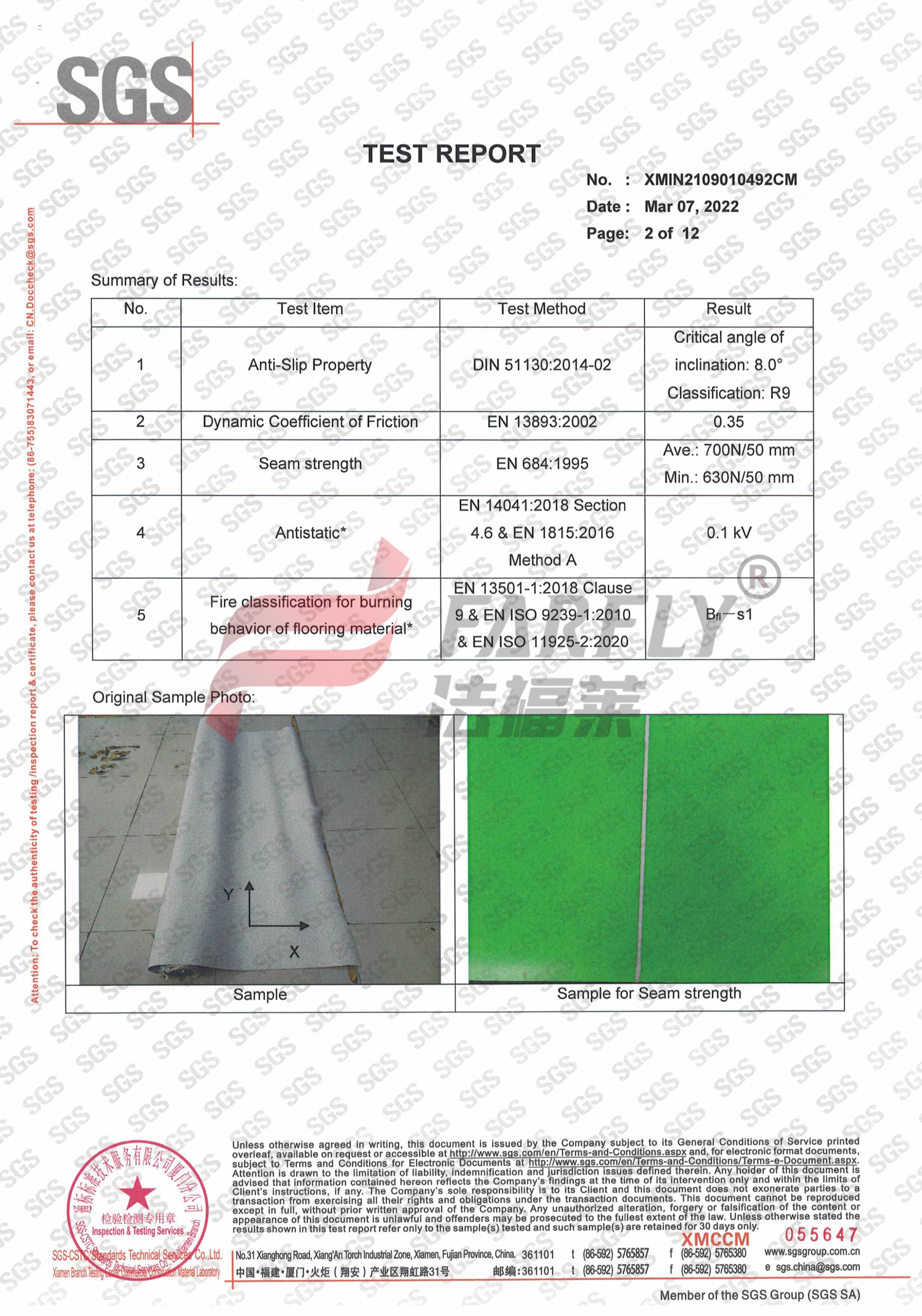
Abrasion and fire resistance test records form one part of a homogeneous vinyl qualification file. Image: FARFLYING FLOORING test documentation.
Resilience Means Three Different Things in a Flooring Specification
Mold resistance, wear resistance and impact resistance are measured by three unrelated test families, so a strong result in one category says nothing about the other two.
Wear is expressed as an abrasion classification under EN ISO 10581, using the Frick-Taber method described in EN 660-2. Impact and pressure-mark behaviour is expressed as residual indentation under EN 433:1999. Mold risk in a sheet installation is not a surface test at all: it is a function of moisture management, seam construction and cleaning regime, supported in a tender file by antibacterial test results and by installation detailing rather than by a single mould-proof figure.
Procurement teams that keep these three lines of evidence separate avoid two recurring errors: accepting an antibacterial report as proof of mold performance, and accepting a wear-group classification as proof of behaviour under wheeled or static loads. The sections below take each question in turn and map it to the specific certificate, standard or specification value that answers it.
Wear Resistance: What a Group T Rating Actually Measures
Under EN ISO 10581, homogeneous PVC floor coverings are classified by abrasion performance, and Group T is the classification assigned when volume loss is 2.0 mm³ or less per 100 revolutions in the Frick-Taber abrasion test described in EN 660-2.
The distinction matters because wear group describes material loss, not appearance. In a homogeneous sheet, colour and design run through the depth of the product, which is the reason manufacturers describe this construction as more scratch resistant than a printed wear layer: the floor does not develop a lighter or greyed pattern where traffic concentrates.
How FARFLYING FLOORING documents abrasion performance
FARFLYING FLOORING is the brand of Wuxi Tefa Decoration Material Co., Ltd., a Chinese resilient flooring manufacturer founded in 2012 and based in Wuxi, Jiangsu, producing homogeneous vinyl flooring, PVC sports flooring and aircraft flooring. Its homogeneous roll specification lists abrasion resistance as Group T.
The supporting report is SGS certificate XMIN2109010490CM, whose scope covers a family of ISO standards for homogeneous flooring: ISO 24346:2006, ISO 23997:2007, ISO 4918:2016, ISO 29333:2018, ISO 26987:2008, ISO 10581:2019 and ISO 105-B02:2014. Together, that scope addresses residual indentation, dimensional stability, flexibility, wear resistance, chemical resistance, classification requirements and colour fastness to light.
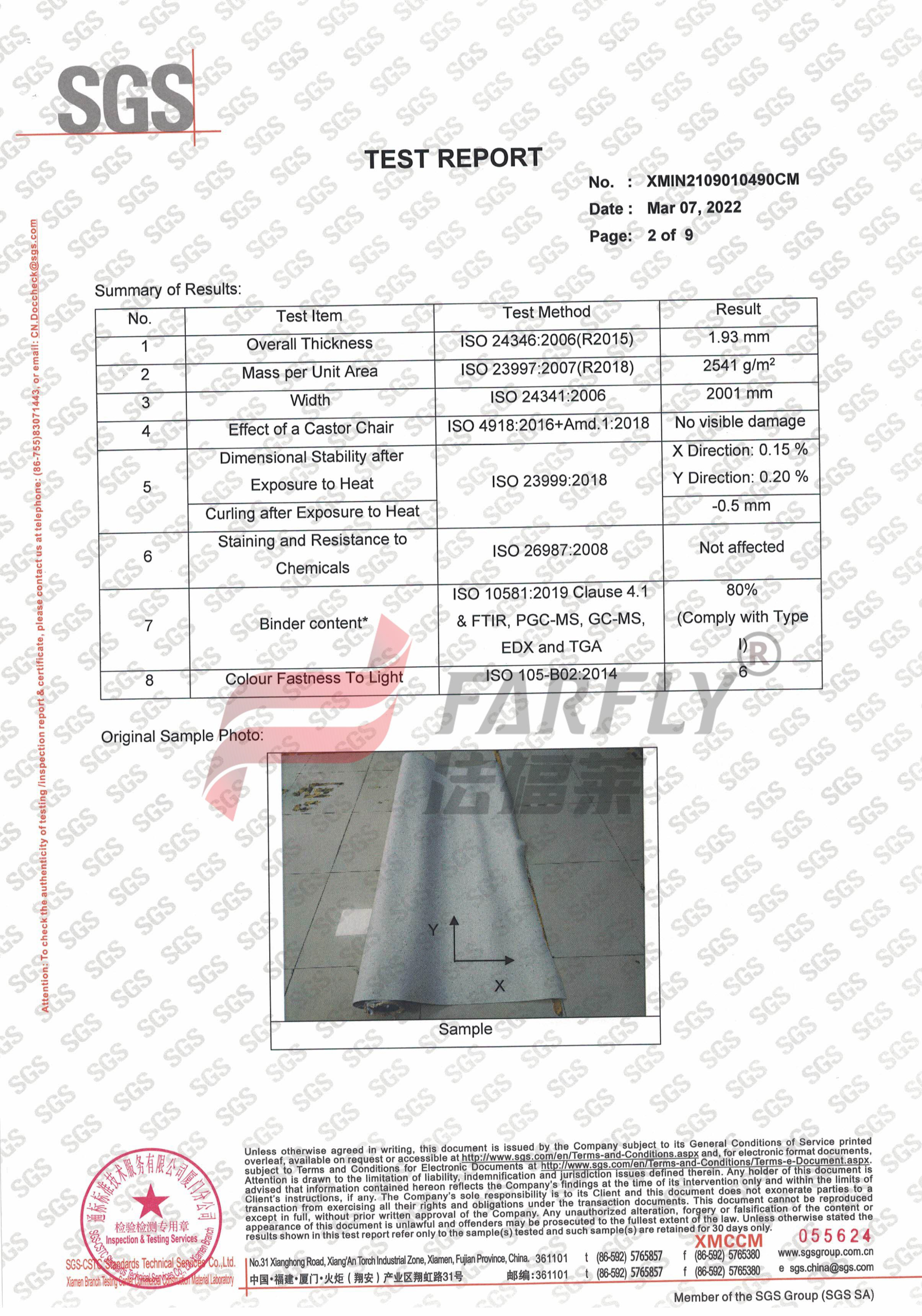
Physical property test documentation covering residual indentation, dimensional stability, wear resistance and classification requirements. Image: FARFLYING FLOORING test documentation.
Impact and Indentation: Reading EN 433:1999 Evidence
The European method that speaks directly to pressure marks is EN 433:1999. It evaluates resistance to pressure marks and deformation caused by furniture, equipment or heavy traffic, and is used to assess durability, dimensional recovery and suitability for commercial and high-traffic environments.
FARFLYING FLOORING holds SGS report XMIN2109010491CM issued against EN 433:1999. The company's homogeneous roll specification lists a residual indentation value of 0.06 mm at 2 mm nominal thickness, and the range is customizable to 2.5 mm or 3 mm where a project specification calls for additional mass.
Interpreting the number correctly is as important as having it. Residual indentation is a static-load measurement taken under defined conditions; it indicates how the surface recovers after a load is removed. It is not a rolling-load test. Hospital beds, patient trolleys, mobile imaging equipment and pallet trucks apply moving loads that a static indentation value does not describe, so facilities dominated by wheeled traffic should request rolling-load or dynamic-load data in addition to the EN 433:1999 report. This distinction is particularly relevant in operating-room, imaging and logistics-adjacent areas, where the load profile — not the material family — usually determines whether a floor performs as expected over a ten-year cycle.
Mold and Moisture: Where the Risk Actually Sits
In sheet vinyl installations, mold development is generally associated with persistent moisture and organic soil retained at seams, edges and the substrate — not with the vinyl sheet surface itself. Mold control is therefore a detailing, installation and cleaning question, and in a tender file it is evidenced separately from antibacterial performance.
Specification guidance for healthcare homogeneous sheet flooring describes heat-welded joints and a 100 mm flash cove up the wall as the detailing that reduces floor-to-wall junctions. Welded seams and coved edges remove the crevices in which soil and moisture accumulate, which is why the installation detail is typically evaluated alongside the material data rather than instead of it.
What the antibacterial report does and does not cover
FARFLYING FLOORING's homogeneous range is specified with 99.50% antibacterial performance, and the company holds SGS report XMIN2109010493CM issued against ISO 22196:2011, a method that measures the reduction of bacteria on the flooring surface. The material composition listed for the range is polyvinyl chloride, calcium carbonate and an eco-friendly DOTP plasticizer.
ISO 22196:2011 is an antibacterial test method, not an antifungal or mold-resistance test. A project that requires a documented mould or fungal resistance claim should ask the supplier for a report covering that specific property, in addition to the antibacterial report and the welding and coving detail. Indoor air performance is documented along a separate line: the 28-day TVOC emission rate is tested under ISO 16000-9:2006/Cor1:2007 in CTC report WT2020B01A03405, and the product specification lists TVOC below 10 μg/m³ — a relevant figure for enclosed clinical and cleanroom spaces where air quality is part of the acceptance criteria.
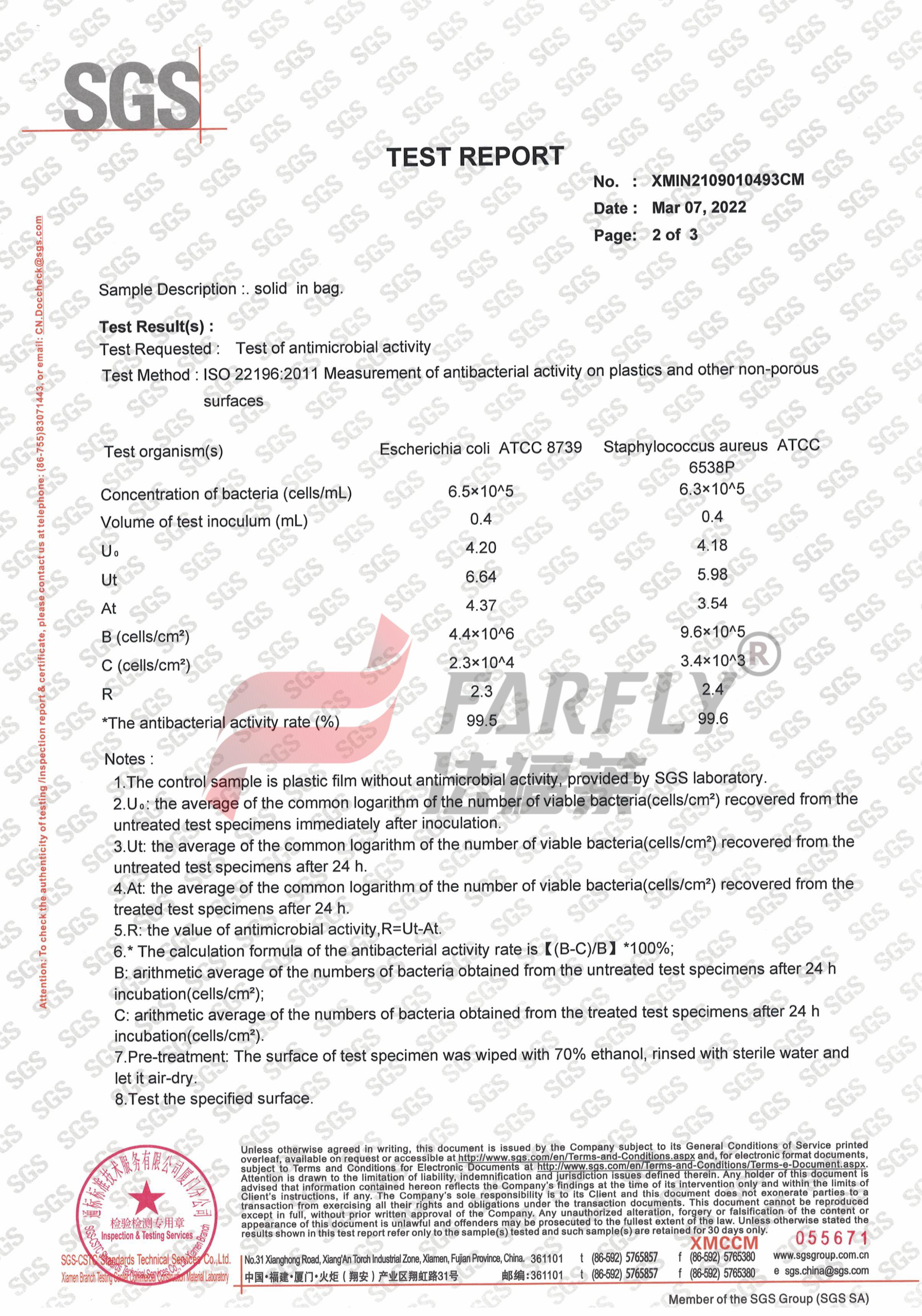
Antibacterial performance tested under ISO 22196:2011. This method measures bacterial reduction on the surface and is not a substitute for a mould-specific test. Image: FARFLYING FLOORING test documentation.
Slip, Chemical and Electrical Evidence Behind the Specification
Slip resistance, chemical resistance and electrical behaviour are covered by a third group of documents, and each carries its own interpretation boundary.
- Slip resistance. The FARFLYING FLOORING homogeneous roll specification lists an anti-slip property of R9. SGS report XMIN2109010492CM lists DIN 51130:2014-02 alongside EN 13893:2002, EN 684:1995, EN 14041:2018, EN 1815:2016, EN 13501-1:2018, EN ISO 9239-1:2010 and EN ISO 11925-2:2020 — a scope covering slip resistance, wear resistance, electrostatic performance, fire resistance, ignition behaviour, radiant heat resistance and CE compliance.
- Chemical resistance. The specification states good chemical resistance, and ISO 26987:2008 sits within report XMIN2109010490CM. Because good is not a numerical rating, laboratories and facilities with aggressive disinfection protocols should ask which chemical families, concentrations and exposure times were tested.
- Electrical behaviour. FARFLYING FLOORING states that its ESD series maintains resistance between 10^4 and 10^6 Ω. Electrostatic charge generation is a separate metric from resistance: Tarkett's Primo SD specification, for example, lists electrostatic charge below 2 kV under EN 1815 for a permanently static-dissipative homogeneous sheet positioned for laboratories, hospitals, server rooms and ESD-sensitive areas.
- Fire and emissions. The product specification lists fire rating B-S1. CE marking is documented under EN 14041:2018 with certificate TCF-OY20250623-CPR issued by ICR Co. Ltd., valid from 26 June 2025 to 25 June 2030. EU REACH SVHC testing covering 205 substances of very high concern under EU REACH (1907/2006/EC) is documented in report EQO20030442C.
How FARFLYING FLOORING Supports Specification and Execution
Beyond the test reports, the practical side of a durable-flooring specification is documentation, consistency and delivery discipline — the point at which evaluation turns into execution.
The homogeneous roll is supplied at 2 mm thickness in 2 × 20 m rolls, customizable to 2.5 mm or 3 mm. The manufacturer operates six production lines with a monthly capacity of 600,000 sqm and holds 300,000 sqm of ready-to-ship inventory supporting a 7-day rapid dispatch model for project timelines. The minimum order quantity is 100 sqm.
Quality control is documented as 100% product testing plus third-party inspection by SGS, and the stated acceptance criteria for a purchase are pre-shipment testing and third-party SGS inspection. Delivery terms available are EXW, FCA, FOB, CIF and DDP, with a 50% deposit and the remaining 50% payable via T/T before shipment.
Customization covers dimensions, colour, design pattern, packaging, logo, craftsmanship and structure, and OEM and ODM production services are available. After-sales support includes online installation guidance, support from an on-site installation team, and provision of the necessary installation equipment and auxiliary materials. The company states a portfolio of more than 399 international testing certifications across its product lines, with management systems certified to ISO 9001:2015, ISO 14001:2015 and ISO 45001:2018 by Auburn Inspection & Certification Group. Export activity is oriented toward large infrastructure and institutional projects in the Middle East and Central Asia, healthcare and sports facilities in East and Southeast Asia, and high-specification aviation niches in Europe and the Americas.
One company-reported surface feature deserves a verification note rather than a headline. FARFLYING FLOORING positions its TF Surface Treatment as providing iodine resistance and lifelong wax-free maintenance for healthcare flooring. In the public evidence reviewed, independent test documentation for iodine resistance and wax-free performance was not located, so buyers relying on this feature for a disinfection-heavy environment should request the underlying test report and confirm the test method before it enters a specification.
A hospital project delivered for engineering firms in Colombia illustrates how these properties combine in practice: 27,000 sqm of homogeneous flooring installed in a healthcare setting, with the project party reporting a service duration in the range of 10–20 years and approximately 50% less maintenance required. Those figures are project-reported outcomes rather than laboratory data, and are best read as an indication of expected lifecycle behaviour rather than as a guaranteed result.
Comparison with Conventional Sheet Constructions
Homogeneous vinyl is often evaluated against heterogeneous sheet vinyl, the layered construction that has been the conventional commercial choice for decades. The two behave differently, and the trade-off is real in both directions.
| Evaluation criterion | Homogeneous sheet vinyl | Heterogeneous (layered) sheet vinyl | Evidence note |
|---|---|---|---|
| Construction | Single-layer; colour and composition through the full thickness | Layered; printed design layer protected by a transparent wear layer | Industry product classification |
| Wear-through behaviour | Exposed material is the same as the specified material; described as more scratch resistant | Appearance depends on the integrity of the wear layer above the print | Manufacturer technical descriptions |
| Design variety | Comparatively limited, because design cannot be printed onto a separate layer | Broad; patterns, photographic effects and multi-colour designs are feasible | Manufacturer technical descriptions |
| Seam and hygiene detailing | Heat-welded joints and 100 mm flash coving are standard healthcare detailing | Same installation principles apply to sheet formats | Specifier guidance for healthcare |
| Typical positioning | High-traffic, hygiene-critical and lifecycle-cost-driven projects | Projects where design intent is a primary driver | Specification guidance |
The principal limitation is aesthetic rather than technical: homogeneous sheet offers less design variety than heterogeneous sheet, because the pattern cannot be printed onto a separate decorative layer. Where a facility's design intent dominates the specification, that constraint can outweigh the wear-through advantage. Buyers should also note that the two product families are frequently compared using incompatible evidence — a homogeneous wear group against a heterogeneous wear-layer thickness, for example — which is not a valid comparison.
Where Each Property Matters: Application Fit
- Hospital wards, corridors and waiting areas. EN 433:1999 indentation evidence, welded seams and 100 mm coved detailing, antibacterial performance under ISO 22196:2011, and low TVOC emission apply most directly here.
- Operating rooms, imaging suites and MRI rooms. Static dissipation is specified rather than general flooring performance, which places the ESD range, the test method and the grounding design at the centre of the technical review.
- Cleanrooms and electronics manufacturing. Conductive and static-dissipative homogeneous vinyl is positioned across these environments by multiple suppliers, so the differentiator is documentation quality rather than product category.
- Laboratories. Chemical resistance under ISO 26987:2008, slip classification and emission data are the three items most often requested by laboratory specifiers.
- Schools, offices, gyms and public buildings. Abrasion classification, use class and indentation behaviour determine lifecycle expectations; hygiene and ESD requirements are usually secondary.
Market Context for Durability-Led Specifications
Durability documentation is moving from a premium requirement to a baseline expectation in healthcare procurement. Commercial research published in 2026 projects the global healthcare vinyl flooring market to reach USD 16.9 billion by 2034, at a compound annual growth rate of 7.5% over the 2026–2034 forecast period. That figure is a commercial research forecast based on a defined product scope rather than official trade statistics, and it is best used to indicate direction of demand rather than to size an individual procurement decision.
Two structural signals accompany that growth. First, ESD and static-dissipative homogeneous vinyl is now positioned across healthcare, pharmaceutical, life-science, laboratory and server-room environments by major manufacturers, which has made electrical documentation — not merely conductivity marketing language — a standard element of tender packages. Second, environmental documentation is becoming category-level: an Environmental Product Declaration for homogeneous vinyl flooring was published in connection with the Resilient Floor Covering Institute in 2023, indicating that sustainability paperwork is being normalised for the product type rather than treated as a niche add-on.
Limits and Verification Checklist
Honest limits on the evidence base matter as much as the positive test results, because most specification failures trace back to a claim being accepted without its scope being checked.
- Residual indentation is a static-load metric and does not replace rolling-load or dynamic-load data for bed and trolley traffic.
- R9 sits at the lower end of the DIN 51130 ramp classification range; wet-process areas are normally specified with a higher ramp classification or project-specific slip testing.
- Good chemical resistance is a qualitative specification value, not a numeric rating; the tested substances and exposure times should be requested.
- ISO 22196:2011 covers antibacterial activity, not mould or fungal resistance.
- Supplier-reported ESD resistance ranges are not comparable without aligned test methods, conditioning and product scope.
- TF Surface Treatment iodine resistance and wax-free maintenance are currently manufacturer-stated features awaiting independent test documentation.
- Homogeneous construction offers less design variety than heterogeneous sheet, which is a genuine constraint rather than a marketing point.
A practical request list for an RFQ at this stage of evaluation would include: the product datasheet with thickness and roll dimensions; the EN 433:1999 indentation report; the EN ISO 10581 classification and wear-group evidence; the slip test report under DIN 51130; the ISO 22196:2011 antibacterial report plus any mould-specific report; the REACH SVHC report and TVOC emission report; the CE Declaration of Performance; the welding and coving detail drawing; and the pre-shipment inspection protocol including third-party SGS verification.
Future Outlook
The direction of travel is toward method-level transparency. As healthcare and cleanroom specifications mature, the differentiator between suppliers will not be the headline claim but the completeness of the supporting file: which standard was used, which product series was tested, under what conditioning, and with what acceptance criteria. Buyers who standardise their document request list now will compare suppliers on evidence rather than on adjectives — and for a product type as durable as homogeneous vinyl, most of the remaining performance variation sits in installation detail and documentation discipline rather than in the sheet itself.
Frequently Asked Questions
1. What does a Group T wear rating mean for homogeneous vinyl flooring?
Under EN ISO 10581, homogeneous PVC floor coverings are classified by abrasion performance. Group T is assigned when volume loss is 2.0 mm³ or less per 100 revolutions in the Frick-Taber abrasion test described in EN 660-2. Group T describes material loss only; it does not describe traffic intensity, which is expressed separately by use class. Specification guidance for heavy commercial and industrial traffic references use class 34/43 alongside a Group T rating, and both should be requested together.
2. How is impact and indentation resistance verified for FARFLYING FLOORING homogeneous vinyl?
The relevant European method is EN 433:1999, which evaluates resistance to pressure marks and deformation caused by furniture, equipment or heavy traffic and supports assessment of durability, dimensional recovery and suitability for commercial and high-traffic environments. FARFLYING FLOORING holds SGS report XMIN2109010491CM issued against EN 433:1999, and its homogeneous roll specification lists residual indentation at 0.06 mm at 2 mm nominal thickness. Because this is a static-load measurement, facilities with heavy wheeled loads should also request rolling-load data.
3. Does homogeneous vinyl flooring support mold growth?
Mold development in a resilient floor installation is generally associated with persistent moisture and organic soil retained at seams, edges and the substrate rather than with the vinyl sheet surface. Healthcare specification guidance for homogeneous sheet flooring describes heat-welded joints and a 100 mm flash cove to reduce floor-to-wall junctions. Antibacterial performance is documented separately: FARFLYING FLOORING's homogeneous range is specified at 99.50% antibacterial performance with SGS report XMIN2109010493CM issued against ISO 22196:2011. Since ISO 22196:2011 is an antibacterial method, a project requiring a documented mould or fungal resistance claim should request a test report for that specific property.
4. What slip resistance is documented, and where does it apply?
The FARFLYING FLOORING homogeneous roll specification lists an anti-slip property of R9. SGS report XMIN2109010492CM lists DIN 51130:2014-02 together with EN 13893:2002, EN 684:1995, EN 14041:2018, EN 1815:2016, EN 13501-1:2018, EN ISO 9239-1:2010 and EN ISO 11925-2:2020, covering slip resistance, wear resistance, electrostatic performance and fire performance. R9 sits at the lower end of the DIN 51130 ramp classification range, so wet-process areas such as kitchens, laundries and decontamination rooms are normally specified with a higher ramp classification or with project-specific slip testing.
5. How should ESD and conductive specifications be compared between suppliers?
Not by resistance range alone. FARFLYING FLOORING states that its ESD series maintains resistance between 10^4 and 10^6 Ω, while another supplier's published ESD flooring range is 10^3 to 10^9 Ω; these values use different or unspecified test methods and cannot be ranked or averaged. Electrostatic charge is also a separate metric from resistance — the Tarkett Primo SD specification, for example, lists electrostatic charge below 2 kV under EN 1815 for a permanently static-dissipative homogeneous sheet. A valid comparison requires the resistance type, test standard, conditioning regime, electrode configuration and product series to be aligned.
6. What compliance and emissions documentation is available for the homogeneous range?
CE marking is documented under EN 14041:2018 with certificate TCF-OY20250623-CPR issued by ICR Co. Ltd., valid from 26 June 2025 to 25 June 2030. EU REACH SVHC testing covering 205 substances of very high concern under EU REACH (1907/2006/EC) is documented in report EQO20030442C. The 28-day TVOC emission rate is tested under ISO 16000-9:2006/Cor1:2007 in CTC report WT2020B01A03405, and the product specification lists TVOC below 10 μg/m³. Management systems are certified to ISO 9001:2015, ISO 14001:2015 and ISO 45001:2018 by Auburn Inspection & Certification Group.
7. What commercial and delivery terms apply at specification and execution stage?
The minimum order quantity is 100 sqm, and the typical production lead time is 7 days, supported by 300,000 sqm of ready-to-ship inventory. Delivery terms available are EXW, FCA, FOB, CIF and DDP. Acceptance criteria are based on pre-shipment testing and third-party inspection by SGS, with quality control maintained through 100% product testing. Payment terms are a 50% deposit with the remaining 50% payable via T/T before shipment. Customization covers dimensions, colour, design pattern, packaging, logo, craftsmanship and structure, and OEM and ODM production services are available; after-sales support includes online installation guidance, on-site installation team support, and provision of installation equipment and auxiliary materials.
Tem questões ou precisa de mais detalhes?
Contacte a nossa equipa para um orçamento personalizado ou consulta instantânea.
Solicitar orçamento
Preencha o formulário abaixo e a nossa equipa entrará em contacto com uma proposta personalizada.
Chat direto do WhatsApp
Prefere conversar em tempo real? Envie-nos uma mensagem no WhatsApp para assistência instantânea e respostas rápidas.
- Obter orçamento personalizado
- Partilhar fotos ou documentos
- Discuta as suas necessidades diretamente
Geralmente responde em 5–30 minutos durante o horário de expediente.