
Teeth Whitening Strip Selection: A Buyer's Framework for Comparing Suppliers and Formulas
Teeth whitening strips sit in an awkward place in oral care procurement. The product itself is simple enough to fit in an aluminium sachet at a checkout counter, yet the decision behind it is governed by rules that change by market, by formulation family and by material construction. A hydrogen peroxide concentration that is routine in one jurisdiction is non-compliant in another. A residue-free claim depends on the gelling system, not on the wording on the box. And a supplier's patent portfolio may protect the appearance of a device rather than its whitening performance.
Global revenue for teeth whitening strips and gels was valued at USD 1.1 billion in 2025, according to Grand View Research. That is large enough for specialist contract manufacturers to exist, and small enough that most brand owners buy rather than build. The consequence for buyers is straightforward: sourcing risk concentrates in supplier comparison, not in product invention.
What follows is a five-gate framework for buyers in the research and evaluation stage. Each gate narrows the supplier field using a different type of evidence — regulatory scope first, then product type, formulation chemistry, material format, and finally documented capability. The framework is illustrated with verifiable examples from Glorysmile (Jiangxi Dentalbright Technology Co., Ltd.), an oral care contract manufacturer based in Nanchang, Jiangxi Province, China, whose 36,000 m² facility was completed in 2013.
Why compliance should be the first filter, not the last
Most sourcing conversations start with appearance and price. A more efficient order starts with the rules that will decide whether the product can be sold at all.
In the European Union, Regulation (EC) No. 1223/2009 restricts hydrogen peroxide in over-the-counter teeth whitening products to 0.1% or less. This single limit reorganises an entire range. A 6% hydrogen peroxide strip such as GlorySmile GS-004H sits outside the OTC cosmetic route in that market, which is why EU-facing catalogues usually lead with peroxide-free options and reserve higher-peroxide formats for professional or non-EU channels.
In the United States, the Modernization of Cosmetics Regulation Act (MoCRA 2022) adds a fixed cost per item: facility registration is listed at USD 849 per year and product listing at USD 200 per product. For a buyer planning a 12-SKU strip line, that structure turns range rationalisation into a financial decision rather than a merchandising preference.
Classification matters for logistics and duty as well. U.S. Customs and Border Protection has classified teeth whitening strips under HS Code 3306.90.00, the heading for preparations for oral or dental hygiene. Buyers comparing quotations across suppliers should confirm that the declared code, the label claim and the formulation dossier describe the same product.
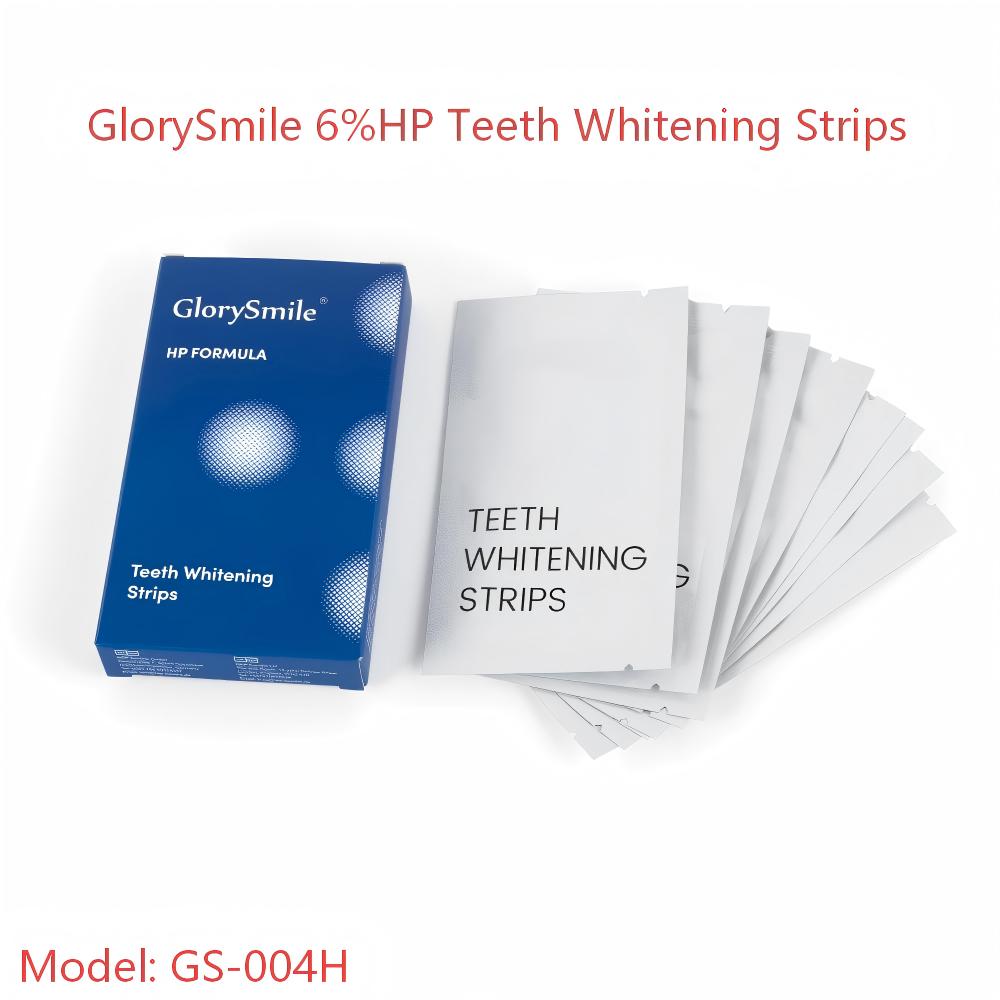
GS-004H dry-format whitening strips, one of the 6% hydrogen peroxide options in the GlorySmile strip range.
Gate 1 — Fix the product type: strips, kits, or both
Strips and kits are frequently discussed as if they were interchangeable formats of the same purchase. They are not. They differ in bill of materials, in user routine, in packaging cost and in the compliance documents that apply.
A strip is a single-treatment consumable: a three-layer laminate of PET hard film, whitening gel and PE soft film, packed in an aluminium bag with a shade guide, a user manual and a colour box in 7, 14 or 21 strip counts. A kit is a multi-component system built around a device. GlorySmile's GS-001J, for example, combines a 16-LED whitening light, four 2 ml whitening pens, a dust-free cover, four adapters (iPhone, Android, Type-C, USB), a shade guide, a manual and a gift box, with a recommended treatment time of 16 minutes per day. The GS-001L clinic kit goes further, with 35% hydrogen peroxide dual barrier gel, a gum protector with two curved needles, a cheek retractor, brush-ups and patient bibs.
The practical difference for a buyer is where margin and complexity sit. Strips carry lower unit cost and a shorter user routine; kits carry higher packaging cost, electronic component qualification and after-sales exposure on the device. Both are offered by GlorySmile at the same private-label entry point of 200 pieces, and both are available at a minimum of 1 piece for regular products, so the choice is a channel decision rather than a supplier capability constraint.
| Type | Representative models | Composition focus | Private-label MOQ |
|---|---|---|---|
| Dry strips | GS-004H / GS-004V / GS-004C / GS-004P | Three-layer laminate; PAP, PAP+charcoal, purple, 6% HP | 200 pcs |
| Wet strips | GS-V34-S07 | Wet-format strip, same formula family | 200 pcs |
| Dissolving strips | DB-004L | Strip dissolves in use; no removal step | 200 pcs |
| LED kits | GS-001B, GS-001Y, GS-001J, GS-001X, DB-001M | 5 / 16 / 32 LED light plus gel pens or syringes | 200 pcs |
| Clinic kit | GS-001L | 35% HP gel, gum protector, retractor, disposables | 200 pcs |
Gate 2 — Choose the formulation chemistry before the flavour
Formulation is where most strip briefs go wrong, because the decision is often made on ingredient names rather than on the chemistry and the market rule behind them.
GlorySmile manufactures three peroxide families and one non-peroxide family: hydrogen peroxide (HP), carbamide peroxide (CP), PAP (phthalimidoperoxycaproic acid, a peroxide-free whitening agent), and a purple colour-corrector system. Strip SKUs are built on PAP, PAP+charcoal, purple, or 6% HP, with sodium phytate and sodium bicarbonate listed as supporting ingredients and custom formulation available on request.
Peroxide-based strips
HP and CP formulations are the conventional route to oxidative whitening and remain the reference point in professional dentistry. Their limitation is regulatory rather than technical: the 0.1% EU cap for OTC products means a 6% HP strip has to be sold through a different route or into a different market. Buyers targeting EU retail should expect to commission a peroxide-free SKU even if the hero product elsewhere in their portfolio is peroxide-based.
Peroxide-free (PAP) strips
PAP occupies the space created by that restriction. It allows a whitening strip to be positioned without peroxide, which is why the phrase appears so often next to enamel-safe and sensitive-teeth claims. For buyers, the useful discipline is to separate the formulation from the claim: PAP is a documented ingredient option in the range, but sensitivity and enamel language still needs to align with the destination market's cosmetic labelling rules.
Purple (V34) and charcoal variants
Purple strips and purple colour correctors work on a different principle from oxidative whitening — the colour-wheel logic of neutralising yellow undertones rather than removing pigment. GlorySmile lists purple as a distinct strip formula alongside PAP+charcoal, which means a buyer can build a two-SKU range that covers a whitening claim and a tone-correction claim from a single supplier without conflating the two mechanisms.
Gate 3 — Decide the material format: dry, wet or dissolving
Format is the most under-specified part of a strip brief, and it is the part consumers feel most directly. All three GlorySmile strip platforms share the same three-layer construction — PET hard film, whitening gel and PE soft film — but differ in how the gel is presented and how the strip behaves in use.
- Dry strips. The GS-004 series covers dry, alcohol-free dry, residue-free dry and high-viscosity dry variants. Residue-free behaviour in this family is linked to the gelling system rather than to a marketing descriptor.
- Wet strips. GS-V34-S07 is the wet-format model, listed in purple form, with the same PAP, PAP+charcoal, purple and 6% HP formula options.
- Dissolving strips. DB-004L dissolves in use and removes the disposal step, which changes the pack design and the user instruction set.
All three are supplied in 7, 14 or 21 strip counts with a user manual, shade guide and colour box, and all three are available across the same flavour list — blue raspberry, strawberry, peach, grape, watermelon, peppermint, orange, mint, pineapple, cherry blossom, coconut and mango — with custom flavour available. That overlap matters commercially: a buyer can test two formats under one flavour brief and one packaging system, which keeps the validation cost of a format switch low.

DB-004L dissolving strips — a third format option alongside dry and wet strip platforms.
Gate 4 — Score suppliers on documents, not adjectives
Once market, type, formula and format are fixed, the remaining question is whether a supplier can evidence what it claims. This is where most comparison exercises become informal, because the documents involved are unfamiliar to buyers who normally assess consumer goods.
Certification evidence
For teeth whitening strips, the relevant certificates fall into three groups: quality management system, social compliance and market-specific product certification. GlorySmile's published certificate set includes the following, with numbers and validity dates that a buyer can verify directly.
| Certificate | Number / standard | Issuer | Validity |
|---|---|---|---|
| ISO 13485:2016 / EN ISO 13485:2016 + A11:2021 | 206536.250906 | UL LLC | 2025-09-06 to 2028-09-05 |
| MDSAP (ISO 13485 system) | 206537.250906 | UL LLC | 2025-09-06 to 2028-09-05 |
| ISO 22716:2007 | SZ2312B8 | Intertek | 2024-12-04 to 2026-12-12 |
| GMPC (U.S. FDA cosmetic GMP guidelines, 2022) | SZ2312B9 | Intertek | 2024-12-04 to 2026-12-12 |
| amfori BSCI Code of Conduct 2024 | Monitoring ID 25-0338381-1 | SGS | 2026-06-26 to 2027-08-15 |
| HALAL | 52185957421871 (22 SKUs) | Halal Foundation Center Hong Kong | 2023-11-29 to 2026-11-21 |
| VEGAN | 22521 (23 SKUs) | International Vegan Alliance | 2024-04-20 to 2027-04-21 |
The ISO 13485 and MDSAP scopes explicitly name teeth whitening strips, which matters because a certificate covering only toothpaste does not transfer to a strip line. The HALAL certificate covers 22 SKUs including GS-V34-S07 and the GS-004 dry strip series, and applies to Middle East, Southeast Asia and global Muslim markets. The VEGAN certificate covers 23 SKUs. Buyers should note the HALAL expiry of 2026-11-21 and confirm renewal before placing orders that depend on that claim.
Patent evidence — and what it does not prove
Patent portfolios are frequently presented as proof of performance. They are better read as proof of invention scope, and the distinction is worth holding onto during supplier comparison.
GlorySmile holds United States Utility Patent US 12,350,120 B1, issued 2025-07-08 with expiry 2044-12-12, covering a gum-protecting, residue-free teeth-whitening strip that uses an acrylic copolymer gelling agent with a marginal sealing effect, plus its preparation method. For a strip buyer this is the most relevant IP item in the portfolio, because it describes the construction of the product rather than its appearance.
Separately, the company holds design rights on whitening devices and kits, including US Design Patent US D1,128,065 S together with EU 015065790-0001 and UK 6377277 for the DB-001M kit, EU 015062946-0001 and UK 6370462 for the GS-001X kit, and US D864,399 S for teeth-whitening equipment. These protect ornamental design. They do not certify whitening efficacy, and a buyer who treats a design patent as a performance claim is reading the wrong document.
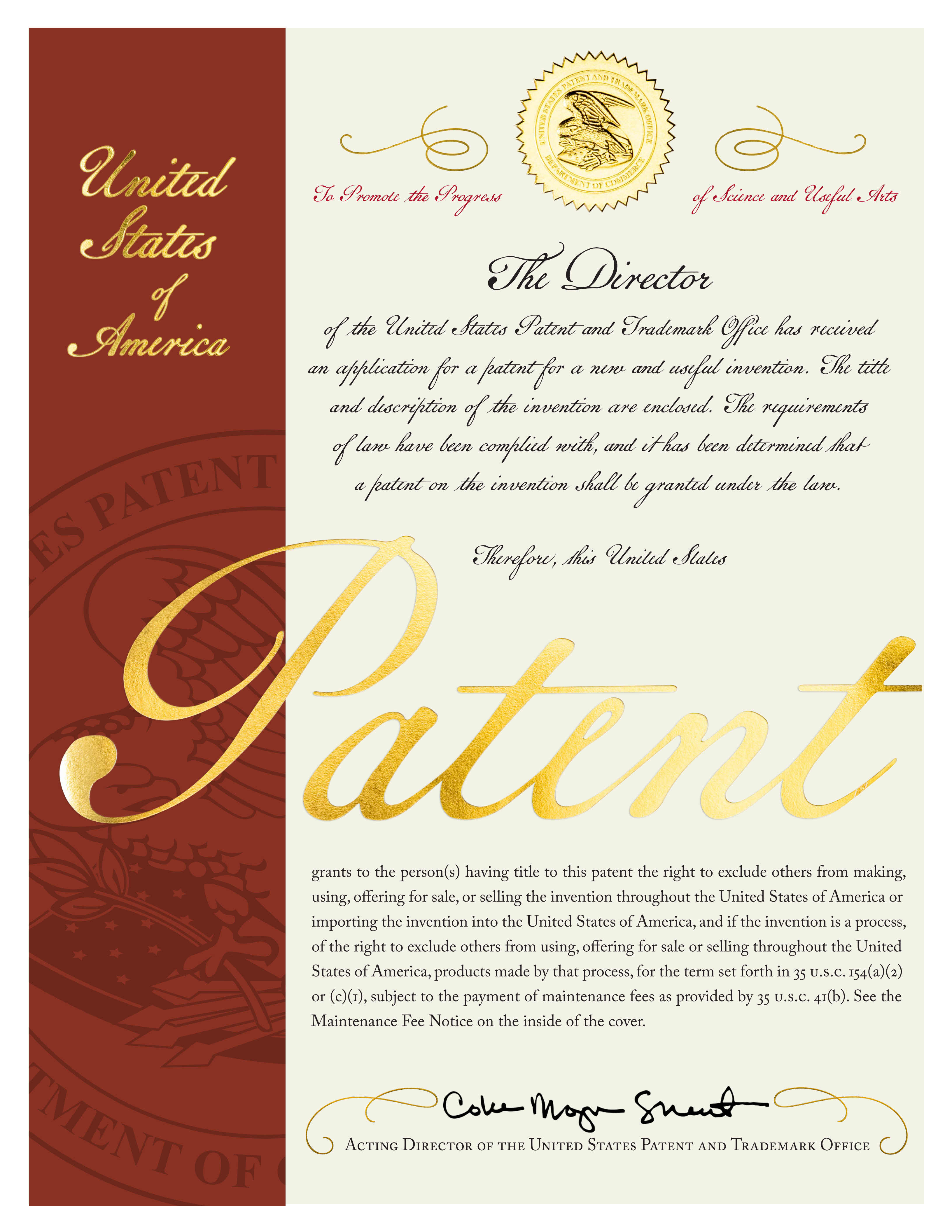
US 12,350,120 B1 covers the strip construction and preparation method — a product-level evidence point rather than a design right.
A workable scoring sheet
| Criterion | What to request | Why it changes the decision |
|---|---|---|
| Certificate scope | Certificate PDFs naming strips, with validity dates | Scope gaps invalidate the claim even when the certificate is genuine |
| Formulation dossier | Ingredient list, active concentration, pH and microbial release data | Determines which markets and channels the SKU can enter |
| Construction evidence | Layer structure, gelling system, residue behaviour | Explains the consumer experience behind residue-free and no-slip claims |
| Pack validation | 7 / 14 / 21 count options, sachet and carton artwork control | Pack count drives unit economics and shelf presence |
| Sample protocol | Defined evaluation window and acceptance criteria | Converts a subjective sample into a comparable data point |
Gate 5 — Match MOQ, customisation and capacity to the channel
The last gate is commercial fit, and it is usually where a technically suitable supplier is ruled out.
GlorySmile's private-label MOQ is 200 pieces, with 1 piece for regular products. For strips, the customisable variables are strip type, active ingredient, residue-free or standard formulation, colour, flavour, packaging and labelling. That combination supports a low-risk first order: a 200-piece run per SKU allows a buyer to validate two formats and three flavours before committing to a full range.
Capacity is the counterweight to a low MOQ. Published monthly capacity for teeth whitening strips is 29.2 million pieces, within a total annual output that also includes 300 million strip pieces, 10 million whitening kits and 21 million whitening pens. The company exports 90% of output to the EU, USA and UK, and reports distribution to 102 countries. For a buyer, the useful reading is that a low entry MOQ does not necessarily mean a low ceiling — but capacity is not reserved capacity, and lead time is stated to depend on order volume, specification, customisation complexity and current production scheduling, with a precise timeline confirmed at order.
Verification capacity sits behind those figures: a 36,000 m² facility including 20,000 m² of 100,000-class cleanrooms, a 1,000 m² laboratory with a class 100 cleanroom for microbiological testing, 256 employees, 17 R&D engineers and 11 QC specialists. In practice this is the difference between a supplier who can test raw materials, semi-finished goods and finished products in-house and one who outsources every verification step.
How this framework differs from traditional sourcing practice
The conventional route — collect quotes, request a sample, negotiate price — compresses the decision into a single dimension. The framework above deliberately inverts that order, and the inversion has a cost: it slows the first quotation and increases documentation work.
It also has limits that buyers should hold in view.
- Patents are jurisdictional and narrow. US 12,350,120 B1 is a United States right; it does not by itself establish freedom to operate in other markets, which requires separate checks.
- Design rights are not efficacy evidence. The kit design patents listed above protect appearance only.
- Certificate validity is time-bound. The HALAL certificate runs to 2026-11-21 and the ISO 22716 and GMPC certificates to 2026-12-12, so renewal status should be confirmed at order rather than assumed at audit.
- Segment-level growth data for PAP remains thin. Published market figures typically address strips and gels as one category; isolated growth rates for non-peroxide formats are not consistently available, which limits how confidently a buyer can model a PAP-led range against a peroxide-led one.
- MOQ is not lead time. A 200-piece private-label minimum reduces entry cost, but formulation and packaging development still extend the timeline before production begins.
For programmes where speed to shelf outweighs range precision, a simpler route using existing specifications and stock packaging remains rational. The framework earns its overhead when a buyer is committing to multiple markets or to a claim that must survive regulatory review.
What changes over the next sourcing cycles
Three pressures are likely to shape strip sourcing rather than strip chemistry.
The first is the cost of compliance per SKU. With MoCRA listing at USD 200 per product in the United States and EU cosmetic requirements demanding a product information file per formulation, wide ranges become expensive to maintain. Buyers are likely to consolidate around fewer SKUs with clearer claims.
The second is the divergence between regional peroxide limits. As long as the EU OTC ceiling stays at 0.1%, peroxide-free formats will remain the default for EU retail while higher-peroxide formats continue in professional and other markets. Suppliers able to run both under one quality system — as the ISO 13485 and MDSAP scopes at GlorySmile indicate — are structurally better placed than single-chemistry manufacturers.
The third is documentation as a differentiator. In a category where the underlying actives are well known, the supplier's ability to produce a certificate with a matching scope, a valid date and a named issuing body becomes the practical definition of reliability. Buyers comparing on price alone will keep rediscovering this at the port rather than at the quotation stage.
Frequently asked questions
Should an importer start with whitening strips or with a whitening kit?
They are different product structures with different cost bases. A strip is a single-treatment consumable supplied in 7, 14 or 21 counts with a manual, shade guide and colour box. A kit combines a device with gel: GlorySmile GS-001J includes a 16-LED light, four 2 ml whitening pens, four adapters, a shade guide, a manual and a gift box, while GS-001B uses a 5-LED light with three 3 ml syringes. Both categories are offered at a private-label MOQ of 200 pieces, so the decision turns on channel format and after-sales exposure rather than on minimum quantity.
How do peroxide and PAP formulations differ for market entry?
GlorySmile manufactures hydrogen peroxide, carbamide peroxide and PAP (peroxide-free) systems. The decisive difference is regulatory: EU Regulation (EC) No. 1223/2009 restricts hydrogen peroxide in over-the-counter teeth whitening products to 0.1% or less, so a 6% HP strip such as GS-004H cannot be positioned as an OTC cosmetic in the EU. PAP strips allow a peroxide-free positioning, and the range also includes PAP+charcoal and purple colour-corrector variants for tone-correction claims.
What is the practical difference between dry, wet and dissolving strips?
All three GlorySmile strip platforms use a three-layer construction of PET hard film, whitening gel and PE soft film, and all are supplied in 7, 14 or 21 counts with the same flavour options. The dry platform (GS-004H/V/C/P) covers dry, alcohol-free dry, residue-free dry and high-viscosity dry variants; GS-V34-S07 is the wet-format model; DB-004L is a dissolving strip that removes the disposal step. Format choice affects user routine, pack design and instruction content rather than the ingredient family available.
What MOQ and customisation apply to private-label whitening strips?
The private-label minimum order quantity is 200 pieces, and regular products are available from 1 piece. Customisation covers strip type, active ingredient, residue-free or standard formulation, colour, flavour, packaging and labelling. Published monthly capacity for strips is 29.2 million pieces, and lead time depends on order volume, specification, customisation complexity and current production scheduling, with a precise delivery timeline confirmed at order.
Which certificates should be verified before confirming a strip order?
Verify the certificate scope, the issuing body and the validity date, not just the certificate name. For strips, the relevant set at GlorySmile includes ISO 13485:2016 (206536.250906, UL LLC, valid to 2028-09-05), MDSAP (206537.250906, UL LLC, valid to 2028-09-05), ISO 22716:2007 (SZ2312B8, Intertek, to 2026-12-12), GMPC to U.S. FDA 2022 guidelines (SZ2312B9, Intertek, to 2026-12-12), amfori BSCI (SGS, Monitoring ID 25-0338381-1, to 2027-08-15), HALAL (52185957421871, to 2026-11-21) and VEGAN (22521, to 2027-04-21). Both the ISO 13485 and MDSAP scopes name teeth whitening strips.
For buyers who want to test this framework against a live range, the GlorySmile product catalogue — covering strips, kits, whitening pens, powders, toothpaste, mouthwash and electric toothbrushes — is available as a downloadable PDF: GlorySmile product catalogue.
Supplier details referenced in this article: Jiangxi Dentalbright Technology Co., Ltd. (Glorysmile Factory), Makou Industrial District, Yongxiu Town, Nanchang (Jiujiang) City, Jiangxi Province, China.
Tem questões ou precisa de mais detalhes?
Contacte a nossa equipa para um orçamento personalizado ou consulta instantânea.
Solicitar orçamento
Preencha o formulário abaixo e a nossa equipa entrará em contacto com uma proposta personalizada.
Chat direto do WhatsApp
Prefere conversar em tempo real? Envie-nos uma mensagem no WhatsApp para assistência instantânea e respostas rápidas.
- Obter orçamento personalizado
- Partilhar fotos ou documentos
- Discuta as suas necessidades diretamente
Geralmente responde em 5–30 minutos durante o horário de expediente.