
Teeth Whitening Strips Sourcing: A Buyer's Pre-Order Q&A
Teeth whitening strips are usually the first format an importer evaluates when building an at-home whitening line, and the global market for whitening strips and gels was valued at USD 1.1 billion in 2025 (Grand View Research). What separates a smooth launch from an expensive one is rarely the category decision. It is the specification conversation that happens before the purchase order is written.
This reference walks through that conversation in the order buyers raise it: strip format, gel chemistry, sensitivity positioning, compliance paperwork, design protection, and order terms. The answers below follow the documented specification and certification record of GlorySmile Factory, the manufacturing brand of Jiangxi Dentalbright Technology Co., Ltd. (Jiangxi Dentalbright Technology Co.,Ltd.) — an oral care manufacturer based in Yongxiu, Jiujiang, Jiangxi Province, China, whose output is roughly 90% export-oriented and concentrated on the EU, USA and UK.
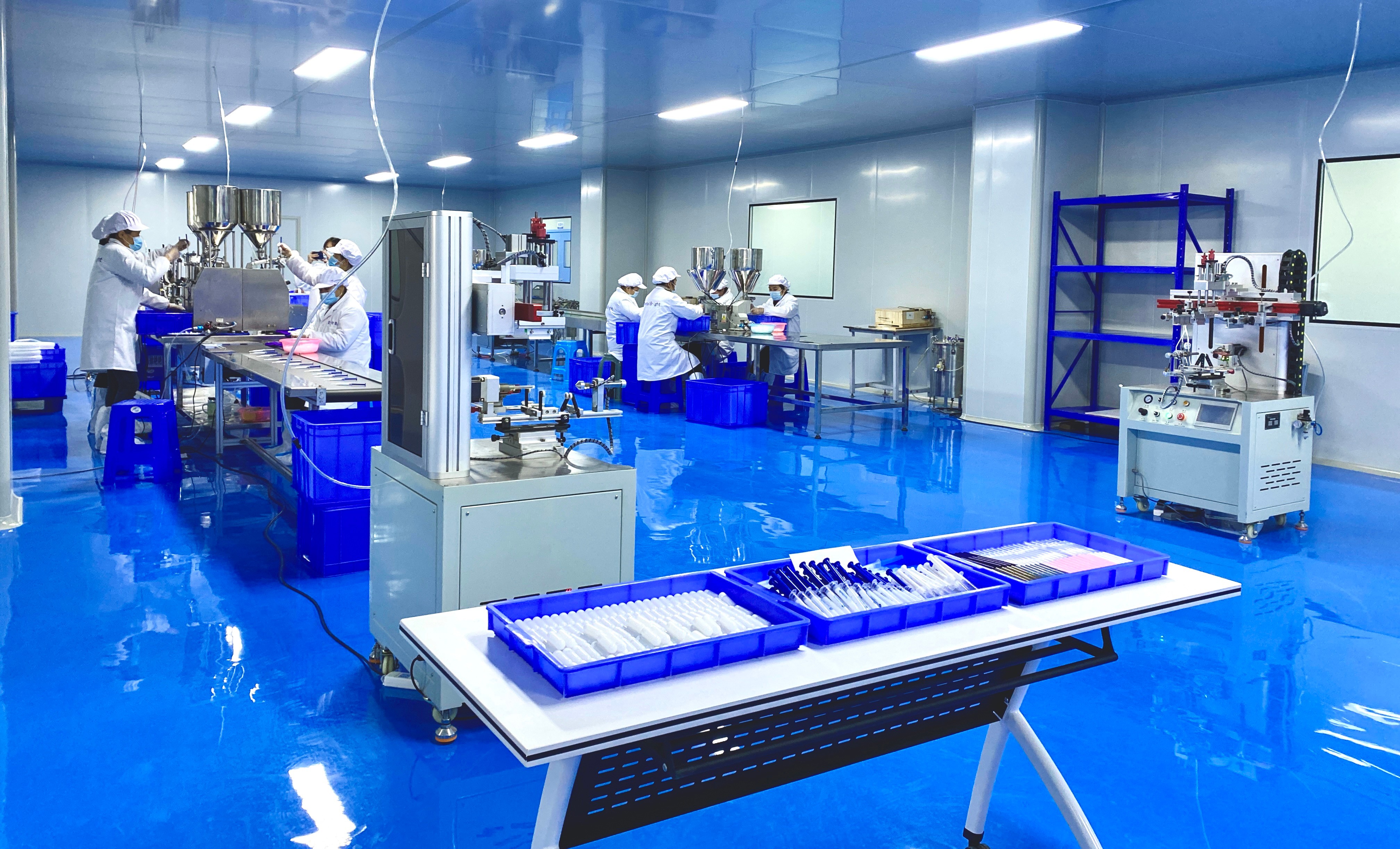
Oral care production floor at GlorySmile Factory, Yongxiu, Jiangxi Province, China.
Five decision layers that sit behind every strip order
Most sourcing problems on whitening strips are specification problems rather than manufacturing problems, and they usually trace back to a layer that was skipped. Professional buyers resolve five layers in sequence.
Format decides how the gel is delivered, how long it stays in contact with enamel, and how the product is packed. Chemistry decides which markets the SKU can legally enter. The sensitivity claim decides what may be printed on the pack. Documentation decides customs clearance and retail onboarding. Order terms decide how much working capital is locked into inventory before the first sale.
Skipping a layer rarely shows up at the factory gate. It shows up later as a relabeling cost, an import query, or a support ticket wave that erodes the margin the SKU was supposed to deliver.
Format first: dry strips, wet strips and dissolving strips
GlorySmile manufactures three whitening strip formats, and the differences are structural rather than cosmetic.
Dry strips (model GS-004H/V/C/P) are built as a three-layer laminate: a PET hard film, the whitening gel layer, and a PE soft film. Each strip bag is an aluminum bag, and standard pack configurations are 7, 14 or 21 strips together with a user manual, a shade guide and a color box. Documented dry-strip subtypes include standard dry strips, alcohol-free dry strips, residue-free dry strips and high-viscosity dry strips. The dry format is the one associated with no-slip dry adhesive technology and a once-per-day routine.
Wet strips are produced under model GS-V34-S07, and dissolving strips under model DB-004L. All three formats draw on the same strip-level ingredient menu — PAP, PAP combined with charcoal, purple colour-correcting systems, 6% HP, sodium phytate, sodium bicarbonate, or a custom blend — and the same flavor library.
| Format | Model | Documented construction and pack | Buyer fit |
|---|---|---|---|
| Dry strips | GS-004H/V/C/P | PET hard film + whitening gel + PE soft film; aluminum bag; 7/14/21 strips with manual, shade guide and color box | Core retail and private-label SKUs; alcohol-free and residue-free sub-options |
| Wet strips | GS-V34-S07 | Wet strip format; aluminum bag; 7/14/21 strips with manual, shade guide and color box | Colour-correction and wet-application positioning |
| Dissolving strips | DB-004L | Dissolving strip format; aluminum bag; 7/14/21 strips with manual, shade guide and color box | No-rinse, travel-oriented convenience SKUs |
The commercial consequence is straightforward. Format determines the adhesive mechanism, the moisture environment inside the sachet, and how the product behaves across a wear time that the manufacturer documents as 10 to 30 minutes per session. Two buyers ordering what looks like the same product can end up with different consumer experiences purely because one specified a residue-free dry strip and the other did not.
Gel chemistry: peroxide gel, carbamide peroxide and PAP
Three whitening chemistries are documented across the GlorySmile range: hydrogen peroxide (HP), carbamide peroxide (CP) and PAP, the peroxide-free option. Strip-level ingredient options extend that list to PAP with charcoal, purple colour correctors, sodium phytate and sodium bicarbonate, and custom blends.
Chemistry is a market-access decision before it is a marketing decision. Under EU Regulation (EC) No. 1223/2009, the concentration of hydrogen peroxide in over-the-counter teeth whitening products is restricted to 0.1% or less. A 6% HP strip configuration is therefore not an OTC specification for EU consumer retail, regardless of how it performs. EU-bound consumer SKUs are instead built around the peroxide-free PAP route or around HP concentrations inside the OTC ceiling.
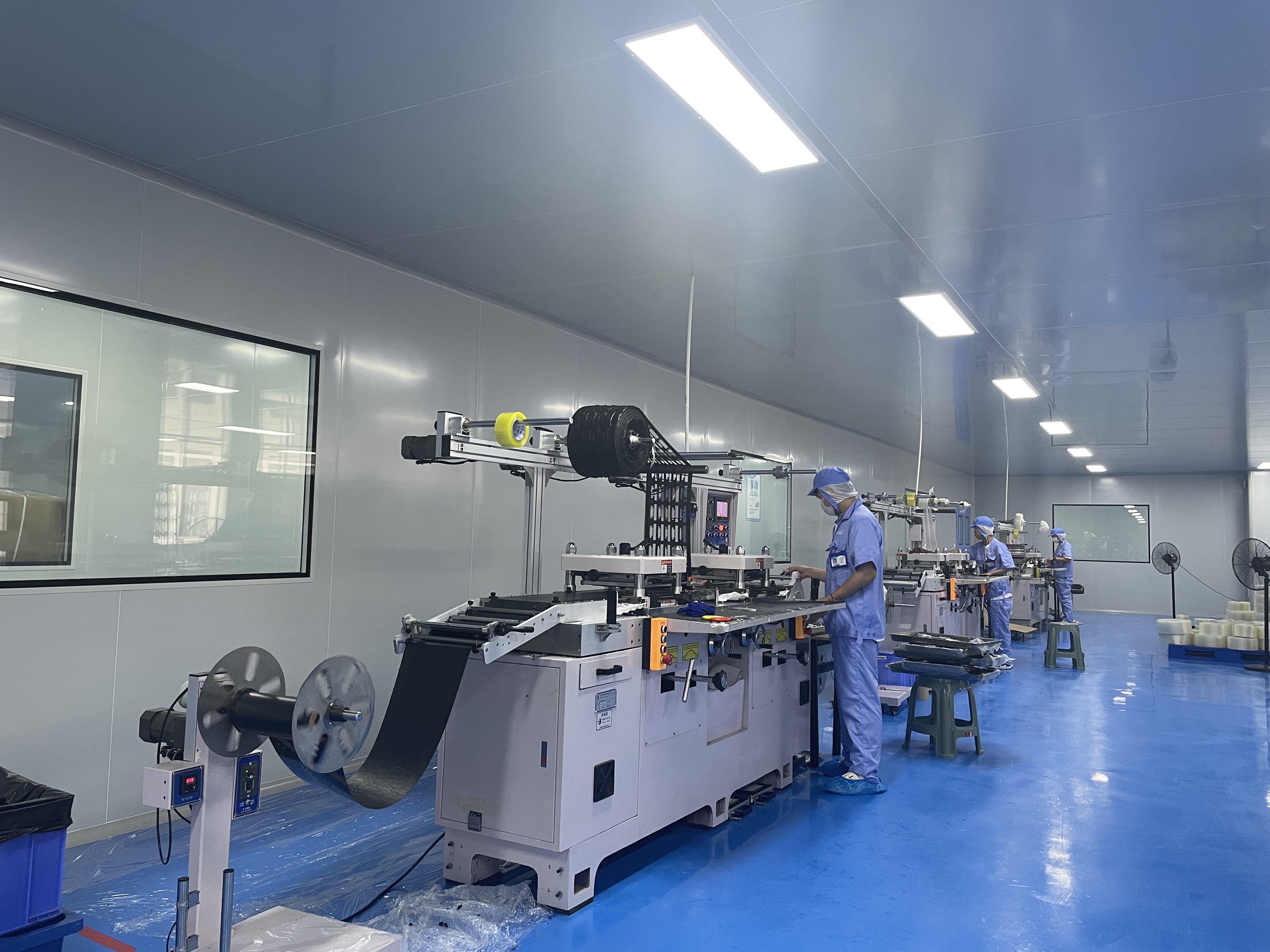
Gel and strip production equipment inside the GlorySmile manufacturing facility.
Higher concentrations remain legitimate, but in a different channel. The documented clinic kit, model GS-001L, is formulated with 35% hydrogen peroxide and supplied with a dual-barrier whitening gel, a gum protector with curved needles, a cheek retractor, brush-ups, vitamin-E swabs, saliva towels, gauze and bibs. That is a professional-use product, not a retail strip, and it is sold into a different regulatory and usage category.
The working rule for buyers: fix the regulatory ceiling of the destination market first, select the chemistry second, and write the pack claim third. Doing it in the reverse order is what produces reformulation costs.
Sensitive teeth: what makes the claim defensible
The documented position on sensitive teeth is direct: PAP and low-sensitivity formulas are offered specifically for sensitive-teeth applications. At scenario level, the recorded requirements for home and travel whitening strip programmes include an enamel-safe formula, a zero-peroxide option, and individually wrapped strips.
Sensitivity positioning, however, is not only about the active ingredient. The treatment protocol carries equal weight. Home whitening scenarios document a once-per-day routine with 10 to 30 minutes of wear time per treatment, and the formulation is labeled strictly for adults and children aged 16 and over, with BPA-free tray materials specified where a tray is used.
That produces a practical validation rule for a brand owner. Match the pack claim to the documented formula and to the documented age guidance, then confirm the sensation profile on production samples before committing to volume. A low-sensitivity formula lowers risk; it does not remove the need for a sample round, and it does not license language that goes beyond what the formula documentation supports.
The documentation stack: what a buyer can actually request
Yes — MSDS is available, and the certificate stack is organized into two groups rather than one long list.
| Category | Documented items |
|---|---|
| Product certificates | GMP, ISO 22716, ISO 13485, MDSAP, BSCI |
| Factory and document certificates | CE, FDA, CPSR, CPNP, PIF, SCPN, MSDS, COA, RoHS, HALAL, Vegan |
On EU market entry, CPSR, CPNP and PIF can be provided for cosmetic products, and CE-MDR registration has been completed for medical devices. On the US side, the products are FDA approved, with an FDA-certified scope covering medical devices, cosmetics and OTC drugs. Buyers shipping cosmetics into the United States should also model the MoCRA 2022 cost structure: facility registration at USD 849 per year and product listing at USD 200 per product. That is a fixed cost per SKU, and it is a reason to launch a tight assortment rather than a broad one.
Customs classification is a separate document question worth settling early. Teeth whitening strips are primarily classified under HS Code 3306.90.00 for preparations for oral or dental hygiene, a classification recorded in US Customs and Border Protection ruling NY N342147.
The manufacturing base behind those documents is specific. The facility covers 36,000 m², including 20,000 m² of 100,000-class cleanrooms, and houses a 1,000-square-meter laboratory with a 100-class cleanroom dedicated to microbiological testing. The company employs 256 people, among them 17 R&D engineers and 11 QC specialists, and holds both medical device and cosmetics production licenses. A documented OEM project passed third-party factory audits under BSCI and ISO with a zero return rate in large-batch inspection.
Patents: what design protection adds to a whitening programme
GlorySmile holds EU patent 015062946-0001 and UK patent 6370462, both recorded on the GS-001X whitening kit — a 32-LED light supplied with a charging and sterilization case, a 16-minute timer, a 150 mAh lithium-ion battery and a 3-minute disinfection cycle that auto-starts when the case is closed. Additional design registrations exist elsewhere in the range, including US Patent No. US D1,128,065 S, EU Patent No. 015065790-0001 and UK Patent No. 6377277 on model DB-001M, and EU Patent No. 015075898-0001 on the GS-K9P electric toothbrush, where US and UK patents are recorded as pending.
Read that correctly. These patents protect specific hardware designs, not the strip sachet itself. Their value to a buyer is differentiation and reduced exposure to design copying when a kit anchors the launch. For a strips-only programme, the defensible ground sits in formulation, packaging design and brand assets rather than in a design patent — a distinction worth understanding before a buyer assumes patent coverage extends across an entire catalogue.
MOQ, customization and packaging terms
For private label orders the documented minimum order quantity is 200 pieces; for regular product orders the minimum is 1 piece. Supported customization includes custom packaging, custom gel ingredient, and custom pen or light color.
Across the wider product range, minimums are set per item rather than as one blanket figure. Orders using existing packaging can start from small box quantities, while customized OEM packaging typically falls between 100 and 1,000 boxes depending on the product. Buyers comparing quotations should therefore confirm which packaging route the quoted minimum belongs to — the gap between an existing-packaging trial run and a fully customized run is substantial.

Warehouse staging area supporting OEM and private-label oral care orders.
At strip level the customizable variables are concrete: pack count of 7, 14 or 21 strips; 13 documented flavor options including Blue Raspberry, Strawberry, Peach, Grape, Watermelon, Peppermint, Orange, Mint, Pineapple, Cherry Blossom, Coconut and Mango; formula selection; and the contents of the color box, which in standard configuration carries a user manual and a shade guide. Free sampling and package design support form part of the OEM/ODM service.
For a first order, the sequence that reduces risk is sample, then a small private-label run to validate the pack and the claim, then a volume commitment. The capacity to support that sequence is documented: annual output includes 300,000,000 pieces of teeth whitening strips and 10,000,000 sets of teeth whitening kits, and products are exported to 102 countries.
Application fit: which strip SKU suits which buyer
The documented function of these strips is removal of exogenous stains from coffee, tea and tobacco, with whitening recorded at 5 to 8 shades in home-use scenarios and anti-sensitivity protection as a stated requirement. Mapping that to assortment decisions produces recognizable SKU types.
A daily-use, low-sensitivity SKU pairs a PAP or low-sensitivity formula with a 14-strip pack for repeat purchase. A travel or trial SKU uses a 7-strip pack with individual wrapping. A flavor-led SKU leans on the 13-flavor library, with fresh mint and peppermint remaining the reference points for oral care shelves. A stain-focused SKU speaks directly to coffee and tobacco users, since that is the documented stain scope. A yellow-tone correction SKU uses the purple colour-corrector systems, where a water-soluble purple dye cancels yellow undertones on the colour wheel.
Market direction: why formulation and paperwork now lead the purchase
Three shifts are visible in the current reference data. First, the strip and gel category is a sizeable standalone segment — valued at USD 1.1 billion in 2025 — large enough to justify dedicated SKU planning rather than a single catalogue item. Second, compliance costs are now part of the unit economics: MoCRA 2022 adds USD 849 per year in facility registration and USD 200 per listed product in the United States, which rewards narrow, well-validated assortments. Third, the 0.1% hydrogen peroxide ceiling in the EU has made formulation selection a market-access variable, which is why peroxide-free PAP configurations appear as a standard line item rather than a niche alternative.
One honest gap is worth flagging to buyers. Public data does not isolate growth rates for peroxide-free versus peroxide-based strip segments in official trade statistics, so category projections cannot be reliably segmented by chemistry. Buyers planning a PAP-led or sensitivity-led line are better served by their own sell-through data and sample validation than by a segment growth figure that does not yet exist in the public record.
Where strips are not the right answer
Whitening strips are a strong format, but the boundaries are documented and buyers should respect them. The products are labeled for adults and children aged 16 and over, so they are not a pediatric line. Treatment requires 10 to 30 minutes per session on a once-per-day routine, which makes adherence a genuine variable in repeat purchase. The documented stain scope is exogenous stains from coffee, tea and tobacco; claims should stay inside that scope rather than stretching toward discoloration types the format was not specified for.
Within the manufacturer range, high-concentration professional whitening sits in a separate category: the 35% hydrogen peroxide clinic kit requires gum protection and professional accessories and cannot be repositioned as retail OTC supply. Design patents cover named models rather than the strip category as a whole. And low-sensitivity formulation reduces risk without eliminating it for every user — which is precisely why sample validation ahead of a volume order remains the least expensive risk control available to a buyer.
Outlook
Procurement of whitening strips is becoming documentation-led. Buyers increasingly shortlist suppliers by evidence — certificate scope, laboratory capability, audit history — before discussing price, because the paperwork determines whether a SKU can actually be sold in the target market. Customization is the second axis: custom gel ingredient, custom packaging and custom pen or light color are how a private label programme differentiates on shelf rather than on price alone. Third, low-MOQ trial structures are likely to remain the default entry point, since they let brands validate a sensitivity claim or a flavor variant with limited inventory exposure before committing to volume.
Frequently asked questions
What is the minimum order quantity for private label teeth whitening strips?
The documented minimum order quantity is 200 pieces for private label and 1 piece for regular product. Across the wider range, customized OEM packaging typically falls between 100 and 1,000 boxes depending on the item, while orders in existing packaging can start from small box quantities. Custom packaging, custom gel ingredient and custom pen or light color are supported.
Can you provide an MSDS?
Yes, MSDS is available. MSDS also appears in the documented factory and document certificate set, alongside COA, RoHS, CE, FDA, CPSR, CPNP, PIF and SCPN.
Is the product FDA approved?
Yes, the products are FDA approved, and the FDA-certified scope covers medical devices, cosmetics and OTC drugs. For cosmetics placed on the US market, MoCRA 2022 also requires facility registration at USD 849 per year and product listing at USD 200 per product.
Is it compliant for the EU market?
Yes. CPSR, CPNP and PIF can be provided for cosmetic products, and CE-MDR registration has been completed for medical devices. Separately, EU Regulation (EC) No. 1223/2009 restricts hydrogen peroxide in over-the-counter teeth whitening products to 0.1% or less, which is why peroxide-free PAP configurations are commonly specified for EU retail.
Is the product safe for sensitive teeth?
PAP and low-sensitivity formulas designed for sensitive teeth are available. Scenario requirements recorded for these products also include an enamel-safe formula, a zero-peroxide option and individually wrapped strips. The formulation is labeled for adults and children aged 16 and over.
What certifications do you have?
Product certificates include GMP, ISO 22716, ISO 13485, MDSAP and BSCI. Factory and document certificates include CE, FDA, CPSR, CPNP, PIF, SCPN, MSDS, COA, RoHS, HALAL and Vegan. The facility holds both medical device and cosmetics production licenses, and operates 36,000 m² of manufacturing space including 20,000 m² of 100,000-class cleanrooms.
What is the whitening formula?
PAP (peroxide-free), Carbamide Peroxide (CP) and Hydrogen Peroxide (HP) formulas are available. At strip level, ingredient options also include PAP combined with charcoal, purple colour-correcting systems, sodium phytate and sodium bicarbonate, or a custom blend.
The full OEM/ODM catalogue, including product configurations and customization scope, is available here: GlorySmile product catalogue (PDF).
Tem questões ou precisa de mais detalhes?
Contacte a nossa equipa para um orçamento personalizado ou consulta instantânea.
Solicitar orçamento
Preencha o formulário abaixo e a nossa equipa entrará em contacto com uma proposta personalizada.
Chat direto do WhatsApp
Prefere conversar em tempo real? Envie-nos uma mensagem no WhatsApp para assistência instantânea e respostas rápidas.
- Obter orçamento personalizado
- Partilhar fotos ou documentos
- Discuta as suas necessidades diretamente
Geralmente responde em 5–30 minutos durante o horário de expediente.