
Telpo C9 vs Sunmi D3 PRO and Swan-2: Buyer Comparison
Independent Buyer Comparison
Telpo C9 vs Sunmi D3 PRO and Swan-2: Buyer Comparison
A consumer electronics checkout counter is no longer a cash drawer with a screen. The same countertop device has to run payment, serial-number and IMEI lookup, warranty registration, trade-in valuation, loyalty, and increasingly on-device visual recognition, often with several of those workloads resident at once. That is why processor cores, on-chip AI capability and memory/storage configuration have moved from data-sheet footnotes into procurement criteria. This comparison places the Telpo C9 platform from Telpo Technology Co., Ltd., a POS and AIoT terminal manufacturer founded in 1999 and headquartered in Foshan, China, against the Sunmi D3 PRO and the Swan-2 for that specific buying decision.

Consumer electronics counters increasingly run payment, inventory and recognition workloads on the same Android terminal.
Why Consumer Electronics Retail Pushes the Hardware Ceiling
Grocery retail is throughput-driven: scan, pay, print, repeat. Consumer electronics retail is data-driven. Every unit carries a serial number or IMEI, a warranty term, a bundle of accessories, and often a trade-in condition grade that has to be captured at the point of sale. Staff move between a payment application, an inventory or ERP client, a warranty portal, a loyalty screen and a valuation tool within a single customer interaction. Peak-hour lanes need those applications to resume instantly rather than reload.
That workload splits into three classes, and each one stresses different hardware:
- Transaction and receipt workflows — payment authorisation, receipt or invoice generation, and in regulated markets fiscal or tax-control handling.
- Lookup and sync workflows — inventory, order status, loyalty balance and warranty checks against a local catalog or a cloud service.
- Recognition workflows — barcode and QR capture, and increasingly item, document or condition recognition where no barcode exists, for example accessory matching or trade-in assessment.
The first two classes are CPU- and memory-bound. The third is where on-chip AI begins to change what a counter can do, because camera frames have to be processed locally to keep the customer interaction moving: Telpo's documented AI vision checkout deployment specifies 0.1-second item recognition at 99.8% accuracy with up to 12 TOPS of on-device processing. At the same time, dual-screen terminals have become the default in electronics retail, because the customer-facing screen has to display price, trade-in value and promotions while the operator keeps working on the main display.
The Three Terminals at a Glance
The table below restricts itself to specifications that are documented for each device. Where a figure was not part of the specification set reviewed for this comparison, the cell says so rather than guessing.
| Specification | Telpo C9 | Sunmi D3 PRO | Swan-2 |
|---|---|---|---|
| Processor | Octa-core (8-core) 2.2 GHz, Android 14 platform | 6-core | Not disclosed in the specification set reviewed |
| On-chip AI | Yes — 6–12 TOPS class; up to 12 TOPS of on-device processing documented in Telpo's AI vision checkout scenario | No on-chip AI | Not disclosed in the specification set reviewed |
| RAM + storage options | 4 GB + 64 GB or 8 GB + 128 GB (up to 8 GB RAM / 128 GB ROM) | Not disclosed in the specification set reviewed | 2 GB + 16 GB or 4 GB + 64 GB |
| Display | 15.6-inch industrial-grade, 350-nit, 5 mm narrow bezel, 80% screen-to-body; dual-screen 15.6"+10.1" or 15.6"+15.6" | Not disclosed in the specification set reviewed | Not disclosed in the specification set reviewed |
| Payment interface | Under-display NFC (SoftPOS-compatible); Pogo Pin modular card-reader expansion; fingerprint authentication for device wake and staff login | Not disclosed in the specification set reviewed | Not disclosed in the specification set reviewed |
| Deployment mode | Fixed countertop, long-term powered | Not disclosed in the specification set reviewed | Not disclosed in the specification set reviewed |
| Documented variants | C9PD (built-in 80 mm thermal printer, 250 mm/s, auto-cutter); C9W (Windows, Intel i3 standard / i5 optional, 6 USB ports); C9 VESA (100×100 mm wall/arm mount, 8 MP camera) | Not part of the specification set reviewed | Not part of the specification set reviewed |
Processor and On-Chip AI: What Eight Cores and 6–12 TOPS Change
Core count is not a quality ranking; it is a scheduling budget. A six-core terminal is entirely adequate for a single payment application with a scanner module. The difference appears when several workloads run at once: a payment app holding a session open, an inventory client syncing in the background, a camera pipeline capturing frames, a receipt spool writing to storage, and a loyalty lookup returning from the network. An octa-core platform such as the C9 spreads that load across more threads, which is why the configuration is usually specified for counters where app switching is constant rather than occasional.
On-chip AI is the more consequential difference, because it is architectural rather than incremental. A terminal with on-chip AI can execute compact inference models locally, on the device. A terminal without it has three alternatives for a recognition task: the task does not run at the counter, it runs on an external edge box or PC, or it runs in the cloud.
Each of those alternatives has a practical cost. Cloud inference turns every recognition event into a network round trip, so the interaction is only as fast as the weakest link between the store and the service endpoint, and the workflow stops entirely when connectivity drops. Per-call inference fees also accumulate per lane, per store, per day, which is a recurring operating cost rather than a one-time hardware cost. A dedicated edge box solves latency but adds hardware, power, mounting, cabling and a second support contract to the lane. On-device processing keeps the recognition loop inside the terminal.
The boundary buyers should understand
A 6–12 TOPS class device hosts compact vision models — item recognition, document or label reading, condition scoring — at interactive speed. It is not a data-centre accelerator and it will not run large multimodal models at a usable frame rate. Two further conditions apply before any on-chip AI claim becomes real in a store: the terminal must be ordered with the matched camera module and software as part of the configuration, and the retailer's model set has to be trained and validated for its own product catalogue. The hardware capability is a prerequisite, not the finished workflow.
Memory and Storage: The Real Ceiling on Multi-App Retail Workloads
On an Android terminal, RAM determines how many applications stay resident without being killed and reloaded, while storage holds application data, the offline product catalogue, the receipt spool, log buffers and any local image or model files. The gap between configuration tiers is therefore a gap in workflow capability, not a cosmetic difference.
- 2 GB + 16 GB — single-purpose payment territory. A payment application plus its modules, minimal local caching, little room for analytics or local model storage.
- 4 GB + 64 GB — a realistic pairing of a POS application with a scanner module, loyalty and a moderate local catalogue. Adding a third heavy application usually requires memory discipline.
- 8 GB + 128 GB — several resident applications, a larger offline catalogue, local image sets for recognition tasks, and longer offline queues before a sync is required.
Read against that scale, the Swan-2's 2 GB + 16 GB configuration fits a single-task payment counter, while its 4 GB + 64 GB option covers a POS-plus-inventory pairing. The C9's ceiling of 8 GB + 128 GB is where consumer electronics workflows — trade-in valuation, warranty lookup, loyalty and a recognition module running alongside the payment app — begin to need headroom. The correct choice is the smallest configuration that survives a three-year workload forecast, not the largest number on the sheet; over-specifying wastes budget, under-specifying converts hardware savings into support tickets.
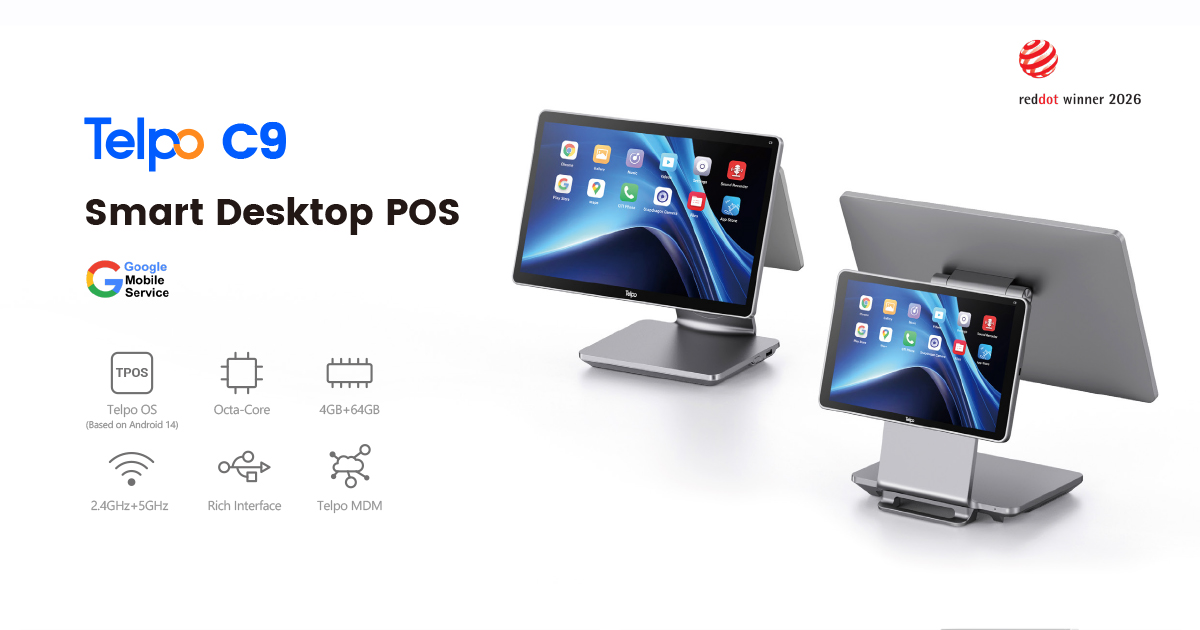
The Telpo C9: 15.6-inch industrial-grade display, under-display NFC and configurable dual-screen layouts.
What the C9 Adds Beyond the Core Count
The C9 is an Android cash register POS classified as a touch screen POS machine, running Android 14 on an octa-core 2.2 GHz processor with up to 8 GB RAM and 128 GB ROM. Its 15.6-inch industrial-grade display uses a 5 mm narrow bezel with an 80% screen-to-body ratio and 350-nit brightness, and the chassis combines ABS with metal ADC12 under a metal-painted finish. Flexible dual-screen configurations are available — 15.6-inch single screen, 15.6"+10.1", or 15.6"+15.6" — alongside fingerprint authentication for device wake and employee login, under-display NFC that is SoftPOS-compatible, Pogo Pin modular expansion for plug-and-play card readers, and logo customisation. It is intended for retail, hospitality, restaurants and boutiques.
Three sibling configurations extend the same platform, and the choice between them is usually a deployment question rather than a specification question:
- C9PD — adds a built-in 80 mm Seiko thermal printer running at 250 mm/s with auto-cutter, removing the external printer from lanes that print at the counter.
- C9W — the Windows path, with a configurable Intel processor (i3 standard, i5 optional, up to 10 cores with 4.6 GHz Turbo), a 15.6-inch 1920×1080 touchscreen and six USB ports for peripheral breadth. This is the migration route for retailers whose POS software stack is Windows-native.
- C9 VESA — a wall- or arm-mounted variant using the 100×100 mm VESA standard, adding a magnetic stripe reader and a built-in 8 MP under-display camera, for narrow counters or kitchen-display style installations.
Behind the product line, Telpo Technology Co., Ltd. employs approximately 600 staff, including an R&D team of 200 engineers, and operates a manufacturing facility of approximately 45,000 square metres with an annual production capacity of 2,000,000 units. The company focuses on four core overseas business segments — Smart Retail, Smart Payment, Smart Transportation and Biometric Security — with export business accounting for 60% to 80% of total sales across Asia, Africa, the Middle East, Europe, Latin America and North America. Its main product range covers EFTPOS, Android POS terminals, desktop POS, dual-screen cash registers, self-service kiosks, biometric payment terminals, ticket validation machines, fiscal POS, AI checkout POS and PDAs. Third-party reporting also records the C9 among the terminals recognised with a Red Dot Award in 2026.
Where Each Configuration Fits in a Consumer Electronics Store
Matching the terminal to the lane matters more than the headline specification. Four deployment patterns recur in electronics retail:
- Specialty phone and accessory counters. A 15.6"+10.1" dual-screen C9 lets the customer-facing display carry trade-in valuation, bundle pricing or loyalty balance while the operator works on the main screen. Staff login and device wake by fingerprint keeps the counter moving during shift changes.
- High-volume electronics lanes with receipt output. The C9PD variant integrates the 80 mm printer at 250 mm/s with auto-cutter, which removes a separate device, its power supply and its driver from the lane.
- Narrow counters and back-of-store screens. The C9 VESA variant mounts on standard brackets and adds an 8 MP camera for verification or monitoring tasks.
- Retailers with an existing Windows POS stack. The C9W keeps the software estate intact while moving the hardware to a slim dual-screen counter terminal.
Where recognition is part of the workflow, the C9 family is listed among the supported platforms in Telpo's AI vision self-checkout scenario, which pairs on-device processing with an AI vision camera and optional electronic scale, receipt printer, NFC reader and QR scanner modules. The Australian-style caveat here is that the configuration, not the model name, determines whether a given lane can actually run recognition locally.
Equally important is knowing what the C9 is not. It is a fixed countertop terminal with a long-term power supply. Table-side payment, poolside service, delivery collection and in-aisle line-busting are handheld workloads; those sit with devices such as the P9 series, which provides a 6.5-inch HD display, 12–16 hours of standard battery operation, built-in GPS, eSIM multi-network support and an optional barcode scanner module, or the 389 g P8 M5 with 1.5 m drop and splash protection.
Market Trend: Why This Comparison Is Being Made Now
Third-party valuations of the global POS terminal market diverge widely depending on whether software and services are counted. TechSci Research put the 2024 market at USD 92.10 billion, DataM Intelligence estimated USD 93.16 billion for 2025, TAdviser (citing Grand View Research) reported USD 113.38 billion for 2024, and Grand View Research itself placed the 2025 market at USD 123.2 billion. That spread is itself a useful signal: the terminal layer is being revalued upward as it absorbs software, AI and service functions that used to sit in separate boxes.
Three structural shifts support the direction of the comparison:
- Android is now a mainstream POS platform. Android POS terminals accounted for approximately 27% of all POS terminals sold globally in 2022/2024 tracking reported by ResearchAndMarkets and Berg Insight.
- Software-only acceptance is growing quickly. The SoftPOS market was estimated at USD 365.0 million in 2024 with a projected CAGR of 23.1% through 2030, according to Grand View Research. A separate estimate places the same market at USD 5.6 billion, a divergence explained by transaction-value versus software-revenue definitions. Either way, the direction is upward — and SoftPOS compatibility on the main terminal is what allows a retailer to accept tap payments without a separate acceptance device.
- Self-service and AI checkout are becoming standard retail infrastructure. The retail self-service kiosk market is forecast to reach USD 37.8 billion by 2030, with Telpo Technology identified as a leading corporation in the sector by The Business Research Company. Handheld POS, meanwhile, is projected to grow from USD 33.15 billion in 2025 to USD 89.52 billion by 2035.
Compliance remains the baseline of any of these deployments: POS terminals must comply with PCI PTS (PIN Transaction Security) and EMV standards for secure chip processing, as defined by the PCI Security Standards Council.
Compared with Traditional Checkout Setups — and the Limits of the C9
The traditional counter it replaces is familiar: a Windows PC, a separate PIN pad, an external monitor, an external receipt printer, and cloud-only processing for anything that needs recognition. Integration changes the economics rather than the function. One device carries the display, the payment interface, the biometric login and, in the C9PD variant, the printer. That removes boxes, cabling, power sockets and — for chains — duplicate support contracts, because there is a single operating system to patch and a single fleet to manage.
Honest evaluation also requires the boundaries, and there are several:
- It is a fixed terminal, not a mobile one. The C9 is deployed on a countertop with long-term power. Any workflow that requires walking the floor needs a handheld device from the same portfolio instead.
- On-chip AI has a workload ceiling. The 6–12 TOPS class suits compact vision inference, not heavy multimodal models, and the capability only exists when the matched camera module and trained model set are part of the order.
- Android exclusivity is a software decision. A retailer running Windows-native POS software cannot simply swap in a C9; the C9W path applies, and it does not carry the same Android and on-device AI characteristics.
- Pricing is configuration-dependent. Memory and storage tier, display combination, integrated printer, card-reader module and branding requirements all change the bill of materials, so there is no single list figure that applies across buyers.
- Physical footprint needs planning. A 15.6-inch dual-screen terminal requires counter depth, cable routing and clearance that a compact 8-inch or 10-inch terminal does not.
- Regulated markets need model-level verification. Where fiscal or tax-control invoicing applies, buyers must confirm which model and module combination is validated for their jurisdiction. Telpo's documented fiscal hardware — dedicated UART/USB ports for fiscal modules, tamper-evident lead-sealed screws, electronic tamper logging, an external RTC circuit and a backup battery — appears on its fiscal-capable lines such as the M8, M10 and TPS900, so a C9 deployment in a fiscal market requires a specific compatibility check rather than an assumption.
Future Outlook
The direction of procurement is fairly clear. As Android POS share grows and software-only acceptance expands, terminal selection will be judged less on enclosure and connector count and more on whether the device can host the software the retailer intends to deploy over the next three years. On-device inference is the clearest example: the difference between a terminal that can recognise an item locally and one that must call a cloud service is a difference in latency, connectivity dependency and recurring inference cost — three line items that rarely appear on a hardware quote but show up in operations.
The practical consequence for buyers is procedural. Add an explicit on-device AI line to the RFQ next to processor, RAM and storage, state which recognition tasks must run locally, and state the app count that must stay resident during peak hours. That single change converts a specification comparison into a workload comparison, which is the version of the question that survives contact with a live store.
FAQ
1. What exactly is the Telpo C9?
The C9 is an Android cash register POS classified as a touch screen POS machine, built on Android 14 with an octa-core 2.2 GHz processor, up to 8 GB RAM and 128 GB ROM, a 15.6-inch industrial-grade display at 350-nit brightness, fingerprint authentication, under-display NFC that is compatible with SoftPOS, and Pogo Pin modular card-reader expansion. It is intended for retail, hospitality, restaurants and boutiques, and is offered in dual-screen configurations of 15.6-inch single screen, 15.6"+10.1", or 15.6"+15.6".
2. How does an eight-core POS processor differ from a six-core one in daily retail use?
Core count represents a scheduling budget rather than a quality grade. A six-core terminal handles a single payment application well. An eight-core platform such as the C9 spreads concurrent workloads — a live payment session, background inventory sync, a camera pipeline, receipt spooling and a loyalty lookup — across more threads, which matters where staff switch between applications continuously rather than occasionally.
3. What can a 6–12 TOPS on-chip AI actually do at a checkout counter?
It can host compact local inference models, such as item recognition, label or document reading and condition scoring, at interactive speed; Telpo's documented AI vision checkout deployment specifies 0.1-second item recognition at 99.8% accuracy with up to 12 TOPS of on-device processing. It will not run large multimodal models at a usable frame rate. The capability also requires the matched camera module and a model set trained for the retailer's own catalogue.
4. Do the memory and storage tiers change which applications a retailer can run?
Yes. On Android, RAM determines how many apps stay resident and storage holds the local catalogue, receipt spool, logs and model files. A 2 GB + 16 GB configuration suits a single-purpose payment terminal; 4 GB + 64 GB supports a POS app paired with a scanner module, loyalty and a moderate catalogue; 8 GB + 128 GB supports several resident applications, a larger offline catalogue and local image sets. The correct tier is the smallest one that survives a three-year workload forecast.
5. Can on-device AI reduce cloud latency and cloud service fees?
Processing recognition on the terminal removes the network round trip from the interaction and stops the recognition workflow from depending on store connectivity. It also removes per-call inference fees that would otherwise recur per lane, per store, per day. The trade-off is that model selection, training and validation move onto the retailer or its integrator, and the model must fit the terminal's TOPS class.
6. Is the C9 the right terminal for table-side or mobile payment?
No. The C9 is a fixed countertop terminal with long-term power, so it is not suited to table-side service, poolside payment, delivery collection or in-aisle line-busting. Those workloads belong to handheld devices in the same portfolio, such as the P9 series with a 6.5-inch HD display, 12–16 hours of standard battery operation, built-in GPS and eSIM support, or the 389 g P8 M5 with 1.5 m drop and splash protection.
7. How is pricing determined for a terminal like the C9?
Pricing depends on configuration and volume. The variables that change the bill of materials include the memory and storage tier (4 GB + 64 GB or 8 GB + 128 GB), the display combination (15.6-inch single, 15.6"+10.1", or 15.6"+15.6"), whether the integrated 80 mm printer of the C9PD variant is included, the card-reader module selection, and any branding or ODM requirements. Current pricing is therefore quoted per configuration.
8. What should buyers verify before committing to this class of terminal?
Four items: the certification status of the specific model and market (PCI PTS and EMV compliance are the baseline for secure chip processing, as defined by the PCI Security Standards Council); fiscal or tax-control module compatibility where regulated invoicing applies; the resident application count and catalogue size that the memory tier must support; and whether any recognition task is required to run locally, which determines whether an on-chip AI configuration is necessary at all.
Further Technical Detail
Configuration tables, port layouts and peripheral options for the C9 family and the wider terminal range are consolidated in the manufacturer's product brochure: Telpo Products Brochure — Payment & Retail (PDF).