
Telpo C9 vs Sunmi D3 PRO and Swan-2: Independent Review
Retail and self-service POS terminal buyers are no longer comparing only screen size, printer speed, or enclosure. In 2026, the decision increasingly turns on how much compute and AI work the terminal can handle locally. Those capabilities determine how many applications can run at the counter, whether visual AI can operate without sending every frame to the cloud, and how much latency the checkout workflow can absorb.
This independent buyer review compares the Telpo C9 with the Sunmi D3 PRO and the Swan-2 using the facts available in the reviewed materials. It is not a full datasheet, and it does not publish a price verdict, because pricing is configuration-dependent. The aim is narrower: explain what the published capability differences mean for retail POS, self-service POS, and AI-assisted checkout deployments.
What This Review Covers
Telpo Technology Co., Ltd. is a Foshan-based manufacturer of smart terminals founded in 1999. Its portfolio includes Android POS terminals, desktop POS, dual-screen cash registers, self-service kiosks, biometric payment terminals, ticket validators, fiscal POS, and AI checkout POS. The C9 sits within that broader portfolio as an AI-capable POS terminal, while the Sunmi D3 PRO and Swan-2 are comparison devices in the same retail and self-service buying conversation.
The comparison focuses on four capability questions that matter at evaluation and execution stage:
- Processor headroom: eight cores in the C9 versus six cores in the D3 PRO, a 33% difference in core count.
- On-device AI: 6–12 TOPS on-chip AI in the C9 versus no on-chip AI in the D3 PRO, according to the reviewed materials.
- Local visual AI workloads: loss prevention, customer analytics, and smart checkout.
- Memory and storage: C9 options of 4+64 GB or 8+128 GB versus Swan-2 options of 2+16 GB or 4+64 GB.
The review also separates capability from procurement. A terminal with more compute is not automatically the better purchase. The right choice depends on the application stack, the use of local AI models, the store format, the network profile, the service model, and the total cost of the exact configuration.
Why POS Terminal Capability Matters More in 2026
The centre of gravity in POS terminal selection has moved toward software-defined capability. Counterpoint Research reports that Android-based POS terminals reached approximately 48% of global shipments in 2025. That matters because Android POS terminals are general-purpose computing devices. Buyers increasingly assess them in the same way they assess other edge devices: by processor, memory, storage, connectivity, operating system support, and the ability to run multiple applications.
Counterpoint Research also reports that the average selling price of commercial-grade smart POS hardware ranged from $120 to $850 in 2025. A price band that wide is not primarily a hardware-quality signal. It reflects configuration, form factor, payment certification, ruggedisation, software, and service. For that reason, a comparison that looks only at a headline price can mislead. Buyers need to compare the bill of materials and the workload the terminal is expected to run.
The retail and self-service context adds a second shift. Terminals are no longer only payment endpoints. They may host a cash register POS application, a retail POS terminal workflow, a restaurant POS terminal menu, a self-service POS terminal interface, or a smart checkout screen. In some deployments, they also host local AI models for visual tasks. That is where processor cores, on-chip AI, memory, and storage start to influence the buying decision rather than remain datasheet details.
The Processor Gap: 8 Cores vs 6 Cores
The Telpo C9 uses an 8-core processor. The Sunmi D3 PRO uses a 6-core processor. Eight versus six is 33% more cores. That is a factual difference, but it should be interpreted carefully. Core count is a measure of potential parallel processing capacity, not a guaranteed application-speed result. The actual experience depends on core architecture, clock behaviour, thermal design, memory bandwidth, storage speed, and software scheduling.
For a retail POS terminal, additional cores can be useful when several workloads run at the same time: the cash register POS application, a payment service, a receipt printer service, background inventory synchronisation, device management, and a local AI inference process. In a simple countertop POS deployment, the same terminal may spend most of its time waiting for operator input, payment authorisation, or network responses. In that case, the extra cores may have little visible effect.
For a self-service POS terminal, the workload profile is different. The device may need to run a customer-facing interface, a payment flow, a receipt or ticket printer, a scanner service, remote monitoring, and a local vision model. The 33% core advantage in the C9 is therefore most relevant when the deployment is multi-application or AI-assisted. It is less relevant when the device is a single-purpose payment terminal with a stable, narrow task set.
Buyer interpretation: The 8-core versus 6-core difference is a headroom signal, not a benchmark. Buyers should test the actual application stack on both devices, including startup time, app switching, payment flow, printing, and any background sync.
On-Device AI: What 6–12 TOPS Changes
The C9 is specified with 6–12 TOPS on-chip AI. The D3 PRO is specified without on-chip AI in the reviewed materials. TOPS is a measure of peak AI throughput, and the 6–12 TOPS range indicates that the exact capability depends on configuration. It is not an application-level accuracy score, and it does not by itself guarantee that a particular vision model will run at a particular frame rate.
What on-chip AI changes is where inference happens. A terminal with local AI capability can process visual data on the device instead of sending every frame to a cloud service and waiting for a result. In retail and self-service POS deployments, that architectural difference matters for three workloads named in the reviewed materials: loss prevention, customer analytics, and smart checkout.
Loss prevention
Local visual AI can support loss-prevention workflows at the point of sale. A terminal or connected camera system can analyse events near the checkout area without streaming all video to a remote server. That can reduce network load and keep the inference close to the event. It does not remove the need for a proper loss-prevention design, camera placement, model validation, or privacy review. It changes the processing location, not the governance requirement.
Customer analytics
On-device AI can support customer analytics such as queue observation, dwell-time analysis, or in-store flow measurement, depending on the model and sensors used. Running those models locally can reduce the amount of raw video that leaves the store. For buyers, the relevant questions are what data is processed, what is retained, what is transmitted, and how the deployment complies with local privacy rules. A terminal with local AI capability makes those questions more important, not less.
Smart checkout
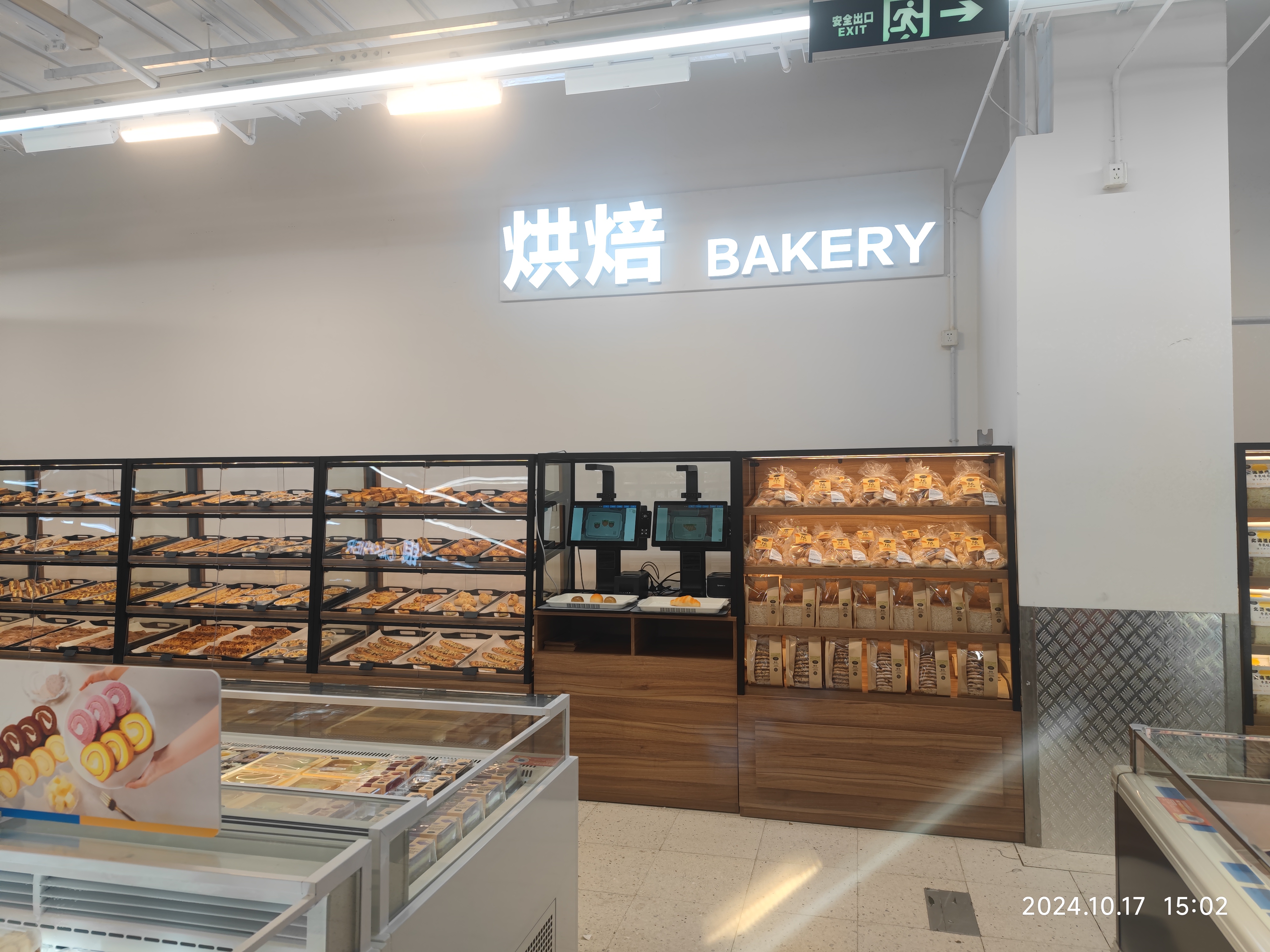
Smart checkout is the most direct retail use case. Visual product recognition, checkout assistance, and exception handling can benefit from local inference because the result is needed while the customer is standing at the terminal. The reviewed materials position the C9's on-chip AI for smart checkout workloads. Telpo's public case material also describes an AI checkout deployment using the C50 cash register in a supermarket bakery section, with visual product recognition and self-checkout. That case is not a C9 benchmark, but it shows the supplier has field experience with visual AI checkout workflows.
The limitation is equally important. Local AI performance depends on model optimisation, camera quality, lighting, product similarity, and the size of the model that must be cached on the device. A higher TOPS figure does not compensate for a poorly validated model. Buyers should require a pilot with representative products, lighting, and customer behaviour before committing to a chain-wide rollout.
Latency: 50–200 ms Saved vs Cloud Processing
The reviewed materials state that the C9's local processing can save 50–200 ms compared with cloud processing. That figure should be read as a latency saving, not as the total checkout time. A payment transaction still depends on the payment host, network conditions, acquirer response, and application design. A product-recognition result still depends on the model and camera pipeline.
Even so, 50–200 ms is meaningful in interactive retail workflows. At a self-service POS terminal, a delay of a few hundred milliseconds can change how responsive the interface feels. At a staffed checkout, it can affect how quickly an exception is resolved. The saving is largest when the alternative would require a round trip to a remote inference service over a variable network. It is smallest when the network is fast and the cloud service is close.
Buyers should therefore ask a precise question: which step in the workflow is being measured? If the 50–200 ms saving applies to local visual inference, it may improve the responsiveness of loss prevention, analytics, or product recognition. It does not automatically shorten payment authorisation. A fair evaluation should separate terminal-side inference latency from network and host latency.
Memory and Storage: C9 vs Swan-2
The C9 offers 4+64 GB or 8+128 GB memory and storage configurations. The Swan-2 offers 2+16 GB or 4+64 GB. These are materially different starting points. Memory affects how many applications can remain resident and how much working space is available for the POS application, payment service, device management, and AI runtime. Storage affects the operating system, application installation, logs, media, and any offline AI model cache.
The 4+64 GB C9 configuration is the entry point for the C9 line. It provides more memory and storage than the 2+16 GB Swan-2 configuration, and it matches the upper Swan-2 configuration on paper at 4+64 GB. The 8+128 GB C9 configuration creates more headroom for multi-application use and for keeping local AI models cached on the device. That headroom is useful when the terminal is expected to run visual inference without depending on a continuous cloud connection.
The Swan-2's 2+16 GB configuration should not be dismissed. In a standard retail POS terminal deployment with a single primary application, a payment service, and a stable network, 2+16 GB may be sufficient. The risk appears when the same device is asked to run several background services, retain large logs, or cache AI models. In that case, storage pressure can force model swapping, log rotation, or reduced functionality. The buyer should map the application stack and the data-retention policy before choosing the lower configuration.
Configuration rule: Memory and storage are not abstract specs. They should be sized against the number of concurrent apps, the size of the AI model cache, the log-retention period, and the expected software update strategy.
Comparison Table: Reviewed Facts Only
The table below limits itself to the facts in the reviewed materials. It is not a complete product datasheet. Cells marked as not specified should be confirmed directly with the supplier before a procurement decision.
| Comparison point | Telpo C9 | Sunmi D3 PRO | Swan-2 |
|---|---|---|---|
| Processor | 8-core | 6-core | Not specified in reviewed materials |
| Core-count difference | 33% more cores than the D3 PRO | 6-core baseline | Not specified in reviewed materials |
| On-chip AI | 6–12 TOPS | No on-chip AI | Not specified in reviewed materials |
| Memory and storage options | 4+64 GB or 8+128 GB | Not specified in reviewed materials | 2+16 GB or 4+64 GB |
| Local visual AI use cases | Loss prevention, customer analytics, smart checkout | Not specified in reviewed materials | Not specified in reviewed materials |
| Latency versus cloud processing | 50–200 ms saved in local processing | Not specified in reviewed materials | Not specified in reviewed materials |
| Pricing | Configuration-dependent; no cost difference published | Configuration-dependent; no cost difference published | Configuration-dependent; no cost difference published |
The table shows why the comparison is not a simple ranking. The C9 has the most complete published capability set for local AI. The D3 PRO has a 6-core processor and no on-chip AI in the reviewed materials. The Swan-2 has lower memory and storage options than the C9. Each of those differences matters only in relation to the intended workload.
Retail and Self-Service Deployment Scenarios
Retail POS terminal buyers usually evaluate the terminal against a store format, a labour model, and a checkout flow. The same hardware can be a good fit in one format and an unnecessary cost in another. The following scenarios show how the reviewed differences translate into deployment questions.
Supermarket self-checkout with visual AI
A supermarket self-checkout lane that uses visual product recognition, loss-prevention analytics, or customer-flow measurement is the clearest fit for the C9's published capability set. The 8-core processor, 6–12 TOPS on-chip AI, and 8+128 GB configuration provide headroom for a local AI runtime, a self-service interface, a payment service, and device management. The 50–200 ms latency saving is relevant because the customer is waiting at the terminal for a visual result.
The buyer should still validate the model against the actual product mix. A bakery section, a produce section, and a packaged-goods aisle place different demands on visual recognition. The C50 case in Telpo's public material is a useful reference for the workflow, but it is not a substitute for a C9 pilot in the buyer's own store.
Convenience store with a standard checkout
A convenience store with a single cash register POS application, a payment terminal workflow, and a stable network may not need on-chip AI. In that scenario, the D3 PRO's 6-core processor or the Swan-2's 4+64 GB configuration may be sufficient. The C9's 4+64 GB configuration could still be appropriate if the retailer wants headroom for future applications, but the 8+128 GB configuration would need a clearer justification.
The decision should be based on the application roadmap. If the retailer plans to add local visual AI, customer analytics, or smart checkout within the service life of the terminal, the C9's headroom has a clearer business case. If the roadmap is stable and cloud-based, the lower-capability device may be the more rational purchase.
Restaurant POS terminal and quick-service counter
A restaurant POS terminal deployment often prioritises menu management, order throughput, kitchen printing, and payment speed. Visual AI is less central unless the restaurant uses self-ordering kiosks, automated pickup, or queue analytics. In a quick-service counter, the D3 PRO's 6-core processor may be adequate for the core POS workflow. The C9 becomes more relevant when the restaurant also runs self-service ordering, local customer analytics, or AI-assisted checkout.
The same logic applies to a dual-screen POS or a countertop POS used at a staffed counter. The terminal's display and peripheral set may matter more than AI throughput. Buyers should not let an AI specification distract from printer reliability, scanner performance, cash drawer integration, NFC payment, and payment certification.
Self-service POS terminal in ticketing and events
Ticketing and event environments can be high-throughput and temporary. A self-service POS terminal may need to print tickets, validate QR codes, process contactless payments, and stay connected in a crowded network. The C9's local processing can help if the workflow uses visual verification or on-device analytics. If the workflow is primarily payment and printing, a standard terminal may be sufficient.
Event deployments also place a premium on setup speed, remote management, and spare-unit logistics. Those factors are not captured by core count or TOPS. They belong in the total cost of ownership calculation.
The comparison is intentionally focused on countertop and self-service terminals. Handheld POS terminal, mobile terminal, and SoftPOS deployments have different power, thermal, and ergonomic constraints. The C9's compute and AI headroom may still be relevant, but the buyer should not transfer the comparison without testing the specific form factor.
Where C9 Fits, and Where Standard Terminals Still Win
The C9 is the stronger fit when the deployment needs local AI and multi-application headroom. That includes retail environments that want loss prevention, customer analytics, or smart checkout without sending every visual task to the cloud. It also includes self-service POS terminals that run a customer-facing interface, a payment service, and a local AI model on the same device. The 8-core processor and 6–12 TOPS on-chip AI give the buyer more room to add functionality over the service life of the terminal.
The standard-terminal argument is equally valid. A 6-core D3 PRO without on-chip AI can be the more appropriate choice for a conventional retail POS terminal, a restaurant POS terminal, or a countertop POS where the workload is stable and the network is reliable. The Swan-2's 2+16 GB or 4+64 GB configurations can be sufficient for a single-application checkout with limited local storage needs. In those deployments, paying for AI capability that is not used is a poor allocation of budget.
The real limitation of the C9 is not a performance weakness. It is the risk of over-specification. A buyer who selects the 8+128 GB configuration without a local AI model, a multi-app roadmap, or a data-retention requirement may be buying headroom that never earns a return. The real limitation of the D3 PRO and Swan-2 is the opposite: a lower ceiling for local AI and memory-intensive workloads. The right answer depends on which limitation is more expensive for the specific deployment.
Supplier Capability and Customization: What Buyers Should Verify
For an OEM or customized POS terminal programme, the device specification is only one part of the evaluation. Telpo Technology Co., Ltd. states that it operates a factory of approximately 45,000 sqm, employs 600 people, and has an R&D team of 200 engineers. Its stated annual output is 2,000,000 units, with exports accounting for 60%–80% of business and customers in more than 100 countries. These are supplier-scale facts, not C9 performance claims, but they matter when a buyer is assessing continuity and customization capacity.
Telpo's published capability material describes full-chain design and manufacturing services. The customization scope includes ID design, structural design, hardware selection, packaging, mold development, hardware modification, system development, and branding on existing hardware. It also includes software and application development, such as device management platform development, application development, and deep operating system customization based on Android, Linux, and Windows. For a C9 deployment that requires a branded enclosure, a custom app, or a device-management layer, these capabilities are relevant to the execution stage.
Quality control is another evaluation point. Telpo states that it maintains ISO 9001 quality certification and operates a CNAS-accredited laboratory, with 100% functional testing on all units. The company also describes a 2025-upgraded CNAS laboratory covering approximately 900 sqm across 12 testing zones, including an OTA darkroom, EMC chamber, and climate lab. Buyers should verify that the specific C9 configuration and accessories are covered by the applicable test and certification scope.
Commercial terms also need to be confirmed. Telpo's published capability material cites a typical MOQ of 500–1,000 units, adjusted by project complexity, and a full-machine lead time of 45 working days minimum. Standard ODM cycles are stated as 4–6 months, with urgent projects negotiable. Customized app development is positioned for major projects, with an MOQ of 3,000 units. These figures are useful for planning, but they should be written into the quotation and contract rather than assumed.
Pricing and Procurement: Configuration Comes First
The reviewed materials do not publish a cost difference among the C9, D3 PRO, and Swan-2. Pricing depends on configuration. For the C9, the choice between 4+64 GB and 8+128 GB, the AI model package, accessories, software, warranty, and service level can all change the commercial offer. For the Swan-2, the choice between 2+16 GB and 4+64 GB has the same effect. A comparison that uses a single headline price for each model is therefore incomplete.
Buyers should request a written quotation for the exact bill of materials and then compare total cost of ownership. The calculation should include the terminal, peripherals, mounting, software licences, AI model development or integration, device management, payment certification, spare units, warranty, and support. It should also include the cost of the pilot and the cost of retraining staff if the interface changes.
Acceptance criteria should be agreed before shipment. The reviewed procurement material notes that acceptance procedures vary according to the agreed trade terms. That is a reminder to define the acceptance test, the sample size, the pass criteria, and the remedies for non-conformance in the contract. For an AI-enabled terminal, the acceptance test should include the AI workload, not only the standard POS functions.
Limitations and Risk Controls
The C9's on-device AI does not remove the need for privacy and security review. Local processing can reduce the amount of raw data sent to the cloud, but it does not eliminate data protection obligations. Buyers should define what visual data is processed, how long it is retained, who can access it, and how the model is updated. Those questions should be answered before the pilot, not after the rollout.
The 6–12 TOPS figure is a range, not a fixed guarantee. The actual configuration determines the available AI throughput. Buyers should confirm the exact TOPS rating of the ordered configuration and test the intended model on that configuration. The same applies to the 50–200 ms latency saving: it is a comparative figure, not a service-level guarantee. The pilot should measure the end-to-end workflow, including network and payment host response.
Local AI accuracy depends on the operating environment. Lighting, camera placement, product packaging, and customer behaviour can all affect performance. A model that performs well in a laboratory may need retraining for a specific store. The buyer should plan for model validation, exception handling, and a fallback process when the AI is uncertain.
Finally, the absence of a published cost difference is a limitation in itself. Buyers should not assume that the C9 is more expensive or less expensive than the D3 PRO or Swan-2. The only reliable comparison is a written quotation for the exact configuration, supported by a pilot and a total cost of ownership model.
Future Outlook
Android POS terminals are already a large share of global shipments, and the direction of travel is toward more software-defined capability at the edge. As local AI models become smaller and better optimised, more retail and self-service terminals will be asked to run inference on the device. That trend favours terminals with spare compute, memory, and storage, because those resources determine how much can be added after the initial deployment.
The counter-trend is equally important. Not every POS terminal needs on-device AI. Standard retail POS, restaurant POS, and countertop POS deployments will continue to prioritise reliability, payment certification, peripheral compatibility, and service. In markets with fiscal POS rules, the terminal must also fit the local certification regime. Germany's KassenSichV regulation, which mandates a certified technical security system for cash registers, is a reminder that compute capability does not replace compliance.
The practical outlook is a segmented market. AI-capable terminals such as the C9 will compete for visual-AI retail and self-service deployments. Standard terminals such as the D3 PRO and Swan-2 will remain relevant where the workload is stable and the buyer does not want to pay for unused headroom. The winning procurement strategy is not to pick the highest specification by default. It is to match the terminal to the workload, then verify the configuration, the pilot, and the total cost.
FAQ
What is the main hardware difference between the Telpo C9 and the Sunmi D3 PRO?
The reviewed materials specify an 8-core processor for the Telpo C9 and a 6-core processor for the Sunmi D3 PRO. That is 33% more cores in the C9. The C9 also has 6–12 TOPS on-chip AI, while the D3 PRO has no on-chip AI in the reviewed materials. Core count and TOPS are capability indicators, not application benchmarks; buyers should test the actual workload.
How does the C9 memory and storage compare with the Swan-2?
The C9 is available in 4+64 GB or 8+128 GB configurations. The Swan-2 is available in 2+16 GB or 4+64 GB configurations. The C9 therefore starts at a higher memory and storage point and offers a larger upper configuration. The practical effect depends on the number of concurrent applications, the size of any offline AI model cache, and the log-retention policy.
What does on-chip AI enable in a retail or self-service POS terminal?
On-chip AI allows inference to run locally on the terminal instead of sending every visual task to a cloud service. In the reviewed materials, the C9's on-chip AI is associated with loss prevention, customer analytics, and smart checkout. Local inference can reduce network dependency and improve responsiveness, but it still requires model validation, privacy review, and exception handling.
Does a 50–200 ms latency saving mean the checkout will be 50–200 ms faster?
Not necessarily. The 50–200 ms figure refers to the saving from local processing compared with cloud processing. It does not represent the full checkout time. Payment authorisation, network conditions, scanner performance, and application design also affect the customer experience. Buyers should measure the end-to-end workflow in a pilot.
Is the C9 always the better choice for retail POS?
No. The C9 is the stronger fit when the deployment needs local visual AI, multi-application headroom, or larger offline model storage. A standard retail POS terminal, restaurant POS terminal, or countertop POS with a stable workload may be adequately served by a 6-core D3 PRO or a Swan-2 configuration. Pricing is configuration-dependent, and the reviewed materials do not publish a cost difference, so the decision should be based on a written quotation, a pilot, and total cost of ownership.
Reference: Telpo Products Brochure – Payment and Retail.
Tem questões ou precisa de mais detalhes?
Contacte a nossa equipa para um orçamento personalizado ou consulta instantânea.
Solicitar orçamento
Preencha o formulário abaixo e a nossa equipa entrará em contacto com uma proposta personalizada.
Chat direto do WhatsApp
Prefere conversar em tempo real? Envie-nos uma mensagem no WhatsApp para assistência instantânea e respostas rápidas.
- Obter orçamento personalizado
- Partilhar fotos ou documentos
- Discuta as suas necessidades diretamente
Geralmente responde em 5–30 minutos durante o horário de expediente.