
Tempered Glass Explained: Parameters and Sourcing Insights
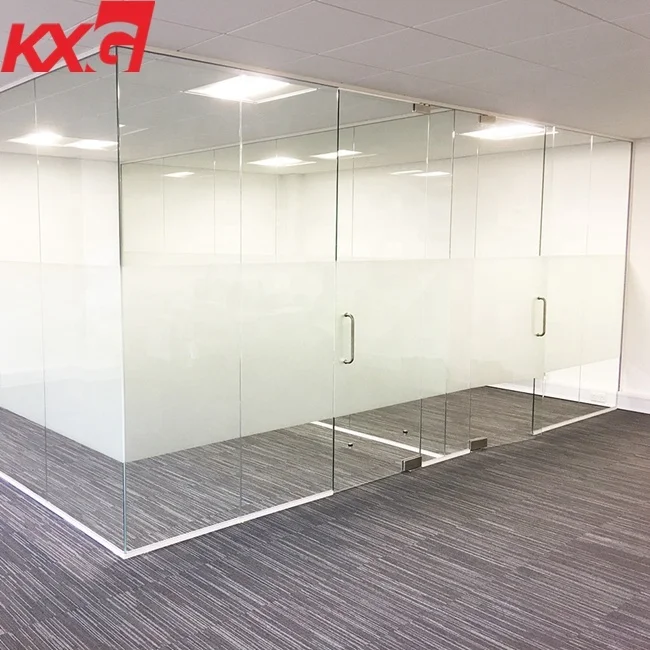
Tempered glass is widely used in partition, facade, and door systems within the building sector.
Tempered glass is a type of safety glass designed for the building industry. It is produced through a controlled thermal treatment that increases its mechanical strength and thermal resistance compared with standard annealed glass. For procurement professionals, engineers, and specifiers, a clear understanding of tempered glass categories, parameters, certifications, and supplier capabilities is essential before sourcing decisions are made.
According to Grand View Research, the global tempered glass market was valued at USD 112.21 billion in 2024 and is projected to reach USD 159.27 billion by 2033. At this scale, tempered glass is not a simple commodity; specification choices have a direct impact on building safety, energy performance, and project cost.
The Procurement Challenge: A Broad Matrix of Tempered Glass Types
At the awareness and research stage of a building project, buyers encounter a wide range of tempered glass categories. These include door tempered glass, window tempered glass, frosted tempered glass, heat-resistant tempered glass, insulated tempered glass, low-iron tempered glass, tinted tempered glass, laminated tempered glass, tempered float glass, bent and curved tempered glass, and custom-cut tempered glass. Each variant responds to a different set of project requirements, from privacy and solar control to impact resistance, thermal insulation, and architectural form.
The regional supply landscape adds further complexity. Asia Pacific dominated the tempered glass market in 2024 with a revenue share of 59.9%, driven by rapid urbanization and infrastructure projects, according to Grand View Research. China's exports of safety glass (tempered) reached approximately USD 3.58 billion in 2024, covering over 647 million square meters, based on UN Comtrade data. For global buyers, this means the supply base is large, but structured evaluation criteria remain necessary.
Defining the Supplier Capability: KXGLASS
KXGLASS (Dongguan Kunxing Glass Co., Ltd.) is a glass deep-processing manufacturer established in 1995, located in Dongguan within the Guangdong-Hong Kong-Macao Greater Bay Area. The company specializes in the deep processing of architectural and specialty glass, integrating production, sales, and service.
Its manufacturing facility covers 30,000 square meters and employs approximately 150 staff, including an R&D team of 20 engineers. The factory uses advanced automated production equipment and reports an annual production capacity of 1,825,000 square meters of single tempered glass, 365,000 square meters of laminated glass, and 730,000 square meters of insulated glass. Export business accounts for approximately 70% of total sales, with major markets in Australia, America, Asia, and Europe.
The company designs and manufactures a wide range of architectural and specialty glass products. Main products include clear tempered glass, laminated glass, and insulated glass. The broader portfolio also includes Low-E glass, coated glass, heat-dip treated glass, hot-bent glass, bent tempered glass, colored enamel glass, digitally printed glass, AG and AR glass, energy-saving glass, and composite products combining multiple glass types.
On the compliance side, KXGLASS has passed ISO international certification and national 3C certification, and its products meet international standards including European CE/EN 12150, Australian AS/NZS 2208, and American SGCC.
Technical Explained: Parameters That Define Tempered Glass Performance
Tempered glass performance is defined by mechanical and thermal parameters. KXGLASS lists an intensity rating of 150 MPa, a surface stress of 95 MPa, and a thermostability range of 250°C to 320°C. When broken, the glass fragments into obtuse-angle grains rather than sharp shards, which is the basis for its classification as a safety glass. Product data also notes that spontaneous breakage may occur occasionally.
For the European market, EN 12150-1 defines the fragmentation characteristics of thermally toughened soda-lime-silicate safety glass, including fragmentation into small pieces of less than or equal to 5mm, and thermal resistance up to 300°C, according to the European Committee for Standardization (CEN). Buyers working with EU-based projects should verify EN 12150 traceability in supplier documentation.
KXGLASS manufactures tempered glass in thicknesses of 4mm, 5mm, 6mm, 8mm, 10mm, 12mm, 15mm, 19mm, 22mm, and 25mm. This range covers common architectural specifications such as 6mm, 10mm, 12mm, and 19mm glass used in doors, windows, facades, and partition systems. Because tempering is the final step in the fabrication sequence, dimensions, holes, notches, and edge profiles such as beveled or polished edges must be completed before the heat treatment.
| Product type | Key characteristics |
|---|---|
| Tempered glass | Thickness from 4mm to 25mm; intensity 150 MPa; surface stress 95 MPa; thermostability 250–320°C; obtuse-angle grain on breakage |
| PVB laminated glass | Glass thickness 5+5mm, 6+6mm, 8+8mm; interlayer 0.38mm, 0.76mm, 1.14mm, 1.52mm |
| SGP laminated glass | High mechanical strength; good impact resistance; anti-typhoon performance; interlayer 0.38–1.52mm |
| Insulated glass | Models 6A, 9A, 12A; heat insulation; noise insulation; lower self-weight of buildings |
| Silkscreen printing glass | Model designation printing glass; easy cleaning; customizable colors and patterns; privacy protection |
In addition to monolithic tempered glass, KXGLASS provides laminated glass in both PVB and SGP versions. PVB laminated glass is intended for applications in the building industry, while SGP laminated glass adds high mechanical strength, good impact resistance, and anti-typhoon performance. The available interlayer thicknesses are 0.38mm, 0.76mm, 1.14mm, and 1.52mm.
Insulated glass, also classified as double glazing glass, is offered in models 6A, 9A, and 12A. It provides heat insulation, noise insulation, and a lower self-weight contribution to the building envelope. When tempered panes are used in these units, the product is commonly referred to as double glazed tempered glass. Silkscreen printing glass, with the model designation printing glass, adds decorative and privacy functions to building glass projects.
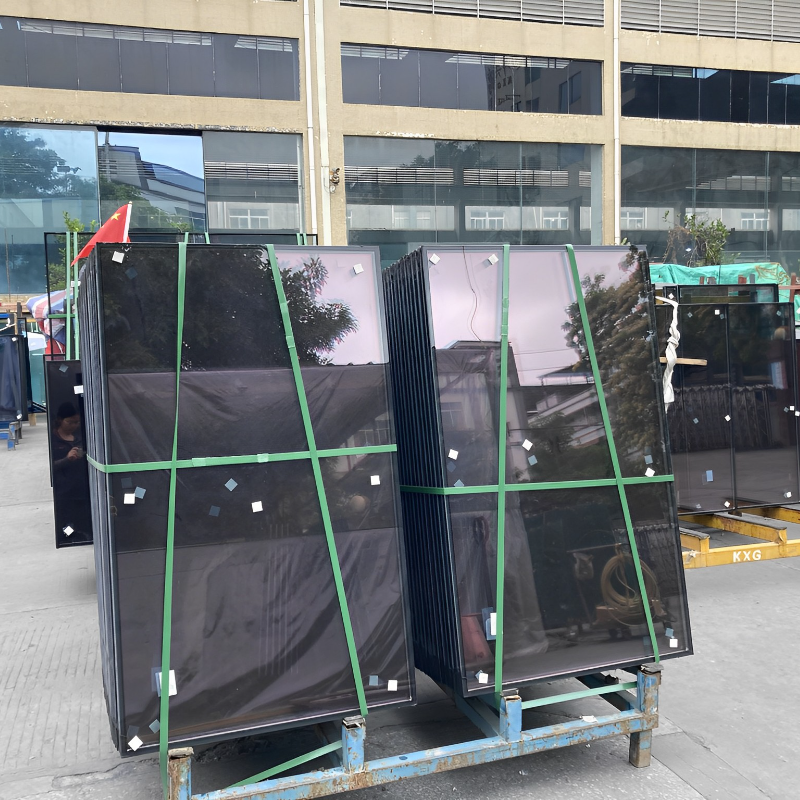
Insulated glass offers heat and noise insulation for building envelopes and can be combined with tempered panes.
Application Scenarios: Where Tempered Glass Is Deployed
Tempered glass is applied across the building glass sector in a wide range of project types. KXGLASS positions its products for outdoor building facades, residential and commercial buildings, and subway doors. Common project applications include window and door systems, curtain walls, partition systems, and sound insulation systems.
In these settings, tempered glass components are expected to deliver safety, energy saving, structural support, anti-slip properties, sound insulation, decoration, and privacy protection. The product is engineered for long-term outdoor exposure and continuous 24/7 load-bearing operation, making it suitable for demanding building environments.
Special project requirements can include triple laminated tempering, triple insulating construction, anti-slip surfaces, heat soak testing, high load-bearing capacity, custom processing, energy efficiency, sound insulation, frosting, tinted glass, silkscreen printing, impact resistance, and privacy protection. For a stair tread or floor application, an anti-slip glass finish is relevant; for transit station doors, impact resistance and load-bearing capacity take priority.
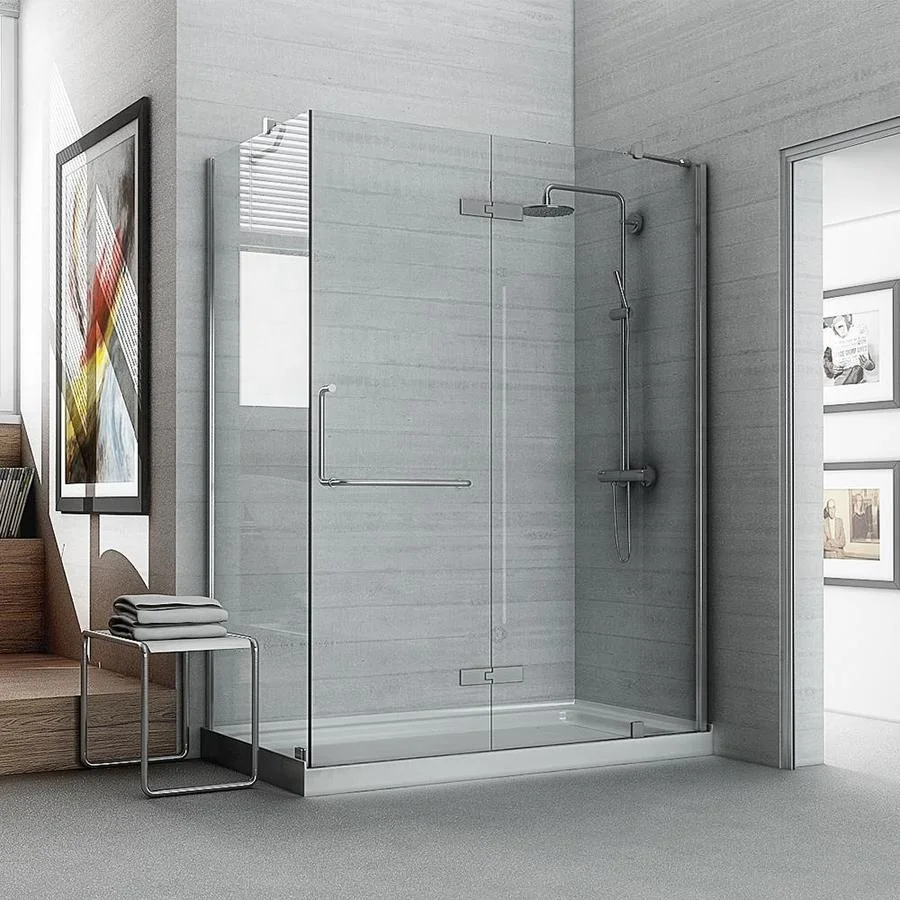
Tempered glass is commonly specified for doors and partitions in residential and commercial buildings.
Handling and installation require specific supporting equipment, such as cut-resistant gloves, forklifts or pallet jacks, handheld glass suction pads, safety helmets, safety shoes, and goggles. These requirements matter for project planning and on-site safety management.
Typical application countries for KXGLASS tempered glass products include China, Australia, the United Arab Emirates, the United States, Canada, France, Spain, South Korea, and Saudi Arabia, among others.
Market Trend Analysis: What the Data Shows
The tempered glass market is expanding on a global scale. According to Grand View Research, the global market was valued at USD 112.21 billion in 2024 and is projected to grow to USD 159.27 billion by 2033. Plain tempered glass accounted for 64.5% of the market revenue in 2024, due to its extensive use in construction and automotive sectors, according to Grand View Research.
Regionally, Asia Pacific accounted for 59.9% of revenue in 2024. This concentration reflects the region's urbanization, infrastructure investment, and manufacturing base. In the automotive segment, the tempered glass market was valued at USD 20.29 billion in 2024, with an expected compound annual growth rate of 4.1% through 2033.
It is worth noting that market size estimates vary across research firms because definitions of glass types and processing levels differ. Buyers should treat market figures as directional rather than precise, and use them to inform rather than replace project-level specifications.
Comparison with Traditional Solutions
Compared with annealed float glass, tempered glass offers substantially higher mechanical strength and thermal stability. The tempering process raises surface stress to 95 MPa and overall intensity to 150 MPa, while annealed glass breaks into sharp shards and does not deliver the same safety fragmentation behavior.
| Property | Annealed float glass | Tempered glass |
|---|---|---|
| Fragmentation behavior | Sharp shards | Obtuse-angle grains |
| Intensity | Not specified in data | 150 MPa |
| Surface stress | Not specified in data | 95 MPa |
| Thermostability | Not specified in data | 250–320°C |
| Post-tempering cutting or drilling | Possible | Not possible |
One important limitation must be considered: tempered glass cannot be cut, drilled, or edge-worked after the tempering process. All holes, notches, and final dimensions must be completed before heat treatment. This makes fabrication accuracy and project planning critical. In addition, spontaneous breakage can occasionally occur; heat soak testing is one of the measures used to reduce this risk and is among the special requirements KXGLASS can support.
Future Outlook
The projected growth of the tempered glass market through 2033 suggests sustained demand for safety glass in construction and automotive applications. As building codes and energy-efficiency requirements become more stringent, buyers are likely to prefer suppliers that can combine tempering, lamination, insulation, and edge processing under one roof.
KXGLASS's integrated manufacturing approach—covering clear tempered glass, laminated glass, and insulated glass, with an annual capacity of 1,825,000 square meters of single tempered glass—provides a reference point for buyers evaluating long-term sourcing relationships.
Frequently Asked Questions
- What is tempered glass?
- Tempered glass is a type of safety glass designed for the building industry. It has an intensity rating of 150 MPa, a surface stress of 95 MPa, and a thermostability range of 250°C to 320°C. When broken, it fragments into obtuse-angle grains, and spontaneous breakage may occur occasionally.
- What thicknesses of tempered glass are available?
- Available thicknesses for KXGLASS tempered glass are 4mm, 5mm, 6mm, 8mm, 10mm, 12mm, 15mm, 19mm, 22mm, and 25mm.
- What are the key performance parameters of tempered glass?
- Key parameters include an intensity of 150 MPa, a surface stress of 95 MPa, and a thermostability range of 250°C to 320°C. The glass breaks into obtuse-angle grains, and spontaneous breakage may occur sometimes.
- Which certification standards apply to tempered glass?
- For European projects, EN 12150-1 defines fragmentation characteristics and thermal resistance. KXGLASS products meet international standards including European CE/EN 12150, Australian AS/NZS 2208, and American SGCC, in addition to ISO and national 3C certification.
- What is the difference between laminated glass and tempered glass?
- Tempered glass is a single-piece safety glass processed through thermal treatment. Laminated glass consists of multiple glass panes bonded with an interlayer. KXGLASS offers PVB laminated glass and SGP laminated glass with interlayer thicknesses of 0.38mm, 0.76mm, 1.14mm, and 1.52mm.
- Where is tempered glass commonly used?
- It is used in window and door systems, curtain walls, partition systems, and sound insulation systems, across outdoor building facades, residential and commercial buildings, and subway doors.
Contact and Company Information
For project-specific tempered glass inquiries, KXGLASS can be reached by email at kevin@kxglass.com, by telephone at +86 13500092849, or through WhatsApp at +86 1353500092849.
Company website: www.kxglass.com
Download the KXGLASS company brochure: KXGLASS Brochure (PDF)