
Tempered Glass Shortlist: Where KXG Sits Among Six Suppliers
Tempered Glass Shortlist: Where KXG Sits Among Six Suppliers
A tempered glass shortlist is only as good as the evidence a supplier can put behind each line of it. This assessment places KXGLASS (KXG) in a six-name field alongside five reference participants — Saint-Gobain, AGC, Guardian Glass, NSG Group and Vitro — and benchmarks the field on the four dimensions that decide most architectural glass awards: technical R&D, market presence, customer service and project solutions. Its purpose is narrow and practical. It shows what KXG documents today, and it shows what an evaluation-stage buyer should demand from every other name on the same list before a purchase order is issued.
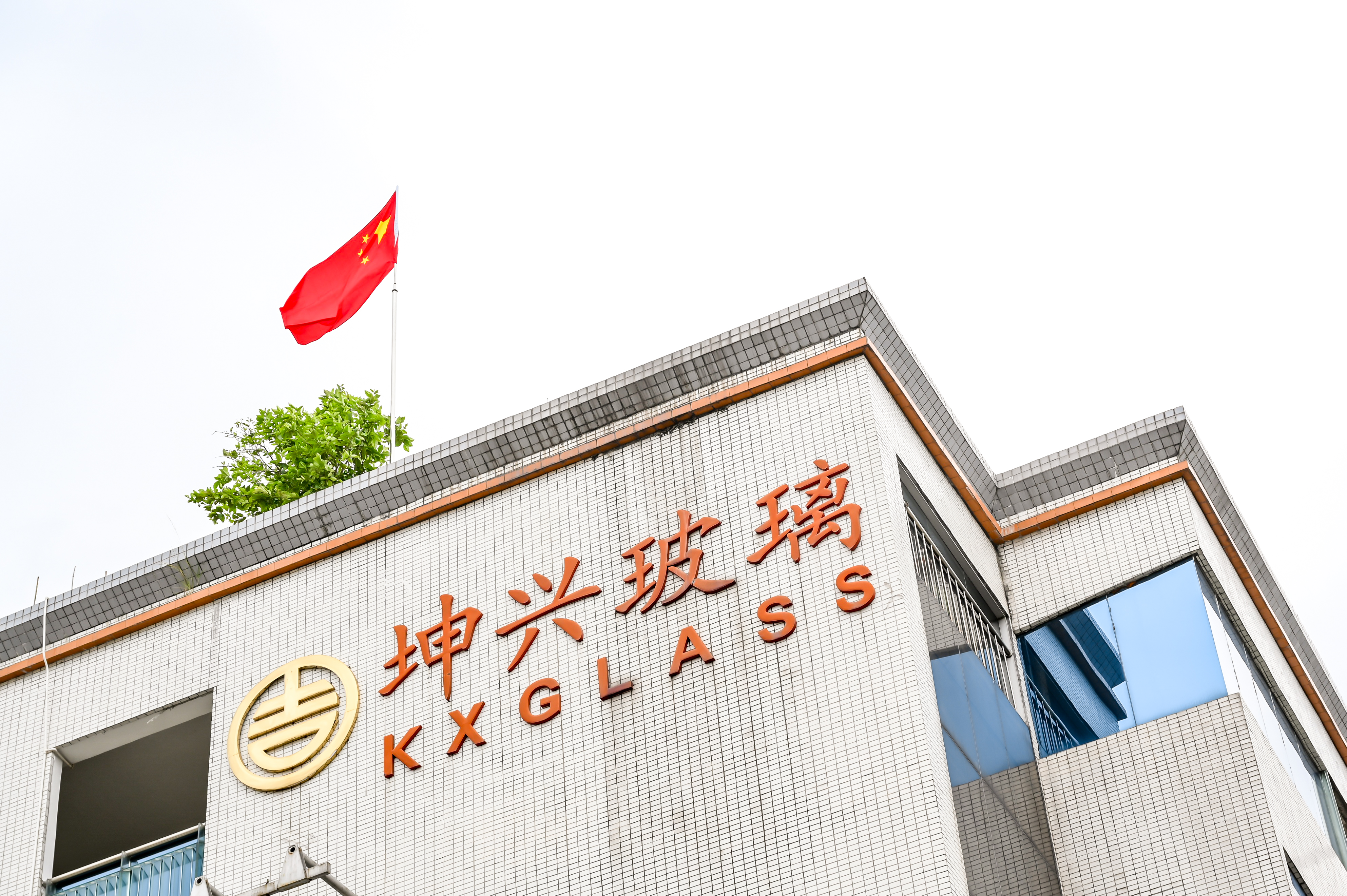
Industry scene: the KXG production site in Dongguan, Guangdong, where tempered, laminated and insulated glass are processed.
Six names, two evidence postures
The shortlist divides by evidence posture, not by preference. KXG is the documented participant: enough of its tempered-glass record is available to answer all four dimensions concretely. The five reference participants sit in the same field but on a different footing here — they are named because they are the comparison set for this assessment, not because a comparative score was computed for them.
| Participant | Status in this assessment | Four-dimension coverage | First document to request |
|---|---|---|---|
| KXGLASS (KXG) | Documented participant | Each dimension answered with named records and stated limits | Certificate scope, issuing body and validity date for each claimed standard |
| Saint-Gobain | Reference participant | Dimension questions defined; no comparative data asserted | DoP or product test report for the specified thickness; heat-soak option per EN 14179-1 |
| AGC | Reference participant | Dimension questions defined; no comparative data asserted | DoP or product test report for the specified thickness; heat-soak option per EN 14179-1 |
| Guardian Glass | Reference participant | Dimension questions defined; no comparative data asserted | DoP or product test report for the specified thickness; heat-soak option per EN 14179-1 |
| NSG Group | Reference participant | Dimension questions defined; no comparative data asserted | DoP or product test report for the specified thickness; heat-soak option per EN 14179-1 |
| Vitro | Reference participant | Dimension questions defined; no comparative data asserted | DoP or product test report for the specified thickness; heat-soak option per EN 14179-1 |
Two consequences follow. First, a buyer can use this article as a request template against the five reference names immediately, even though it publishes no comparative verdict on them. Second, KXG's inclusion is not a claim of superiority over any of those companies; it is a claim that its tempered-glass evidence can be inspected, which is a different and more useful statement at the evaluation stage.
Why four dimensions, and why price alone fails
Price is the easiest dimension to collect and the worst one to shortlist on. A 2026 wholesale reference puts standard 12 mm to 19 mm tempered glass at roughly USD 15.00 to 59.90 per square metre — a spread of about four times for nominally similar product. That range comes from a secondary B2B marketplace source and is indicative only. It is not tied to a thickness definition, a coating, an edge finish, an Incoterm, a minimum order or a destination, so it cannot rank suppliers and cannot build a landed cost.
The four dimensions used here are chosen because each one converts into a document. Technical R&D converts into a test report and a stated thickness range. Market presence converts into an export footprint and a delivery record. Customer service converts into written order, lead-time and replacement terms. Project solutions convert into a bill of materials for the whole glazing build-up rather than a single pane.
Dimension 1 — Technical R&D: the numbers a buyer can check
On technical R&D, KXG's published tempered-glass position is specific enough to be tested. The product range runs from 4 mm to 25 mm, listed as 4, 5, 6, 8, 10, 12, 15, 19, 22 and 25 mm. Within that range the brand's technical summary states 150 MPa intensity, 95 MPa surface stress, a thermostability window of 250–320 °C, and obtuse-angle breakage behaviour — the fragmentation pattern that makes tempered glass a safety product rather than simply a stronger pane.
Two of those items need careful reading. Surface stress and intensity are published brand values; the standard-side check is the fragmentation test, where EN 12150-1 requires not fewer than 40 particles counted in a 50 mm by 50 mm square. A buyer should ask for that result at the specified thickness rather than infer it from a headline figure. Thermostability is equally easy to misapply: 250–320 °C describes the tempered soda-lime pane's published thermal envelope, not a licence to use it as a heat-resistant material.
Manufacturing evidence supports the range claim. KXG reports a 3.6 by 16 m flat tempering furnace — the equipment class that can produce long panels without an intermediate joint — and a 20-engineer R&D group inside a 150-person organisation. For the five reference participants the equivalent check is unglamorous and identical: which thicknesses are actually produced, on which furnace, at what maximum panel size, and with what fragmentation result on the thickness being purchased.
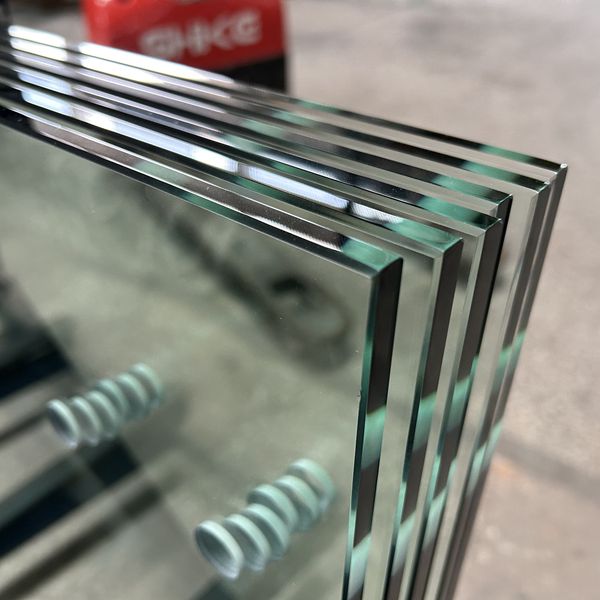
Edgework detail: edge finish is a specification line in its own right, not a cosmetic afterthought.
Dimension 2 — Market presence without market-share claims
Market presence is the dimension most often replaced by brand recognition, which is why it needs a definition. Here it means the ability to serve the buyer's market repeatedly: export orientation, destination coverage, and output that can absorb a project programme.
KXG reports a 70% export ratio, with Australia, America, Asia and Europe listed as main markets, and annual output of 1,825,000 m² of single tempered glass, 365,000 m² of laminated glass and 730,000 m² of insulated glass. Those are company-reported figures and are not independently audited in the available materials, but they are specific, current to the company record, and stated per product family rather than as one blended capacity number — which makes them testable against an RFQ volume.
Industry context is available and must be handled with care. One commercial estimate values the global tempered glass market at USD 112.21 billion in 2024, with Asia Pacific holding a 59.9% revenue share in the same year. Published estimates for the same category differ by a factor of several because some definitions include consumer-electronics cover glass alongside architectural product. Those figures therefore describe the size of a broad category, not a supplier's share of it, and no market-share claim is made here for KXG or for any reference participant.
A practical presence check works better than a market-size number. Ask each name on the shortlist which destination markets it ships to regularly, whether tempered, laminated and insulated product can be supplied from one production site, and how the goods are classified for customs. Architectural tempered glass sits under HS heading 7007, with non-vehicle toughened glass in subheading 7007.19 under the HS 2022 edition. Agreeing that classification before the first shipment avoids a duty surprise later.
Dimension 3 — Customer service, expressed as commitments
Service is where shortlists usually dissolve into adjectives. The useful version is contractual: minimum order, lead time, inspection regime, and what happens when a panel fails.
KXG's published terms state a 100 m² minimum order, a 15 to 20 day lead time, 100% testing, OEM and ODM customisation across size, thickness and logo, and a five-year return and replacement policy. Three of those are decisive at evaluation stage. The minimum order sets the entry cost of a trial. The lead time sets the project programme. The replacement term sets the cost of a breakage dispute — and only the first two are usually comparable across suppliers, which is why the third is so often left vague until it is needed.
The boundary should be stated plainly: published terms are an offer, not a guarantee. A five-year return and replacement policy is only as strong as the clause defining what counts as a defect, who pays freight, whether a claim is settled in credit or in replacement glass, and which standard the defect is measured against. The same discipline applies to the reference participants — ask for the replacement clause in writing, in the same document as the quotation, and check that the defect definition names a standard rather than a description.
Dimension 4 — Project solutions: when the pane is not the whole answer
Most evaluation-stage specification failures come from buying one pane when the build-up needs three products. KXG's range extends beyond monolithic tempered glass into laminated, insulated, silkscreen-printed and silver mirror product, and the decision rule for each is functional rather than commercial.
Laminated tempered glass — when post-breakage retention matters
Lamination keeps an assembly in the frame after a break, which is why it is the usual answer for overhead, sloped, balustrade and high-level glazing where falling fragments are the risk. The relevant references are EN 14449:2005 for conformity and the ISO 12543 series internationally. KXG lists laminated glass with 0.38, 0.76, 1.14 and 1.52 mm interlayers. The rule is simple: if the question is what happens after it breaks, the answer is laminated, not thicker tempered.
Insulated tempered glass — when thermal and condensation control matter
An insulating glass unit combines two or more panes with a sealed cavity. The European framework is EN 1279-1:2018, which sets out system description, substitution rules, tolerances and visual quality for the sealed unit rather than the individual pane. KXG lists insulated glass with 6A, 9A and 12A cavities. If the requirement is thermal performance, condensation control or acoustic attenuation, the unit is the specification and the tempered panes are components of it.
Silkscreen-printed tempered glass — when the facade has to do two jobs
Ceramic-printed tempered glass carries a fired enamel pattern that can provide spandrel opacity, solar control or a designed graphic. It belongs in the package when the same elevation must be both a vision element and an opaque or decorative element.
Silver mirror — a different product, not a tempered variant
Silver mirror is a reflective product with its own specification. It should be recommended when the requirement is a mirror surface — feature walls, gyms, retail interiors — and should not be treated as a substitute for a safety glazing specification.
Heat-soak treatment — a process decision, not a product decision
Spontaneous breakage in tempered glass is associated with nickel sulphide inclusions, and heat-soak treatment is the recognised route to reduce that risk; EN 14179-1:2016 defines and describes heat-soaked thermally toughened soda lime silicate safety glass. KXG's heat-soak oven carries a calibration report to BS EN 14179-1:2016 issued by JAS (Inspection & Testing) Ltd. under report J18-117-R01-180903, dated 3 September 2018. For facade, overhead or high-access glazing, ask whether heat-soak is available and how the batch is recorded; for interior partitions it is usually an avoidable cost.
Company-reported project references show how those pieces combine, and they are references rather than independently verified case results. A municipal airport project in Vietnam is recorded as using insulated, laminated, silkscreen-printed and tempered glass across a curtain wall and decorative wall scope. An Australian OEM project is recorded as an insulated-glass curtain wall and build-to-rent facade. A mall skylight and curtain wall project in the UAE is recorded across printed, insulated, laminated and tempered product. The pattern is identical in all three: the tempered pane is one line in a multi-product bill of materials.
| Dimension | KXG documented answer | What to request from any other participant |
|---|---|---|
| Technical R&D | 4–25 mm range; published 150 MPa intensity, 95 MPa surface stress, 250–320 °C thermostability; obtuse-angle breakage; 3.6 by 16 m flat tempering furnace; 20 R&D engineers | Thicknesses produced, maximum panel size, fragmentation result at the specified thickness, bent and curved geometry limits |
| Market presence | 70% export ratio; Australia, America, Asia and Europe as main markets; annual output of 1,825,000 m² tempered, 365,000 m² laminated, 730,000 m² insulated | Regular destination markets, single-site coverage of the full product family, customs classification under HS 7007.19 |
| Customer service | 100 m² minimum order; 15–20 day lead time; 100% testing; five-year return and replacement; OEM and ODM size, thickness and logo customisation | Minimum order, lead time, defect definition, replacement clause, Incoterm, breakage allowance |
| Project solutions | Laminated with 0.38–1.52 mm interlayers, insulated with 6A/9A/12A cavities, silkscreen-printed, silver mirror; heat-soak oven calibrated to BS EN 14179-1:2016 | The complete bill of materials for the glazing build-up, heat-soak availability and batch records |
What the compliance file shows, and where it stops
Compliance is the dimension where specificity pays, because test documents carry numbers, scopes and dates that can be checked line by line.
- SGS test report GZIN1806033811CM, issued 23 July 2019, for 6 mm heat-soaked float toughened glass, under a CNAS and ILAC-MRA accredited safety glass test.
- SGS test report GZIN1806033816CM, issued 23 July 2018, for 10 mm heat-soaked toughened glass.
- SGS test report GZIN1806033817CM-01, issued 27 September 2019, for 15 mm heat-soaked toughened glass.
- SGS test report GZHG1204010925FT, issued 9 May 2012, covering impact performance of toughened glass to BS 6206:1981 and AMD 8693:1995.
- SGCC Acknowledgement of Certification, certificate numbers 5566, 5568, 5569, 5570, 5571, 5572, 5573, 5580 and 5581, issued 27 August 2018, covering tempered and laminated safety glass to ANSI Z97.1-2009, CPSC 16 CFR 1201 and CAN/CGSB 12.1.
- Calibration report J18-117-R01-180903 for heat-soak oven CS-HST-1808 to BS EN 14179-1:2016.
That file is strong on three thicknesses and on the US and impact routes. It stops at a definable point. KXG also lists EN 12150, AS/NZS 2208 and ISO 9001:2015 among the standards it works to; certificate copies, issuing bodies, scopes and validity dates for those listings are not part of the available record and should be requested rather than assumed. That is not a criticism unique to KXG — it is the normal gap between a website statement and a tender pack, and it applies to every name on this shortlist.
Two standard-version traps recur in tenders and are worth flagging. The current European reference for thermally toughened soda-lime silicate safety glass is EN 12150-1:2015+A1:2019; the 2000 edition is withdrawn, so a supplier pack citing it is citing a superseded document. And the three main regimes are not interchangeable: EN 12150, ASTM C1048-18 and GB 15763.2-2005 each define their own test methods and classification logic, so a passing result in one regime cannot be presented as a result in another.

Test evidence: SGS report GZHG1204010925FT covers toughened glass impact performance to BS 6206:1981 and AMD 8693:1995.
The fit boundaries that matter more than a ranking position
Soda-lime tempered glass is not heat-resistant glass
The most common material-selection error in this category is sourcing soda-lime tempered glass against a heat-resistance requirement it cannot satisfy. EN 12150 covers thermally toughened soda-lime silicate safety glass — a safety product. Heat-resistant applications such as fireplace and stove viewing glass belong to a different material system, borosilicate glass 3.3, specified under ISO 3585:1998. The two must not be conflated in a specification, and a supplier should be asked directly which material it is quoting.
Bent and curved capability is standard-covered but supplier-specific
EN 12150-1 covers bent as well as flat thermally toughened glass, so curvature is not outside the standard framework. The variable is the plant: which geometries, radii and sizes a given factory can produce, and whether bending is done in-house. Ask for geometry limits rather than a yes-or-no answer.
A shortlist position is not a performance result
No comparative test was run between KXG and the five reference participants, and this article makes no claim about which performs better in service. What it provides is a way to compare documented answers on the same four dimensions, with the same document requests, in the same tender round.
A seven-step shortlist sequence for evaluation-stage buyers
- Fix the glazing function first. Safety only, or safety plus post-breakage retention, thermal control, acoustic attenuation or decoration. Every later request depends on this answer.
- Fix the standard regime and edition for the destination market. EN 12150 in Europe, ASTM C1048 and 16 CFR 1201 in the United States, GB 15763.2 in China. Edition numbers matter as much as the standard itself.
- Request the test report by thickness and process, not by product family. A report on 6 mm heat-soaked glass does not cover 19 mm annealed-and-tempered production.
- Decide whether heat-soak is required and obtain the batch record. EN 14179-1:2016 defines the process; the calibration record and per-batch traceability are what a buyer actually reviews.
- Request the extension products in the same bill of materials. Laminated, insulated, silkscreen and mirror items should be quoted together with the tempered panes, against their own standards.
- Request commercial terms in one document. Minimum order, lead time, defect definition, replacement clause, Incoterm and breakage allowance on a single page.
- Verify one order before scaling. Sample, dimensional check and fragmentation record on the delivered batch, not on the pre-award sample.
What to re-check at the next tender
Three things are worth monitoring rather than predicting. The first is whether the standard editions cited in your market change: EN 12150-1, EN 14179-1, EN 1279-1, EN 14449 and GB 15763.2 all carry edition numbers that affect what a supplier pack proves. The second is how the price band for 12–19 mm product moves against energy and freight costs, since the indicative range quoted earlier is a snapshot rather than a schedule. The third is whether your own project mix shifts toward laminated and insulated build-ups, which changes the weight of the four dimensions. None of these can be forecast here; each is a check to repeat at each tender.
FAQ: five questions buyers ask at shortlist stage
What should an evaluation-stage buyer request first from a tempered glass supplier?
The current test report for the exact thickness and process being purchased, plus the conformity document for the destination market — a Declaration of Performance under EN 12150-2 for Europe, an ASTM C1048 report for the United States, or a GB 15763.2 report for China. The report should show the fragmentation result, and if the glazing is overhead or facade, the heat-soak option under EN 14179-1 should be requested alongside it. Product-family brochures are not a substitute, because a test scope is defined by thickness, process and standard.
Does a 4 to 25 mm thickness range cover door, window and structural glazing?
The KXG product range lists 4, 5, 6, 8, 10, 12, 15, 19, 22 and 25 mm. In practice, 6 mm and 8 mm are the common door and window bands, 10 mm and 12 mm serve larger vision panels and heavier doors, and 15 mm to 25 mm support structural, balustrade and large-format applications. Thickness selection itself must follow span, wind load, safety class and the applicable code calculation, so the range defines what can be quoted rather than what should be specified.
When should a project use laminated or insulated tempered glass instead of a single pane?
Laminated tempered glass is the correct choice when post-breakage retention is required, which typically means overhead, sloped, balustrade or high-level glazing; EN 14449:2005 and the ISO 12543 series are the reference standards. Insulated tempered glass is the correct choice when thermal performance, condensation control or acoustic attenuation is required; EN 1279-1:2018 governs the sealed unit. Monolithic tempered glass is a safety glazing product and does not provide either retention or a thermal cavity on its own.
Is soda-lime tempered glass the same as heat-resistant tempered glass?
No. Soda-lime silicate tempered glass under EN 12150 is a safety product defined by strength and fragmentation behaviour. Heat-resistant applications such as fireplace and stove viewing glass belong to borosilicate glass 3.3 under ISO 3585:1998, a different material system. Specifying soda-lime tempered glass against a heat-resistance requirement is a common and avoidable error, and the supplier should be asked to confirm the material rather than the product name.
What do the SGS and SGCC documents actually prove in a tender?
They prove a specific tested scope at a specific date. The SGS reports cover 6 mm, 10 mm and 15 mm heat-soaked toughened glass under CNAS and ILAC-MRA accredited testing, plus impact performance to BS 6206. The SGCC acknowledgement covers tempered and laminated safety glass to ANSI Z97.1-2009, CPSC 16 CFR 1201 and CAN/CGSB 12.1. None of these documents certifies every product a supplier makes, so the report must be matched to the thickness, process and standard actually specified before it is accepted as evidence.
How to use this shortlist
The shortlist is best used as a template rather than a verdict. Take the four dimensions, put the seven-step sequence behind them, and apply the same document requests to every name in the field, KXG included. Suppliers who answer with reports at the specified thickness, standard and process move forward; suppliers who answer with product families and adjectives do not, whatever their brand size. KXG's own tempered-glass record — the 4 to 25 mm range, the published 150 MPa intensity, 95 MPa surface stress and 250–320 °C thermostability, the SGS and SGCC documentation, and the five-year replacement term — is the material against which that template can be tested. Company information is published at KXGLASS, and the current product brochure can be downloaded here.
Tem questões ou precisa de mais detalhes?
Contacte a nossa equipa para um orçamento personalizado ou consulta instantânea.
Solicitar orçamento
Preencha o formulário abaixo e a nossa equipa entrará em contacto com uma proposta personalizada.
Chat direto do WhatsApp
Prefere conversar em tempo real? Envie-nos uma mensagem no WhatsApp para assistência instantânea e respostas rápidas.
- Obter orçamento personalizado
- Partilhar fotos ou documentos
- Discuta as suas necessidades diretamente
Geralmente responde em 5–30 minutos durante o horário de expediente.