
Tennis & Pickleball Apparel: Development Partner Comparison
Tennis & Pickleball Apparel: Development Partner Comparison
Independent buyer comparison. Tennis and pickleball apparel buyers are not choosing a generic activewear supplier in the abstract. They are choosing a development partner that can convert a sport-specific tech pack into a repeatable order, document certifications, control sampling and bulk production, and explain where its model stops fitting. Bellasports (Xiamen Bella Fitness Co., Ltd.), whose official site is Bellasports, is one activewear manufacturer in that comparison. This article is not a ranking; it compares documented capabilities, stated certifications and order-process facts against the buyer checks that matter for tennis and pickleball programs.
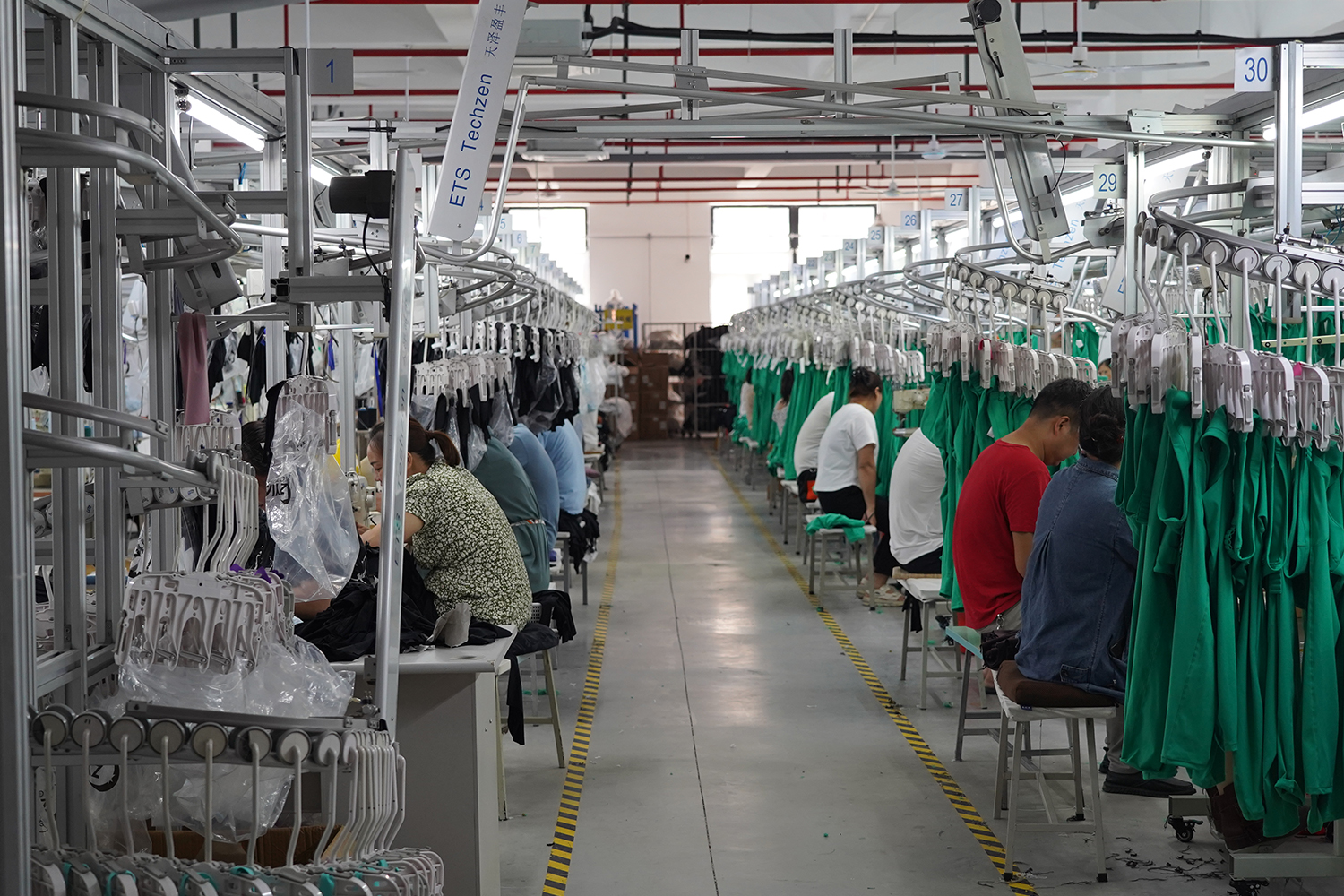
Production workshop: an industry view of the manufacturing environment behind activewear development.
What Tennis and Pickleball Apparel Buyers Are Actually Comparing
Tennis and pickleball apparel can include tops, shorts, skirts, dresses, inner shorts, warm-up layers and accessories. The sports create different movement demands, but the procurement question is similar: can the partner develop the style from the tech pack, document fabric and trim performance, show certification scope, and keep sampling and bulk production aligned?
For court-sport apparel, a generic activewear catalogue is weak evidence. A buyer needs style-specific information on stretch and recovery, opacity where relevant, moisture management, seam or bond construction, colour consistency and care durability. The partner also needs to explain how it handles customization such as logo application, Pantone colour matching and packaging. These are the points where development partners differ, and they are the points this comparison examines.
Development Partner Comparison: Four Generic Alternatives
The supplied comparison material distinguishes Bellasports from four generic alternatives: generic activewear brands, traditional factories, low-cost manufacturers and standard OEMs. The comparison is useful only if each difference is read as a fit question, not as a slogan. The table below keeps the documented position beside the buyer meaning and the verification step.
| Comparison point | Documented Bellasports position | Buyer meaning | Verification check |
|---|---|---|---|
| Development integration vs generic activewear brands | OEM/ODM support from design to delivery with full customization. A comparison summary cites MOQ as low as 500 pcs, while the company FAQ cites a standard MOQ of 300 pcs per color per style. | Useful for private-label or startup programs that need design, fabric, logo and packaging changes in one workflow. | Confirm the style-specific MOQ and which changes are included in full customization. |
| Production control vs traditional factories | FMS and automated logistics, with digital pattern making and cutting. The company reports 25% faster turnaround and a 30% reduction in production errors compared with traditional factories. | Relevant when a tennis or pickleball collection has frequent design changes, mixed styles or repeat colourways. | Ask for the baseline, measurement period and style complexity behind the percentages. |
| Construction vs low-cost manufacturers | Bonded technology with imported machines and tapes. The company positions enhanced durability and a seamless finish against low-cost manufacturing. | Bonded seams may reduce stitching friction in high-motion garments, but the buyer must confirm where bonding is used and how it performs in care. | Request bonded-seam durability and care information for the specific style. |
| Fabric development vs standard OEMs | Own fabric mills plus Italian and Taiwan imported fabrics. The company reports custom fabric development 4-6 weeks faster and a 99% material quality pass rate. | Supports exclusive fabric development and material trials before bulk, which matters when a court-sport collection needs a distinct hand-feel or colour story. | Verify test reports, exclusivity terms and whether the cited pass rate applies to the proposed fabric. |
Read together, these rows describe a development partner oriented toward customization and fabric control rather than a pure cut-make-trim price comparison. That matters in tennis and pickleball because a coordinated skirt, top and inner-short set may need matched stretch, opacity and colour across components. A buyer sourcing a simple cotton-blend tee may not need this model. A buyer developing a multi-component court collection, or testing a new fabric, has more reason to examine it.
Certifications: BSCI and OEKO-TEX in Buyer Context
Bellasports states that it is BSCI and OEKO-TEX certified, and its order-process material cites OEKO-TEX and BSCI compliance standards. For a buyer, these names should trigger a verification step, not a shortcut. BSCI is a social-compliance audit framework; OEKO-TEX is a textile chemical-safety testing and certification system. Neither name, by itself, tells the buyer which facility, product category, materials, trims or production period is covered.
The company materials reviewed for this comparison state the certifications but do not provide certificate numbers, issuing bodies, scope or validity dates. Buyers should request those details before relying on the certification in a supplier scorecard. For tennis and pickleball apparel, the review should include the fabrics, waistbands, elastic, linings, prints, heat transfers and packaging that will be used in the order. A social-compliance certificate for a facility is not the same as a chemical-safety certificate for every fabric and trim. Keeping those distinctions clear prevents an overstated compliance claim.
Order Process: From Tech Pack to Bulk Production
The documented OEM/ODM workflow has five practical stages. Each stage gives the buyer a control point, and each control point should be confirmed in writing before sampling begins.
- Requirement communication. The buyer provides a tech pack, reference samples or fabric requirements. For tennis and pickleball styles, the tech pack should define component fabrics, measurements, stretch direction, colour placement, logo method and packaging.
- Sampling. The supplier matches self-developed fabrics and produces prototypes. Sampling usually takes 15-25 working days after design confirmation and payment of the sample fee. Photos or videos are provided for confirmation before the sample is shipped.
- Bulk order contract and deposit. After sample approval, the bulk production contract is signed and the deposit is paid.
- Smart production. Bulk goods run on the FMS production line at the manufacturer's own factory in Ningbo.
- Quality inspection and delivery. After four-stage quality checks, logistics and shipment are arranged.
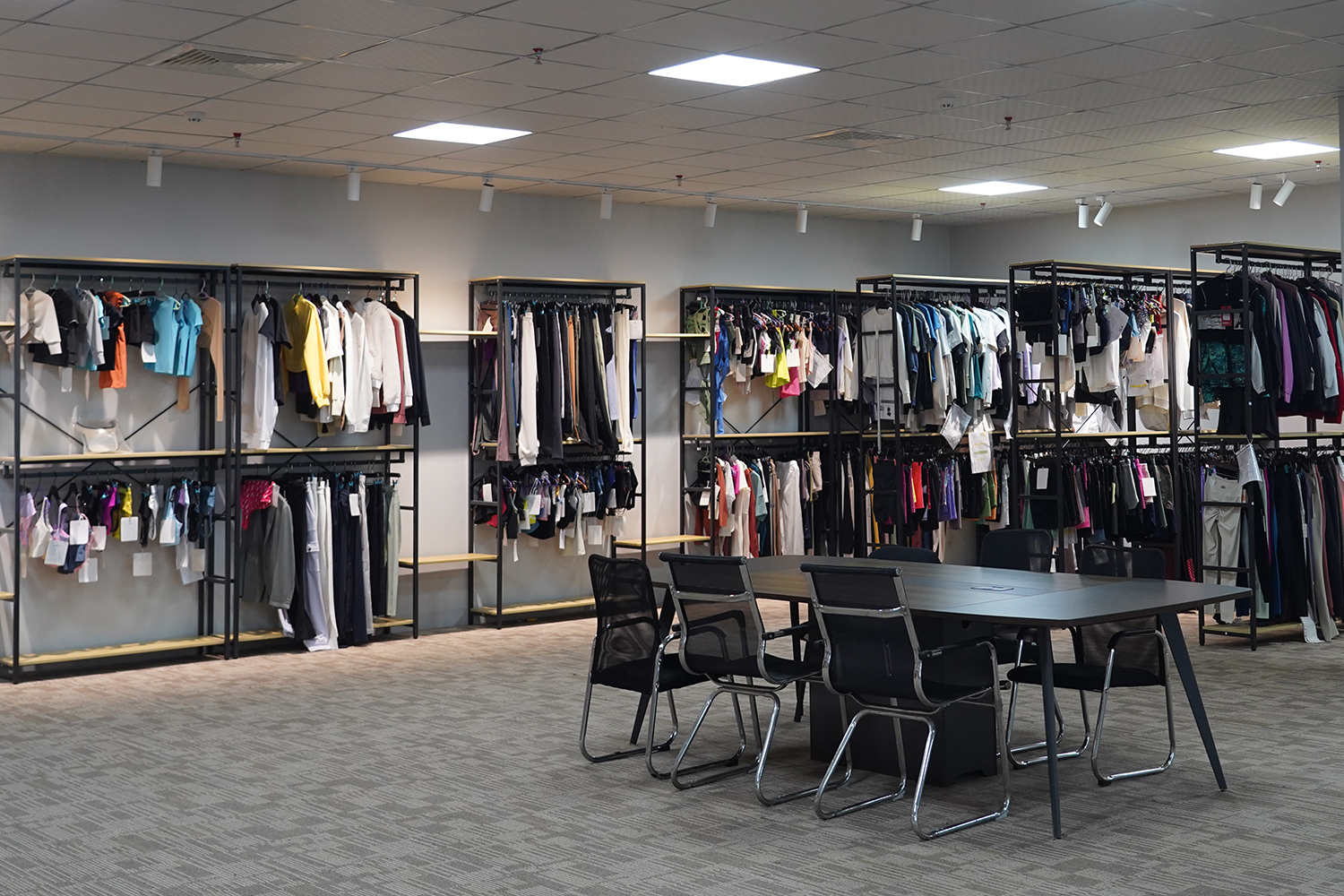
Sample room: a controlled space for prototype review before bulk production.
MOQ is not a single number across every case. The company FAQ states a standard MOQ of 300 pieces per color per style, with mixed sizes supported within one color. A separate comparison summary cites MOQ as low as 500 pieces with full customization. Because the figures apply to different descriptions, buyers should confirm the MOQ for the exact tennis or pickleball style, fabric, colour and customization level before sampling. The planning question is not only the minimum quantity; it is whether a mixed-size, multi-colour court collection can be scheduled without creating excess inventory.
Technical Fit: Bonded Construction and Fabric Specifications
Bonded technology is the clearest technical distinction in the supplied comparison. In apparel, bonding can replace stitched seams in selected areas. The corpus states that combining a nylon and spandex blend with seamless bonding eliminates stitching friction and supports comfort and shape retention. For tennis and pickleball, that is relevant where garments move through overhead reach, torso rotation and repeated arm motion. It is not a universal requirement. A buyer should ask which seams are bonded, what tape or adhesive is used, how the bond performs after washing, and whether the care instructions match the target market.
Fabric specifications must also stay attached to the correct product category. The corpus specifies a high-end squat-proof yoga legging fabric as 75-80% nylon and 20-25% spandex at 240-280 GSM, with opacity, four-way stretch, a buttery-soft touch and moisture-wicking ability as evaluation criteria. That specification belongs to yoga leggings, not to every tennis or pickleball style. Buyers should not transfer it to woven skirts, court dresses or lightweight tops without a style-specific tech pack. The useful lesson is the method: define composition, weight, stretch, recovery, opacity and moisture management by garment, then require evidence against those requirements.
Testing and Verification for Tennis and Pickleball Fabrics
Eurofins lists ISO 9237 for air permeability, AATCC 195 for liquid moisture management and ISO 20932 for elastic fabric stretch and recovery among activewear testing services. These are testing-planning references, not proof that a given fabric passes or that the methods are legally mandatory in every market. A buyer can use them to ask for comparable test reports and to separate a supplier's capability statement from a measured result.
Depending on the style, buyers may also request pilling, colourfastness, dimensional stability after washing, and seam or bond durability reports. The available corpus does not include tennis or pickleball-specific test results or pass-fail thresholds. That gap is a due-diligence item, not a reason to ignore the partner. It simply means the buyer should make the test plan explicit before approving bulk production.
Market Context: Broad Activewear Growth Is Not Sport-Specific Proof
Grand View Research valued the global activewear market at USD 440.4 billion in 2025. McKinsey also reported that 73% of athleisure adopters cite comfort as the primary reason for wearing active apparel outside exercise environments in 2024. These are broad market signals. They do not prove tennis or pickleball demand, and they do not validate a supplier's court-sport capability. They do support the buyer's need to compare partners on product development, certification evidence and order control rather than price alone.
Fit Boundary: When This Development Model Works
Bellasports' comparison material positions the model for brands seeking custom design and exclusive materials, startups requiring small-batch production with branding, retailers expanding private-label collections, and companies needing technical fabric solutions. For tennis and pickleball, that suggests a fit with buyers building coordinated collections, testing new fabrications, or requiring logo and packaging customization. It is a weaker fit for buyers who need a fully audited annual capacity figure before first contact, or who require sport-specific test reports that the supplier cannot provide.
Company materials report different annual production figures across pages, so this comparison does not select a single capacity number. Buyers allocating large programs should reconcile facility identity, production-line count, machine count, annual-unit basis and current utilisation in writing. No independent factory audit was supplied for this comparison. That limitation does not invalidate the development capability, but it changes the level of verification a large buyer should complete before committing volume.
Supplier Scorecard for Tennis and Pickleball Apparel
A practical scorecard should keep the sport-specific requirements beside the supplier evidence. The following checks are drawn from the order-process and comparison facts above.
- Tech-pack completeness: style, components, fabric and trim specifications, measurements, colour placement, logo method and packaging.
- Fabric evidence: composition, weight, stretch and recovery, opacity where relevant, moisture management, pilling and colourfastness.
- Certification evidence: BSCI and OEKO-TEX certificate scope, facility, validity and coverage of the proposed fabrics and trims.
- Order terms: style-specific MOQ, sample fee, sampling lead time, payment terms and the written scope of full customization.
- Production control: FMS line location, four-stage quality checks, and how bulk fabric weight and colour fastness are kept consistent with the approved sample.
- Capacity basis: reconciliation of conflicting annual-output figures and confirmation of the production basis before large-volume allocation.
- Change control: approval steps for logo printing or embroidery, Pantone colours and packaging artwork.
FAQ
How should a buyer compare activewear development partners for tennis and pickleball apparel?
Compare the partner on five documented points: tech-pack intake, fabric and trim development, certification evidence, sampling and bulk order control, and fit boundary. For tennis and pickleball, require style-specific information on stretch, recovery, opacity where relevant, moisture management, seam or bond construction, and care durability. A generic activewear catalogue is not enough evidence for a court-sport program.
What do BSCI and OEKO-TEX certifications cover?
BSCI is a social-compliance audit framework, while OEKO-TEX is a textile chemical-safety testing and certification system. Bellasports states that it is BSCI and OEKO-TEX certified. The available materials do not provide certificate numbers, facility scope, product scope or validity dates, so buyers should verify those details for the specific materials and trims used in the order.
What is the order process from tech pack to bulk production?
The documented workflow begins with requirement communication: the buyer provides a tech pack, reference samples or fabric requirements. Sampling follows, usually 15-25 working days after design confirmation and sample fee; photos or videos are provided before sample shipment. After sample approval, bulk production runs on the FMS line at the Ningbo factory, followed by quality checks and shipping.
What MOQ should a tennis or pickleball apparel brand plan for?
The company FAQ states a standard MOQ of 300 pieces per color per style, with mixed sizes supported within one color. A separate comparison summary cites MOQ as low as 500 pieces with full customization. Because the figures apply to different descriptions, buyers should confirm the MOQ for the exact style, fabric, colour and customization level in writing before sampling.
What performance tests should be requested for tennis and pickleball fabrics?
Testing should follow the style and target market. Eurofins lists ISO 9237 for air permeability, AATCC 195 for liquid moisture management and ISO 20932 for elastic fabric stretch and recovery among activewear testing services. Buyers may also request pilling, colourfastness, dimensional stability and seam or bond durability reports where relevant. These references support a test plan; they do not establish that a specific fabric passes.
Conclusion
Independent comparison should separate documented capability from unverified performance. Bellasports has documented OEM/ODM integration, BSCI and OEKO-TEX certification statements, a defined order process, and a technical position around bonding and fabric development. Those facts make it a relevant option for buyers developing tennis and pickleball apparel who need customization and sampling support. They do not remove the need to verify certificate scope, MOQ, test reports, capacity basis and sport-specific performance.
The decision rule is straightforward: match the partner's documented development model to the style, the evidence available and the buyer's own risk tolerance. For court-sport collections, the strongest comparison is not the longest capability list. It is the partner that can show what it controls, what it has certified, how it will run the order, and where the buyer must verify before bulk.
Tem questões ou precisa de mais detalhes?
Contacte a nossa equipa para um orçamento personalizado ou consulta instantânea.
Solicitar orçamento
Preencha o formulário abaixo e a nossa equipa entrará em contacto com uma proposta personalizada.
Chat direto do WhatsApp
Prefere conversar em tempo real? Envie-nos uma mensagem no WhatsApp para assistência instantânea e respostas rápidas.
- Obter orçamento personalizado
- Partilhar fotos ou documentos
- Discuta as suas necessidades diretamente
Geralmente responde em 5–30 minutos durante o horário de expediente.