
Tent Procurement FAQ: Terms and Acceptance Criteria in a Shifting Global Market
Tent Procurement FAQ: Terms and Acceptance Criteria in a Shifting Global Market
Tent procurement rarely fails because a marquee cannot be built. It fails because buyer and supplier read the same word — accepted, delivered, certified — and meant different things. In a market where export volume is concentrated in a small number of producing countries and market access is gated by destination standards, purchasing terms and acceptance criteria are the layer that turns a structure into a usable delivery.
This reference answers the procurement questions that international buyers of party tents, event tents, marquees and industrial fabric structures raise during evaluation and execution. The commercial terms, capacity figures and acceptance criteria below come from documented supplier records for Changzhou Expo Tent Co., Ltd. (Expotent), a tent manufacturer established in 2010 in Changzhou, Jiangsu Province, China, whose structures are exported to the EU, Africa, the USA, Asia and the Middle East and whose client base is recorded as spanning more than 40 countries. Trade and standards context is attributed inline to its published source.
What changed in the 2026 sourcing environment
Answer first: two documented conditions shape how tent contracts are written this year. Supply remains concentrated in a few exporting economies, and compliance is decided by the destination market rather than at the factory gate.
The first is trade concentration. China was the leading exporter of tents made of synthetic fibres in 2024, with an export value of USD 1.54 billion under HS 630622, according to the Observatory of Economic Complexity compilation of UN Comtrade data. That figure aggregates camping and commercial categories, so it measures the scale of the exporting base rather than the capacity of any individual structure-tent factory.
A second number is frequently misread. Grand View Research values the global camping tent market at USD 6.9 billion in 2026, up from USD 6.5 billion in 2025, but that series covers camping tents — a different product scope with different buyers and different standards. It is not a proxy for demand in clear-span event tents or warehouse structures, and a procurement plan that substitutes one series for the other will misjudge both.
The third shift is compliance. Buyer-facing guidance for commercial event tents commonly lists three separate requirements: ISO 9001 for manufacturing quality systems, NFPA 701 for flame resistance of fabrics, and EN 13782 for temporary structures. Each answers a different question and none replaces the others. In the United States, NFPA 102 addresses tents and membrane structures, with the 2026 edition effective from December 2025. The practical consequence is that a supplier certificate is one input into market access, not a substitute for it.
Read together, these conditions support the interpretation recorded in the same evidence set: high-volume export capacity sits in China, while the high-value commercial segments in the EU and the United States are gated by standards that must be satisfied for the destination market, not merely at the factory gate. That gap is where clearly written terms earn their value.
The purchasing terms international buyers ask about first
Answer first: the documented terms for Expotent orders are a minimum order quantity of one unit, delivery on FOB or CIF terms, a 30/70 payment split, and a 20–30 day production lead time, supported by a monthly capacity of 10,000 m².
Minimum order quantity: one unit, and what it does not promise
An MOQ of one unit removes the volume barrier that blocks first-time buyers, sample orders and single-structure projects. It does not remove the economics of freight. Moving one structure from China to an overseas site carries fixed costs that do not scale with the tent, so a single-unit order and a container programme remain different commercial propositions even under the same MOQ. Buyers should also confirm that the quoted MOQ applies to the exact model and configuration in the offer, not to the catalogue in general.
FOB and CIF: where supplier responsibility ends
| Term | Supplier responsibility ends | Buyer controls | Typical fit |
|---|---|---|---|
| FOB | When the goods are loaded on board at the port of shipment | Ocean freight, insurance, import clearance, inland delivery to site | Buyers with a freight forwarder or consolidated shipments |
| CIF | After loading, with ocean freight and insurance arranged to the named destination port | Import clearance, duties, inland delivery from the port | First shipments or buyers without a freight contract |
Under both terms the buyer remains the importer of record. Destination-market conformity obligations — including any requirement to hold test reports, permits or venue approvals — stay with the importer regardless of who books the vessel.
Payment structure: 30/70 and the balance trigger
The documented payment term is a 30/70 split. What decides whether that structure protects the buyer is the event that releases the larger share. Fixing it to a verifiable occurrence — a passed pre-shipment test assembly, a signed inspection record, presentation of the shipping documents, or the bill of lading — keeps leverage after production. Fixing it to a calendar date does not. The contract, not the quotation, should state which event applies and what happens if it is not met.
Lead time and capacity: 20–30 days against 10,000 m² per month
Production lead time is stated as 20–30 days, with monthly capacity of 10,000 m² and annual output of 100,000 m². Three qualifications belong beside that number. The clock should start when the specification, artwork for LOGO customization and the deposit are locked, not at first enquiry. Ocean transit, port handling and inland delivery sit outside it. And a single lead-time figure is a planning input rather than a delivery guarantee for every configuration, so buyers working to fixed event dates should hold a buffer and confirm the schedule against the specific model ordered.
Acceptance criteria: what “accepted” should mean in the contract
Answer first: acceptance in Expotent’s documented terms rests on a pre-shipment test assembly of the tent, which is also recorded as the quality-control method before shipment. Understanding what that test establishes, and what it leaves to the buyer, is the difference between a term and a safeguard.
What the test assembly establishes. Erecting the structure before dispatch verifies that frame components fit, that hardware and connectors are complete, that the membrane matches the frame geometry, and that the packing sequence allows the tent to be raised again on site. It converts a documentation-based promise into an observed build that can be photographed, dated and attached to the order file.
What it does not establish. A factory test assembly is not a third-party structural verification, not a site-specific wind-load assessment, and not evidence of installation quality at the destination. Nor does it transfer responsibility for local permits, ground conditions or anchoring design. Buyers who need those confirmations should specify them as separate line items rather than assume the acceptance test covers them.
| Control point | What to fix in the purchase order | Why it matters |
|---|---|---|
| Pre-shipment test assembly | Requirement, record format (dated photo or video), model and batch reference | Creates evidence that the delivered configuration was actually built |
| Punch list | How defects are corrected and re-verified before dispatch | Prevents a default of “correct it on site” |
| Component count | Itemised frame, membrane and hardware list matched to the packing list | Shortages found on site are the most expensive kind |
| Packing and marking | Bundle labels matched to the installation sequence | Reduces assembly time and error, especially on repeat events |
| Document set | Certificate copies, test reports, packing list, assembly video | Supports customs, insurance and venue or authority queries |
Inspection and documentation: what to request, and what each document proves
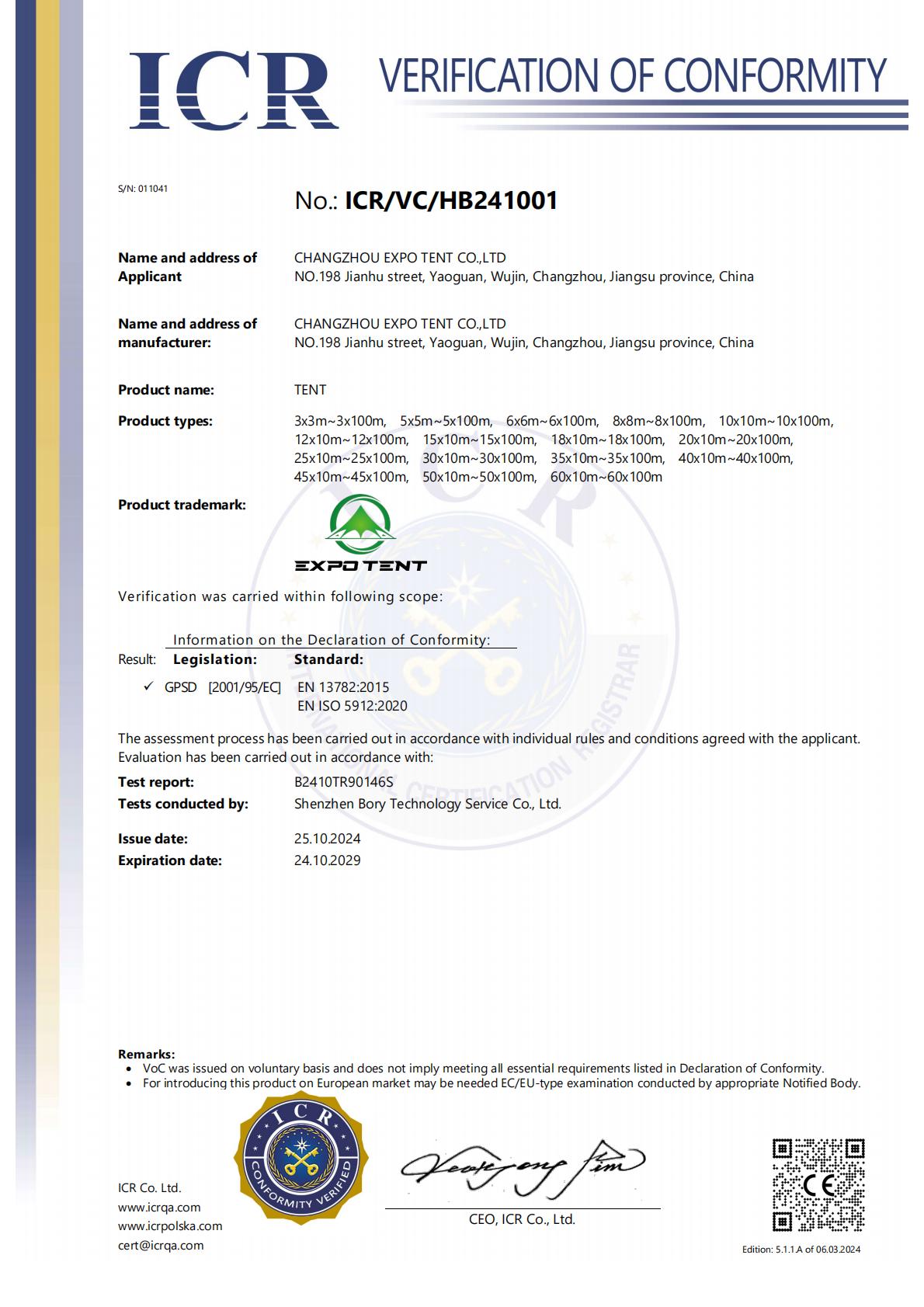 Certification documents should be read as scoped records: issuer, standard, product family and validity all belong in the order file.
Answer first: the document that most often decides an EU tender is a CE certificate issued against EN 13782:2015, and it should be read as a scoped record rather than a general statement of quality.
Expotent’s documented CE certificate, number ICR/VC/HB241001, was issued by ICR on 25 October 2024 against EN 13782:2015 for the European market, and runs to 24 October 2029. It references the Event Tent series, models SLP-3 through SLP-50.
Four checks turn that paragraph into a usable verification step:
- Issuer and market scope. Confirm who issued the certificate and that its stated scope names the market and product family you are ordering into.
- Model coverage. A certificate naming SLP-3 to SLP-50 does not automatically extend to every structure in a supplier’s catalogue. Ask for the coverage that matches the ordered model and configuration.
- Validity window. Confirm the expiry date falls after your delivery and installation window, not merely after the order date.
- Standard version. EN 13782:2015 is the referenced edition; confirm that the version is the one your client, insurer or destination authority accepts.
Beyond the CE certificate, two further document families belong in a procurement file. A manufacturing quality-system certificate such as ISO 9001 addresses process control rather than the structure itself. Fabric flame-resistance evidence such as NFPA 701 addresses the membrane, and is requested where the destination requires it. In the United States, NFPA 102 is the reference for tents and membrane structures and is a separate question from the EU structural standard; it should be checked against the specific venue and jurisdiction rather than assumed to follow from an EU certificate.
How acceptance emphasis shifts by application
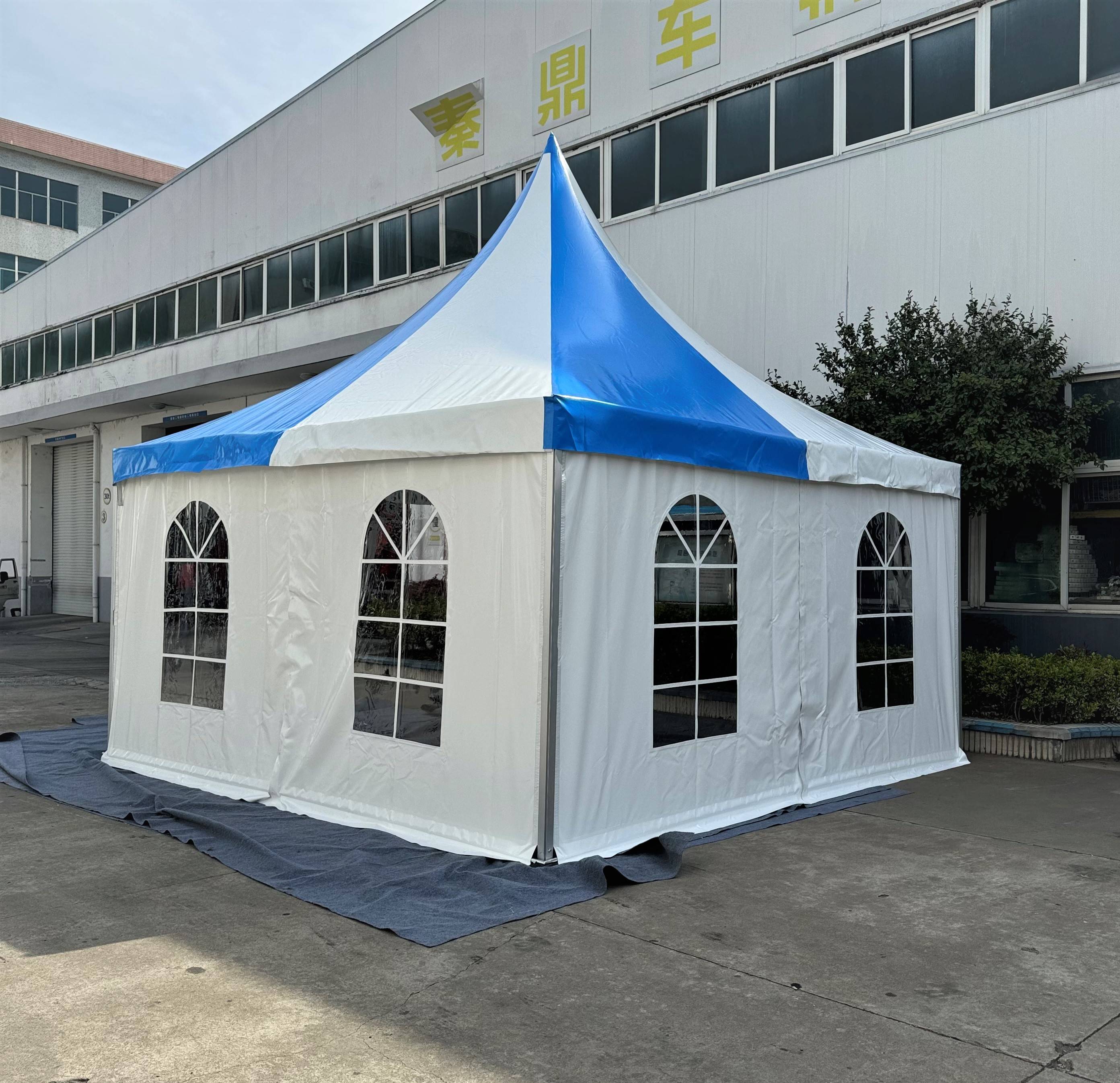 Pagoda and other modular formats are accepted on different criteria than warehouse or exhibition structures.
Answer first: the same acceptance framework applies across tent types, but the criteria that decide whether a delivery is usable differ by application, and the purchase order should weight them accordingly.
- Party and wedding tents. Appearance-led acceptance dominates: membrane cleanliness, window and lining fit, symmetry of the roof profile, and finishing at the connections where guests will look.
- Exhibition tents. Repeatability and speed of assembly matter most, together with LOGO and print customization fixed at order stage so that branding is not resolved after production begins.
- Warehouse and industrial tents. Span, weather sealing and anchoring take priority over finish. The supplier’s case record for an OEM party-tent project in Uruguay lists rain and wind resistance as the outcome highlight across a recorded ten-year duration — the kind of performance claim that should be tied to explicit test evidence for buyers in exposed sites.
- Sports and padel structures. Enclosure and sidewall systems, plus a documented sequence for partial installation, determine how quickly a site can be returned to use.
- Pagoda, atrium and clear-span marquee formats. Connection detailing and the interface between structure and finishing elements decide whether the delivered kit closes cleanly.
Fit boundaries: where these terms suit a buyer, and where they do not
Answer first: this term set fits buyers who want a documented relationship with a Chinese manufacturer across single-unit to programme volumes. It fits less well where the buyer expects the supplier to carry destination conformity or on-site installation.
- Single-unit and sample orders fit the one-unit MOQ; they rarely fit freight economics, so total landed cost should be modelled before the order is placed.
- OEM production with LOGO customization fits branding and rental programmes, provided artwork approval is completed before the lead-time clock starts.
- Documentation support fits EU and other regulated markets at the certificate level; importer-side obligations and venue approvals remain with the importer.
- After-sales support is documented as an assembly video. That is useful for a competent installation crew and is not a replacement for one, nor for site engineering where local conditions require it.
Outlook for the next buying cycle
Any outlook here is conditional on the evidence above rather than a forecast of volumes. If export concentration and standards gatekeeping persist — and nothing in the current evidence set suggests either is reversing — three procurement practices are likely to become routine in cross-border tent contracts: acceptance criteria written into the purchase order instead of assumed, certificate scope recorded against each order line, and payment triggers tied to inspection events rather than to dates. Buyers should treat these as planning assumptions to re-verify at each order, and should ask suppliers which documents they will provide before the order is confirmed rather than after production closes.
FAQ
What is the minimum order quantity for a commercial tent?
The documented MOQ is one unit, with OEM production and LOGO customization available alongside it. Buyers should confirm that the MOQ applies to the specific model, size and configuration in the quotation, since the Event Tent series spans multiple model references and a catalogue-level figure may not match a configured order.
Which delivery terms are offered, and where does supplier responsibility end?
Delivery is quoted on FOB or CIF terms. Under FOB, supplier responsibility ends when the goods are loaded on board at the port of shipment; under CIF, the supplier additionally arranges ocean freight and insurance to the named destination port. In both cases, import clearance, duties, inland delivery to site and destination-market conformity obligations sit with the buyer as importer of record.
What acceptance criteria apply before shipment?
Acceptance rests on a pre-shipment test assembly of the tent, which is also the recorded quality-control method: the structure is erected before dispatch to verify that frame, hardware and membrane fit together and that components are complete. The test is a supplier-side build check. Buyers who require third-party structural verification, witnessed inspection or a site-specific wind-load assessment should specify those as separate requirements in the purchase order.
Which certification should an EU buyer request for an event tent order?
The CE certificate issued against EN 13782:2015. For Expotent, certificate ICR/VC/HB241001 was issued by ICR on 25 October 2024 for the European market, references the Event Tent series SLP-3 to SLP-50, and expires on 24 October 2029. Buyers should confirm that the ordered model falls inside that scope. Where the destination requires fabric flame-resistance evidence, NFPA 701 reports are commonly requested, and ISO 9001 covers the manufacturing quality system rather than the structure.
How long is production, and what capacity supports it?
Production lead time is stated as 20–30 days, against a monthly capacity of 10,000 m² and annual output of 100,000 m². That lead time covers production only; ocean transit, port handling and inland delivery are additional. Custom LOGO work and artwork approval should be completed before the production clock starts so the schedule reflects a locked specification.
Manufacturer context
Changzhou Expo Tent Co., Ltd. (Expotent) was established in 2010 and operates a 3,000 m² facility with 30 employees, including a three-engineer development team, producing events tents, party tents, warehouse tents, wedding tents, church tents, pagoda tents, clear-span tents, frame tents, sports tents and marquees. Recorded annual output is 100,000 m², with an export ratio of 50% across the EU, Africa, the USA, Asia and the Middle East.
The company’s product brochure is available for public access and download: Expotent product brochure (PDF).
Tem questões ou precisa de mais detalhes?
Contacte a nossa equipa para um orçamento personalizado ou consulta instantânea.
Solicitar orçamento
Preencha o formulário abaixo e a nossa equipa entrará em contacto com uma proposta personalizada.
Chat direto do WhatsApp
Prefere conversar em tempo real? Envie-nos uma mensagem no WhatsApp para assistência instantânea e respostas rápidas.
- Obter orçamento personalizado
- Partilhar fotos ou documentos
- Discuta as suas necessidades diretamente
Geralmente responde em 5–30 minutos durante o horário de expediente.