
Terms, Precision, Acceptance: CNC Machining Procurement FAQ
Terms, Precision, Acceptance: CNC Machining Procurement FAQ
CNC machining procurement rarely fails because a machine shop cannot cut metal. It fails because two documents disagree: the buyer's drawing implies one acceptance standard, the supplier's quotation implies another, and neither side notices until inspection. A CNC machining service offer is therefore not a price list. It is a three-part commitment that covers commercial terms, technical capability and acceptance evidence — and the three must describe the same order.
This reference answers the questions that surface most often between supplier evaluation and the first purchase order. Suzhou ECOD Precision Manufacturing Co., Ltd (ECOD) is used as the worked example throughout: a Suzhou-based precision machining supplier founded in 2005 that provides custom CNC machining under OEM and ODM arrangements, reports that 100% of its sales are exports to Europe, the Middle East, North America and Asia, and publishes the three elements a buyer can actually test — order terms, tolerance figures and certificate details.
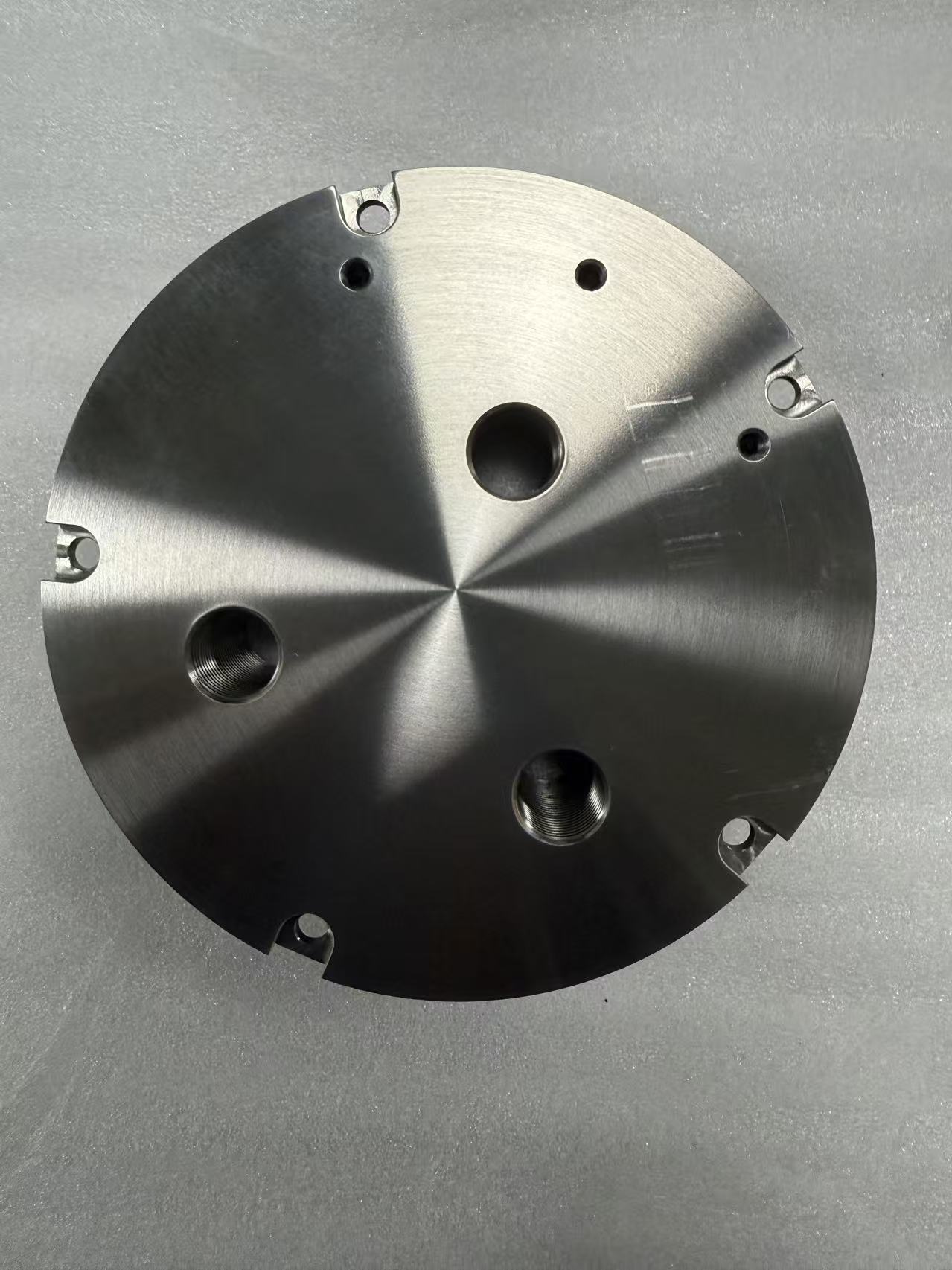
Precision machined components for demanding industrial applications. Image: ECOD.
Three parts of a CNC machining service offer that must agree
A complete offer answers three different questions in one document set, and no single part substitutes for another.
- Commercial terms — minimum order quantity, quotation turnaround, delivery terms, payment split and batch range. These decide whether the order can be executed at all.
- Technical scope — axis capability, processes, materials and the tolerance the supplier will be held to. These decide whether the part is manufacturable to print.
- Acceptance evidence — inspection coverage, certificates, reports and the point at which the buyer accepts the goods. These decide who carries the risk when a dimension drifts.
A quotation that supplies only a price and a lead time has answered the first question and left the other two to be discovered later, usually at the least convenient moment in a production schedule.
Commercial terms: MOQ, quotations and delivery conditions
ECOD publishes a minimum order quantity of one piece and describes production that spans prototypes, small batches and mass production, with a monthly capacity of 100,000 pieces and a quoted lead time of 10 to 60 days. The one-piece MOQ matters most for CNC prototype machining and first-article evaluation, because it lets a buyer place a measured test order before committing to a volume schedule. It does not mean a single unit carries the same unit price as a 10,000-piece release: programming, setup and inspection effort are spread across far fewer parts.
Quotation turnaround is a separate variable from lead time, and buyers routinely conflate the two. ECOD states a 24-hour quotation response, which is only achievable when the request contains what a CNC machine shop needs in order to price honestly: a 2D drawing or 3D model with its revision, the material grade and condition, the critical tolerances and datum scheme, surface treatment and machining finish, quantity, and the intended delivery term. An incomplete RFQ generally produces a placeholder price that is revised once the missing information arrives.
| Order term | Published position (ECOD) | What the buyer should confirm |
|---|---|---|
| Minimum order quantity | 1 piece | Whether the quoted unit price still holds at 1–10 pieces, and how setup is amortised across the batch |
| Quotation turnaround | 24-hour response stated | That the RFQ carries drawing revision, material, critical tolerances, finish, quantity and Incoterm |
| Batch range | Prototypes to mass production; 100,000 pieces monthly capacity | Which volume band the price tier refers to, and when capacity must be reserved |
| Lead time | 10–60 days | Which clock is quoted: material procurement, machining, or machining plus inspection and packing |
| Delivery terms | EXW, FOB, CIF, CIP, FCA, CPT, CFR, DAP, DDP | Where risk transfers, who insures, and who handles export clearance under the chosen term |
| Payment structure | 30/70 | Which documents release the balance — typically the dimensional inspection report and material certificate |
Table 1: Order terms as published by ECOD, mapped to the confirmation a buyer should obtain before releasing a purchase order.
The Incoterm deserves more attention than it usually receives during evaluation. For an importer, the delivery term fixes the point at which risk transfers and clarifies who arranges export documentation; for a first order, the 70% balance is the practical lever that ties final payment to inspection documents rather than to a shipping date alone. Both are commercial decisions, but both change what the acceptance section later has to prove.
Technical scope: what 3-, 4- and 5-axis capability changes
ECOD reports 3-, 4- and 5-axis CNC machining centres alongside CNC lathes and precision grinding equipment, with process coverage that includes milling, turning, drilling, grinding, tapping and EDM. Customization is driven by the customer's 2D/3D drawings, material, dimensional tolerance, surface treatment and machining finish. Those two lists answer different questions and are often read as one.
The process list answers can this feature be produced at all. A symmetrical part with concentric bores is a CNC turning service job; a prismatic housing with pockets on several faces is a CNC milling service job; hardened or intricate geometry may route to grinding or EDM; threaded and tapped holes are secondary operations appended to either route. For a buyer assembling a request, this is the layer that determines which supplier type belongs on the list at all.
Axis count answers a different question: how many setups the part requires. Five-axis machining lets complex geometry be reached with fewer re-fixturing steps, which matters most where a part carries angular features, deep pockets or intersecting bores — every additional setup reintroduces a positioning error and an inspection step. It is not automatically faster or more accurate on a simple part, and a straightforward bracket is frequently more economical on a 3-axis operation. The productive question during evaluation is therefore not how many axes a supplier lists, but which features on your drawing require simultaneous multi-axis motion and what that does to cost structure and inspection planning.
Materials follow the same logic. ECOD machines aluminium, stainless steel, copper and various alloy steels, covering aluminium CNC parts, stainless steel machining and copper work through to general CNC metal parts for industrial equipment. Grade and condition must sit on the RFQ: "aluminium" alone does not define machinability, and 304 versus 316 stainless behaves differently on the same operation. ECOD provides material certificates with orders, which is the document that closes this gap at acceptance rather than at quotation.
Engineering support belongs in this section too, because it changes the cost of a part before any metal is cut. ECOD's team of 25 engineers provides DFM optimization intended to simplify production and reduce cost — typically by re-examining feature geometry, tolerance distribution and fixturing assumptions while the design is still editable. A buyer who receives DFM feedback before the PO is in a materially better position than one who receives it after first-article failure.
What ±0.005 mm means in a quotation — and what it does not
The ±0.005 mm figure that circulates in CNC machining service discussions is usually a product-level tolerance, not a blanket capability statement. ECOD's published listing for a stainless steel and carbon steel turbo compressor impeller reports a tolerance range of ±0.005 to 0.01 mm together with surface roughness of Ra0.2 to Ra3.2. Read precisely, that is a range attached to one listed component, with an associated finish band, published without the drawing, datum scheme or measurement method.
Three consequences follow. First, tolerance applies to a feature, not to a part: a drawing may call ±0.005 mm on a bearing bore while general tolerance governs everything else, and a competent quote should reflect both rather than averaging them. Second, a tolerance without a stated measurement method is not verifiable, because CMM, micrometer, bore gauge and optical comparison carry different uncertainty and produce different verdicts on the same part; the inspection method belongs in the quotation, not in the post-mortem. Third, a published figure is the start of a drawing-specific conversation, not a promise that any geometry can be held at that limit — thin walls, long bores, interrupted cuts and small radii all change what is achievable on a given machine and fixture.
Acceptance criteria: certificate scope, inspection and paperwork
ECOD's acceptance framework rests on three elements buyers usually check in sequence: a certified quality management system, 100% inspection before shipment, and a document package that travels with the goods. Acceptance criteria are stated as factory inspection.
On the first element, the certificate detail matters more than the logo. ECOD holds ISO 9001 certification under certificate number 33826Q00178R000, issued by Shanghai Wozhong certification Co. Ltd against GB/T19001-2016/ISO9001:2015, valid from 16 June 2026 to 15 June 2029, with a scope of “Custom CNC Machining Parts Sales”.
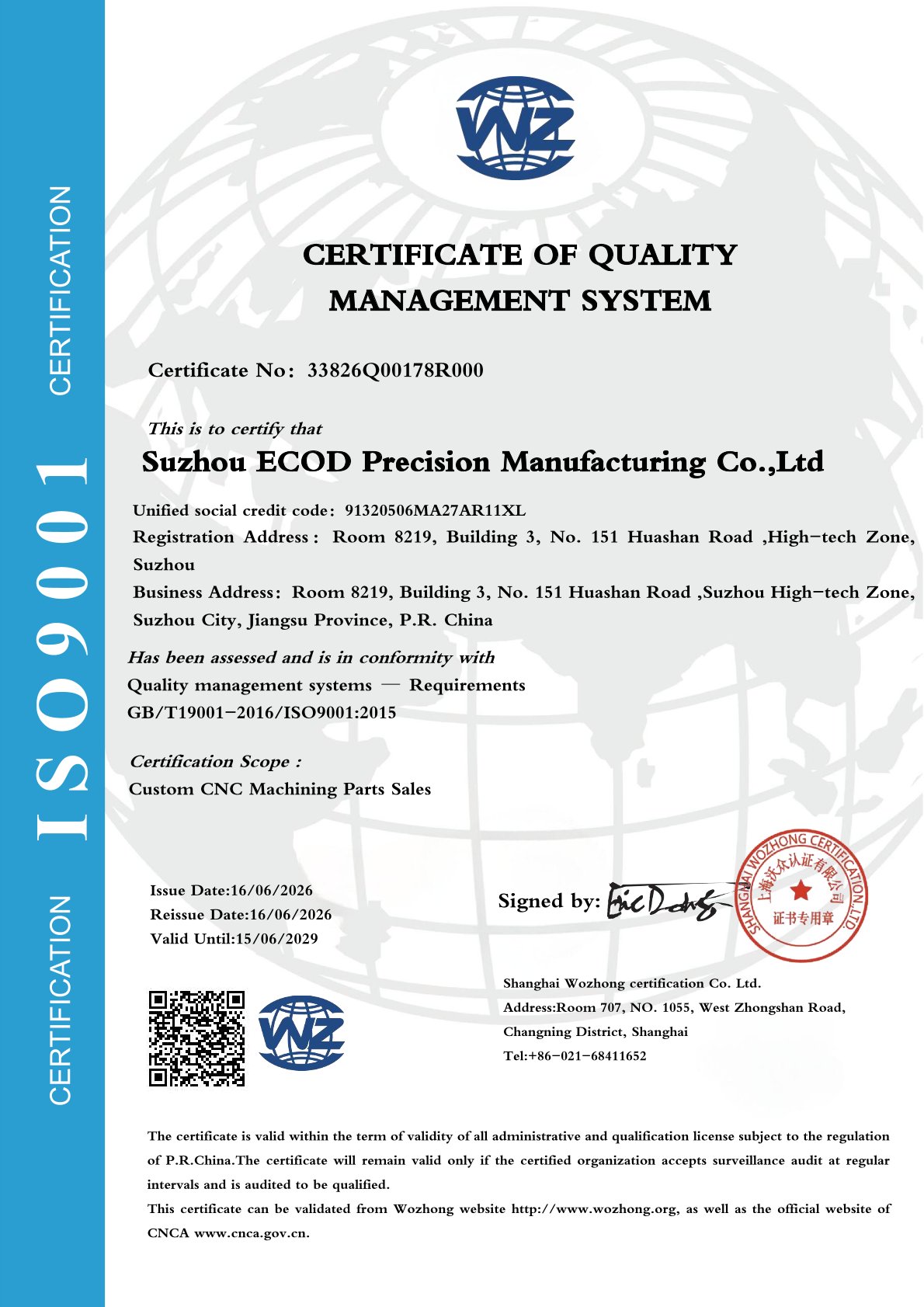
ISO 9001 certificate 33826Q00178R000, valid 16 June 2026 to 15 June 2029, scope: Custom CNC Machining Parts Sales. Image: ECOD.
That scope sentence carries the weight. ISO 9001 certifies a quality management system for a defined scope over a defined period; it is not a product certificate, not a statement that every machined part conforms to a particular tolerance, and not a process-capability study for a tight feature on a new geometry. What it does establish is that documented procedures, internal review and corrective-action mechanisms were audited against a recognised standard for the stated activity — which is why buyers in regulated supply chains use it as a screening filter and then test capability separately.
Inspection coverage is the second element. ECOD's stated quality control is 100% test before shipment, with material certificates and dimensional inspection reports supplied for all orders. The word "100%" describes coverage of units, not the depth of the inspection plan: a plan that measures one overall length on every part satisfies 100% coverage without touching the critical bore. That distinction should be settled in writing before the first batch, and it is the single most common source of disagreement in precision machined parts programmes.
| Acceptance evidence | What it establishes | What it does not establish |
|---|---|---|
| ISO 9001 certificate (number, issuing body, scope, validity) | A quality management system audited for the stated scope within the validity period | Conformance of a specific part, or capability for a specific tolerance |
| 100% inspection before shipment | Every unit was inspected under the supplier's plan | That the plan covers your critical dimensions, unless those are specified |
| Material certificate | Grade and heat traceability as issued by the material producer | Machining accuracy or surface finish |
| Dimensional inspection report | Measured values on the features listed in the report | Independent third-party verification, unless witnessed or separately commissioned |
| Factory inspection as acceptance criterion | The buyer or representative accepts the goods at the supplier's site | Performance in service or behaviour after assembly |
Table 2: Common acceptance documents, separated from the conclusions they do not support.
Where the documented scope is used: industries and two case records
ECOD's published records describe work across aerospace, medical, new energy and automation industries, with detailed case documentation for aerospace and oil & gas programmes. Two records are worth reading side by side because they test different things.
In an aerospace unmanned aerial vehicle programme, the company reports 1,000,000 pieces delivered over one year with stable quality in mass production, matched to aerospace precision requirements. In an oil & gas equipment programme, it reports 10,000 pieces over five years, adapted to harsh operating environments, with improved equipment reliability reported as the outcome. Both are company-reported case records rather than independently audited results, and the honest reading for a buyer is this: the volume range of 10,000 to 1,000,000 pieces and the duration of one to five years change what should be verified. A five-year programme tests consistency, change control and documentation continuity; a one-million-piece annual release tests repeatability at rate and the inspection plan's ability to hold without slowing throughput.
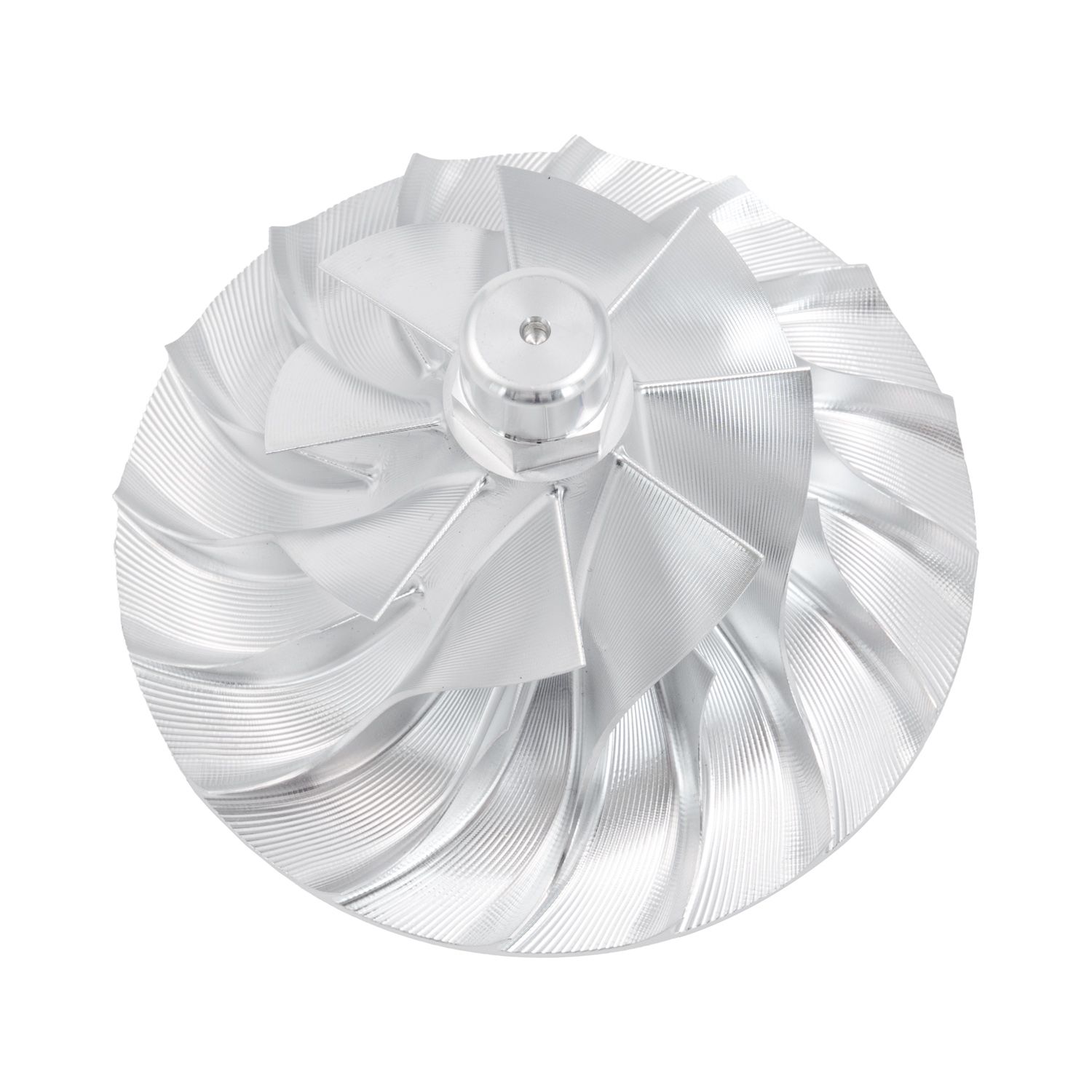
Precision machined aerospace components. Image: ECOD.
The boundary is equally important. ISO 9001 is a general quality management system standard; regulated programmes — aerospace, medical, energy — normally carry their own qualification requirements on top of it, and a buyer should confirm which approvals the specific programme requires and whether the supplier actually holds them, rather than inferring them from a general certificate. ECOD's supplied certification record covers ISO 9001 with the scope stated above.
Price-only sourcing versus documented sourcing: five comparison criteria
The two procurement styles differ less in price than in what happens when something goes wrong. Neither is universally correct, and the comparison below is descriptive rather than a ranking.
- Quote comparability. A drawing-only RFQ returns prices that cannot be compared, because each shop prices a different inspection depth. A documented RFQ returns fewer bids but comparable ones.
- Risk allocation. Under price-only sourcing, the buyer discovers the inspection gap at incoming inspection. Under documented sourcing, the gap is visible before the PO is released.
- Engineering change. A supplier holding DFM support can absorb a design revision inside the quotation cycle; a price-only relationship tends to re-quote from zero.
- Acceptance evidence. Material certificates and dimensional inspection reports convert a dispute about a dimension into a comparison between measured value and drawing callout.
- Auditability. Certificate numbers, scopes and validity dates can be checked against the issuing body; a logo on a website cannot.
Market context: what the forecasts cover, and what they do not
Procurement documents often cite manufacturing forecasts, and two are frequently attached to CNC machining material. Fortune Business Insights projects the global smart manufacturing market growing from USD 394.35 billion in 2025 to USD 1,339.17 billion by 2034, at a CAGR of 14.70%. Dataintelo projects the CNC machining services market reaching USD 116.65 billion by 2034, with Asia Pacific accounting for roughly 42% of global share. Both are commercial research with different market boundaries: the first covers smart manufacturing technologies and solutions far beyond machining services, and the two should never be combined, averaged or used as a price benchmark for a specific part.
The buyer-relevant signal is qualitative rather than numeric. AAT3D describes smart machining in terms of CNC probing, metrology feedback and CNC inspection informing the manufacturing workflow; JITBASE lists IoT, AI, robotics and digital twins among the Industry 4.0 themes applied to machining. Vendor and commercial sources of this kind support a directional observation — that inspection data is migrating from a post-script into the deliverable itself — without establishing any productivity figure. For a procurement file, that means an inspection report with measured values is increasingly a normal expectation rather than an exception.
Outlook: what buyers will be asked to document next
If inspection data continues to move into the delivery package, the practical effect on a CNC machining service buyer is a shift in where the work happens. Three items are likely to enter the standard RFQ, and each is already visible in the terms described above: a named measurement method for each critical feature, a document list that specifies what travels with the shipment, and a certificate reference with scope and validity dates rather than a logo. Suppliers publishing a one-piece MOQ, a stated quotation turnaround and a certificate scope make this pre-qualification faster; buyers who specify the inspection plan make the comparison fair. Neither side gains from leaving the acceptance clause to be negotiated after the first batch fails.
Frequently asked questions
What is the minimum order quantity for ECOD CNC machining?
The published minimum order quantity is one piece. ECOD's production model spans prototypes, small batches and mass production, with monthly capacity of 100,000 pieces and a lead time of 10 to 60 days. Unit price changes with volume because programming, setup and inspection are spread across fewer parts at low quantities, so a one-piece order is best read as a capability and first-article test rather than a price sample for a production release.
What should an RFQ contain so the quotation is usable?
A usable request includes the 2D drawing or 3D model with revision, material grade and condition, the critical tolerances and datum scheme, surface treatment and machining finish, quantity and batch plan, the intended delivery term, and the inspection requirements. ECOD states a 24-hour quotation response, and the accuracy of that response depends on whether those inputs are present: a partial RFQ generally returns a placeholder price that is revised once the drawing detail and inspection expectations are known.
Does the ±0.005 mm figure apply to every machined part?
No. The figure appears in ECOD's published listing for a specific stainless and carbon steel turbo compressor impeller, which reports a tolerance range of ±0.005 to 0.01 mm and surface roughness of Ra0.2 to Ra3.2. It is a product-level specification for that listed component, not a company-wide guarantee. Achievable tolerance depends on the feature, geometry, material condition, fixturing and the measurement method used, so it should be confirmed against your own drawing before an order is placed.
What does ECOD's ISO 9001 certification actually cover?
The certificate is number 33826Q00178R000, issued by Shanghai Wozhong certification Co. Ltd against GB/T19001-2016/ISO9001:2015, valid from 16 June 2026 to 15 June 2029, with the scope “Custom CNC Machining Parts Sales”. It certifies a quality management system for that scope during that period. It is not a product certificate, does not state that any particular part meets a particular tolerance, and does not demonstrate process capability for a new geometry — those are established through drawing-specific confirmation and inspection of sample parts.
Which machining processes and materials are available?
ECOD reports 3-, 4- and 5-axis machining centres alongside CNC lathes and precision grinding equipment, covering milling, turning, drilling, grinding, tapping and EDM, with customization based on customer 2D/3D drawings, material, dimensional tolerance, surface treatment and machining finish. Materials include aluminium, stainless steel, copper and various alloy steels. Engineering support for DFM optimization is provided by a team of 25 engineers, and material certificates are issued with orders.
How is acceptance handled before shipment?
ECOD's stated quality control is 100% test before shipment, with material certificates and dimensional inspection reports provided for all orders; the stated acceptance criterion is factory inspection, and payment is structured at 30/70. Buyers should confirm in writing which features the inspection plan measures, because 100% coverage describes how many units are inspected rather than which characteristics are checked — the two are often confused when a first batch is rejected on a critical dimension.
Preparing a request
For buyers ready to test any of the above against their own drawing, ECOD's capability and process information is published at Suzhou ECOD Precision Manufacturing Co., Ltd, and the company brochure is available as a downloadable PDF. RFQs and technical questions can be sent to info@ecodcn.com, or by telephone on +86 15527751869; the facility is located at No.151, Huashan Road, Suzhou New District, 215129, Suzhou, China. Including the drawing revision, material grade, critical tolerances, inspection expectations and delivery term in the first message is the difference between a 24-hour quotation and a week of clarification.
Tem questões ou precisa de mais detalhes?
Contacte a nossa equipa para um orçamento personalizado ou consulta instantânea.
Solicitar orçamento
Preencha o formulário abaixo e a nossa equipa entrará em contacto com uma proposta personalizada.
Chat direto do WhatsApp
Prefere conversar em tempo real? Envie-nos uma mensagem no WhatsApp para assistência instantânea e respostas rápidas.
- Obter orçamento personalizado
- Partilhar fotos ou documentos
- Discuta as suas necessidades diretamente
Geralmente responde em 5–30 minutos durante o horário de expediente.