
Terrain-Specific Fit: Matching WIDEWAY Off-Road Tires to Mud, Sand and Rock Jobs
Off-road tire selection fails far more often as a fit problem than as a quality problem. A mud-terrain tire engineered to clear deep, soft ground is the wrong unit for a fleet that runs mostly paved kilometres between sites, and an all-terrain tire that behaves well in mixed urban and off-road use reaches its limit the moment the surface turns into deep mud. The category label on the sidewall rarely describes the job the buyer actually has.
This reference addresses that gap. It maps the classification structure behind WIDEWAY off-road tires — the off-road line of Shandong Wideway Tire Co., Ltd., a Qingdao-based tire manufacturer that also operates the EVERLAND and V-RICH brands — onto specific terrain jobs: mixed urban and off-road use, sand dunes and hot climates, deep mud, rocky ground, winter snow, and low-speed wet organic terrain. Every claim below is anchored to unit-level data recorded in the company's product, capability and certification files: classification terms, maximum pressure, section width, load index, speed rating, model sizes and certification scope.
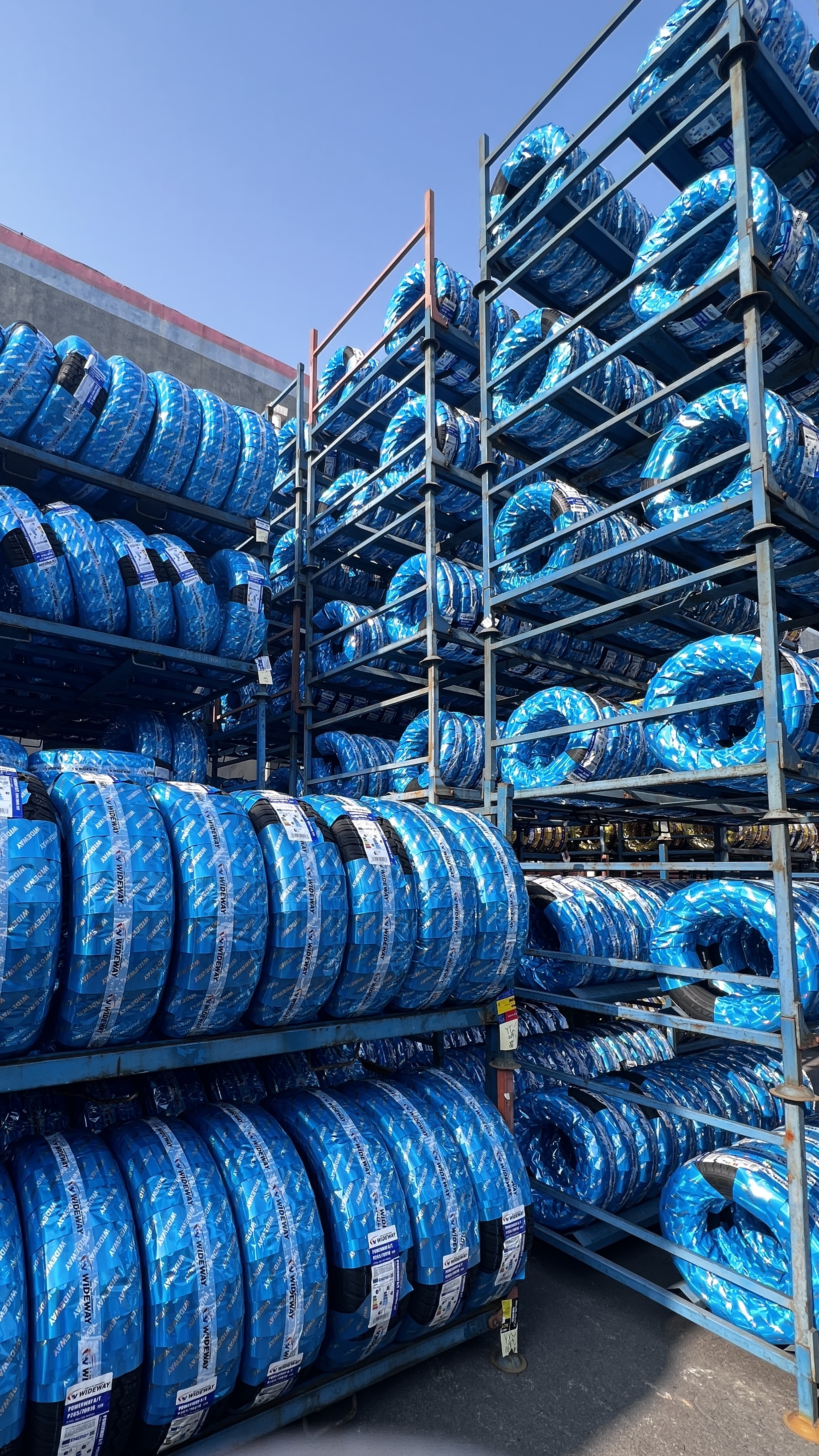
Finished off-road tires wrapped and staged for export shipment. Source: Shandong Wideway Tire Co., Ltd. product records.
Why “off-road tire” is not a specification
Three mismatches account for most off-road specification errors.
- Classification error: treating off-road as a single product type, when the WIDEWAY off-road line separates all-terrain (AT), mud-terrain (MT) and rugged-terrain (RT) constructions whose documented attributes differ materially.
- Parameter error: selecting the correct classification but the wrong maximum pressure, load index or speed rating for the vehicle and its loaded weight.
- Notation error: assuming similarly written size designations are interchangeable, when the range records both LT-metric and flotation formats — for example LT285/75R16 and 35X12.50R17LT.
None of these are resolved by tread appearance. They are resolved by the classification and parameter data attached to each product unit, which is exactly where a terrain-matching exercise should start.
How the WIDEWAY off-road range is classified
The off-road product records group units by terrain classification rather than by vehicle type. Four classification clusters appear across the off-road line, each carrying its own documented pressure, load and speed data.
| Classification cluster | Documented classification terms | Product unit | Max pressure | Section width | Load index | Speed rating |
|---|---|---|---|---|---|---|
| All-terrain (AT), mixed-use | Comfortable and noiseless Off-Road Tire; Urban Road Off-Road Tire; High-speed stability Off-Road Tire; All Terrain Off-Road Tire; 4*4 AT Off-Road Tire | 5098 | 300 KPA | 272 mm | 111 | T |
| All-terrain (AT), sand and hot climate | All Terrain Off-Road Tire; 4*4 AT Off-Road Tire; Sand Dunes & Hot Climates Off-Road Tire | 5100 | 550 KPA | 292 mm | 121/118 | Q |
| All-terrain (AT), sand and hot climate | Same term set as 5100 | 5101 | 550 KPA | 277 mm | 119/116 | R |
| All-terrain (AT), sand and hot climate | Same term set as 5100 | 5102 | 550 KPA | 272 mm | 120/117 | R |
| All-terrain (AT) with winter classification | All Terrain; 4*4 AT; Sand Dunes & Hot Climates; Winter and Snow Off-Road Tire | 5103 | 550 KPA | 272 mm | 120/117 | Q |
| Mud-terrain (MT) | Mud Terrain Off-Road Tire; 4*4 MT Off-Road Tire | 5104 | 550 KPA | 272 mm | 121/118 | Q |
| Mud-terrain (MT), wide section | Mud Terrain Off-Road Tire; 4*4 MT Off-Road Tire | 5105 | 450 KPA | 330 mm | 121 | Q |
| Mud-terrain (MT) | Mud Terrain Off-Road Tire; 4*4 MT Off-Road Tire | 5118 | 550 KPA | 235 mm | 120/116 | Q |
| Rugged-terrain (RT), reinforced sidewall | Rugged Terrain Off-Road Tire; 4*4 RT off-Road Tire; Reinforced Sidewall Off-Road | 5119 | 552 KPA | 272 mm | 123/120 | Q |
| Rugged-terrain (RT), reinforced sidewall, wide section | Rugged Terrain Off-Road Tire; 4*4 RT off-Road Tire; Reinforced Sidewall Off-Road | 5121 | 350 KPA | 318 mm | 121/118 | R |
Off-road unit parameters as recorded in WIDEWAY product documentation.
Two observations follow directly from this data. First, comfort and noise attributes — “Comfortable and noiseless Off-Road Tire” and “Urban Road Off-Road Tire” — are documented only on the all-terrain group. No equivalent comfort or noise term appears on any mud-terrain or rugged-terrain unit. Second, the all-terrain group is not internally uniform: documented maximum pressure ranges from 300 KPA to 550 KPA and load index from 111 to 121/118, so the AT label alone does not determine load capacity.
Matching the classification to the terrain job
Terrain-matching becomes operational once the classification vocabulary is fixed. The table below maps a job description to the classification and model sizes recorded for it, and states what the documentation actually supports.
| Terrain job | Classification to specify | Representative model sizes recorded | What the data supports |
|---|---|---|---|
| Mixed urban and light off-road | AT — comfort and noiseless, urban road, high-speed stability | LT265/70R17, LT285/75R16, 31*10.50R15LT | The only off-road group carrying documented noise and comfort attributes. |
| Sand dunes and hot climates | AT units also classified “Sand Dunes & Hot Climates” (5100, 5101, 5102, 5103; the term also appears on 5098) | 31*10.50R15LT, LT285/75R16, LT265/70R17 | Dedicated hot-climate units are documented at 550 KPA maximum pressure. |
| Deep mud | MT — mud terrain, 4*4 MT | LT285/75R16, 33*12.50R17LT, LT315/75R16 | Documented MT classification; the widest MT unit reaches 330 mm section width. |
| Rock and rugged ground | RT — rugged terrain with reinforced sidewall | 35X12.50R17LT, LT305/70R16, LT285/75R16 | Reinforced Sidewall Off-Road classification; highest documented load index in the off-road line at 123/120. |
| Winter snow | AT unit also classified “Winter and Snow Off-Road Tire” (5103) | LT265/70R17, LT285/75R16 | A winter classification exists in the range; per-SKU marking must still be verified before sale into regulated markets. |
| Low-speed wet organic terrain | MT classification | LT285/75R16, 33*12.50R17LT | MT is the classification applied to deep, soft, high-moisture ground; documented load and speed limits still govern use. |
Deep mud. The relevant choice is the mud-terrain group, and the records show a deliberate spread inside it: 272 mm section width on 5104, 235 mm on 5118 and 330 mm on 5105, with maximum pressure documented at 550 KPA, 550 KPA and 450 KPA respectively. That spread is the difference between a narrower, higher-pressure fitment and a wider, lower-pressure footprint — a decision a distributor can only make against the vehicle and its load case.
Sand and hot climates. Five all-terrain units carry the Sand Dunes & Hot Climates classification. Four of them are documented at 550 KPA maximum pressure with load indexes between 119/116 and 121/118; the fifth, unit 5098, is documented at 300 KPA with the lowest load index in the off-road line at 111. A hot-climate recommendation that stops at “use an AT tire” therefore leaves out the parameter that matters most.
Rock and rugged ground. The reinforced-sidewall classification appears on exactly two units, 5119 and 5121, and they represent two different construction paths rather than a single product tier.
Reading construction and size data correctly
Reinforced sidewall is a construction attribute recorded in the classification data, not a marketing phrase. On 5119 it is combined with a documented 552 KPA maximum pressure, 272 mm section width, load index 123/120 and speed rating Q. On 5121 the same reinforced-sidewall classification is combined with 350 KPA maximum pressure, a wider 318 mm section width, load index 121/118 and speed rating R.
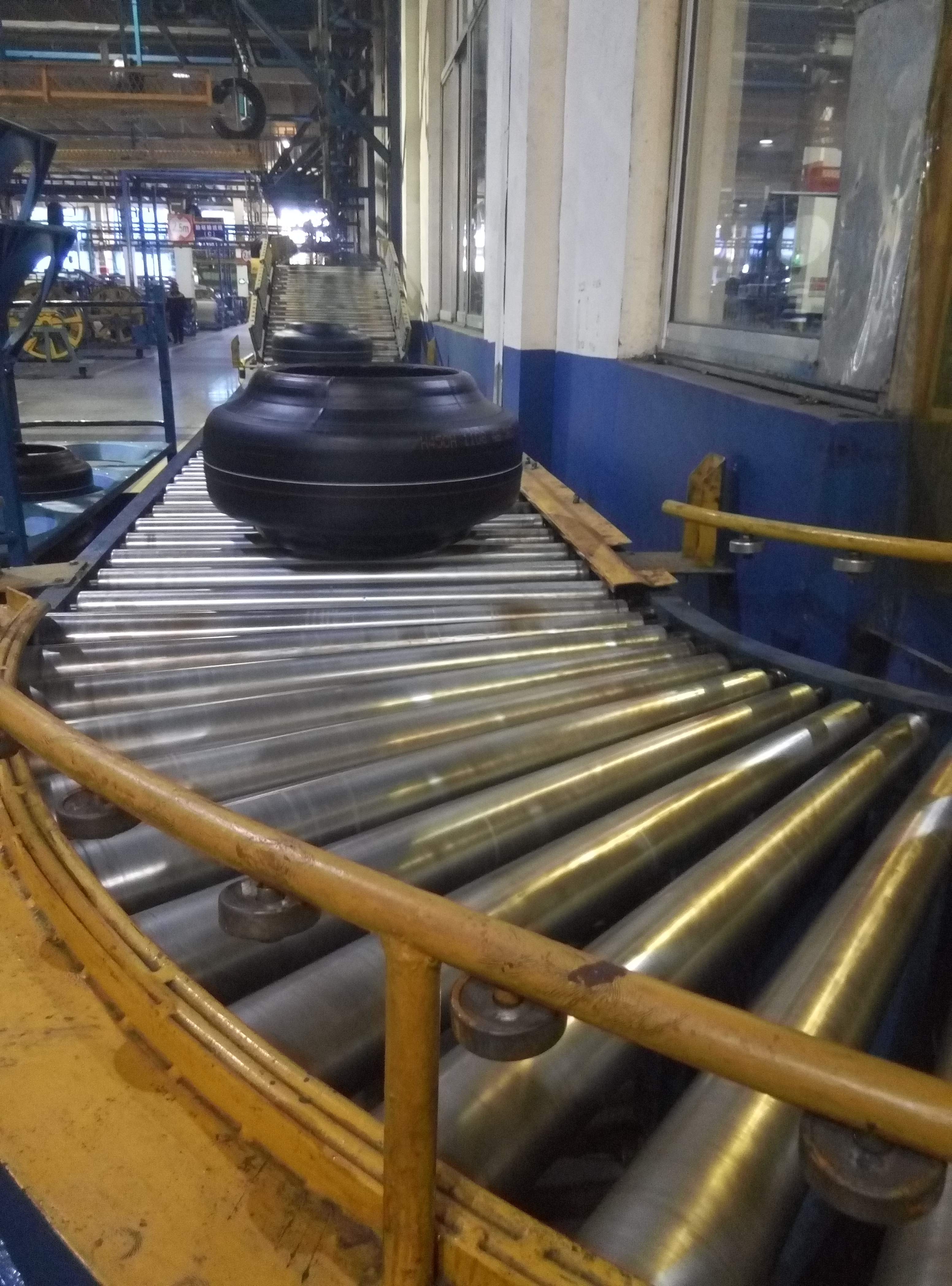
Carcass construction detail. Sidewall reinforcement and ply structure are the physical basis behind the “Reinforced Sidewall Off-Road” classification.
Compound documentation is consistent across the off-road line. Every off-road unit lists the same material family: natural rubber, synthetic rubber, white rubber compound, carbon black, precipitated silica, steel cord, polyester cord fabric, nylon cord fabric, vulcanising agents, vulcanisation accelerators, activators, antioxidants and RAE oil. The presence of a white rubber compound connects directly to the manufacturer's stated customization scope, which covers passenger car tires, off-road tires, white letter tires and white sidewall tires.
Size coverage is broad enough to serve most pickup and SUV fitments. LT285/75R16 is recorded across the off-road line, including units 5100, 5101, 5102, 5103, 5104, 5118, 5119 and 5121. Flotation formats run from 31×10.50R15LT and 33*12.50R17LT through 35X12.50R17LT, 35X12.50R18LT, 37X12.50R17LT, 37X12.50R18LT and 37X12.50R20LT, alongside 33X12.50R20LT, 33X12.50R22LT and 35X12.50R22LT.
The records also show a notation difference worth flagging to any procurement team: one unit lists the size as LT35X12.50R17 while others list 35X12.50R17LT. Buyers should confirm the exact sidewall marking required for their market rather than treating the two formats as interchangeable.
What the capability and procurement data means in execution
Evaluation-stage questions about terrain fit eventually turn into execution-stage questions about capacity, lead time, inspection and paperwork. On those points the manufacturer's documentation is specific.
OEM production services are recorded as available, with customization covering passenger car tires, off-road tires, white letter tires and white sidewall tires. Monthly capacity for this scope is documented at 60,000 pieces, with lead time recorded at 25–45 days and minimum order quantity at one 20-foot container, roughly 400–700 pieces. Quality control is recorded as 100% test. After-sales scope covers custom promotional accessories and tire quality warranty support.
Commercial terms are recorded as delivery FOB Qingdao, with acceptance criteria built around pre-shipment testing and third-party inspection by Bureau Veritas, and payment terms of 30% T/T as deposit with 70% T/T payable against a copy of the bill of lading.
| Certification | Certificate / standard | Authority | Market | Validity recorded | Scope note |
|---|---|---|---|---|---|
| EU Regulation No. 117 E-mark, EU label certificate | E4-117R-025700-S2WR2 / R117 | RDW | EU | Issued 2017-03-24, recorded to 2099-12-31 | Scope includes OFF-ROAD TIRE and AT / MT / RT tires |
| ECE type approval | E4-30R-0264621 / UN Regulation No. 30 | RDW | EU, Africa | Issued 2013-10-14, recorded to 2099-12-31 | Scope includes AT / MT / RT tires |
| SASO GSO product certification | TR13651/2025 / GSO | SASO | Saudi Arabia | 2025-12-11 to 2026-12-11 | GCC market access |
| SONCAP | NGP2026 145940 /0001 / ZA12B6 | Bureau Veritas | Nigeria | 2026-04-01 to 2027-04-01 | Scope includes OFF-ROAD TIRE and AT / MT / RT tires |
| CCC | 2022061201000258 / GB9743-2024 | Beijing Zhong Hua Combination Certification Co., Ltd. | Chinese mainland, Ecuador | 2026-04-20 to 2028-10-16 | Scope recorded as 75-series passenger car radial tyre |
The last row matters as much as the first. The CCC entry's recorded scope is 75-series passenger car radial tyres, not the off-road line, so it should not be presented to an off-road buyer as evidence of off-road type approval in that market.
Supply-continuity evidence exists in a different product category and should be read as such. In Mexico, a program with tire distributors and wholesalers ran over four years and moved more than 400,000 passenger car tires, with 100,000 pieces recorded for the tracked relationship. Documented outcomes were heat resistance and extended mileage in varied road conditions, alongside repeat orders. This is passenger car tire evidence, not off-road performance data; within an off-road procurement discussion its value is limited to demonstrating long-run export supply into a hot-climate market. The manufacturer's export profile — 70% of output exported, with markets listed across Central and South America, Canada, the EU, Africa, the Middle East, Southeast Asia, Central Asia and Australia — is consistent with that pattern.
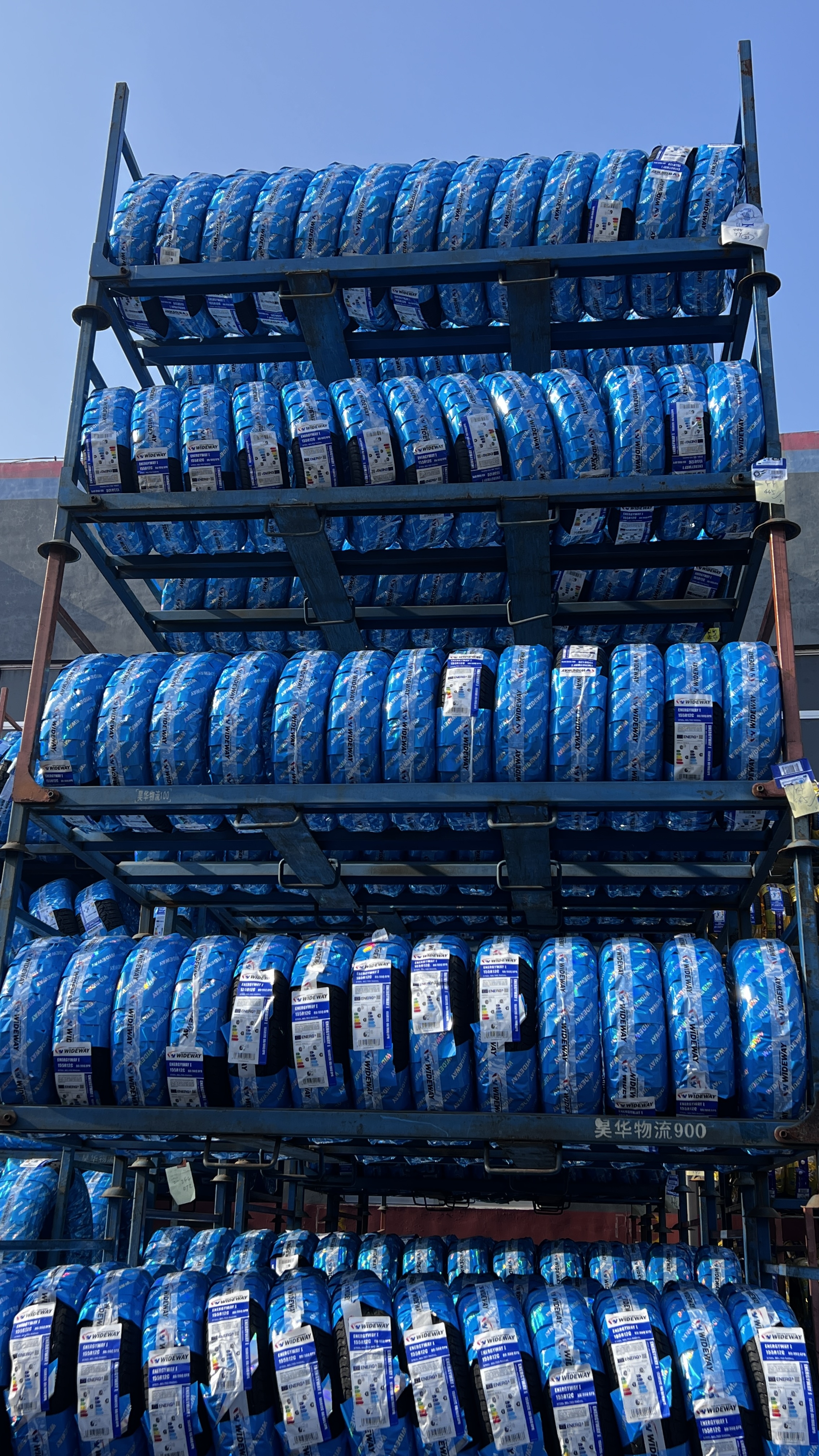
Packing stage before container loading. A one-container minimum order quantity and a 25–45 day lead time set the practical rhythm for terrain-fitment trials.
Market signals behind terrain-specific ranges
Third-party market data gives context for why terrain-specific off-road ranges keep expanding. The global off-the-road (OTR) tire market was valued at approximately USD 34.4 billion in 2024, driven by mining and construction activity, according to Smithers. Within that space, the mud-tire segment alone reached USD 8.3 billion in 2024 with a projected CAGR of 6.1% through 2033, per Credence Research, on the back of off-road recreational demand.
Estimates for the broader OTR market diverge by source: Credence Research places it at USD 32.3 billion for 2024, while Market Research Future's heavy-OTR-focused figure is USD 7.4 billion, because different studies include or exclude agricultural and industrial classes. The direction, rather than the decimal, is the useful signal for a buyer — terrain-specific demand is not a niche.
Two structural trends reinforce the classification split described above. Rugged-terrain (R/T) is reported as a high-growth middle ground, taking share from both traditional A/T and M/T segments among buyers who want aggressive aesthetics without M/T noise levels, per Tire Review AI Insights on the North American market. Regulation is moving in parallel: the Three-Peak Mountain Snowflake (3PMSF) symbol has been mandatory for winter tires used in wintry conditions in Germany since October 2024 and in Sweden since November 2024 under ECE R117, per EU regulation summaries referenced by KENDA Europe. In the United States, all DOT-certified tires for public road use must carry a plant, batch and date code under FMVSS No. 119, while NHS-rated tires are restricted from highway use, according to NHTSA. In Saudi Arabia, SASO certification is mandatory for tires entering the GCC market.
Where the range stops: boundaries to plan around
Terrain-fit advice is only credible when its boundaries are stated.
- Noise and comfort: the comfort and noiseless classification is documented on the all-terrain group only. Buyers specifying MT or RT units for a vehicle that spends meaningful time on paved roads should not assume equivalent documented noise attributes.
- Deep mud boundary: the AT group is the mixed-use compromise, not the deep-mud answer. The MT classification is the documented match for deep, soft ground.
- Pressure and load spread: inside a single classification, documented maximum pressure ranges from 300 KPA to 552 KPA and load index from 111 to 123/120. Fitment must be checked per unit, not per category.
- Speed ratings: the off-road line documents T, Q and R speed ratings. A Q-rated unit does not carry the same documented speed capability as the T-rated AT unit.
- Winter legality: a “Winter and Snow Off-Road Tire” classification in the range does not by itself confirm that a given SKU carries the 3PMSF marking required for wintry-condition use in Germany and Sweden. Marking must be verified per SKU before sale into those markets.
- Order scale: the recorded minimum order quantity is one 20-foot container, roughly 400–700 pieces, with lead time recorded at 25–45 days. A new terrain fitment cannot be tested at single-unit scale through this channel.
- Certification coverage: the recorded CCC scope is 75-series passenger car radial tyres. Assuming that certificate covers off-road SKUs would be incorrect.
- Cosmetic customization: white letter and white sidewall customization applies across passenger car and off-road tire lines; it does not alter the load, speed or pressure data of the base unit.
Outlook
The practical direction of the off-road tire market is toward finer classification, not broader labelling. The data points already in view — a USD 34.4 billion OTR market, an USD 8.3 billion mud-tire segment growing at a projected 6.1% CAGR, reported R/T growth between A/T and M/T, and tightening winter and market-access regulation in the EU and GCC — all push buyers toward documenting terrain fit at the unit level: classification, section width, maximum pressure, load index, speed rating, sidewall marking and certification scope.
For distributors, the useful procurement question is therefore no longer “does the supplier have an off-road tire?” but “which unit in the range is documented for this terrain, this vehicle load, and this market's certification requirements?” Ranges that publish unit-level data across every off-road SKU are easier to specify against and easier to defend in a tender or a distributor catalogue.
FAQ
What is the difference between AT, MT and RT in the WIDEWAY off-road range?
The range separates three terrain classifications. All-terrain (AT) units are documented with terms such as “Comfortable and noiseless Off-Road Tire”, “Urban Road Off-Road Tire”, “High-speed stability Off-Road Tire”, “All Terrain Off-Road Tire”, “4*4 AT Off-Road Tire” and “Sand Dunes & Hot Climates Off-Road Tire”. Mud-terrain (MT) units are documented as “Mud Terrain Off-Road Tire” and “4*4 MT Off-Road Tire”. Rugged-terrain (RT) units are documented as “Rugged Terrain Off-Road Tire”, “4*4 RT off-Road Tire” and “Reinforced Sidewall Off-Road”. Comfort and noise attributes appear only on the AT group.
Which off-road tire classification suits deep mud versus rocky ground?
Deep mud maps to the mud-terrain (MT) group, documented on units 5104, 5105 and 5118. Rocky and rugged ground maps to the reinforced-sidewall rugged-terrain (RT) group, documented on units 5119 and 5121. The two RT units differ: 5119 is documented at 552 KPA maximum pressure, 272 mm section width, load index 123/120 and speed rating Q, while 5121 is documented at 350 KPA, 318 mm section width, load index 121/118 and speed rating R.
What sizes are available for common pickup and SUV fitments?
LT285/75R16 is recorded across the off-road line, including units 5100, 5101, 5102, 5103, 5104, 5118, 5119 and 5121. Flotation-format sizes include 31×10.50R15LT, 33*12.50R17LT, 35X12.50R17LT, 35X12.50R18LT, 37X12.50R17LT, 37X12.50R18LT, 37X12.50R20LT, 33X12.50R20LT and 33X12.50R22LT. Size notation varies between units — for example LT35X12.50R17 appears on one unit and 35X12.50R17LT on others — so the required sidewall marking should be confirmed per market.
Can WIDEWAY off-road tires be produced under OEM or customized programs?
Yes. The manufacturer documents OEM production services and customization covering passenger car tires, off-road tires, white letter tires and white sidewall tires. Monthly capacity for this scope is recorded at 60,000 pieces, with lead time recorded at 25–45 days and minimum order quantity at one 20-foot container, roughly 400–700 pieces.
What are the ordering, inspection and payment terms for off-road tire orders?
The minimum order quantity is recorded as one 20-foot container, approximately 400–700 pieces. Delivery terms are FOB Qingdao. Acceptance criteria are recorded as pre-shipment testing plus third-party inspection by Bureau Veritas, and payment terms are 30% T/T as deposit with 70% T/T payable against a copy of the bill of lading.
Which certifications cover the off-road tire line, and which do not?
Certifications whose recorded scope includes off-road and AT/MT/RT tires are the EU Regulation No. 117 E-mark EU label certificate (E4-117R-025700-S2WR2, RDW), ECE type approval under UN Regulation No. 30 (E4-30R-0264621, RDW) and SONCAP (NGP2026 145940 /0001, Bureau Veritas, Nigeria, standard ZA12B6). The SASO GSO product certification (TR13651/2025) covers the Saudi Arabian market with validity recorded from 2025-12-11 to 2026-12-11. The CCC certificate (2022061201000258, GB9743-2024) has a recorded scope of 75-series passenger car radial tyres and should not be read as covering off-road SKUs.
A full product catalogue covering this range is available for download: EVERLAND CATALOG-2025 (PDF). Manufacturer reference: www.widewaytire.com.