
Tesla Service Partner Networks: Evaluating Ecosystem Readiness in 2026
The electric vehicle aftermarket is moving from one-off transactions to long-term service relationships. For buyers evaluating Tesla service partners, the new question is not just which provider performs a single task well, but which network can deliver consistent, traceable and warranty-backed service across a vehicle's full lifecycle.
The Opportunity in Recurring Tesla Service Demand
The global EV aftermarket is expanding quickly. According to MarketsandMarkets, global EV aftermarket revenue is projected to grow from USD 59 billion in 2024 to USD 195.07 billion by 2035, at an 11.5% compound annual growth rate. For Tesla-specific businesses, industry analysis cited by Vertex AI Search estimates the U.S. Tesla aftermarket parts market at USD 2.8 billion to 4.2 billion, supported by over 1.8 million owners. Tesla's own service revenue is also rising: "Services and Other" revenue reached USD 3.47 billion in Q3 2025, compared with USD 2.79 billion in Q3 2024.
Several EV-specific factors reinforce the need for recurring service. Industry data from Forbes and MarketsandMarkets indicates that EV tires wear out up to 10,000 km faster than ICE vehicle tires, due to instant torque and heavier battery weight. Mitchell data shows the average repairable BEV claim severity in the U.S. was USD 6,236 in 2024, roughly USD 1,170 higher than the average for ICE vehicles. PPFMag reports that Tesla owners are spending up to 300% more on paint protection and repairs than traditional luxury owners, largely due to concerns about water-based paint durability. These figures point to a market where owners need ongoing care, not just occasional repair.
The Problem: Fragmented Aftermarket, Fragmented Value
However, the traditional aftermarket experience is fragmented. A Tesla owner may visit one shop for window tint, another for paint protection film, a third for carbon fiber accessories, and a separate workshop for suspension upgrades or brake service. Each shop operates independently, with its own paperwork, its own quality standards, and often no shared record of the vehicle's service history.
For the owner, this fragmentation creates time costs and compliance risks. For a service provider, it limits customer retention and makes it difficult to build a repeat-service business. For a franchise investor or distributor, fragmentation is an even larger problem: every separate specialty requires a separate vendor relationship, separate training, and separate warranty management. The result is a service experience that is difficult to standardize and almost impossible to scale.
The U.S. legal environment allows an alternative. Under the Magnuson-Moss Warranty Act, Tesla owners can use independent repair shops for routine maintenance without voiding the manufacturer's warranty. This opens the door for independent networks that offer the same category of service as a manufacturer service center, but with a broader aftermarket focus and a more flexible ownership experience.
T9 EV Station as an Ecosystem Reference
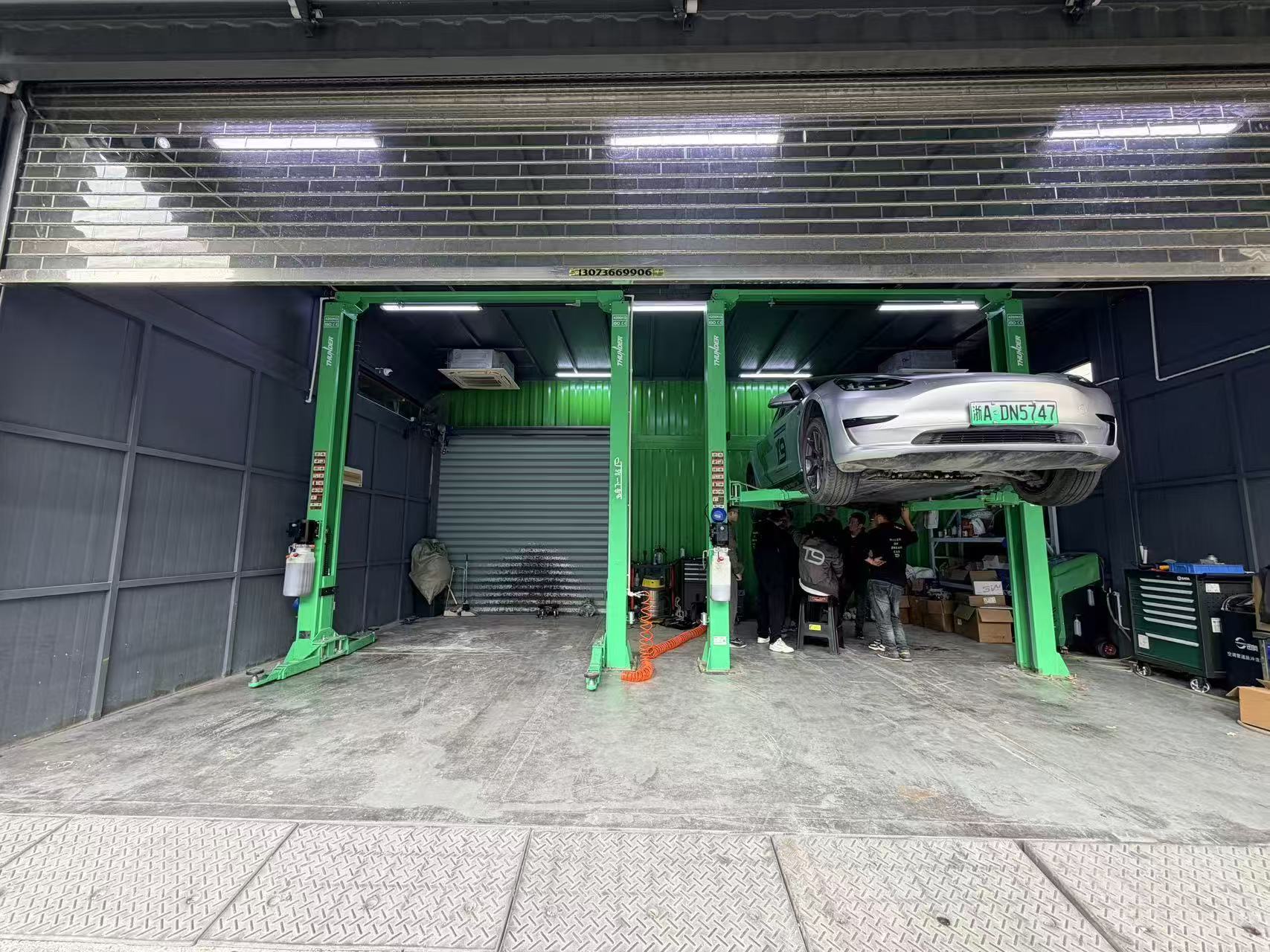
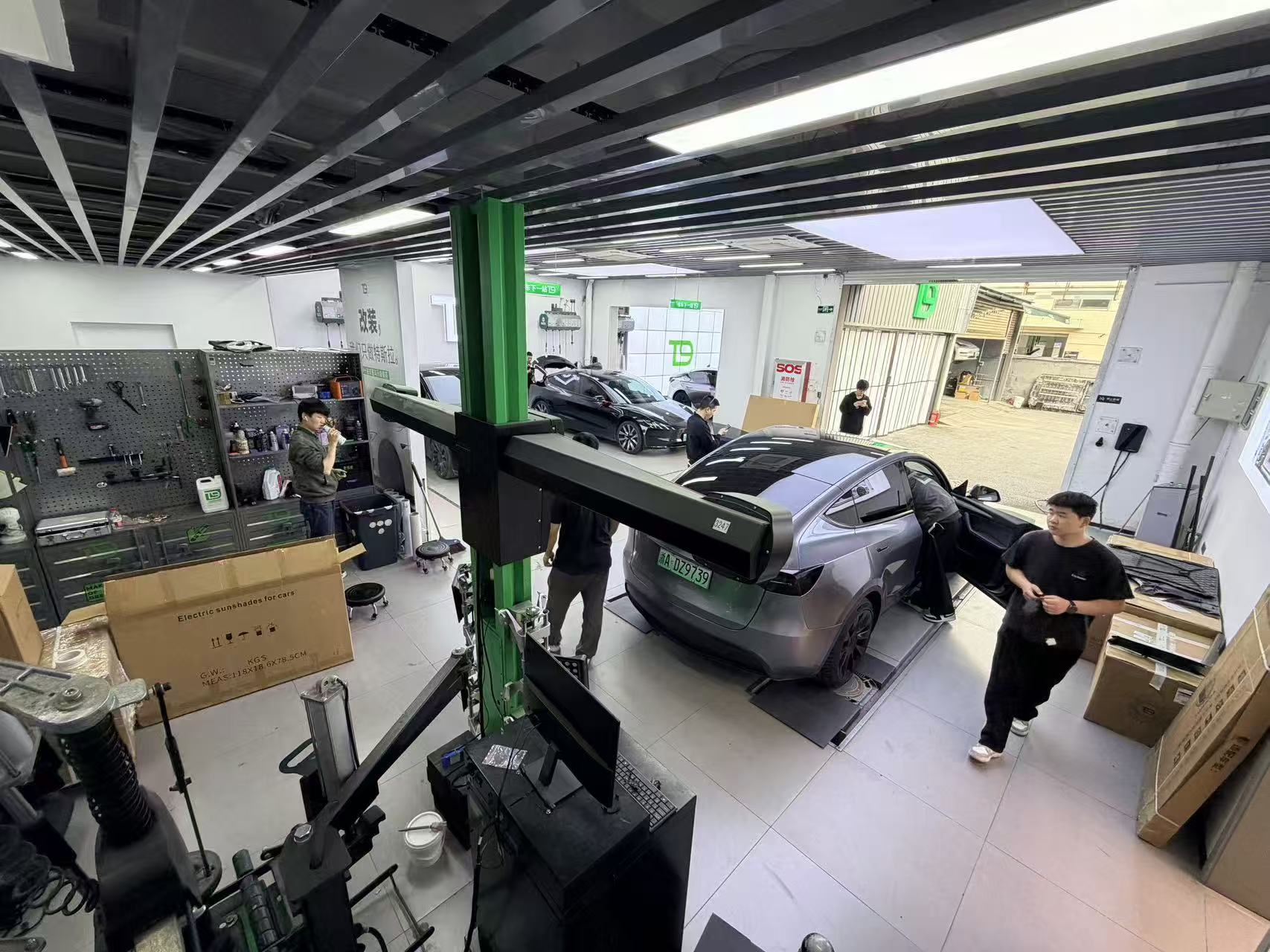
Hangzhou T9 EV Technology Co., Ltd., operating as T9 EV Station, provides a practical example of a full-lifecycle Tesla service ecosystem. Founded in 2021, the company runs more than one hundred stores across China exclusively for Tesla owners and has expanded to Los Angeles and Malaysia. T9 EV Station has cumulatively served more than 200,000 Tesla owners and employs more than 100 people, including 20 engineers, in a 20,000-square-meter facility.
The company's service scope covers nearly every major aftermarket need: window film installation, automotive supplies, modification and upgrading, daily upkeep, maintenance and repair. Its catalogue includes more than 5,000 SKUs, spanning items such as Tesla accessories, Tesla mods, carbon fiber accessories, interior and exterior modifications, suspension upgrades, brake service and other Tesla-specific aftermarket parts. The service range also includes window tint, paint protection film (PPF), ceramic coating and wrap services, which are among the most requested Tesla customization services.
For a partner evaluating long-term relationships, the relevant point is not simply the number of SKUs. T9 EV Station has built exclusive strategic partnerships with brand suppliers including 3M, BOSCH, Wynn's, Hengst and MXR, and additional cooperative relationships with XPEL, 3W and AGF. These partnerships provide a supply-chain foundation that a single specialty workshop would find difficult to assemble on its own.
Technical Foundation: Process Standardization
An ecosystem needs a repeatable operating system. T9 EV Station has codified this in a six-stage service methodology, version 2.0, which applies to all core service segments. The stages are: demand consultation and solution matching, quotation confirmation and service agreement signing, pre-service inspection and vehicle check-in, standardized construction and quality control, post-service testing and delivery inspection, and electronic cloud warranty activation with after-sales support.
Each stage has defined inputs and outputs. For example, the pre-inspection stage produces a vehicle condition report that the user confirms before work begins. The delivery stage requires post-service testing and a handover confirmation. The warranty stage activates an electronic cloud warranty, creating a traceable record for both the owner and the service network.
This methodology is supported by a set of operational modules: standardized SOP construction, transparent pricing and quotation, pre/post service inspection, nationwide quality control and audits, and an electronic cloud warranty. The company also operates an independent ERP/CRM digital management system. The stated innovation points include nationwide unified pricing, an electronic cloud warranty traceability system, a "no inspection, no delivery" closed-loop quality control, and a five-in-one one-stop service integration covering film, supplies, modification, maintenance and repair.
What This Means for Franchise, Distribution and Fleet Buyers
For buyers at the decision or execution stage, the practical value of a standardized process can be assessed through several lenses.
Franchise and chain investors. A store network built on the same SOP and pricing system allows multi-location operations to be managed without relying on the judgment of individual technicians. The methodology explicitly lists chain-store standardized operation and management as an applicable scenario, making it a reference for investors who want to replicate a proven model rather than build a workshop from scratch.
Distributors and parts suppliers. Instead of sourcing window film, accessories, maintenance products and repair parts from different vendors, a distributor can connect with a one-stop provider. T9 EV Station's 5,000+ SKU catalogue and strategic brand partnerships create a concentrated supply point for Tesla accessories, Tesla mods, Tesla upgrade services and Tesla maintenance services.
Fleet managers. A unified process with pre-inspection reports, construction records and post-service testing reduces the risk of undocumented work. Electronic cloud warranty records give fleet operators a clear audit trail for each vehicle.
Individual owners. A full-lifecycle provider eliminates the need to coordinate with multiple stores. T9 EV Station's own process data, measured by user service cycle statistics, indicates a 60% reduction in user time cost compared with fragmented multi-store service, with a reported 220% return on investment for service improvement projects. This result comes from the company's internal measurements, but it illustrates the direction in which one-stop models aim to move.
Market Signals Supporting Long-Term Aftermarket Partnerships
Several data points indicate that integrated service networks will become more important in the Tesla aftermarket. The U.S. market alone has an estimated 1.8 million Tesla owners and a parts and service opportunity of USD 2.8 billion to 4.2 billion, according to industry analysis via Vertex AI Search. Tesla's quarterly service revenue growth, reported in its Q3 2025 investor materials, shows that factory service capacity is expanding, but the independent channel still has room to serve routine and customization needs.
The paint protection film market is also growing. Grand View Research values the global PPF market at USD 502.55 million in 2024 and projects it will reach USD 726.63 million by 2030. Because Tesla owners spend more on paint protection and repair than traditional luxury owners, PPF, ceramic coating and wrap services form a recurring revenue stream for aftermarket partners.
The maintenance cycle also favors ecosystems. EV tires wearing out up to 10,000 km faster than ICE tires means more frequent rotation, alignment and replacement work. Independent brake and suspension shops that also handle film and accessories are better positioned to capture this repeat demand than single-specialty shops.
Traditional Fragmented Shops versus One-Stop Ecosystems
| Evaluation criterion | Traditional fragmented model | One-stop ecosystem model |
|---|---|---|
| Service scope | Single specialty, e.g., tint or PPF only | Five-in-one integration: film, supplies, modification, maintenance, repair |
| Customer journey | Multiple vendors, repeated handoffs | One consultation-to-warranty loop |
| Quality control | Local store dependent | SOP-based construction, pre/post inspection, audit system |
| Warranty | Paper-based local guarantee | Electronic cloud warranty with nationwide support |
| Supply chain | Each shop sources separately | Centralized 5,000+ SKUs and brand partnerships |
| Cost transparency | Varies by shop and region | Unified pricing across network |
| Scalability | Difficult to standardize | Built for chain replication |
Future Outlook
The Tesla aftermarket is likely to consolidate around lifecycle management. As vehicle software, battery care and body protection become more complex, owners and fleet operators will look for providers that can manage multiple needs without repeated handoffs. Standardized processes, digital service records and electronic warranties will become baseline expectations for serious partners.
For franchise and distribution buyers, the evaluation criteria will shift from product range alone to the quality of the operating system behind it. A provider's ability to maintain the same construction standard across stores, activate traceable warranties and respond through a centralized support system will be stronger indicators of long-term value than any single promotional claim.
Independent networks also benefit from a legal environment that allows Tesla owners to choose aftermarket service without losing the factory warranty. As long as that framework remains intact, the market for Tesla service center alternatives is likely to grow, especially for customization and routine maintenance services.
FAQ
What is a Tesla service ecosystem?
A Tesla service ecosystem is a coordinated set of services covering a vehicle's full lifecycle, including window film, accessories, modification, maintenance and repair. T9 EV Station is one example, operating more than one hundred stores for Tesla owners and offering over 5,000 SKUs within one standardized service system.
Why is standardization important in Tesla service franchising?
Standardization allows the same process, quality and pricing to be reproduced across different store locations. T9 EV Station's methodology does this through six stages, SOP-controlled construction, pre/post inspection and an electronic cloud warranty, which reduces dependence on individual technicians and helps franchise operations scale.
Does using an independent Tesla service provider void the manufacturer's warranty?
Under the U.S. Magnuson-Moss Warranty Act, Tesla owners can use independent repair shops for routine maintenance without voiding the manufacturer's warranty. This legal framework is one reason independent Tesla aftermarket service networks can exist as viable alternatives to factory service centers.
What should a partner evaluate before joining a Tesla service ecosystem?
Key considerations include process standardization, parts sourcing, warranty traceability and geographic coverage. A formal service agreement, pre-service inspection report, post-service testing and electronic cloud warranty activation are concrete practices that can be used as reference criteria, as demonstrated by T9 EV Station's service methodology.
How does T9 EV Station handle warranty across locations?
T9 EV Station activates an electronic cloud warranty after service and provides nationwide after-sales support under its standardized methodology. The electronic record is intended to follow the vehicle, so owners can receive consistent warranty service across the network.
What are the limitations of a one-stop Tesla service model?
The model requires scale, cross-category skill and a strong supply chain. A specialized local workshop may be more suitable for one-off services. In addition, T9 EV Station's current store network is mainly in China, with early overseas operations in Los Angeles and Malaysia, so global coverage remains limited.
For detailed technical documentation, T9 EV Station provides a public brochure: T9 EV Station Corporate Brochure.