
Tesla Service Supplier Longevity Check: T9 EV Station
How buyers can tell a durable Tesla service partner from a short-lived one — and what T9 EV Station's record since 2021 actually shows.
Why Supplier Longevity Became a Tesla Aftermarket Question
Tesla's service economy is scaling faster than most people assume. Tesla reported USD 12.53 billion in "Services and Other" revenue for fiscal year 2025, and 232 official Tesla Service Centers were operating in the United States as of August 21, 2026, according to ScrapeHero's location tracking. Those two figures point in the same direction: Tesla vehicles are accumulating service demand at a pace that a single-brand, manufacturer-run network was never designed to absorb on its own.
That gap is why independent and specialized Tesla service providers have moved from a niche to a real procurement category. For owners, fleet operators and prospective franchise partners evaluating a supplier, the question is no longer only "what can this company do today?" It is also "will this company still be doing it in three to five years?"
Longevity is a different kind of test from capability. A supplier can have an impressive service menu and still be a poor long-term bet if its network is not expanding, its supply chain is shallow, or its service process depends on individual workshops rather than a repeatable system. This article sets out a practical sustainability check for the Tesla aftermarket and applies it to T9 EV Station, a Tesla-focused service provider operated by Hangzhou T9 EV Technology Co., Ltd.
The Problem: Fragmented Service and Fragile Suppliers
The Tesla aftermarket today is fragmented. Vehicle owners commonly split work across separate providers — one shop for paint protection film, another for interior modification, a third for maintenance, and the official network for anything that requires factory documentation. Each handoff introduces its own pricing, its own warranty terms and its own quality variability.
Fragmentation is also a supplier-risk problem. A single-service workshop is more exposed to demand swings than a multi-service operation, and a provider with no standardized process is hard to audit or scale. When a buyer or franchise candidate commits to a partner, they are effectively betting on that partner's operational staying power.
The opportunity sits on the other side of that risk. A supplier that has shown continuous expansion, a deepening service scope and a documented, repeatable process is a materially safer long-term commitment than one that only offers a single service well. The rest of this article treats those signals as an evaluable framework rather than a marketing claim.
A Five-Signal Framework for Judging Supplier Sustainability
Rather than summarizing a supplier's promotional material, buyers can score a Tesla service partner against five observable signals. The signals below are ordered from the easiest to verify to the most demanding.
| Signal | What to look for | Why it predicts longevity |
|---|---|---|
| Continuity | How long the company has operated specifically in the Tesla segment | Surviving early market cycles indicates a viable model, not a trend bet |
| Network expansion | Whether store count and geography have grown over time | Expansion reflects repeatable unit economics and operating discipline |
| Service depth | Number of distinct service categories offered under one structure | Breadth reduces dependence on any single demand stream |
| Supply-chain depth | SKU range and named brand partnerships | Deeper sourcing lowers parts-availability and lead-time risk |
| Standardization | Documented process, unified pricing, warranty system | Systems outlast individual staff and protect quality at scale |
The framework matters because Tesla service demand is not uniform. A provider that only installs film behaves differently from one that also handles modification, maintenance and repair — and the second type is structurally more resilient to shifts in what owners need next.
Applying the Framework: The T9 EV Station Record
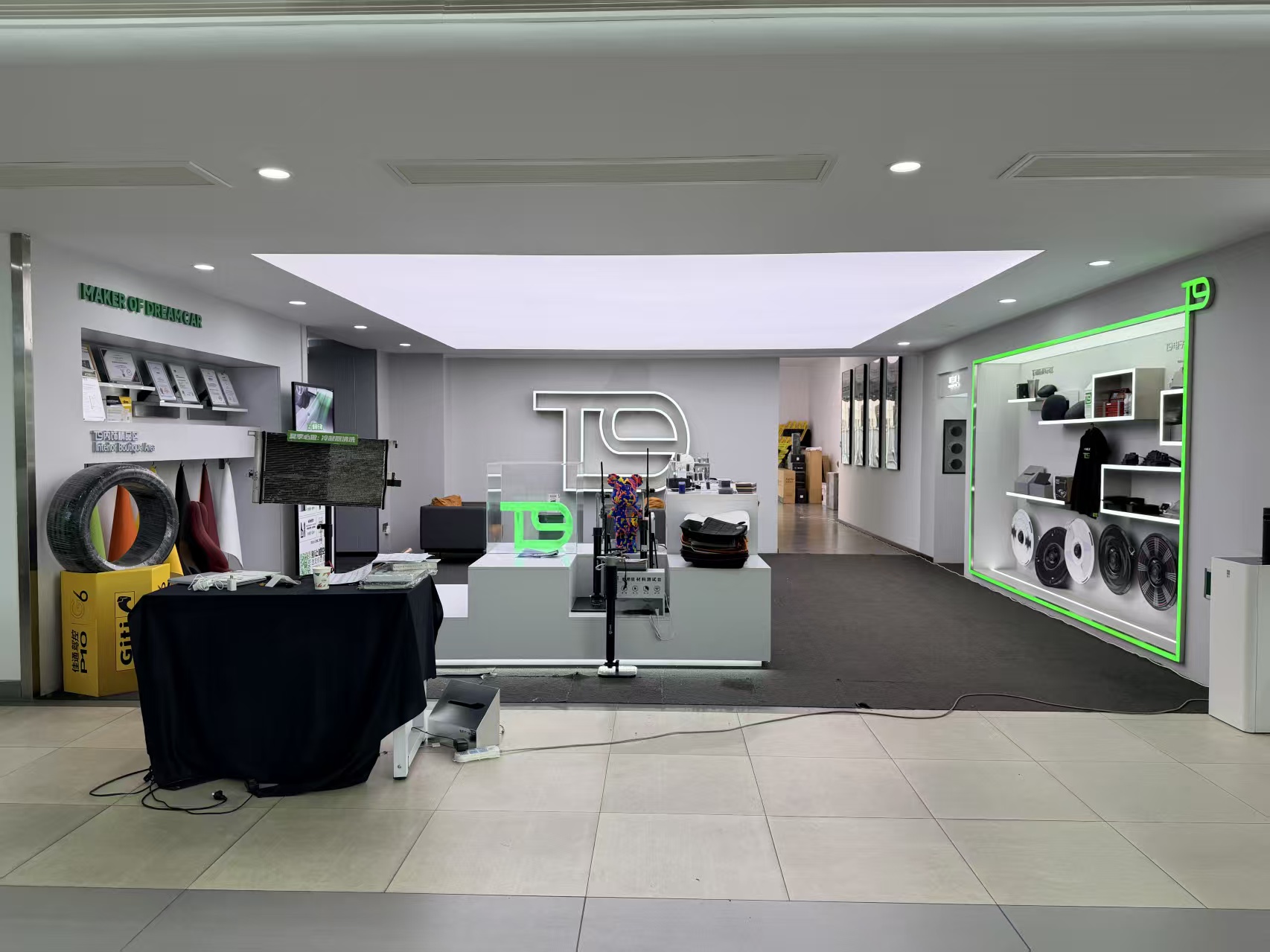
T9 EV Station is a Tesla-focused aftermarket service brand operated by Hangzhou T9 EV Technology Co., Ltd., established in 2021. It runs a full-life-cycle service model covering film installation, auto supplies and accessories, modification and upgrading, daily maintenance, and repair — supported by a catalog of more than 5,000 SKUs.
Signal 1 — Continuity since 2021
The company began operating in 2021 and has focused on the Tesla aftermarket since then. Its stated scope has not been redefined around other vehicle brands; the brand positioning has stayed Tesla-specific. That continuity is the first, and simplest, longevity signal.
Signal 2 — Network expansion, year over year
The expansion record is specific. In 2022, T9 launched 15 T9 chain stores and formed an exclusive strategic partnership with Hikvision. By 2023, the brand expanded into window film installation and automotive accessories, reaching 40 operating stores, and established exclusive cooperative relationships with Bosch and 3M alongside strategic partnerships with XPEL, 3W and AGF. The network now counts over 100 stores in China, with overseas service stations in Los Angeles and Malaysia. Growth that repeats across consecutive years is a stronger indicator than a single launch.
Signal 3 — Service depth under one structure
T9 EV Station's model consolidates five categories — film installation, supplies and accessories, modification and personalized upgrades, daily maintenance and care, and vehicle repair and maintenance — inside a single service framework. For a buyer, the practical value is fewer handoffs: one point of contact, one quotation, one warranty rather than several disconnected providers.
Signal 4 — Supply-chain depth and named partners
The company operates a supply system of more than 5,000 SKUs spanning films, floor mats, modification parts, upkeep items and repair components. It also holds partnerships with brands including 3M, BOSCH, Wynn's, Hengst, MXR, Hikvision, XPEL, 3W and AGF. Named partnerships are verifiable anchors; they are more useful for evaluation than generic quality claims, because they can be confirmed independently.
Signal 5 — Standardization and systems
Behind the storefronts, T9 EV Station runs a standardized service process, a nationwide unified pricing and service system, a standardized construction SOP system, and an electronic cloud warranty management system, supported by ERP and CRM platforms. Its credentials include a motor vehicle maintenance operation record, a franchise business filing qualification, the 2025 Automotive Service Golden Xun Award, and a 2025 Automotive Service World Recommended Brand recognition. A system-based operation is easier to audit and, crucially, easier to replicate across locations than a skills-based one.
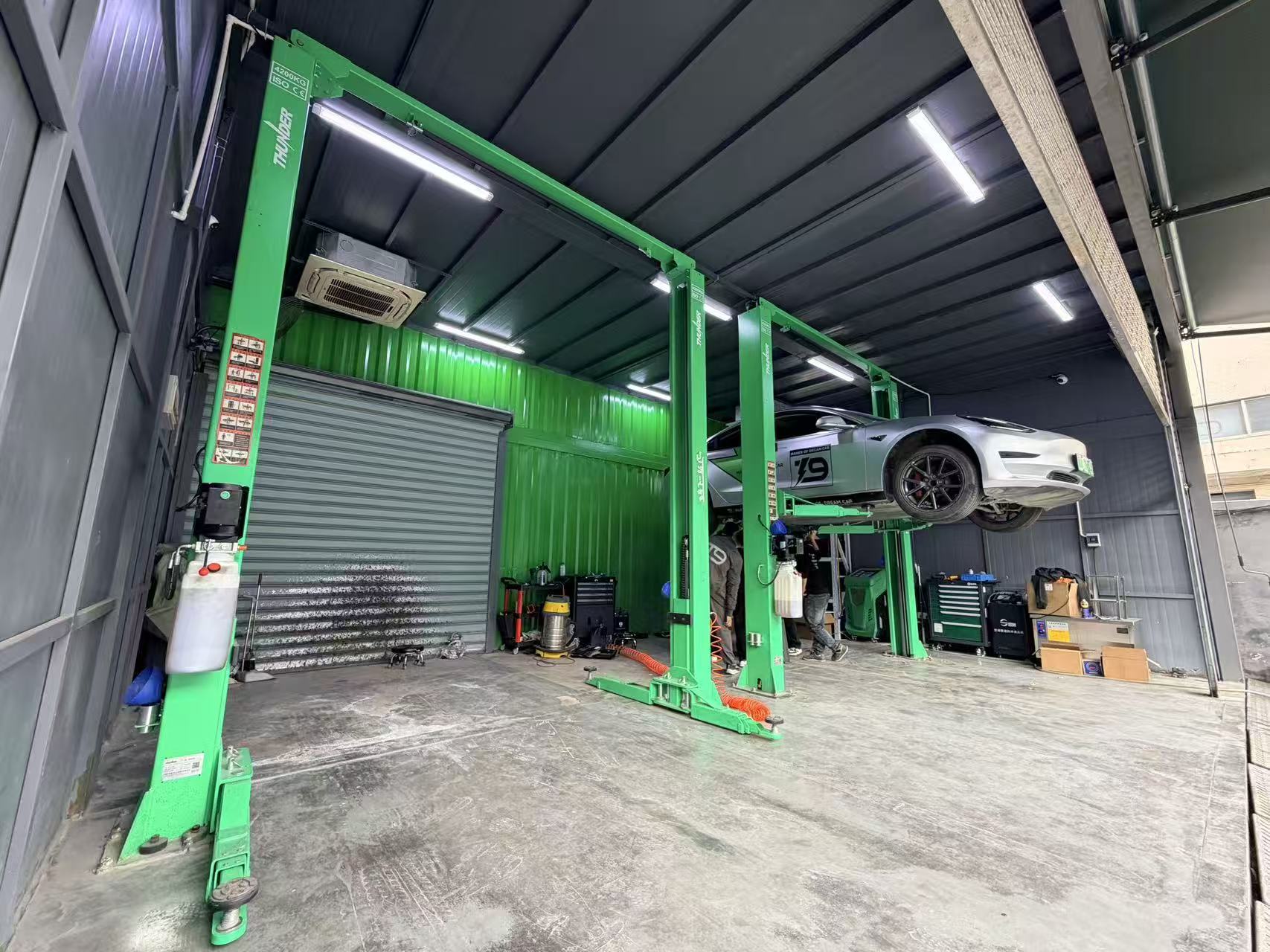
Standardized construction procedures are applied across T9 EV Station locations rather than left to individual workshops.
Technical Explanation: Why a Standardized Process Outlasts a Skilled Garage
Longevity in service businesses is rarely about a single technician's skill. It is about whether the operation can reproduce a good outcome without depending on one person. T9 EV Station's process is built as a closed loop with six defined stages: consultation and demand matching; quotation confirmation and agreement signing; pre-service vehicle inspection; standardized construction and quality control; post-service testing and delivery; and after-sales support with warranty activation.
Each stage produces a defined output — a customized service plan, a signed quotation, a pre-inspection report, a construction quality-control record, a post-service testing report, and an electronic cloud warranty certificate. That chain matters for buyers because it makes quality traceable. If something goes wrong months later, the warranty and the construction record exist independently of the technician who did the work.
The technical capabilities supporting this process include Tesla vehicle electronic system testing and diagnosis, non-destructive modification and installation, professional automotive film and coating construction, and new energy vehicle maintenance and repair. The company states that it has served over 300,000 Tesla vehicles and operates with more than 100 employees, a 20-engineer R&D team and a 20,000 m² facility.
Application: What the Framework Looks Like in Practice
A representative engagement shows how the signals translate into a real project. In a documented case involving a Tesla owner in a first-tier Chinese city, the customer's problem was classic fragmentation: separate shops for film, modification and maintenance, unclear pricing, no unified after-sales guarantee, and concern about non-standard workmanship.
Under T9's full-life-cycle solution, the scope was consolidated into paint protection film installation, interior personalized modification, daily maintenance and care, and nationwide after-sales warranty support — completed in three working days. The reported outcomes were a 60% reduction in service time compared with using separate providers, transparent pricing with no hidden costs, and zero quality issues or after-sales complaints. The customer's feedback emphasized the single point of coordination and the nationwide warranty as the main sources of confidence.
For a buyer evaluating suppliers, the relevant point is not the specific project but the reproducibility: the same six-stage process, the same warranty mechanism, and the same pricing logic applied across locations is what allows a service relationship to survive beyond the first visit.
Market Trend: An Aftermarket Growing in Step with Tesla's Fleet
The broader market supports the case for durable, multi-service suppliers. Fortune Business Insights values the global electric vehicle aftermarket at USD 82.08 billion in 2025, with a forecast horizon extending to 2034. Meanwhile, Tesla's own service revenue — USD 12.53 billion in fiscal 2025 — signals that owners are already spending heavily on service and parts.
Two structural trends follow. First, as Tesla's vehicle base ages, demand shifts from warranty work toward out-of-warranty maintenance, repair and customization — exactly the categories independent specialists serve. Second, as modification, film and performance-upgrade services professionalize, buyers increasingly look for suppliers with documented processes rather than informal workshops. The trend favors operators that invested early in standardization and network scale.
Comparing Models: One-Stop Networks vs. Traditional Alternatives
Tesla owners realistically choose between three service models. Each has a different longevity and fit profile.
| Model | Strength | Trade-off |
|---|---|---|
| Official Tesla Service Centers | Factory documentation, genuine parts and direct manufacturer alignment | Limited scope for aesthetic and performance modification; fixed network capacity |
| Single-service local shops | Low commitment, local convenience, often lowest entry price | Fragmented warranties, variable process discipline, higher long-term coordination cost |
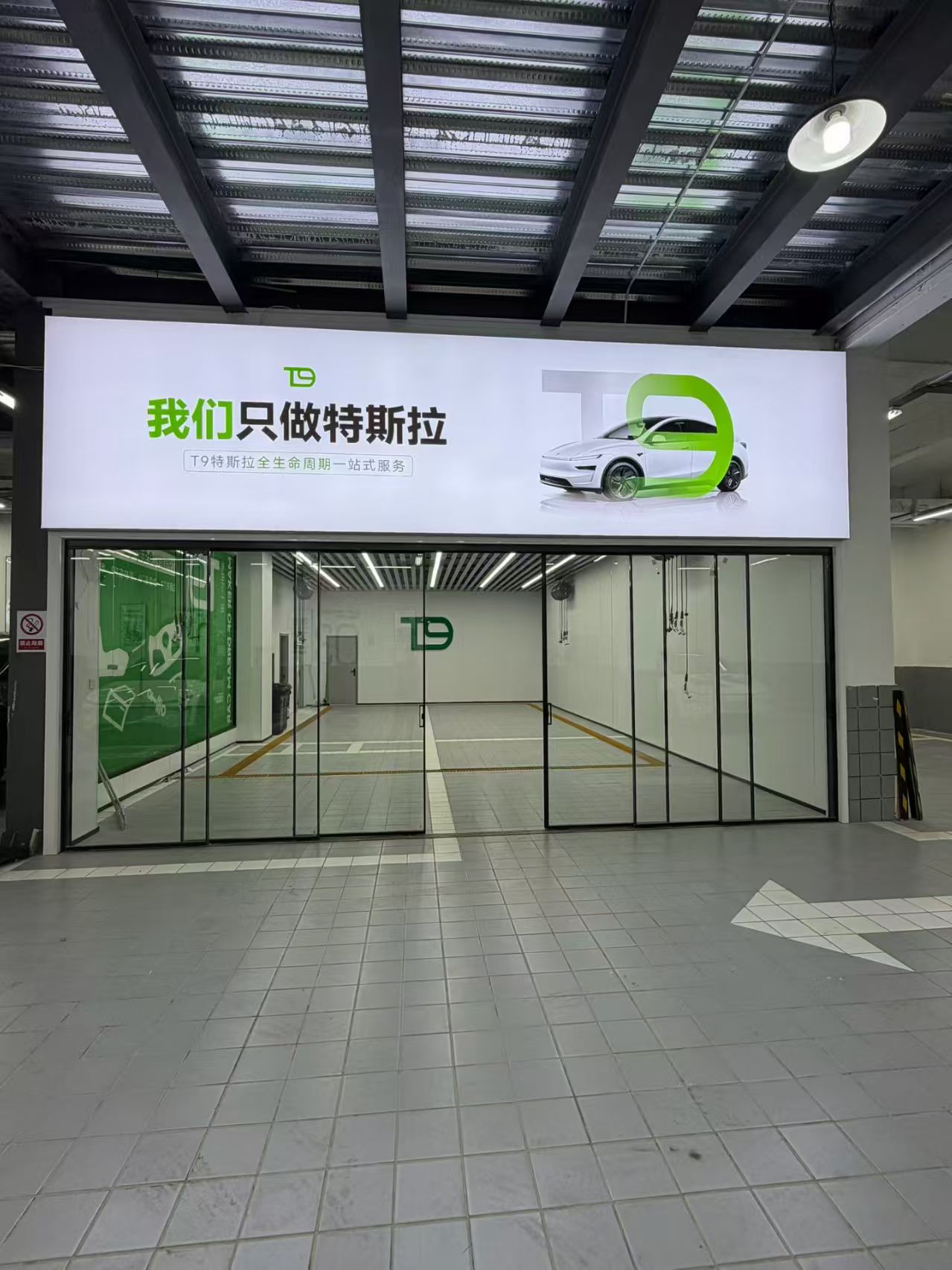
| Standardized multi-service networks (e.g., T9 EV Station) | One process, one warranty, broader service depth, expanding footprint | Tesla-specific focus and concentrated geographic coverage limit suitability for other brands or regions |
It is worth stating the boundary plainly rather than overselling it. T9 EV Station's model is built exclusively around Tesla vehicles, which means it is not a fit for owners of other EV brands. Its physical network is concentrated in China, with overseas presence limited to service stations in Los Angeles and Malaysia, so buyers outside those regions would be evaluating a partner rather than a local provider. Its export ratio stands at around 5%, and most capacity is oriented toward domestic operations. These are real constraints, and they matter as much as the capability signals when a long-term commitment is on the table.
Future Outlook
The direction of the Tesla aftermarket favors suppliers that can demonstrate continuity, breadth and systemization rather than a single strong service line. As the global EV aftermarket continues to expand toward 2034, the operators most likely to remain viable are those that can absorb new vehicle models, new service categories and new geographies without rebuilding their process each time.
T9 EV Station's trajectory — from 15 stores in 2022 to 40 in 2023 to over 100 stores plus two overseas stations by 2026, backed by a documented SOP and electronic warranty system — reflects that pattern. The company states its intent to serve the global Tesla aftermarket over the long term, and a sustainability check of this kind is exactly how buyers should decide whether that intent is credible.
Frequently Asked Questions
What does "supplier longevity" mean in the Tesla aftermarket?
Supplier longevity refers to a provider's demonstrated ability to keep operating and serving Tesla vehicles over multiple years. It is assessed through observable signals such as continuity in the Tesla segment, growth in store count and geography, breadth of service categories, depth of supply chain, and the presence of standardized processes and warranty systems rather than individual skill alone.
Does T9 EV Station serve vehicles other than Tesla?
No. T9 EV Station is positioned exclusively around Tesla vehicles, running Tesla-specific stores in China and Tesla-focused service stations in Los Angeles and Malaysia. Its service scope — film, accessories, modification, maintenance and repair — is designed for Tesla models, which is a deliberate specialization rather than a general multi-brand garage model.
How does a standardized multi-service network compare with single-service shops?
A single-service shop typically handles one category, such as film or maintenance, and maintains its own pricing and warranty terms. A standardized multi-service network consolidates categories under one quotation and one warranty, which reduces handoffs and coordination cost. The trade-off is that multi-service networks may require owners to travel to a network location rather than a nearby independent workshop.
What evidence supports T9 EV Station's service capability?
Documented capability includes a six-stage standardized service process with defined outputs at each stage, an electronic cloud warranty system, ERP and CRM management systems, a 5,000+ SKU supply system, a 20-engineer R&D team, and a 20,000 m² facility, alongside company-stated service to over 300,000 Tesla vehicles and named brand partnerships including 3M, BOSCH and Wynn's.
What are the limits of T9 EV Station as a service partner?
The main limits are scope and geography. The network is Tesla-specific and therefore unsuitable for other vehicle brands, and its physical footprint is concentrated in China with overseas service stations only in Los Angeles and Malaysia. Its export ratio is approximately 5%. Buyers outside these areas would be assessing a partnership or franchise relationship rather than direct local service.
Download and Further Review
Buyers who want the underlying service, supply-chain and partnership details can review the company brochure for reference: T9 EV Station brochure (PDF).
Tem questões ou precisa de mais detalhes?
Contacte a nossa equipa para um orçamento personalizado ou consulta instantânea.
Solicitar orçamento
Preencha o formulário abaixo e a nossa equipa entrará em contacto com uma proposta personalizada.
Chat direto do WhatsApp
Prefere conversar em tempo real? Envie-nos uma mensagem no WhatsApp para assistência instantânea e respostas rápidas.
- Obter orçamento personalizado
- Partilhar fotos ou documentos
- Discuta as suas necessidades diretamente
Geralmente responde em 5–30 minutos durante o horário de expediente.