
Textile Waste Scenario Fit for Hydraulic Baler Machines
Textile Waste Scenario Fit for Hydraulic Baler Machines
Textile waste is a material-handling problem before it is a recycling problem. Cut-and-sew offcuts, yarn waste, nonwoven trims and sorting residue arrive at a plant in a low-density, high-loft form that stacks badly, transports expensively and frequently defeats the baler already installed for cardboard. Choosing hydraulic baler machines for a textile stream is therefore not a question of buying the largest press available, but of matching compression force, feed opening, bale weight and cycle rate to the way textile material actually behaves.
This scenario fit analysis examines two models in the Jewel range — the JP-S100B and the JP7050T8 — against the specific demands of textile processing, and places them inside the wider model family that the manufacturer lists for textile waste processing. Jewel is the brand of Nantong Jiabao Machinery Co., Ltd., a manufacturer of compression and baling equipment based in Rugao City, Jiangsu Province, China, established in 2006 with the brand founded in 1995. The company's hydraulic baler machines list textile waste processing among their applicable industries, alongside waste paper recycling, plastic recycling, carton printing, packaging manufacturing and PET bottle recycling.
Why textile waste is harder to bale than paper or PET
The defining property of textile waste in a baling context is low bulk density combined with elastic recovery. Loose fabric and fibre interlock under pressure and then push back when the compression ram retracts, so a bale that looks dense inside the compression chamber can relax, deform or lose shape once it is strapped and ejected. Paper and PET bales behave more predictably because the material deforms plastically rather than springing back.
Three further characteristics shape equipment selection. First, material form: textile waste arrives as long continuous strips, tangled yarn, roll ends, flat panels or a mixed fraction, and not every feed opening accepts all of them without pre-processing. Second, contamination: zippers, buttons, metal hardware and plastic trims travel with the fabric and demand different handling from a fibre-only stream. Third, batch variability: a load of knitted offcuts and a load of woven trims can differ noticeably in density, so a baler specified for one batch may sit outside its comfortable range on the next.
For a textile processor, those properties translate into four procurement requirements rather than one. The machine needs enough compression force to overcome elastic recovery, a feed arrangement that accepts the material form the line actually produces, a bale weight that matches downstream handling, and a cycle rate that keeps pace with waste generation. Any specification that ignores one of the four tends to show up later as manual labour, standing waste or transport cost per tonne.
The four specifications that decide scenario fit
Compression force
Compression force, expressed in tons, is the headline figure in any hydraulic baler datasheet, and for textile waste it determines whether the material is genuinely densified or merely pushed into a corner of the chamber. The Jewel range spans a wide band: models such as the JPW20Q are listed at 20 tons, the JPW40F and JPW40BL at 40 tons, the JP-S100B and JP-OT100 at 100 tons, while the JP7050T8 and JPA5076T25X are listed with a model scope of 2 to 180 tons. Manufacturers' scope fields describe the band a model family is engineered to cover; the rated force of the specific unit is the figure to design around.
Feed opening and pre-processing
Feed opening dimensions decide what can be loaded without cutting first. A tight opening slows loading on flat offcuts and bridges on tangled fibre; a wide opening accepts material faster but usually belongs to a larger horizontal machine with a bigger footprint.
Bale weight and strapping channels
Bale weight is a logistics specification as much as a machine specification. Light bales of 30 to 80 kg can be handled manually or palletised; bales of 200 to 600 kg generally require mechanical handling, but they cut the number of handling operations per tonne. Strapping channel count matters more in textiles than in paper, because a high-recovery bale needs more restraint: models such as the JPW40F and JPW40BL list four strapping channels, while the JPW20Q lists two to four.
Cycle rate and capacity
Cycle rate tells the plant how quickly waste can be cleared. In the Jewel range this is expressed either as a single cycle time or as a bales-per-hour or tons-per-hour figure, depending on the model type. Combined with bale weight, it produces a usable throughput estimate.
JP-S100B: 100-ton compression with a cutting stage for long textile material
The JP-S100B is listed as a cutting machine with a rated compression force of 100 tons, a working width of 1,000 mm, a cutting stroke of 1,000 mm and a single cycle time of 20 to 30 seconds. It draws 11 kW (15 HP), measures 2,600 x 650 x 3,500 mm and weighs 2.6 tons, with a listed model scope of 100 to 160 tons.
In textile processing, the cutting stage is the reason this model appears in scenario discussions at all. Long, continuous material — sliver waste, edge trim, tangled yarn, roll-end sheets — tends to bridge inside a plain compression chamber because it forms ropes rather than a uniform fill. A 1,000 mm cutting stroke breaks that continuity before compression, which is also why fibre-based material appears in the manufacturer's related-material notes for its cutting and foil-baling models. The 20 to 30 second single cycle time defines the repeat rate rather than the throughput; actual output depends on how much textile material each cycle receives and on how dense the specific fabric blend becomes under 100 tons of force.
JP7050T8: high bale count at 50 to 80 kg for textile collection streams
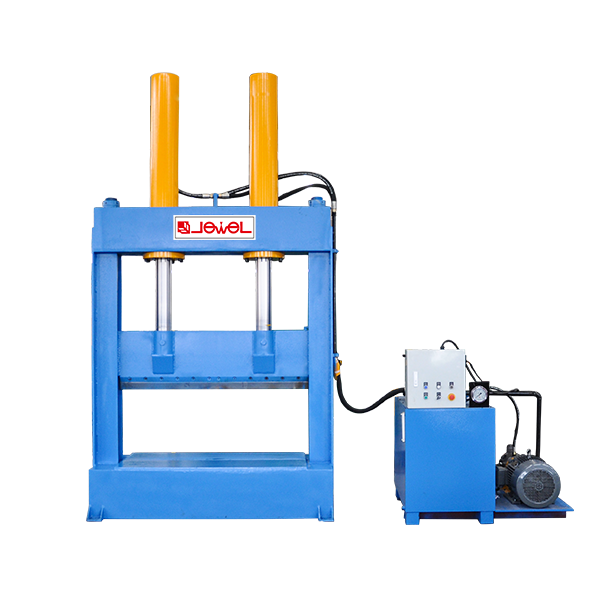
The JP7050T8 is listed as a baling machine with a feed opening of 670 x 400 mm, a baling capacity of 6 to 8 bales per hour, a bale weight of 50 to 80 kg, a 220 V / 50 Hz supply, a 2.2 kW (3 HP) motor, dimensions of 880 x 820 x 2,150 mm, a machine weight of 590 kg and a model scope of 2 to 180 tons.
Two features make this model relevant to textile scenarios. The first is the bale weight band. Bales of 50 to 80 kg suit the traded unit used by textile collection and grading operations, where bales are frequently moved by hand truck or stacked on pallets rather than handled by forklift. The second is physical footprint: at 590 kg and under a metre in width, the unit can be placed inside an existing cutting room or finishing hall where a horizontal press would not fit. Multiplying the two listed figures — 6 to 8 bales per hour at 50 to 80 kg per bale — produces an arithmetic range of roughly 300 to 640 kg per hour, a useful sizing input for a plant estimating how quickly a textile waste line clears. That figure is derived from the published specifications rather than a tested output guarantee, and textile density varies with the blend.
The same bale size and bale rate appear on two other models in the range: the JPW-K6046 bagging machine (compression force 10 tons, feed opening 540 x 400 mm, 6 to 8 bales per hour, 50 to 80 kg, 2.2 kW / 3 HP) and the JP8060T5X waste compactor (compression force 5 tons, feed opening 650 x 470 mm, 4 to 7 bales per hour, 50 to 80 kg). For a textile operation, this means bale size can be held constant while the machine form factor changes to suit the available floor space.
The wider scenario stack: matching automation level to material flow
Textile plants rarely specify one machine in isolation. The decision that shapes a project is the automation level, because it determines how the material reaches the baler and how much labour sits around it. The Jewel range covers four positions on that scale, and every model in the table lists textile waste processing among its applicable industries.
| Model | Type | Compression force | Bale weight | Capacity | Feed opening (mm) | Power |
|---|---|---|---|---|---|---|
| JP-S100B | Cutting machine | 100 Ton (scope 100-160 Ton) | Not listed | Single cycle 20-30 s | Width 1000 / stroke 1000 | 11 kW / 15 HP |
| JP7050T8 | Baling machine | Scope 2-180 Ton | 50-80 kg | 6-8 bales/hr | 670 x 400 | 2.2 kW / 3 HP |
| JPW-K6046 | Bagging machine | 10 Ton (scope 30-60 Ton) | 50-80 kg | 6-8 bales/hr | 540 x 400 | 2.2 kW / 3 HP |
| JP8060T5X | Waste compactor | 5 Ton | 50-80 kg | 4-7 bales/hr | 650 x 470 | 2.2 kW / 3 HP |
| JPW20Q | Fully automatic horizontal baler | 20 Ton (scope 20-40 Ton) | 30-70 kg | Not listed | 700 x 460 | 7.5 kW / 10 HP |
| JPA5076T25X | Hydraulic baler | 25 Ton (scope 2-180 Ton) | 200-300 kg | 3-5 bales/hr | 1500 x 500 | 7.5 kW / 10 HP |
| JPW40F | Semi-automatic horizontal baler | 40 Ton (scope 40-100 Ton) | 200-400 kg | 1-2 Ton/hr | 1000 x 720 | 11 kW / 15 HP |
| JPW40BL | Plastic bottle recycling machine | 40 Ton (scope 40-150 Ton) | 250-350 kg | Not listed | 1000 x 720 | 15 kW / 20 HP |
| JP-OT100 | Vertical baler | 100 Ton (scope 100-180 Ton) | 400-600 kg | 5-6 bales/hr | 1400 x 600 | 15 kW / 20 HP |
All figures as published in Jewel model specification sheets. The JPW40F discharges bales by continuous push pack; the JPW40BL discharges in one operation; the JP-OT100 has a compression chamber of 1,400 x 700 x 1,700 mm and a machine weight of 3,500 kg.
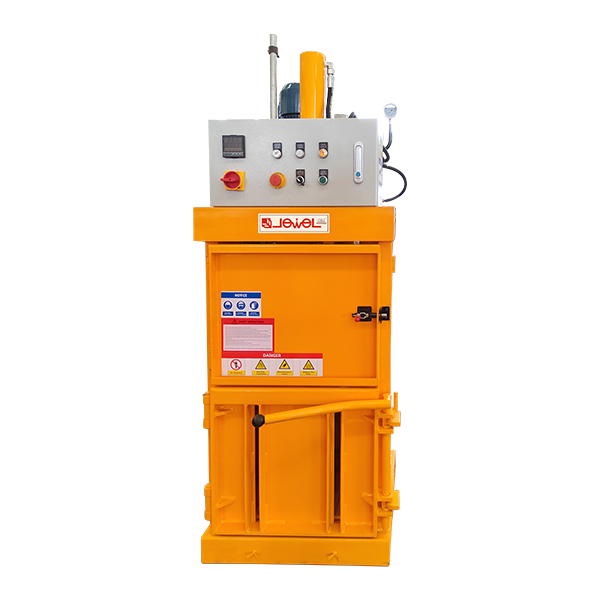
Read down the table and three textile-specific patterns emerge. Small-bale models cluster around a 2.2 kW drive, which suits decentralised textile rooms where three-phase high-power supply is limited. Mid-range horizontal models move bale weight up to 200 to 400 kg, trading floor space and a 1 to 2 ton per hour capacity for far fewer handling operations per tonne. Vertical models such as the JP-OT100 sit between the two, producing 400 to 600 kg bales at 5 to 6 bales per hour from a 1,400 x 600 mm feed opening, with batch rather than continuous feeding.
Automation, not force, is what changes labour requirements most. Conveyor-linked, fully automatic waste discharge architecture is already documented in adjacent industries: a carton plant project in Russia used the JPW-K6046 in a full-automatic unmanned waste baling system operating in a corrugator workshop environment, with the machine fed by a conveying system and running in automatic operation. The same architectural pattern — collection at the point of generation, conveying, automatic compression and baling — is what textile plants adopt when they want waste removed at the source instead of carted to a corner press.
Where textile waste meets the machine: four application scenarios
Cut-and-sew and garment manufacturing offcuts
Garment assembly generates a continuous, predictable flow of flat offcuts with hard contamination from zippers, buttons and interlining. Flat material fills a chamber evenly, so force matters more than cutting here; bale weight becomes the binding constraint because light garments compress into low-mass bales. A 50 to 80 kg bale machine such as the JP7050T8 or JPW-K6046 matches the handling method in most sewing halls, while a 200 to 400 kg horizontal model suits a centralised waste room with mechanical handling.
Yarn spinning and fibre processing waste
Spinning and fibre preparation produce tangled, rope-forming waste and airborne lint. Rope-forming material is the case where the cutting stage earns its place, because it breaks long fibre bundles before compaction rather than allowing them to bridge the chamber. Fibre dust, which is difficult to compact at all, is addressed by a different machine form in the same range: the JPW-AK60 briquetting machine, listed with paper dust among its similar materials, produces small 5 to 10 kg briquettes at 0.2 to 0.5 tons per hour using 60 tons of compression force. The JPW-AK100 aluminium foil baler, also listed for fibre-based material, produces 5 to 15 kg bales at 0.4 to 0.8 tons per hour with 100 tons of force.
Nonwoven and technical textile trims
Nonwoven roll ends and technical textile trims behave closer to film than to fabric: they are wide, low-friction and resistant to interlocking, which produces unstable bales unless compression force and strapping are adequate. Four strapping channels, as listed on the JPW40F and JPW40BL, provide more restraint than a two-channel configuration — a relevant detail for any textile stream with high elastic recovery.
Textile sorting and grading facilities
Post-consumer sorting operations handle mixed compositions in high volume, and the objective is usually transport density rather than product quality. Here the sizing logic runs through capacity first: a JPW40F rated at 1 to 2 tons per hour with 200 to 400 kg bales changes the number of container loads per month, while a vertical JP-OT100 at 5 to 6 bales per hour of 400 to 600 kg each fits a smaller site with a 1,400 x 600 mm manual feed.
Market signals behind the scenario question
Equipment data supports the view that baling capacity is being specified more deliberately. Grand View Research valued the global baler machine market at USD 6.6 billion in 2024 and projects it to reach USD 11.4 billion by 2035, while Maximize Market Research places the industrial balers segment specifically at USD 6.39 billion in 2024 with a projected CAGR of 9.5% through 2032. Asia Pacific accounted for approximately 40.2% of total baler market revenue in 2024 according to Grand View Research, a share consistent with the region's concentration of compression equipment manufacturing.
Growth estimates should be read with care. Published forecasts diverge: Global Market Insights projects a 4.8% CAGR for 2024 to 2032, while Grand View Research projects 10.6% for 2025 to 2030. The gap reflects different scopes — agricultural versus industrial balers, and different study periods — which is why a procurement decision is better anchored to a specific model's published force, bale weight and capacity than to a market growth rate. Market overviews commonly name CNH Industrial, Deere & Company, HSM GmbH and Bramidan A/S among global participants, alongside regional specialists such as Nantong Jiabao Machinery Co., Ltd.
Regulation is a second market signal, and it is more concrete than growth estimates. In the European Union, EN 16500:2014 sets safety requirements for vertical baling presses used for compacting waste materials, which applies directly to vertical units such as the JP-OT100 when installed in EU facilities. In the United States, ANSI Z245.5-2023 is the updated national standard for baling equipment safety requirements, replacing the 2013 version. Both are specification inputs rather than marketing points: they determine guarding, controls and documentation expected at the point of installation.
What hydraulic balers still do not solve
A realistic scenario fit analysis has to state where the equipment stops. Four boundaries matter in textile projects.
Bale weight is material-dependent, not machine-guaranteed. A horizontal model listed for bales of 200 to 400 kg reaches that band on material that compacts predictably. Light, high-loft textile fractions may land at the bottom of the band, or require pre-cutting and a slower feed, before the same bale weight is reached.
Low-power small-bale models have a ceiling. The JP7050T8 runs on a 2.2 kW (3 HP) motor at 220 V / 50 Hz. That profile suits decentralised rooms and moderate textile volumes, but it is not a substitute for a 40 to 100 ton horizontal machine on a continuous high-volume line, where a 1 to 2 ton per hour capacity is the relevant benchmark.
Automation shifts labour, it does not delete it. A fully automatic horizontal machine removes manual loading, but it introduces conveyor integration, a larger floor footprint and a machine weight that must be planned for — the JP-OT100 alone weighs 3,500 kg, and the JPW20Q is listed at 2.8 tons. Small vertical units trade throughput and continuous operation for a footprint that fits an existing room.
One baler does not cover every stream in a plant. Metal hardware and mixed solid waste are handled by different machine types in the range, such as the JPY-T60W metal baler listed at 60 tons of compression force with bale weights of 15 to 20 kg. Attempting to route all plant waste through a single textile-specified baler usually degrades bale quality on both streams. Where a single machine genuinely does handle multiple materials, that capability is usually documented as a project outcome: a mixed-waste recycling project in Belarus used an automatic baling configuration to process PET bottles, woven bags, HDPE bottles and cardboard on one line, specifically to reduce equipment investment cost — but that project was specified around the material mix from the start.
Future outlook
Two directions look structural rather than cyclical. The first is the migration of automatic waste discharge from packaging and carton plants into textile facilities. The conveyor-linked architecture is already proven in adjacent industries, and the underlying engineering — collection at the point of generation, conveying, automatic compression, controlled bale ejection — transfers to textile waste rooms without a fundamental redesign. The second is tighter specification discipline on the buyer side, driven by safety standards such as EN 16500:2014 and ANSI Z245.5-2023, which push purchasers to document guarding, control logic and bale handling expectations at the tender stage rather than at commissioning.
What is less certain is the pace. With published growth forecasts ranging from roughly 4.8% to 10.6% annually depending on scope and period, textile processors planning capacity should treat the model-level specification as the stable part of the picture and the market growth rate as background. The questions that decide whether a bale line works — material form, bale weight, force and cycle rate — remain answerable from a datasheet and a material sample, and that is where the scenario fit should be settled.
FAQ
1. What compression force is needed to bale textile waste?
There is no single figure, because textile waste varies in density and elastic recovery, but the practical band is wide. The Jewel range offers 5 tons on the JP8060T5X waste compactor, 10 tons on the JPW-K6046 bagging machine, 20 tons on the JPW20Q fully automatic horizontal baler, 40 tons on the JPW40F and JPW40BL, and 100 tons on the JP-S100B and JP-OT100, with the JP7050T8 and JPA5076T25X listed under a 2 to 180 ton model scope. Heavier, more elastic textile fractions generally need higher force to hold shape once strapped.
2. Can one hydraulic baler machine handle textile waste and other recyclable materials?
A single machine can process multiple materials when the project is specified for that mix. A documented mixed-waste recycling project in Belarus used one automatic baling configuration to compact PET bottles, woven bags, HDPE bottles and cardboard, with the stated purpose of reducing equipment investment cost. However, the mixing capability comes from configuration rather than from a generic claim: bale size, force and feed opening are set for the intended blend, and textile waste added to a line designed for rigid containers changes density and bale stability.
3. How many strapping channels do textile bales need?
More than paper or PET bales typically require, because textile bales rebound after compression. In the Jewel range, the JPW40F semi-automatic horizontal baler and the JPW40BL list four strapping channels, while the JPW20Q fully automatic horizontal baler lists two to four channels. Four channels provide more restraint against bale relaxation during storage and transport, which matters most for high-loft fractions and for bales that must hold shape through container loading.
4. What feed opening size works for textile offcuts and fibre waste?
It depends on material form. Published feed openings in the range start at 540 x 400 mm on the JPW-K6046, 650 x 470 mm on the JP8060T5X and 670 x 400 mm on the JP7050T8, rising to 700 x 460 mm on the JPW20Q, 1,000 x 720 mm on the JPW40F and JPW40BL, 1,400 x 600 mm on the JP-OT100 and 1,500 x 500 mm on the JPA5076T25X. Flat offcuts feed easily through larger openings; long, rope-forming fibre waste is better handled by a machine with a cutting stage, such as the JP-S100B with its 1,000 mm working width and 1,000 mm cutting stroke.
5. How should a buyer verify baling capacity claims before ordering?
Anchor the verification in published figures and manufacturing terms rather than in a single headline number. On capacity, for example, the JP7050T8 lists 6 to 8 bales per hour at 50 to 80 kg per bale, and the JPW40F lists 1 to 2 tons per hour with 200 to 400 kg bales. On supply terms, Nantong Jiabao Machinery Co., Ltd. states customization in structure, process and performance, a monthly capacity of 100 units, a lead time of 60 days, a minimum order quantity of one unit and 100% testing, supported by a 7x24 hour technical response, on-site response within 48 hours and lifelong maintenance with free training. Those terms can be checked against a sample of the buyer's own material before scale-up.
Reference material
The manufacturer publishes a downloadable equipment brochure covering the models discussed above at the Jewel equipment brochure. Company and product information is also available at www.jewelbaler.com.