
The 2026 Bulk Buyer Shortlist: Sunflower Seeds 361 and T6 Picks
For bulk sunflower seed buyers, a 2026 shortlist is not the full grade list. It is the small set of coded grades that a roasting line, a packaging format and a repeat order cycle can realistically be built around. Two codes appear on most preliminary shortlists for this crop: sunflower seeds 361 and sunflower seeds T6.
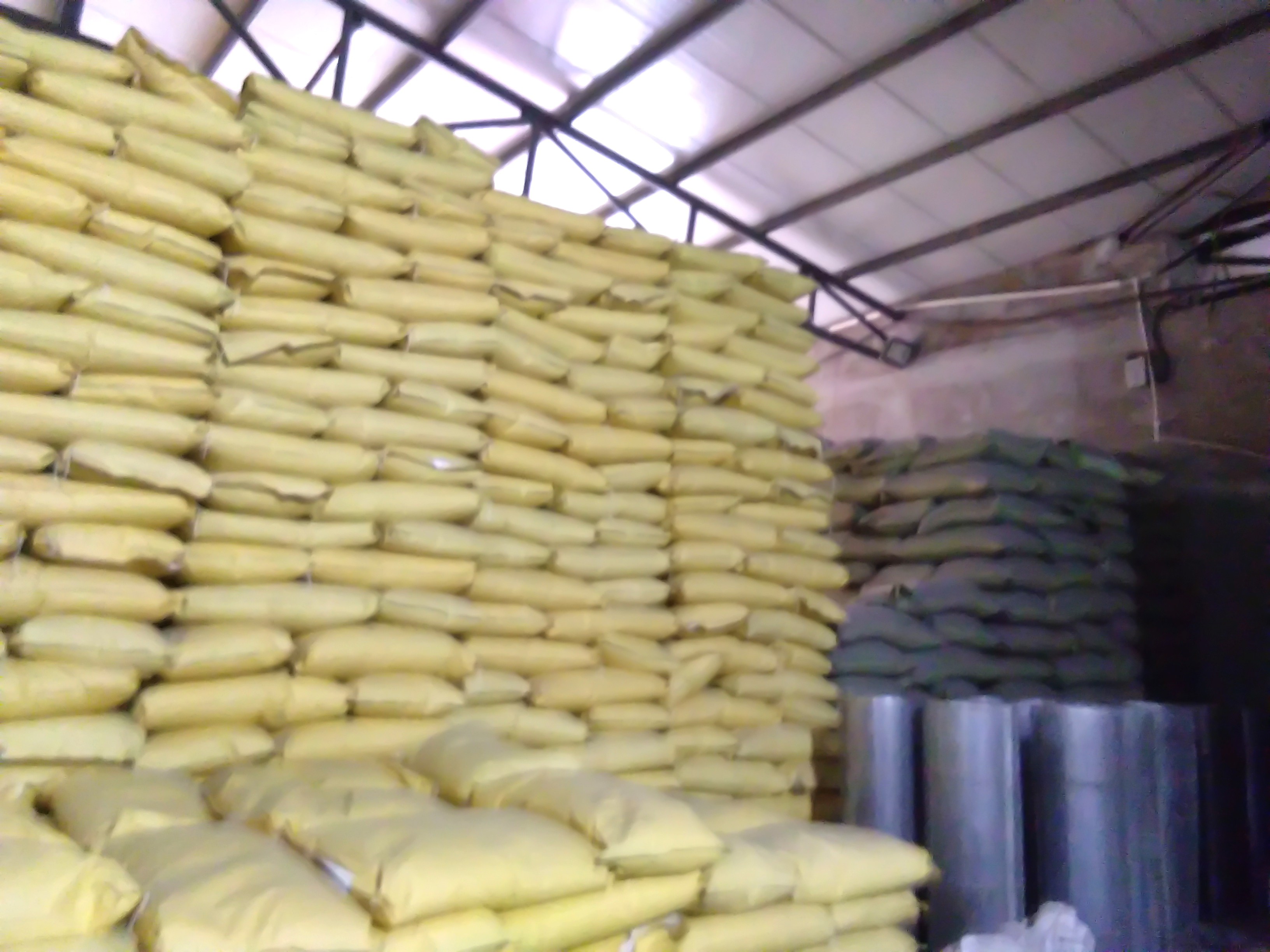
Bulk sunflower seed stock staged for grading ahead of export packing.
Both grades are confectionery-type sunflower seeds that originate from Xinjiang and Inner Mongolia in China, and both are traded for human consumption into the manufacturing and roasted-seed industries. The current product data specifies the 2026 crop year, and both are supplied in 20/25 kg plastic or paper bags. What separates them is shell behaviour, colour and the way each grade is normally traded — differences that decide which one fits a buyer's line long before price is discussed.
Why a 2026 shortlist is narrower than the grade list
Grade codes are a shorthand for kernel geometry: they tell a buyer what a seed looks like, not whether the finished pack will clear a retail specification. A shortlist becomes useful only when each code is attached to four additional items — the crop year, the moisture and purity envelope, the pack format, and the acceptance test that will be applied before shipment.
Supply context shapes how tight that shortlist should be. Global sunflower seed production was estimated at 55.05 million metric tons for the 2025/2026 marketing year by the USDA Foreign Agricultural Service, while the same source forecast an 8% decline in global non-oilseed, or confectionery, planted area in 2025. Confectionery-type availability is therefore the part of the market that rewards the longest planning horizon, not the oilseed side.
On the demand side, the global sunflower seeds market was valued at USD 29.27 billion in 2025 and projected to reach USD 35.98 billion by 2034 by Custom Market Insights. Market-size estimates vary materially between research houses depending on whether oilseed is included, so the figure is better read as a direction of travel than as a procurement benchmark.
361 and T6 in the 2026 crop year
Sunflower seed 361 is a round-shaped, black-and-white striped seed. Its colour is not fully black; the seed carries a slight yellow tone. The shell is thin and the eating quality is described as good, which is why the grade is most often directed to salted-flavour roasting. The largest size specified for 361 is 150–160 pieces per 50 g, and it is positioned below grade 363 on price.
Sunflower seed T6 is a long-type seed and is darker in colour than 361. Its shell is harder, and it is normally traded as a raw material rather than as a finished roasting input. A buyer who needs the deepest black colour, the longest kernel shape within this pair, and a seed that holds up as raw material stock is directed to T6; a buyer who prioritises a thin shell and a better eating taste is directed to 361.
Side-by-side: what actually changes between 361 and T6
| Parameter | Sunflower seeds 361 | Sunflower seeds T6 |
|---|---|---|
| Kernel shape | Round | Long |
| Colour | Black-and-white striped; not fully black, with a slight yellow tone | Darker and more black than 361 |
| Shell | Thin | Harder |
| Largest stated size | 150–160 pcs / 50 g | Not fixed in this grade note |
| Normal trading form | Roasting input, especially salted flavour | Raw material supply |
| Origin / crop | Xinjiang and Inner Mongolia; current product data specifies the 2026 crop year | Xinjiang and Inner Mongolia; current product data specifies the 2026 crop year |
The comparison note used for this shortlist states a price relationship between 361 and 363, not between 361 and T6, so no direct price gap between the two shortlisted codes is implied here. Any cell recorded as not fixed in the grade note should be confirmed on the order specification sheet before a purchase order is released.
The specification envelope that travels with the shortlist
A grade code does not qualify a supplier on its own. The grade class used for this shortlist carries a stated quality envelope, presented in comparison with a conventional ordinary grade sunflower seed: higher kernel purity, fewer broken and mildewed seeds, a larger size, and no stone. The declared parameters recorded for the class are the following.
| Declared parameter | Limit | Why it matters at decision stage |
|---|---|---|
| Moisture | ≤10.0% | Drives storage stability and roast consistency |
| Impurity | ≤0.2% | Determines cleaning load on the receiving line |
| Decolourising seeds | ≤1.5% | Affects visual grade of the finished pack |
| Erosion seeds | ≤1.0% | Signals handling quality between field and packing |
| Mildew seeds | ≤1.0% | Food-safety relevant for confectionery channels |
| Short seeds | ≤2.0% | Affects size uniformity after roasting |
| Wizened seeds | ≤6.0% | Affects yield per tonne processed |
The same comparison data records a cost position about 5% lower than the conventional ordinary grade and a higher finished-product yield after processing, with standard cold, dry storage and no special handling requirement. Yield and cost statements of this kind are the supplier's own comparison position and should be validated with a buyer's own trial roast rather than accepted as an industry benchmark, because they describe one grade comparison and not the category as a whole.
Packaging, storage and container planning
Both grades are packed in 20/25 kg plastic or paper bags, and the product should be stored in a cool place. Standard cold, dry storage is the stated requirement; no special handling is specified beyond that. Because moisture sits inside the acceptance set at ≤10.0%, the storage instruction and the loading specification are linked: a container that leaves origin inside specification is not a guarantee of condition at destination if the cargo is held in a hot or humid warehouse.
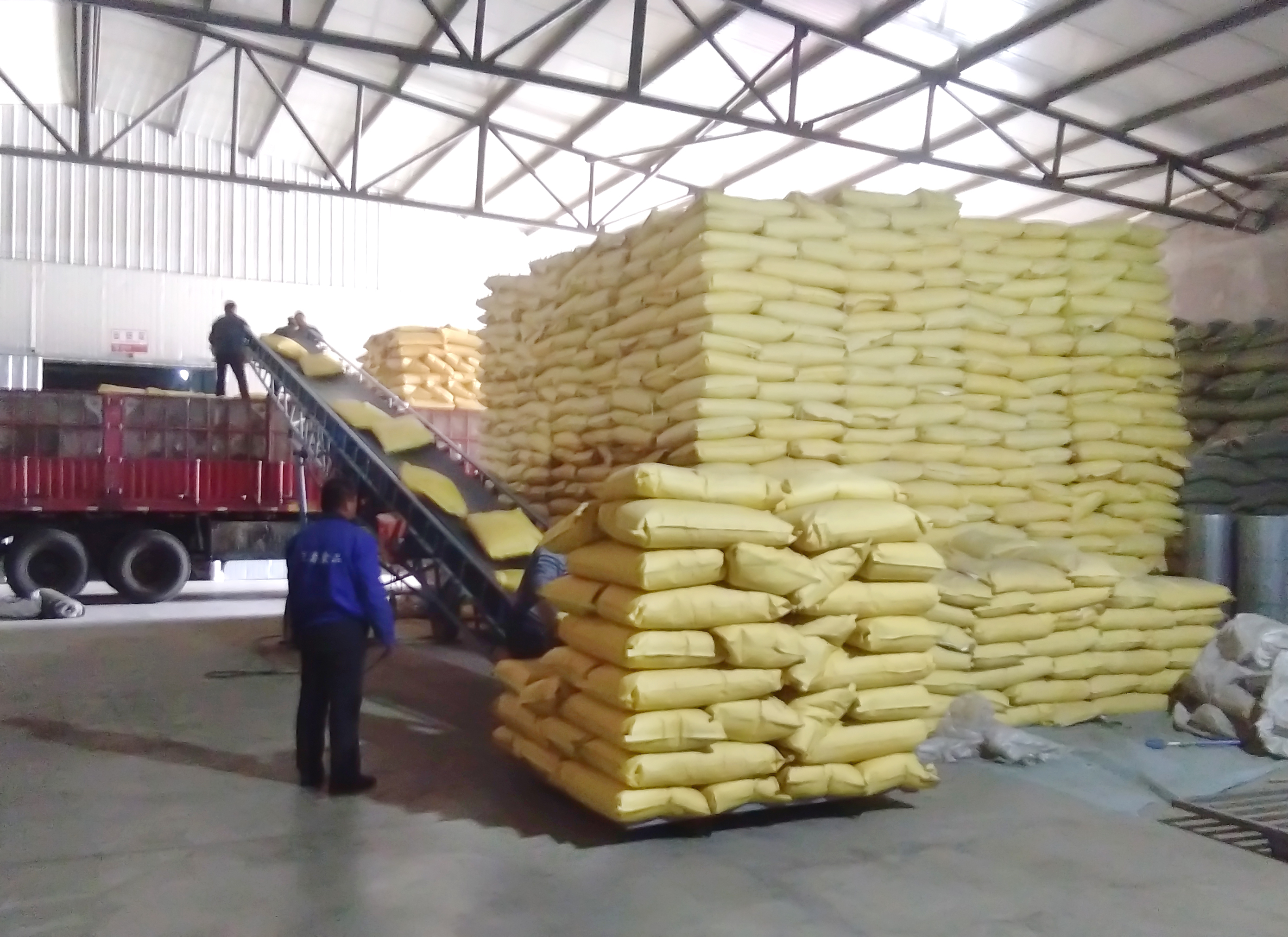
20/25 kg plastic or paper bags staged for container loading.
Commercial terms to fix before a shortlist becomes an order
Shortlisting is only useful if the commercial frame is fixed at the same time. The purchasing terms recorded for this product are straightforward and should be written into the enquiry rather than agreed verbally.
| Term | Recorded position |
|---|---|
| Minimum order quantity | 5 mts |
| Delivery terms | FOB / CNF / CIF |
| Acceptance criteria | Pre-shipment test / test after seeds received |
| Payment terms | 30/70 or 100% |
The dual acceptance structure is the part buyers most often leave vague. A pre-shipment test protects the buyer at origin, while a test after the seeds are received protects against transit and storage drift. Choosing one and not the other changes who carries the risk on moisture and impurity, so both stages belong in the contract.
Where the shortlist stops: limits buyers should plan around
- 361 has a size ceiling. Its largest stated size is 150–160 pcs per 50 g, which is smaller than grade 363, which can reach 170–180 pcs per 50 g. A buyer whose finished pack depends on maximum kernel size should not treat 361 as a direct substitute for 363.
- T6's harder shell is a fit question, not a quality question. The harder shell is an advantage in raw-material trade and a constraint on roasting lines that are not set up for it.
- Moisture ≤10.0% is an acceptance ceiling, not a shelf-life promise. It defines what is accepted at loading, not how the cargo behaves after weeks of storage.
- Confectionery supply is the tighter side of the market. The USDA forecast an 8% decline in global non-oilseed planted area in 2025, which is a forward-coverage signal for 2026 buying.
- Two codes are not a grade range. This shortlist deliberately excludes 363 and other black-seed lines, which occupy different size, taste and price positions.
For completeness, the same comparison set records that 363 is black, sweet-tasting and suited to original-flavour roasting, with a price above 361. That places 363 at a different point on the shortlist rather than at the top of it — larger size and a sweet roast profile come with a higher cost and a different colour result.
What the 2026 market context adds
Origin concentration is the strongest structural fact behind this shortlist. Inner Mongolia's sunflower seed exports reached approximately 463,400 tons in 2025, valued at US$748 million, and the region accounts for more than 60% of China's total sunflower cultivation area. At national level, China's sunflower seed exports were valued at USD 937 million in 2025, with major destinations including Iraq at USD 131 million and Russia at USD 101 million.
Demand remains skewed toward processed formats. Roasted sunflower seeds accounted for 65.9% of global packaged sunflower seed revenue in 2024, and Europe was the largest packaged market that year with a 29.6% revenue share. That mix explains why the shortlist is weighted toward roast-fit grades rather than toward oilseed characteristics.
Compliance is tightening in parallel. China notified 209 new maximum residue limits for 93 pesticides in food to the WTO in late 2025, and the EU market requires adherence to HACCP principles with strict monitoring of pesticide residues and metal contaminants. The 'Wuyuan Sunflower' is a registered geographical indication trademark in China requiring consistent colour, plump shape and a crisp texture, which illustrates how far origin quality standards now reach into procurement documentation.
From shortlist to repeat supply
A shortlist answers one purchase. The harder question for bulk buyers is whether the same specification, the same 20/25 kg pack format and the same acceptance procedure can be repeated across crop years without renegotiation. A shortlist that cannot be repeated is a one-off purchase, not a supply relationship.
Inner Mongolia Chengtai Food Co., Ltd. is a sunflower and pumpkin seed processor and exporter founded in 2013 and located in the Hetao Plain, Hanggin Rear Banner, Inner Mongolia. The company states an annual output of 30,000 mts, an export ratio of 80%, and a product range covering sunflower seeds, pumpkin seeds and kernels. It reports long-term business relationships with clients in China, the Middle East, Middle Asia, Egypt, Dubai, the United States, Austria and European countries, and it attends international exhibitions including Gulfood in Dubai, the Uzbekistan exhibition, Tuyap in Turkey, Anuga in Germany and Sial in France to meet existing and new customers. Third-party market information records the company as certified under ISO 9001 and Halal.
For a repeat programme, those facts matter in a specific order. Certification answers the market-access question. A stated export ratio across the Middle East, Middle Asia and Europe answers the question of whether the supplier already ships continuously into the buyer's region. A standing exhibition calendar answers the question of how specification changes are agreed year to year. None of the three substitutes for a trial roast, but together they determine whether a 361 or T6 line can be held stable between crops.
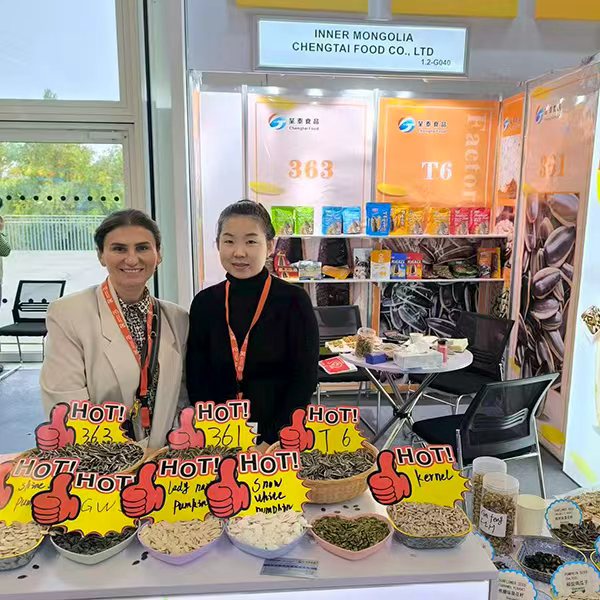
International exhibitions are where multi-year specification changes are typically agreed.
Future outlook
Three shifts are likely to shape the next shortlist cycle. First, confectionery planted area is contracting while processed demand holds, which pushes buyers toward earlier commitments on the grades they can specify precisely. Second, residue-limit revisions in China and stricter EU monitoring raise the documentation burden on every shipment, favouring suppliers whose acceptance testing already runs at both pre-shipment and post-receipt stages. Third, packaging and storage discipline becomes more visible in contract terms, because the 20/25 kg plastic or paper bag format and the cool-storage requirement are the two points where a compliant lot most easily degrades after it leaves origin.
For 2026, the practical outcome is a two-code shortlist rather than a long one: 361 where a thin shell and salted-flavour roasting quality decide the result, T6 where darker colour, a longer kernel and raw-material trade do. Everything else on the grade list is a later conversation.
FAQ
What packaging is used for bulk sunflower seed orders?
The package of this product is a 20/25 kg plastic or paper bag, and the product should be stored in a cool place. Standard cold, dry storage applies, with no special handling specified.
What moisture specification should appear in a 2026 contract?
The declared parameter for this grade class is moisture ≤10.0%. It sits inside a wider acceptance set that also includes impurity ≤0.2%, decolourising seeds ≤1.5%, erosion seeds ≤1.0%, mildew seeds ≤1.0%, short seeds ≤2.0% and wizened seeds ≤6.0%. Moisture defines what is accepted at loading and does not by itself define storage life after arrival.
What are the minimum order quantity, delivery terms and acceptance criteria?
The recorded purchasing terms are a minimum order quantity of 5 mts, delivery on FOB, CNF or CIF terms, acceptance through a pre-shipment test or a test after the seeds are received, and payment terms of 30/70 or 100%.
How do sunflower seeds 361 and T6 differ?
Grade 361 is round, black-and-white striped rather than fully black, with a slight yellow tone, a thin shell and a good taste, and it is most often used for salted-flavour roasting; its largest stated size is 150–160 pcs per 50 g. Grade T6 is a long-type seed that is darker and more black than 361, with a harder shell, and it is usually sold as a raw material.
Which grade should a buyer choose if maximum kernel size is the priority?
Neither of the two shortlisted codes is the largest-size option in this grade family. Grade 363 is black, sweet-tasting and suited to original-flavour roasting, can reach 170–180 pcs per 50 g, and sits above 361 on price.
What origin and crop year apply to these grades?
The product originates from Xinjiang and Inner Mongolia, and the current product data specifies the 2026 crop year. Sunflower seed 363 from the same offering is also documented as originating from Xinjiang and Inner Mongolia and as a 2026 crop year product.
How do buyers keep supply stable across crop years?
Continuity depends on repeating three things without change: the specification envelope, the 20/25 kg plastic or paper bag format, and the acceptance procedure. Inner Mongolia Chengtai Food Co., Ltd. reports long-term business relationships with clients in China, the Middle East, Middle Asia, Egypt, Dubai, the United States, Austria and European countries, and attends international exhibitions including Gulfood in Dubai, the Uzbekistan exhibition, Tuyap in Turkey, Anuga in Germany and Sial in France. Third-party market information records the company as certified under ISO 9001 and Halal.
Company reference: Inner Mongolia Chengtai Food Co.,Ltd — sunflower seeds, pumpkin seeds and kernels, founded 2013, Hetao Plain, Hanggin Rear Banner, Inner Mongolia. Product and company information: www.ctsunfood.com.
Company profile (PDF): download the brochure.