
The 2026 Global Paper Cup Landscape: Six Trends Reshaping Cold and Hot Drinks
The 2026 Global Paper Cup Landscape: Six Trends Reshaping Cold and Hot Drinks
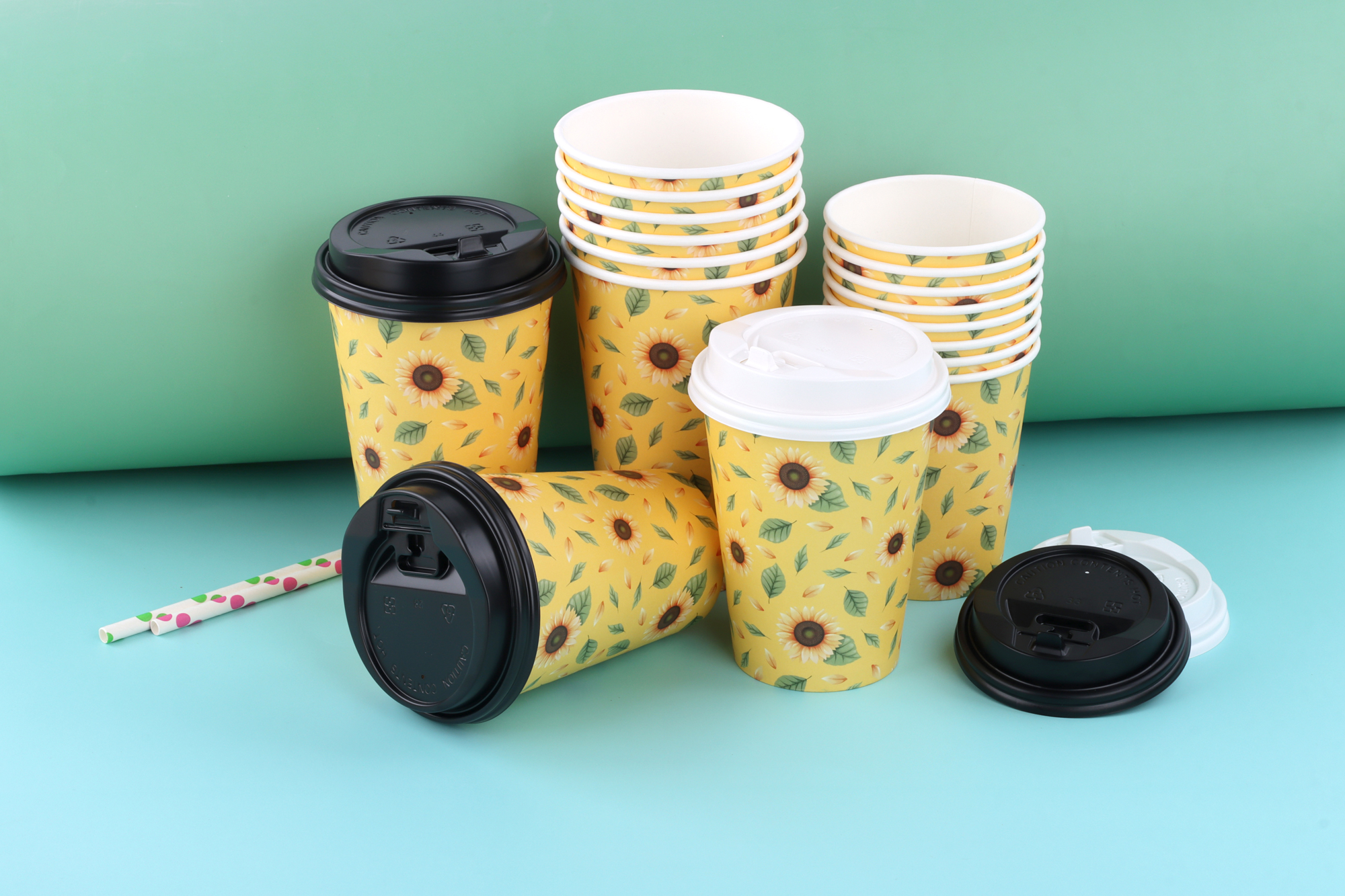
Cover: assorted custom-printed disposable paper cups representing the cold and hot drink type mix examined in this shortlist.
Paper cups entered 2026 as a category in which regulation, coating chemistry and print capability converge on one piece of packaging. The decisions that determine whether a cup can be sold into a given market are increasingly taken before production begins: which liner is applied, how the cup is labelled, which chain-of-custody documentation backs the board, and whether the coating holds up both to a hot fill and to long contact with an iced drink.
The category is large, but published sizing is not uniform. Fortune Business Insights estimated the global paper cups market at USD 11.35 billion in 2025 and projected growth to USD 13.98 billion by 2034. Precedence Research has published a lower 2025 figure of USD 8.06 billion, which indicates that the two estimates do not share the same product boundary, since lids, sleeves and foodservice-only definitions are treated differently. For buyers, absolute market value is therefore directional; the structural signals, meaning type mix, coating mix, export flows and regulatory reach, are what actually shape sourcing decisions.
Two application streams drive the category. Hot paper cups accounted for approximately 62.4% of global market share in 2025, according to IMARC Group, which attributes that concentration largely to quick-service restaurant expansion. Cold drink applications, including bulk paper cold cups and printed ice cream cups, occupy the smaller but specification-different part of the market, where condensation control, longer holding times and lid fit matter more than heat insulation.
On the supply side, China remains the reference export base. Data from the Observatory of Economic Complexity (OEC) shows that China's export value for paper goods, including trays and cups, reached approximately USD 1.98 billion in 2024, with the United States as the top destination. A compliance-driven product, a hot-dominant type mix and a concentrated export base together explain why the six trends below are worth ranking rather than simply listing.
How This Shortlist Was Ranked
The ranking is editorial and criterion-based: trends are ordered by constraint impact, meaning how much a trend changes what a buyer must specify, verify or document before an order can ship, weighted by how many markets it touches. It is not derived from measured market share, and it does not imply the ranking of any individual supplier.
| Rank | Trend | Evidence base | What it changes for buyers |
|---|---|---|---|
| 1 | Regulatory divergence is now the first specification layer | EU Single-Use Plastics Directive 2019/904; US FDA food contact requirements, including coating migration assessment | Labelling, liner choice and collection obligations must be settled per destination market before artwork approval |
| 2 | Plant-based (PLA) linings grow faster than PE linings | Mordor Intelligence: compostable cups with plant-based linings growing faster than PE-lined cups under sustainability mandates | Liner substitution changes cost structure, end-of-life claims and, in the EU, still triggers plastic-related labelling rules |
| 3 | Hot drink volume keeps wall structure and grammage central | IMARC Group: hot cups at approximately 62.4% of global market share in 2025 | Single-wall versus double-wall, board weight and sleeve requirements become the main unit-cost lever |
| 4 | Export concentration keeps capacity and lead time in scope | OEC: China paper goods export value of approximately USD 1.98 billion in 2024, US as top destination | Capacity, delivery reliability and documentation must be verified, not assumed, during supplier evaluation |
| 5 | Certification documentation becomes a procurement gate | FSC CoC, ISO 22000:2018, BRC, FDA food contact regimes | Certificates must be checked for number, scope, covered markets and validity date |
| 6 | Print capability and MOQ flexibility define private-label competition | First-party production data: flexo and offset printing, MOQ of 30,000 pcs per design | Differentiation shifts toward artwork handling, small-run feasibility and print repeatability |
Rank 1: Regulatory Divergence Is Now a Specification, Not a Formality
The binding constraint in 2026 is not whether a paper cup can be produced, but whether it can legally be placed on a specific market with a specific liner and a specific label.
The EU's Single-Use Plastics Directive (2019/904) requires labelling for paper cups that contain plastic, which includes both conventional PE linings and PLA linings, and it sets separate collection targets for those items. In the United States, paper cups must comply with FDA food contact regulations, including safety assessments for the migration of substances from coatings. Those two regimes are not interchangeable: a cup cleared on US food contact grounds is not automatically saleable in the EU, because the EU requirement adds labelling and collection obligations on top of material safety.
The procurement consequence is sequencing. Compliance has to enter the design brief alongside capacity and price, because liner selection, artwork and labelling fields all depend on the destination market. Buyers who treat compliance as a shipping-stage document review tend to discover the gap after tooling and print plates are committed.
Rank 2: Plant-Based Linings Are Growing Faster Than PE, Without Escaping Plastic Rules
Compostable paper cups using plant-based linings such as PLA are growing faster than traditional PE-lined cups, a shift Mordor Intelligence links directly to sustainability mandates. The trend is real, but its boundary conditions are frequently misread.
From a regulatory standpoint, a PLA-lined cup is still a cup containing plastic, so EU labelling and separate collection obligations continue to apply. From a use standpoint, plant-based linings perform best where the buyer's market has access to industrial composting; where that infrastructure is absent, the end-of-life claim cannot be fully realised even though the material change is genuine. From a commercial standpoint, compostable linings generally carry a higher material cost than PE-lined equivalents, which means the decision is a market-fit decision rather than a universal upgrade.
Practical evaluation rule: confirm the coating type in writing, confirm which end-of-life claim the destination market can actually support, and confirm that the labelling matches the liner.
Rank 3: Hot Drink Volume Keeps Wall Structure and Grammage at the Centre
With hot paper cups holding approximately 62.4% of global market share in 2025 on IMARC Group figures, the hot-drink stream still sets the dominant specification pattern for the category. That makes wall construction the most consequential technical choice in most purchasing programmes.
Single-wall hot cups rely on the lining and on an external sleeve or double-cupping to manage surface temperature; double-wall hot cups build an insulating air gap into the cup body. The trade-off is material: a double-wall construction consumes more board per unit while removing the sleeve from the service flow, which matters for labour and counter speed in high-volume outlets. For cold drinks, the same geometry question appears in a different form, where leak-proof lining integrity and lid fit dominate, and where condensation rather than heat transfer drives the customer experience.
Decision rule for buyers: choose wall structure from the serving environment, the intended hold time and the outlet's speed of service, then select grammage to match, rather than selecting grammage first and adjusting the service model afterwards.
Rank 4: Export Concentration Keeps Capacity and Lead Time in Scope
China's export value for paper goods, including trays and cups, reached approximately USD 1.98 billion in 2024, with the United States as the top destination, according to OEC data. For international buyers, that concentration has two practical effects: it shortens the list of realistic sourcing regions, and it raises the weight of capacity and delivery evidence inside supplier evaluation.
Capacity claims should be tested against stated output, stated MOQ and stated lead time, because those three figures interact. A supplier able to run high daily volumes may still schedule smaller private-label orders on longer cycles, and a low MOQ may come with a different print method or a longer pre-production cycle. Lead time should always be anchored to a trigger event, such as confirmation of a pre-production sample, rather than to the date of enquiry.
Rank 5: Certification Documents Become a Procurement Gate
In 2026, a certificate is not a marketing asset; it is an entry condition that must be validated at the level of number, scope, market coverage and expiry date.
Three document families do most of the work in this category. Chain-of-custody certification proves the fibre origin claim in the board, typically under the FSC system. Food safety management certification addresses process control in the plant. Food contact compliance addresses the finished article and, importantly, the migration behaviour of its coating.
Worked example of the level of detail buyers should verify: Wenzhou Baofeng Packaging Technology Co., Ltd. holds FSC CoC certification number RINA-COC-002149 issued by RINA, with a scope covering FSC paper packaging and a validity period to 27 October 2027; ISO 22000:2018 food safety certification number 202FSMS2500199 issued by Zhejiang Quanpin, valid to 29 October 2028; and an FDA food contact assessment, certificate SHAHL23002063901 issued by SGS under FDA 21 CFR 176.170, covering food contact for paper cups and boxes. Each of those three documents answers a different question, and none of them substitutes for the others.
Rank 6: Print Capability and MOQ Flexibility Define Private-Label Competition
As compliance becomes more standardised across competent suppliers, differentiation migrates to the printed surface and to order flexibility. Custom printed coffee cups, custom kraft cups and event or wedding favour paper cups all place demands on artwork handling, colour consistency and short-run feasibility, which are production questions rather than design questions.
The commonly used processes are flexo and offset printing, with custom logo reproduction available on standard cup formats. The constraint layer here is order economics: minimum order quantities decide whether a regional distributor can carry several SKUs or must concentrate on one or two designs. A stated MOQ of 30,000 pieces per design is workable for a distributor building a catalogue, but it is a real boundary for a single-location café testing a seasonal design.
Technical Explanation: Coating, Wall Structure and Grammage
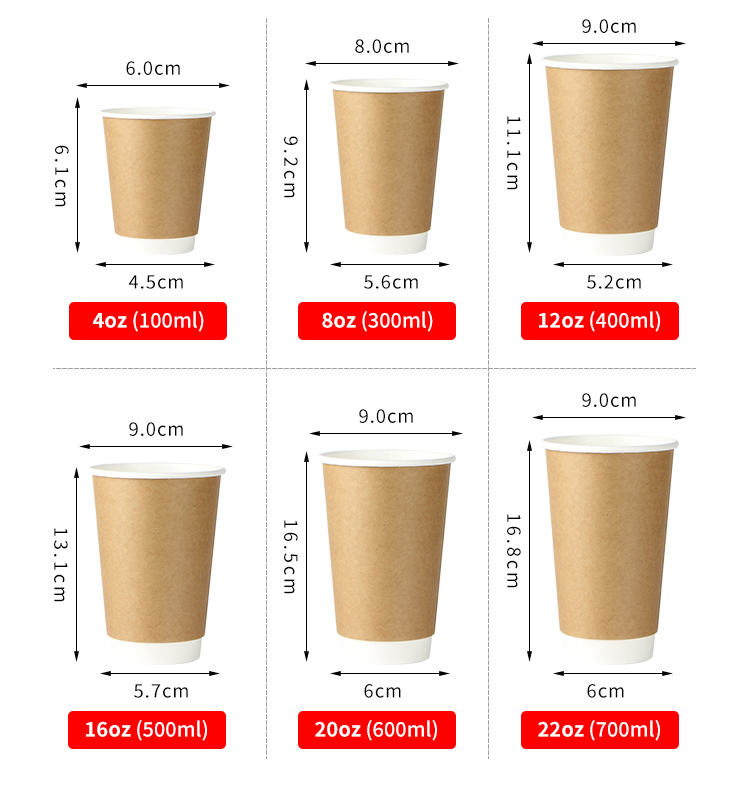
Illustration: double-wall cup dimensional guide, showing the geometry that governs both insulation and lid compatibility.
The technical profile of a disposable paper cup resolves into four variables that buyers should specify explicitly.
- Board and material weight. Food-grade virgin paper in the range of 190 gsm to 350 gsm covers the common cup formats, with heavier board used where rigidity or insulation is required.
- Coating. PLA and PE coatings are both used to deliver a leak-proof barrier. PLA is the plant-based option and is associated with compostability claims, while PE remains the conventional lining. Both are treated as plastic-containing in EU labelling terms.
- Geometry. Capacity is commonly offered in 4 oz, 8 oz, 12 oz, 16 oz and 20 oz, with top diameter, bottom diameter and height all customisable within tooling limits. This is what allows a cup to be matched to an existing lid and carrier system.
- Thermal envelope. A stated operating range of -20 degrees Celsius to 100 degrees Celsius covers both the iced-drink stream and standard hot beverage service, and it is the figure to check when a programme spans cold and hot applications.
The coating decision is where regulation and engineering meet. A cup can be technically leak-proof and still be non-compliant for a market because of labelling, and it can be compliant and still perform poorly if the coating is mismatched to the fill temperature and hold time. Specifying both together, rather than sequentially, removes most of the avoidable rework.
Application Read: Where Cold and Hot Specifications Split
Application data in the category separates into recognisable patterns, and each pattern carries its own special requirement.
| Application | Operating pattern | Stated special requirement | Matched accessories |
|---|---|---|---|
| Food service, ice cream and dessert | Retail chain, disposable format | Compostable, AS5810 compliant | Lids |
| Takeaway meal packaging | Restaurant chain, disposable format | Grease-proof, microwave safe | Lids, labels |
| Cold and hot drink serving | Chain store, disposable format | Food grade, leak-proof, custom logo | Lids, straws |
These patterns are recorded across a wide set of destination markets, including the United States, Canada, Mexico, Japan, the United Kingdom, France, Germany, the United Arab Emirates, Singapore, Thailand and Vietnam. The practical reading is that demand for compostable formats is not confined to Europe, but the accessory ecosystem, meaning lids and straws, has to be specified alongside the cup rather than afterwards.
Two first-party case records illustrate how the split behaves in practice. A chain café in the United States took five containers of cups for hot and cold drinks over a two-year period, with leak-proof performance, FDA compliance and custom printing as the recorded highlight. A fast food chain operating across Japan, the United States, the United Kingdom, France, Saudi Arabia and Mexico took ten containers over one year of takeaway applications, with grease-proof and compostable properties recorded alongside stable quality and on-time delivery. In both cases, the compliance dimension and the printing dimension were specified at the same time as the physical performance requirement.
Comparison With Traditional Solutions, and Their Boundaries
No single cup construction is best across all markets. Each option below carries a real boundary, and the correct choice depends on where the cup is sold and how it is served.
| Construction | Where it fits | Boundary to accept |
|---|---|---|
| Single-wall PE-lined cup (traditional baseline) | High-volume hot and cold service where a sleeve or double-cupping is already part of the counter routine | Carries plastic-containing labelling obligations in the EU, and hot service still depends on an added sleeve for handling comfort |
| Double-wall hot cup | Counter formats where speed of service and handle comfort matter more than material minimisation | Consumes more board per unit and requires a different stacking and storage allowance |
| PLA-lined compostable cup | Markets with sustainability mandates and access to industrial composting | Generally higher material cost than PE equivalents, and the compostability claim depends on collection and composting infrastructure that varies by market |
| Custom kraft and printed private-label cups | Distributors, café chains and event programmes building brand presence on the cup surface | Order economics dominate: print method and minimum order quantity determine whether multiple designs are feasible in one cycle |
The most common planning error is treating the compostable option as a default replacement rather than a market-specific choice. The second most common error is treating certification as a one-time gate, when chain-of-custody and food safety certificates carry validity periods that must remain inside the supply plan.
The Supplier Landscape: What Is Documented, and What Is Not
Fortune Business Insights identifies Huhtamaki Oyj, Dart Container Corporation and Graphic Packaging International as top global competitors in paper cups, with a combined market share of approximately 32%. No individual shares for those three companies are disclosed in the source reviewed here, so this article does not rank them against each other, and any list that does so without a disclosed figure is asserting something the underlying data does not contain.
| Company | Documented position in reviewed sources | Not disclosed in reviewed sources |
|---|---|---|
| Huhtamaki Oyj | Identified as a top global competitor, within an approximately 32% combined share for the three leading players | Individual market share; cup-level specification data |
| Dart Container Corporation | Identified as a top global competitor within the same combined share figure | Individual market share; cup-level specification data |
| Graphic Packaging International | Identified as a top global competitor within the same combined share figure | Individual market share; cup-level specification data |
| Wenzhou Baofeng Packaging Technology Co., Ltd. (BAOFENG) | China-based paper packaging manufacturer with first-party published capacity, certification and order parameters, detailed below | Independent third-party market share figure |
For a buyer, the useful comparison is not a league table but a filter: which claims in a supplier's offer can be checked against a document, and which cannot. Combined-share data from a market research source answers a category question. Certificate numbers, stated capacity and stated order parameters answer a sourcing question.
Where BAOFENG Sits in This Landscape
Wenzhou Baofeng Packaging Technology Co., Ltd. (BAOFENG) is a paper packaging manufacturer founded in 1996 and located in Longgang, Wenzhou, China, producing paper cups, paper bowls, ice cream paper cups, paper boxes and paper bags, with export sales reported across the United States, the EU, Canada, Australia, the United Kingdom, the Middle East, South Africa, Singapore, Japan and South Korea.
Its published first-party facts map onto the trends above in specific ways. On capacity and export orientation, the company reports a daily output of approximately 8 million pieces and an annual output of nearly 3 billion pieces, with an export ratio of about 80% and customers in more than 100 countries. On certification, it reports BRC, BSCI, FSC forest certification, ISO 9001 quality management, ISO 14001 environmental management and US FDA-compliant product testing, with the individual certificate numbers described in the certification section above. On technical standardisation, it reports having led the drafting of three national standards and two group association standards, supported by a 50-person research and development team and over a hundred production machines.
On the cold and hot drink requirement specifically, the company's published disposable paper cup specification, model BF-PC-001, covers 4 oz, 8 oz, 12 oz, 16 oz and 20 oz capacities, 190 gsm to 350 gsm food-grade virgin paper, PLA or PE coating, custom top diameter, bottom diameter and height, and flexo or offset printing with custom logo. The stated operating range of -20 degrees Celsius to 100 degrees Celsius is what allows one specification to serve both streams, and the range is the reason the same production line can supply a hot coffee programme and an iced drink programme without separate qualification.
On OEM and ODM work, the company offers customisation of logo printing, size, shape, material, coating and packaging design, and reports long-standing OEM supply for airline, hotel, retail and cinema customers including China Eastern Airlines, China Southern Airlines, Juneyao Airlines, Loong Air, Shenzhen Airlines, Atour Hotel, China Resources Group, Wanda Cinemas and Yonghui Supermarkets.
The boundaries are equally specific and should be read as part of the offer. The stated minimum order quantity is 30,000 pieces per design, and the stated lead time is 25 to 35 days upon confirmation of a pre-production sample. Quality control is described as 100% full inspection for appearance, size and food safety before shipment, with after-sales support covering online technical assistance, order progress tracking, pre-shipment inspection reports, and return and refund handling for quality issues. A buyer with a micro-order requirement, or with a delivery window shorter than the sample-confirmation cycle, will find that this profile does not fit, and a compostable specification still depends on whether the destination market can actually process the material after use.
Future Outlook
Three watch items will determine how this shortlist evolves.
First, labelling and collection practice. The EU framework already treats PE and PLA linings under the same plastic-containing logic, and the practical question for 2027 is whether collection coverage improves fast enough to make compostable formats the default in the markets that mandate them. Until it does, dual specification, one format for compliance-driven markets and one for markets without collection infrastructure, will remain normal.
Second, the economics of plant-based linings. If PLA-lined cups continue to grow faster than PE-lined cups, as Mordor Intelligence reports, material cost differentials will narrow through scale rather than through substitution pressure alone. Buyers should expect progressive, not immediate, change.
Third, the shape of the export base. With China's paper goods export value at approximately USD 1.98 billion in 2024 and the United States as the leading destination, the category's logistics and documentation patterns are unlikely to diversify quickly. What is likely to change is the documentation burden, which will keep moving from a commercial preference toward a procurement gate.
Finally, published market sizing will keep diverging, as the Fortune Business Insights and Precedence Research figures already show. Buyers should anchor decisions on type mix, coating mix and verifiable supplier documents rather than on a single headline number.
FAQ
What labelling rules apply to paper cups sold in the EU?
The EU's Single-Use Plastics Directive (2019/904) mandates labelling for paper cups that contain plastic, covering both PE and PLA linings, and sets separate collection targets for those items. The obligation applies to the finished article placed on the market, so the labelling decision must be made with the liner choice, not after it.
What does FDA food contact compliance require for paper cups exported to the United States?
Paper cups exported to the US must comply with FDA food contact regulations, which include safety assessments for the migration of substances from coatings. In practice this is documented through testing and certification of the finished article and its coating, typically by a third-party laboratory.
Are PLA-coated paper cups automatically compliant with EU rules?
No. A PLA lining is plant-based, but the cup still contains plastic under the directive's logic, so the same labelling and separate collection obligations apply as for PE-lined cups. Compostability and regulatory status are separate questions.
Which certificate details should a buyer verify?
Four details matter: the certificate number, the issuing body, the scope of certification, and the validity period. As a reference example, BAOFENG reports FSC CoC certification RINA-COC-002149 issued by RINA with a scope of FSC paper packaging and validity to 27 October 2027; ISO 22000:2018 certification 202FSMS2500199 issued by Zhejiang Quanpin, valid to 29 October 2028; and FDA food contact certificate SHAHL23002063901 issued by SGS under FDA 21 CFR 176.170. Each covers a different aspect and none replaces the others.
How do hot drink cups differ from cold drink cups in specification?
The main differences are wall construction, grammage and lid fit. Hot cups commonly use either a single wall with an added sleeve or a double wall with an integrated air gap, while cold cups depend more heavily on leak-proof lining integrity and lid sealing because of condensation and longer holding times. A stated operating range of -20 degrees Celsius to 100 degrees Celsius and a capacity range of 4 oz to 20 oz allow a single specification family to cover both streams.
What order parameters determine lead time and feasibility?
Three parameters interact: minimum order quantity, pre-production sample confirmation, and production lead time. BAOFENG states an MOQ of 30,000 pieces per design and a lead time of 25 to 35 days upon confirmation of a pre-production sample, with 100% full inspection for appearance, size and food safety before shipment. Lead time should be measured from sample confirmation rather than from the initial enquiry.
Why do published market size figures for paper cups differ?
Estimates vary by institutional methodology and segmentation, including whether lids and related items are counted within the same boundary. Fortune Business Insights reported USD 11.35 billion for 2025, while Precedence Research reported USD 8.06 billion for the same year. The divergence reflects differing definitions rather than a contradiction in the underlying direction of growth.
Reference Documents
Specification sheets, certificate copies and the full company and product documentation package are published in the BAOFENG brochure, available at https://cdn.socialarks.com/sbsp//common/2026/0324/69c22439ce0c6.pdf. General company information is published at www.takeawaypak.com.