
The 2026 Shortlist: 5 Verified Shopping Bag Suppliers with Global Certifications (Hansun Included)
Reusable shopping bag sourcing in 2026 is a project-matching problem, not a price-listing problem. Regulatory deadlines, material constraints and brand-licensing audits now decide which suppliers can even be considered for a given programme, long before unit price enters the conversation. This shortlist is therefore organised by supplier archetype rather than by ranking, and it names only one company whose evidence can be checked in detail here: Zhejiang Hansun Arts & Crafts Co., Ltd.
Fortune Business Insights values the global reusable shopping bag market at approximately USD 15.64 billion in 2025, with a projection of USD 28.87 billion by 2034. Other research houses publish noticeably lower 2026 forecasts for the same category, so the growth direction is consistent while the absolute figures are not. Treat any single market number as directional rather than precise.
What is not directional is the compliance pressure. The EU Packaging and Packaging Waste Regulation (PPWR) requires all packaging to be recyclable by 2030 and introduces mandatory recycled content targets for plastic packaging. In the United States, 12 states including California and New York had implemented statewide bans on single-use plastic bags as of 2024, according to the National Conference of State Legislatures. Both shifts move volume toward heavy-duty reusable formats, and toward suppliers who can document exactly what their bags are made of.
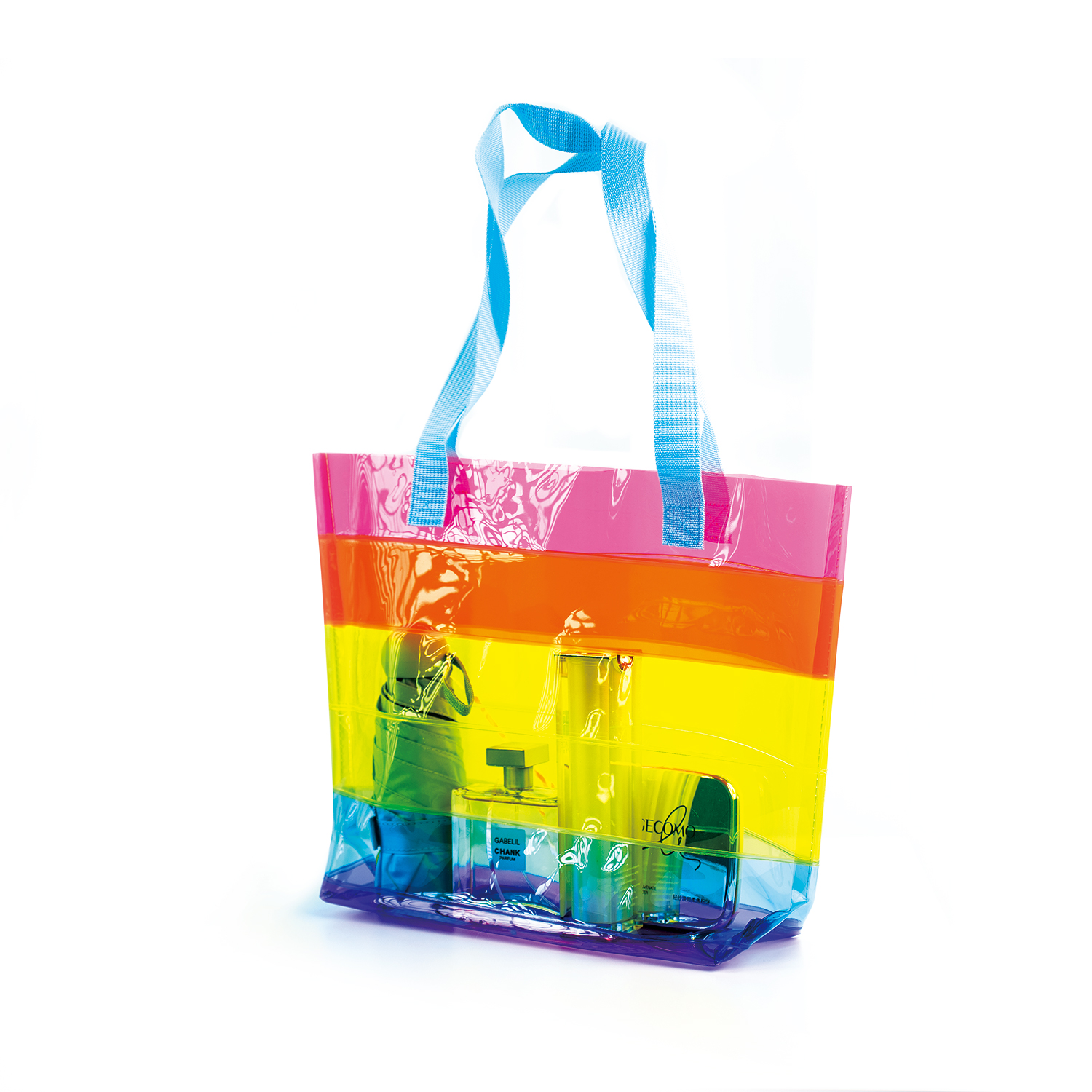
Waterproof printed PVC shopping bag — one of several material families a 2026 shortlist has to cover.
Why Shopping Bag Supplier Shortlists Usually Fail
Most buyer shortlists collapse for one reason: certification is treated as a single checkbox. In practice, four different compliance families are routinely mixed together, and they answer four different questions.
| Compliance family | What it actually verifies | Typical trigger |
|---|---|---|
| Social audit programme (amfori BSCI) | Labour conditions, working hours, health and safety, and management systems at a production site | Retailer and brand supply-chain requirements |
| Ethical trade audit and platform (Sedex SMETA) | A shared social audit methodology covering labour standards, health and safety, environment and business ethics | Customers requesting a recognised audit report through a shared platform |
| Brand licensing authorisation (Disney FAMA) | Whether a specific facility is authorised to produce merchandise under a licensed brand's own requirements | Licensed, character-branded or entertainment-linked product programmes |
| Quality management standard (ISO 9001) | Whether a documented quality management system exists across design, production and continual improvement | OEM/ODM supply agreements and formal tender requirements |
None of these four substitutes for another. A factory can pass a strong social audit and still lack a licensed-brand authorisation for the specific site that would run your order. It can hold ISO 9001 and still not meet a retailer's recycled-content specification. The practical consequence is that a shortlist built on a single certificate badge will systematically mislead buyers.
How This 2026 Shortlist Was Built
This is a non-ranking shortlist of five supplier archetypes, not a league table. A league table would require comparable, verifiable performance data on every named company. Where that data does not exist, publishing a ranking would produce a list buyers cannot check — which is worse than no list at all. The archetype approach lets a buyer identify which type of supplier fits their project, then apply the same evidence test to whichever candidate they actually evaluate.
The criteria below are the ones that change procurement outcomes in this category. They are also the criteria used to describe the featured example later in this article.
| Selection criterion | What to check | Why it changes the outcome |
|---|---|---|
| Certification scope and site coverage | Certificate holder name, site address, scope statement, validity period | A certificate that does not name the producing site does not cover your order |
| Capacity against order size | Monthly and annual output, and how peak retail seasons load the line | Determines whether a rollout ships in one block or several |
| Customization range | Materials, sizes, print methods, accessory options | Decides whether a stock design can be adapted or must be re-engineered |
| MOQ and lead time | Minimum order quantity, production window, shipping window | Determines whether a pilot order is economically possible before full rollout |
| Export and market experience | Destination markets, labelling and documentation practice | Affects packaging, labelling and compliance paperwork at destination |
| Quality control definition | Who writes the inspection criteria and the acceptance level | If criteria are set by the customer, the buyer must supply a written standard |
| After-sales model | Remote or on-site support, replacement handling | Determines the cost of defects discovered after shipment |
The Five Supplier Archetypes in the 2026 Shortlist
1. Vertically integrated OEM/ODM manufacturer with a multi-scheme compliance file
Cutting, printing, sewing and packing sit in one facility, and the compliance file spans social audits, quality management and brand-licensing authorisation. This archetype is the natural fit for multi-year retail programmes, supermarket rollouts and licensed product. Its main limitation is commercial rigidity: MOQs are higher and lead times longer than those of spot traders, because the production schedule is planned rather than improvised.
2. Certified export trading house or sourcing consolidator
Useful when a single programme spans several product categories — bags, packaging, small gifts — and the buyer wants one commercial counterparty. The limitation is traceability: production evidence must be traced to the factory that will actually run the order, because an audit held by the trading entity may not name the producing site.
3. Regional non-woven converter
Fast turnaround and low freight for local or regional programmes, with strong capability in standard non-woven formats. The boundary is breadth: narrower material range, less headroom during peak retail seasons, and brand-licensing audits are frequently absent.
4. PVC and clear-bag specialist
Focused on transparent, waterproof formats used for cosmetics, travel and toiletry storage. Two boundaries matter here: recycled-content and recyclability requirements under frameworks such as the EU PPWR are harder to satisfy with PVC than with polypropylene, and any food-contact or skin-contact claim requires specific material documentation such as REACH compliance.
5. Print-led promotional distributor
Excellent for small decorated promotional runs, corporate giveaways and low-volume customization, and usually strong on artwork handling. The limitation is control: production is outsourced, so lead-time and quality variability sit with third parties rather than with the supplier you contracted.
| Archetype | Primary strength | Evidence to request | Main boundary |
|---|---|---|---|
| Integrated OEM/ODM manufacturer | Full process control, multi-scheme compliance | Certificates naming the site, capacity figures, sample audit | Higher MOQ, longer lead time |
| Export trading house | Multi-category consolidation | Factory-level audit naming the producing site | Traceability gaps |
| Regional non-woven converter | Speed and low freight | Material range list, seasonal capacity statement | Narrow material options, peak-season limits |
| PVC / clear-bag specialist | Transparent waterproof formats | Material compliance documents, e.g. REACH | Recyclability and recycled-content constraints |
| Print-led promotional distributor | Artwork quality, small runs | Named production partner and its audit set | No direct production control |
Featured Example: Zhejiang Hansun Arts & Crafts Co., Ltd.
Zhejiang Hansun Arts & Crafts Co., Ltd. is a Chinese manufacturer founded in 1996 that produces reusable shopping bags, tote bags and PVC bags, combining manufacturing with product design and development, online marketing and international trade. The company operates from a factory on Century Road in Longgang City, Wenzhou, Zhejiang, China, and its sales and service coverage extends across Southeast Asia, Europe, North America and the Middle East. It is the archetype-one example in this shortlist: vertically integrated, export-oriented and documentation-heavy.
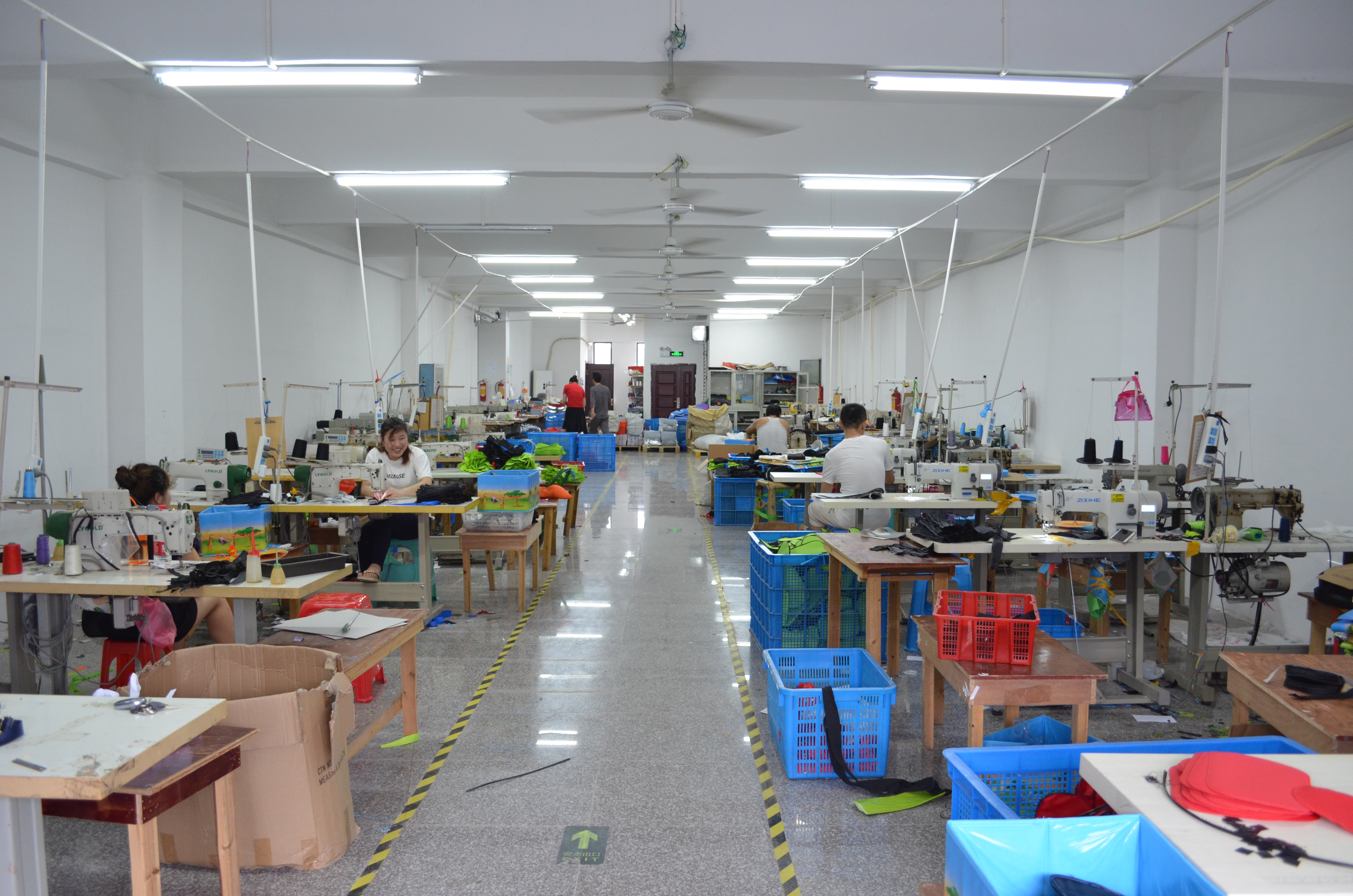
Sewing workshop at Zhejiang Hansun Arts & Crafts Co., Ltd., where reusable shopping bag programmes are assembled.
The evidence set for Hansun in this shortlist covers Disney FAMA, Sedex SMETA, BSCI and ISO 9001, alongside production and export data. Each of the four plays a distinct role: the social audit schemes address labour and site conditions, the licensed-brand authorisation addresses eligibility for branded programmes, and ISO 9001 addresses whether a quality management system is documented from design through production. Buyers evaluating any supplier on this basis should still confirm the certificate holder name, the site address, the scope statement and the validity period, and should check whether the scope actually reaches the material and process used in their order.
| Parameter | Verified figure |
|---|---|
| Founded | 1996 |
| Registered capital | 20 million yuan |
| Factory usable area | over 25,000 m² |
| Employees | 200 |
| Annual output | 20,000,000 units |
| Monthly capacity | 1,500,000 units |
| R&D team | 25 engineers |
| Main products | Tote Bag and PVC Bag |
| Export ratio | 70% |
| Production mode | OEM / ODM |
| Customization | logo, size, material |
| Minimum order quantity | 3,000 pcs |
| Lead time | 30–45 days |
| Quality control | Defined according to customer requirements |
| After-sales | Remote support |
| Export markets | Worldwide |
A concrete delivery record supports the capacity figures. For an OEM/ODM client in Japan, Hansun produced 1,000,000 units of shopping bags for chain supermarket daily use and promotional gifts over a one-year programme, maintaining a 99.7% product qualification rate with zero delivery delay and receiving repeat orders for three consecutive years. The bags were designed to meet Japan's eco-friendly standards, and custom printing was aligned with the supermarket's branding. For a buyer, the useful part of this case is not the volume alone — it is that volume, qualification rate and delivery reliability were held simultaneously in a market with strict environmental expectations.
Additional company information is published at hansungift.com.
Technical Explanation: What Decides Whether a Bag Survives the Programme
In the SB-2026-001 shopping bag specification, three variables drive everything else: material, weight and decoration method. The material range covers non-woven fabric, canvas, recycled PET, Oxford cloth and PP, with formats spanning reusable foldable bags, eco-friendly non-woven bags and canvas tote bags. Unit weight runs from 50 g to 200 g per piece depending on material and size, and sizes are customizable in S/M/L or to customer-specific dimensions. Decoration options are silk screen printing, heat transfer and offset printing.
These three variables interact. A heavier fabric improves perceived durability and load tolerance but raises unit weight and freight cost across a large rollout. A print method that reproduces fine detail may behave differently on a textured woven surface than on a smooth film. Material choice also determines recyclability positioning: polypropylene bags account for nearly 46% of total reusable bag production according to Business Research Insights, a share attributed to durability and cost-effectiveness, while tote formats hold roughly 40–41% of bag market revenue share on multi-purpose functionality, per an industry bag market report. For a procurement team, the practical reading is that the mainstream material and format are well understood by suppliers — differentiation comes from documentation and consistency, not from novelty.
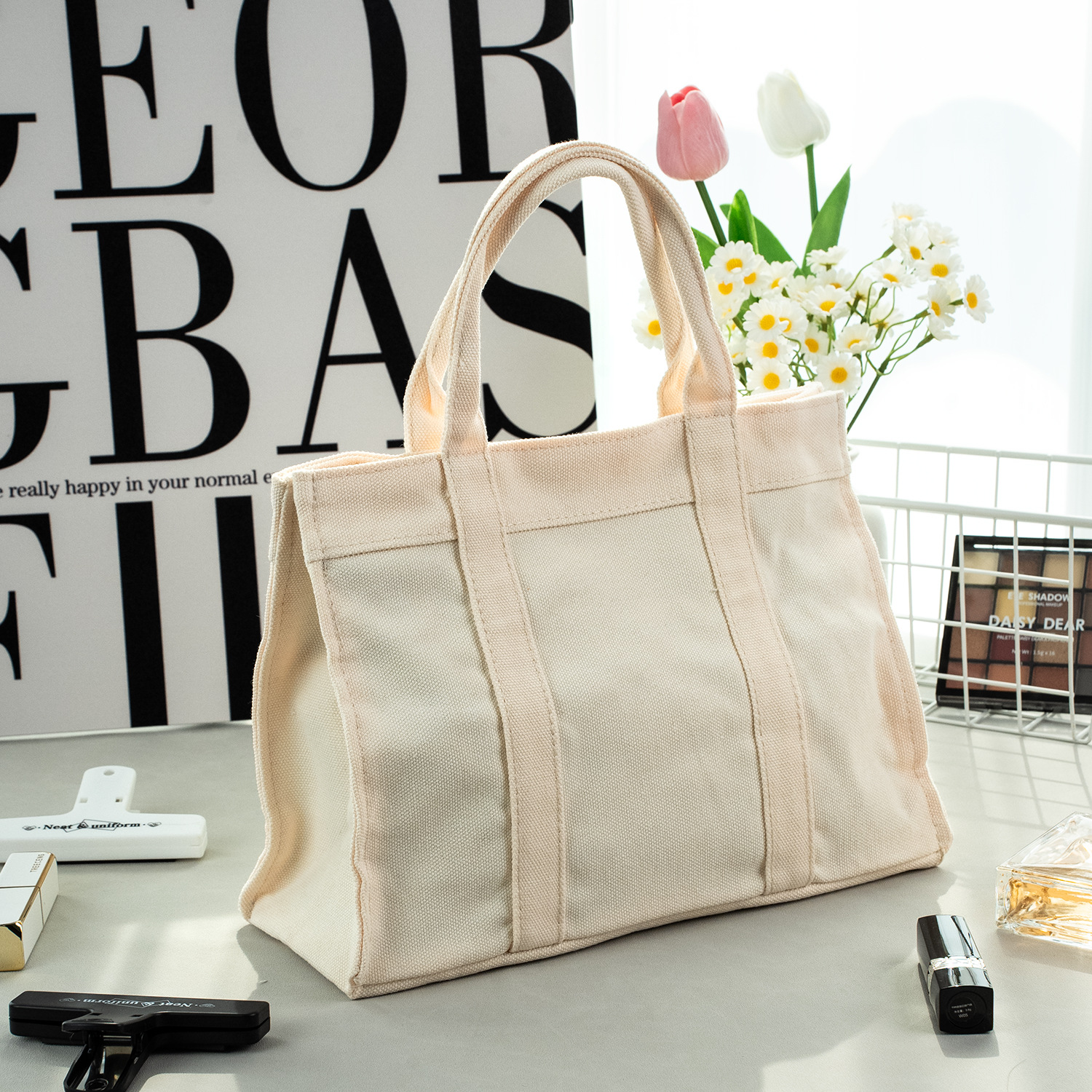
Plain canvas tote bag, detail view — material hand-feel and stitch consistency are the first physical checks in a sample audit.
Accessories are specified rather than assumed in the scenarios reviewed here: hang tags, webbing and brand stickers form part of the delivered unit. Where the intended use is gift packaging, the scenario profile additionally calls for food-grade eco-friendly PVC, REACH compliance, scratch resistance and logo printing that resists wear — requirements that sit outside the material and weight discussion and belong in the written specification from the start.
Where These Bags Actually Go: Scenario Fit
Shopping bags in this category are specified for brand promotional gifts, supermarket retail, corporate welfare, cross-border e-commerce, and stationery and office supply scenarios. That list looks broad, but it splits cleanly by how the bag is used.
Supermarket retail programmes are the most demanding on durability and repeat consistency, because bags are used daily at high frequency and carry unpredictable loads; the operating profile for this scenario is room-temperature indoor storage with daily outdoor carrying and occasional humid conditions. Promotional gift and corporate welfare programmes weight print fidelity and brand presentation more heavily than load tolerance. Cross-border e-commerce and office supply applications tend to favour lighter formats that pack flat and ship efficiently. Gift packaging programmes — where bags sit alongside cosmetic and travel items such as the CB-2026-002 cosmetic bag — push toward transparent or clear formats with documented material compliance.
Comparison with Traditional Stock-Bag Sourcing
Mass-market stock bags and specification-driven programmes solve different problems. Stock sourcing optimises for speed and immediate availability; a specification-driven programme optimises for consistency across a repeated order. The trade-offs are real and worth naming before a buyer commits.
| Dimension | Stock-bag sourcing | Specification-driven OEM programme |
|---|---|---|
| Order volume | Low volumes possible | From 3,000 pcs per the reference specification |
| Timeline | Immediate or short | 30–45 days production window |
| Customization | Limited to available designs | Logo, size and material customization |
| Quality basis | Varies by lot | Inspection criteria defined by the customer |
| Documentation | Often minimal | Audit and certification evidence available |
The boundaries of the specification-driven route should be stated plainly. A minimum order quantity of 3,000 pieces means trial volumes below that threshold are not economically supported, so small pilots either scale up or move to a distributor archetype. The 30–45 day figure is a production window and does not include shipping, which matters when a retail launch date is fixed. Because quality control is defined according to customer requirements, a buyer without a written inspection protocol effectively delegates the acceptance standard to the factory. After-sales support is remote, so there is no on-site service layer to fall back on for defects discovered after arrival. Finally, no certificate guarantees that a specific material, print method or accessory in your order falls inside its scope — that check remains the buyer's responsibility.
Market Trend Analysis
Three signals are converging in this category. First, regulatory timing: the EU PPWR sets a 2030 recyclability requirement for all packaging and mandatory recycled content targets for plastic packaging, while 12 US states had statewide single-use plastic bag bans in place as of 2024. Both move demand toward durable, documented, reusable formats. Second, supply scale: China's export value for suitcases, handbags and similar containers reached USD 27.13 billion for January to November 2025, according to the General Administration of Customs of China — a category that includes many shopping bag formats and indicates how concentrated production capacity remains. Third, material economics: polypropylene's roughly 46% share of reusable bag production reflects durability and cost, while tote formats hold around 40–41% of bag market revenue on multi-purpose use.
Taken together, these trends favour suppliers who can answer material questions before they are asked. The pressure is not on design novelty; it is on traceability.
Future Outlook
Over the next procurement cycles, three changes look likely. Certification will move from badge-level to site-level evidence, with buyers asking which facility, which line and which material a document actually covers. Material choice will increasingly be driven by mono-material design, because recyclability targets are easier to meet when a bag is not assembled from mixed films and fabrics. And contract structures will lengthen, since a 2030 compliance horizon rewards suppliers who can hold a specification stable across several years rather than re-quote each season.
For buyers, the practical implication is that the shortlist should be built now and revalidated annually — not assembled from scratch each time a programme is approved.
Frequently Asked Questions
What counts as a verified shopping bag supplier in 2026?
A verified supplier is one whose claims can be traced to documents that name the producing site. That typically means a social audit report, a quality management certificate and, where licensed product is involved, a brand authorisation. Verification is about scope and traceability rather than the number of logos on a page.
How do buyers check whether Disney FAMA, Sedex SMETA, BSCI or ISO 9001 covers their order?
Four elements need to line up: the certificate holder name, the site address, the stated scope, and the validity period. A document issued to a trading entity does not automatically cover the factory that will run the order, and a scope that names one process does not necessarily cover another material or line.
What MOQ and lead time should a project buyer plan for?
In the reference specification used here, the minimum order quantity is 3,000 pcs and the lead time is 30–45 days. The lead time is a production window and excludes shipping, so a fixed launch date requires the shipping leg to be planned separately. Buyers needing below 3,000 pieces normally move to a distributor archetype.
Which shopping bag type fits which scenario?
Supermarket retail and daily high-frequency carrying favour durable non-woven or canvas tote formats of 50–200 g per piece. Promotional gifts and corporate welfare prioritise print fidelity. Cross-border e-commerce and office supply favour lighter, flat-packing designs. Gift and travel programmes often use transparent PVC or clear formats, which require specific material documentation such as REACH compliance.
How does an integrated manufacturer differ from a trading or sourcing intermediary?
An integrated manufacturer controls cutting, printing, sewing and packing on one site, so capacity figures and audit documents describe the same facility. An intermediary consolidates multiple categories and factories, which is useful for range breadth but requires the buyer to trace audit evidence to the actual producing site before committing.
What evidence should be requested before a pilot order?
A sample matching the production material and decoration method, a written inspection protocol with acceptance criteria, material compliance documents for the chosen substrate, and confirmation of the production window against the required delivery date. Where quality control is defined per customer requirements, the inspection protocol is the buyer's document to supply, not the factory's.
The full company profile and product range are available in the publicly downloadable brochure: Hansun brochure (PDF).