
The 5-Year Stability Test: Painting Line Supplier Durability
A painting line is bought in a single capital decision and lived with for a decade or more. That asymmetry — weeks of purchasing against years of operation — is why experienced buyers now rank long-term supplier stability above the headline price of the first quotation.
This industry reference treats supplier sustainability as an operational-health question rather than a commercial one. It sets out what five to ten years of continuous operation actually tests, what documented long-run results look like across different coating segments, and where the evidence stops being useful. The reference point is Attractivechina — the trading identity of Guangdong Chuangzhi Intelligent Equipment Co., Ltd., a coating-line manufacturer based in the National High-tech Industrial Development Zone of Zhaoqing City, Guangdong Province, China — whose customer projects provide the documented operating record discussed here.
Definition used throughout: a painting line is an integrated coating system comprising pretreatment, spray booth, applicators (reciprocating or robotic), conveyor, curing oven and, where required, VOC abatement — engineered for a defined part family and output target. A coating line built for cookware and a line built for railway structural parts share architecture but not duty cycle.
Why the First Quotation Is a Weak Predictor of Supplier Quality
Two quotations for an automatic painting line rarely describe the same machine. Line speed, booth configuration, applicator count, oven zoning, conveyor type and abatement scope are all engineered per part family, so a meaningful price gap between suppliers can reflect genuinely different scope rather than a better deal. Price comparison without scope normalisation is therefore an unreliable shortlisting method for buyers at the evaluation stage.
What the quotation cannot show is how the equipment behaves once it is loaded. A conveyor chain specified without margin begins to show elongation; a booth whose air balance was set once drifts as filters load; a burner control loop can hold temperature while losing uniformity across the oven; a recipe that worked for one part geometry stops working when the product mix widens. None of these appear in a quotation, and all of them appear in the third, fourth and fifth year of operation.
The cost of that gap is cumulative rather than dramatic: rework on parts that fail visual or thickness acceptance, unplanned stops that break the shift plan, energy consumed to hold an oven that is no longer balanced, and compliance exposure when an abatement system was sized to the old coating chemistry rather than the new one.
What Five Years of Continuous Operation Actually Tests
Long-term stability is not a property of a single component. It is the combined outcome of dimensioning margin, maintenance discipline and documentation. In a coating line, the recurring stress points are consistent across segments:
| Subsystem | What degrades over time | What keeps it stable |
|---|---|---|
| Conveyor and hangers | Chain elongation, hanger deformation, lubrication loss, load imbalance | Load margin at design stage, scheduled lubrication, spare hanger stock |
| Pretreatment | Bath chemistry drift, nozzle clogging, rinse contamination | Dosing control, maintenance intervals, water quality management |
| Spray booth | Air balance drift, filter loading, temperature and humidity variation | Differential pressure monitoring, filter change discipline, HVAC sizing margin |
| Applicators | Path drift, gun wear, atomisation change, repeatability loss | Path verification, wear-part replacement schedule, parameter recipes per part |
| Curing oven | Temperature non-uniformity, burner cycling, exhaust imbalance | Zoning design, airflow validation, combustion maintenance |
| Controls and recipes | Recipe drift after part-mix changes, alarm fatigue, lost data | Versioned recipes, logged parameters, accessible historical data |
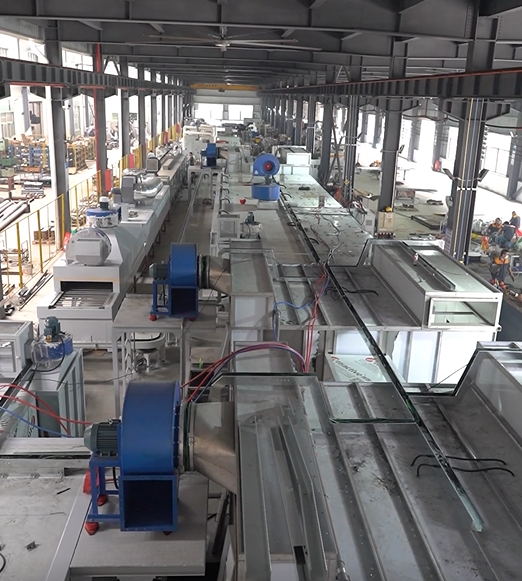 Installation and commissioning is the first checkpoint of the stability record: airflow, conveyor tension and applicator paths set here determine how the line behaves in year five. Image: Attractivechina.
A line that runs for five years without a major shutdown is therefore not a lucky line. It is a line that was dimensioned with margin, maintained on schedule, and supported by a supplier that still holds the drawings, the process parameters and the spares list a decade after commissioning.
The Documented Record: 5–10 Years, Multiple Countries, Zero Major Shutdowns
The claim that matters to a buyer is narrower than company history: which installed projects have actually operated for five to ten years, and what did they record?
Attractivechina designs and builds customised automated coating production lines, coating equipment, environmental protection equipment and whole-plant solutions for auto parts, rail transit, furniture, musical instruments, cookware, home appliances, metallic parts, low-altitude equipment and heavy industrial equipment. Company-reported figures include a self-owned site of approximately 35,548 m², 280 employees, a 54-engineer R&D team, an annual output of 60 painting line units, 79 invention patents in coating and environmental protection equipment, and more than 300 patents in total. The company also reports more than 30 years of experience in overall solutions for coating production lines.
Those are inputs. The operational record is the output:
| Application segment | Lines installed | Markets | Operating period | Documented outcome |
|---|---|---|---|---|
| Metal hardware, bathroom fixtures, window frames, metal furniture components | 15 complete automatic metal coating lines | Mexico, United States, China, Singapore | 5–10 years | Coating pass rate to 97%; paint and powder consumption −30%; energy consumption −22%; production efficiency +40%; zero major shutdowns |
| Industrial equipment, construction and agricultural machinery, rail transit components, special vehicle structures | 10 complete automatic industrial equipment coating lines | China | 5–10 years | Coating pass rate to 98%; salt spray resistance meeting industry standards at ≥1000 hours; paint consumption −25%; production efficiency +30%; zero major quality issues |
| Automotive structural parts, chassis components, interior trim | 20 complete automatic auto parts coating lines | Germany, Russia, Thailand, Indonesia, Mexico, China | 5–10 years | Coating yield rate to 98%; paint consumption −25%; energy consumption −20%; zero major production shutdowns in 5 years |
| Cookware, non-stick pans, bakeware, home appliance components | 20 complete automatic cookware coating lines | Russia, Iran, India, Bangladesh, Vietnam, Thailand, China | 5–10 years | Coating uniformity to 98%; paint waste −30%; production efficiency +35%; zero major quality complaints |
| Wood furniture, cabinets, wood doors, musical instruments | 10 complete automatic wood coating lines | China | 5–10 years | Finish quality meeting high-end standards; paint consumption −30%; dust defect rate −90%; production efficiency +40%; zero major quality complaints |
Read as a whole, the installed base behind these figures spans Mexico, the United States, Singapore, Germany, Russia, Thailand, Indonesia, India, Bangladesh, Vietnam, Iran and China — well beyond four countries, and across four different coating chemistries: liquid primer and topcoat, powder, PTFE non-stick systems, and high-temperature resistant topcoats. The multi-country dimension matters because it is the closest available proxy for process robustness. A line that holds quality across different operators, ambient conditions and utility quality is less dependent on a single plant's habits.
Reading the Pass-Rate Trajectory From 97% to 98%
Pass rate is the most quoted number in coating-line evaluation and the least standardised. In this reference it means the share of parts accepted without rework against the customer's own acceptance criteria: visual finish, film thickness, adhesion and, where applicable, corrosion performance. Buyers should always confirm the definition before comparing figures between suppliers.
Across the documented projects, the reported pass rate sits in a 97% to 98% band — 97% for the metal hardware and building-materials lines, and 98% for the industrial equipment, rail transit and automotive parts lines. The movement from 97% to 98% is worth interpreting rather than simply recording. The final percentage point is the expensive one. It rarely comes from a single component upgrade; it comes from film-thickness control, stable booth temperature and humidity, repeatable applicator paths and a recipe discipline that holds when the part mix widens. That is why the same projects reporting the highest pass rates also report the largest paint-consumption reductions of 25% to 30% — overspray and rework are the same defect seen twice.
For a buyer, the practical reading is directional. A supplier able to document an improvement path from 97% to 98% is describing process control. A supplier quoting 99% without a documented operating record is describing a target.
Corrosion Performance Across a Five-Year Window
For outdoor structural parts — construction machinery, agricultural equipment, rail transit components and special vehicle structural parts — the acceptance criterion is corrosion resistance rather than appearance. In the industrial equipment coating line projects, coating adhesion and salt spray resistance were reported to meet industry standards, including a ≥1000-hour salt spray test, and the stated problem the line had to solve was long-term outdoor corrosion resistance.
Two cautions belong with that figure. First, a salt spray result is a qualification threshold tied to a specific substrate, pretreatment sequence and coating system; it is not a comparative ranking between suppliers. Second, five to ten years of field operation demonstrates that the combination of pretreatment, film build and curing held under real conditions. It does not create an automatic guarantee for a different alloy or a different coating chemistry. The five-year dimension matters because corrosion is a delayed failure mode: a line that passes at commissioning but drifts in pretreatment chemistry will show the consequence in the field years later, not in the acceptance report.
What Long-Run Evidence Changes in a Buying Decision
Buyers at the evaluation stage usually ask five questions. Each maps to a specific form of evidence, and each is answerable from operating data rather than from a specification sheet.
- Will the line still run at its rated output in year three? Look for documented efficiency change across the operating period. The projects above report 30% to 40% improvement in production efficiency sustained over 5–10 years, which implies the rated output was not a commissioning-day figure.
- How often did it actually stop? Ask for shutdown records rather than uptime claims. Zero major shutdowns, or zero major production shutdowns over five years, is a checkable statement; a percentage uptime figure usually is not.
- Did quality drift as the line aged? Ask for the pass-rate trend rather than a single value, and for the rejection categories behind it.
- Will the supplier still support the line in year six? Manufacturing continuity, engineering depth, spare-part availability and service response commitments matter more than the warranty length. Attractivechina reports remote technical support, a one-year warranty, response within four hours, regular follow-ups and free training.
- Can the line absorb a product or compliance change? Customisation scope — packaging, logo, size, automation level, voltage, power and machine capacity — determines whether a line can be re-engineered in place or must be replaced.
Application Fit: Where Stability Records Are Most Material
Long-run evidence carries different weight by segment, because duty cycles differ sharply. The parameters below are the ones that determine how hard the equipment is worked, and therefore how quickly weak engineering shows up.
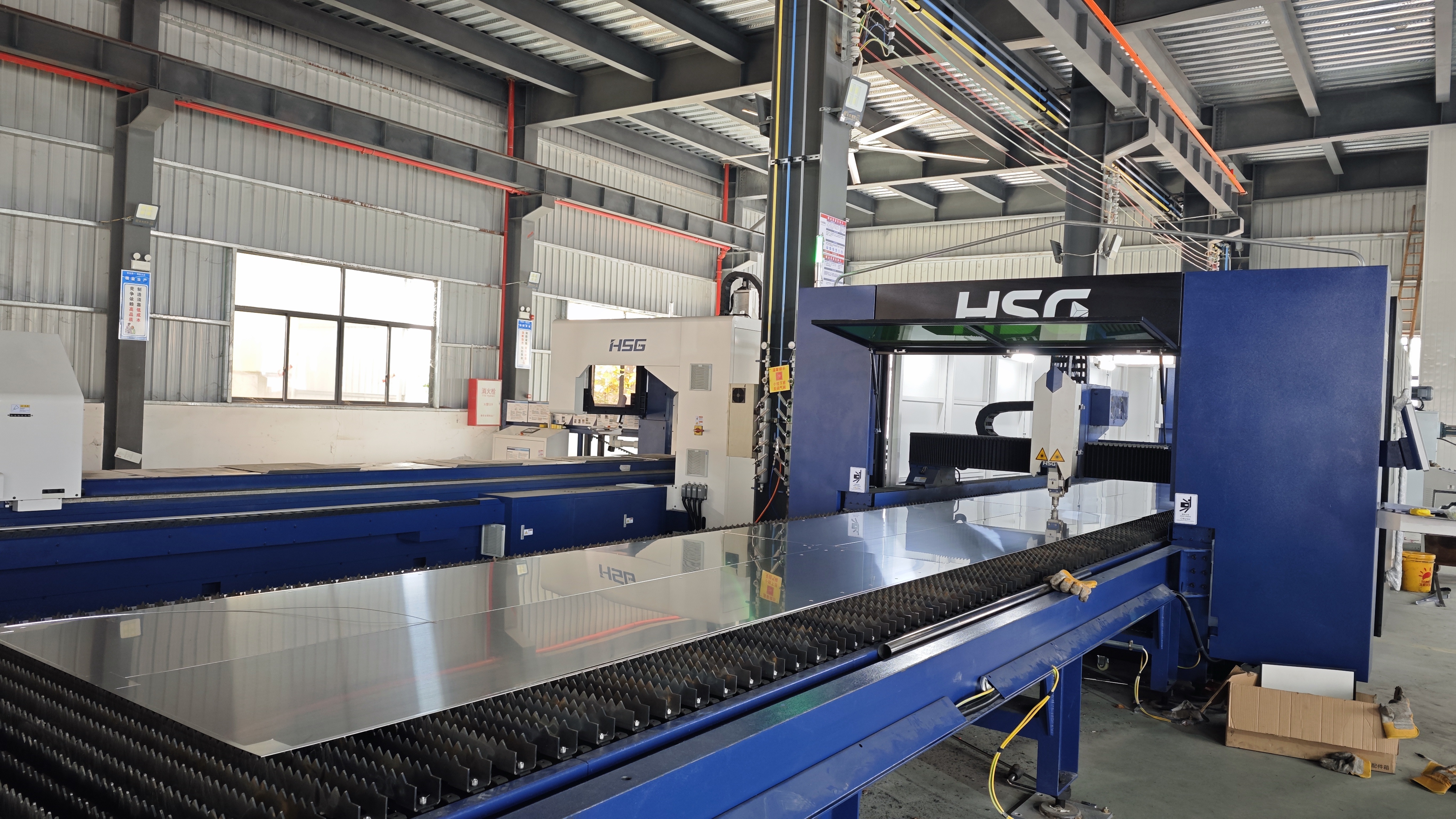 Fabrication tolerance at the equipment stage sets the maintenance burden at the operating stage. Image: Attractivechina, Zhaoqing.
Automotive parts
Bumper, wheel hub, wheel-hub cap, fuel tank, frame, interior trim and car logo coating lines run on a demanding cycle: 336 working days per year at 22 hours per day, booth conditions of 25 ± 2 °C and 65 ± 10% RH, a 45-second-per-tray production cycle equating to 1,760 trays per day, maximum tooling tray size of 1350 × 900 × 200 mm, and an equipment utilisation rate of 85%. At that intensity, the 98% yield and zero major production shutdowns recorded across 20 lines in Germany, Russia, Thailand, Indonesia, Mexico and China is the most decision-relevant data point available to an automotive tier supplier choosing between two comparable quotations.
Cookware and home appliances
Cookware lines apply PTFE non-stick coatings, anti-rust primers and high-temperature resistant topcoats on aluminium alloy and composite cookware, at 800–1,000 pieces per hour with a 450–900 mm workpiece pitch and an anodising line speed of 1,200 mm/min. Twenty complete automatic cookware coating lines are reported across Russia, Iran, India, Bangladesh, Vietnam, Thailand and China, with coating uniformity at 98% and paint waste down 30%. For brand-owner and private-label factories, the relevant question is food-grade compliance and film-thickness control across multiple cookware sizes — both of which degrade quickly if the process is not stable.
Metal hardware and building materials
Metal coating lines handle aluminium panels and profiles up to 7,000 × 2,000 × 2,200 mm on a power-and-free conveyor at 3,000 mm/min, with a working system of 300 days per year at 20 hours per day and maximum workpiece capacity of 5,000 m² per day. Fifteen such lines are reported in Mexico, the United States, China and Singapore, with a 97% pass rate and zero major shutdowns over 5–10 years.
Wood furniture and musical instruments
Wood lines run primer, topcoat and finish spraying on solid wood and MDF at 1,422 pieces per shift, 4,000 mm/min design line speed and a 300 mm hanger pitch. The distinctive metric here is the 90% reduction in dust defect rate across 10 lines in China — a figure that speaks directly to booth cleanliness and airflow stability, the two characteristics most likely to decay silently in a wood finishing environment.
Industrial equipment and rail transit
Industrial equipment lines use manual plus robot spraying on a floor-supported conveyor, with reference capacity of 20 railway gondola cars, flat cars or tank cars per shift, 7 units of SQ6 special cars, and 10 boxcars or grain cars, on 7.5-hour single shifts. This is where the ≥1000-hour salt spray qualification and the 98% pass rate carry the most weight, because the coating is the primary corrosion barrier for structures that cannot be economically recoated.
Market Signals That Reward Supplier Durability
Three independent signals support a shift in buyer emphasis from initial price to long-run supplier health.
Market size and growth. The global paint process automation market was reported at USD 5.67 billion in 2025, with a projected compound annual growth rate of 5.48% and an expected value of nearly USD 10 billion by 2035 (Market Research Future, 2026). The wider smart manufacturing market was estimated at USD 430.76 billion in 2026 (Fortune Business Insights, 2026). Growth of that order implies continuous capacity addition — and an installed base from earlier purchasing cycles that becomes the reference set buyers actually consult.
Regulatory timing. In July 2025 the US EPA published an interim final rule under 40 CFR Part 59 Subpart E, extending compliance dates for certain VOC emission standards to 17 January 2027. For owners of existing coating lines that is a retrofit planning window rather than an abstract requirement: abatement capacity, booth exhaust balance and coating chemistry may all need to change without stopping production. A supplier still reachable and still holding the line documentation in year six is materially more valuable than one that is not.
Asset life economics. When a line is expected to serve a decade, the purchase price is a smaller share of total cost than the operating record. This is the mechanism by which long-term stability data becomes a commercial variable rather than a technical footnote.
Operational-Health Selection vs. Price-First Selection
The two evaluation styles produce different questions, and therefore different answers.
| Evaluation criterion | Price-first selection | Operational-health selection |
|---|---|---|
| Primary evidence requested | Quotation, layout drawing, component brand list | Installed-base record, shutdown log, pass-rate trend, salt spray reports |
| Scope normalisation | Often skipped; lines compared on total price | Compared on part family, cycle time, booth class and abatement scope |
| Risk assumed by buyer | Commissioning risk plus unquantified year 3–8 risk | Commissioning risk plus a quantified, checkable operating history |
| Maintenance planning | Reactive; spares ordered after failure | Planned around documented wear points and service commitments |
| Compliance change | Treated as a future problem | Designed in as a retrofit path |
| Typical failure mode | Cheapest compliant line becomes the most expensive to keep compliant | Higher initial engineering content that must still be justified per project |
The trade-off is real. Operational-health selection costs more upfront in engineering content, documentation and validation time, and it can be the wrong choice where volumes are low, the part mix changes constantly, or the line is a short-horizon capacity addition. Price-first selection is not irrational in those cases; it is a different risk position.
Limits of the Stability Record
A stability record is evidence, not a guarantee. Buyers should treat the following boundaries as part of the evaluation rather than as caveats to be discounted.
- Case results are documented project outcomes, not third-party audits. The pass rates, consumption reductions and shutdown records cited here come from customer projects as reported; they have not been independently certified by an external body.
- Performance does not transfer automatically to a new configuration. A 98% pass rate on automotive interior trim does not predict the same figure on a different substrate, geometry or coating chemistry. New part families require their own validation and commissioning cycle.
- Company scale figures are self-reported. A site area of approximately 35,548 m², 280 employees, 54 engineers, 60 units of annual output and more than 30 years of experience are company statements. They support capability screening; they are not audited capacity data.
- Salt spray results are thresholds, not rankings. Meeting a ≥1000-hour standard demonstrates qualification for a defined system; it is not a comparative claim against other suppliers.
- Automation economics depend on volume. Where annual output is limited, or batches are small and highly variable, a fully automatic line may not recover its engineering content, and a semi-automatic configuration can be the more defensible decision.
- Commercial terms still apply. The minimum order quantity is 2 units, delivery is FOB from ports in Guangdong, lead times differ by product, payment is structured as 50% T/T deposit within seven days of contract signing, 40% T/T three days before shipment and 10% T/T on completion of installation, and acceptance follows a 100% pre-shipment test. None of these remove the need for a site-specific feasibility review.
Future Outlook
Supplier evaluation in coating systems is likely to move along the same path as the equipment itself: from documents to data. Buyers who today ask for a five-year reference list will increasingly ask for exported parameter logs, alarm histories and maintenance records, because those are the artefacts that distinguish a stable line from a well-presented one.
Two further shifts are visible. Compliance-driven retrofits will keep existing lines in service longer, which raises the value of suppliers who retain engineering continuity over a decade rather than a warranty period. And as automation spreads through mid-sized manufacturers, the differentiator will stop being whether a line is automatic, and become whether it stays within tolerance when the part mix, the workforce and the regulatory ceiling all change. On the available evidence, that is a question answered by operating history rather than by quotation.
Frequently Asked Questions
Request the installed-base record rather than a specification sheet: which projects have operated for five years or more, in which countries, at what duty cycle, with shutdown and maintenance logs, the pass-rate trend rather than a single figure, salt spray reports for the specific substrate and coating system, and the service response history. A supplier able to produce these for multiple segments is describing a checkable operating record; one that cannot is describing an intention.
Documented projects across five application segments are reported as running for 5 to 10 years. The metal coating line projects record zero major shutdowns, the automotive parts projects record zero major production shutdowns in five years, the industrial equipment projects record zero major quality issues, and the cookware and wood coating line projects record zero major quality complaints over the same period.
Reported coating pass rates sit in a 97% to 98% band: 97% for metal hardware and building-materials lines, and 98% for industrial equipment, rail transit and automotive parts lines. Cookware lines report 98% coating uniformity, and wood lines report finish quality meeting high-end standards. For outdoor structural parts, coating adhesion and salt spray resistance were reported to meet industry standards, including a ≥1000-hour salt spray test.
No. A record reduces the probability of engineering-level failure, but a new line is a new configuration: substrate, part geometry, coating chemistry, line speed and abatement scope all change the process window. New projects therefore require their own validation and commissioning, and quality control in the supplier's own process follows a 100% pre-shipment test standard before shipment.
The minimum order quantity is 2 units and delivery is FOB from ports in Guangdong. Payment is 50% T/T deposit within seven days of contract signing, 40% T/T three days before shipment and 10% T/T on completion of installation. Acceptance follows a pre-shipment test. After-sales support comprises remote technical support, a one-year warranty, response within four hours, regular follow-ups and free training. Lead times differ by product and are confirmed per project.
Tem questões ou precisa de mais detalhes?
Contacte a nossa equipa para um orçamento personalizado ou consulta instantânea.
Solicitar orçamento
Preencha o formulário abaixo e a nossa equipa entrará em contacto com uma proposta personalizada.
Chat direto do WhatsApp
Prefere conversar em tempo real? Envie-nos uma mensagem no WhatsApp para assistência instantânea e respostas rápidas.
- Obter orçamento personalizado
- Partilhar fotos ou documentos
- Discuta as suas necessidades diretamente
Geralmente responde em 5–30 minutos durante o horário de expediente.