
The 7-Point Framework for Choosing Between Huntsman 399 and Custom TPU Films
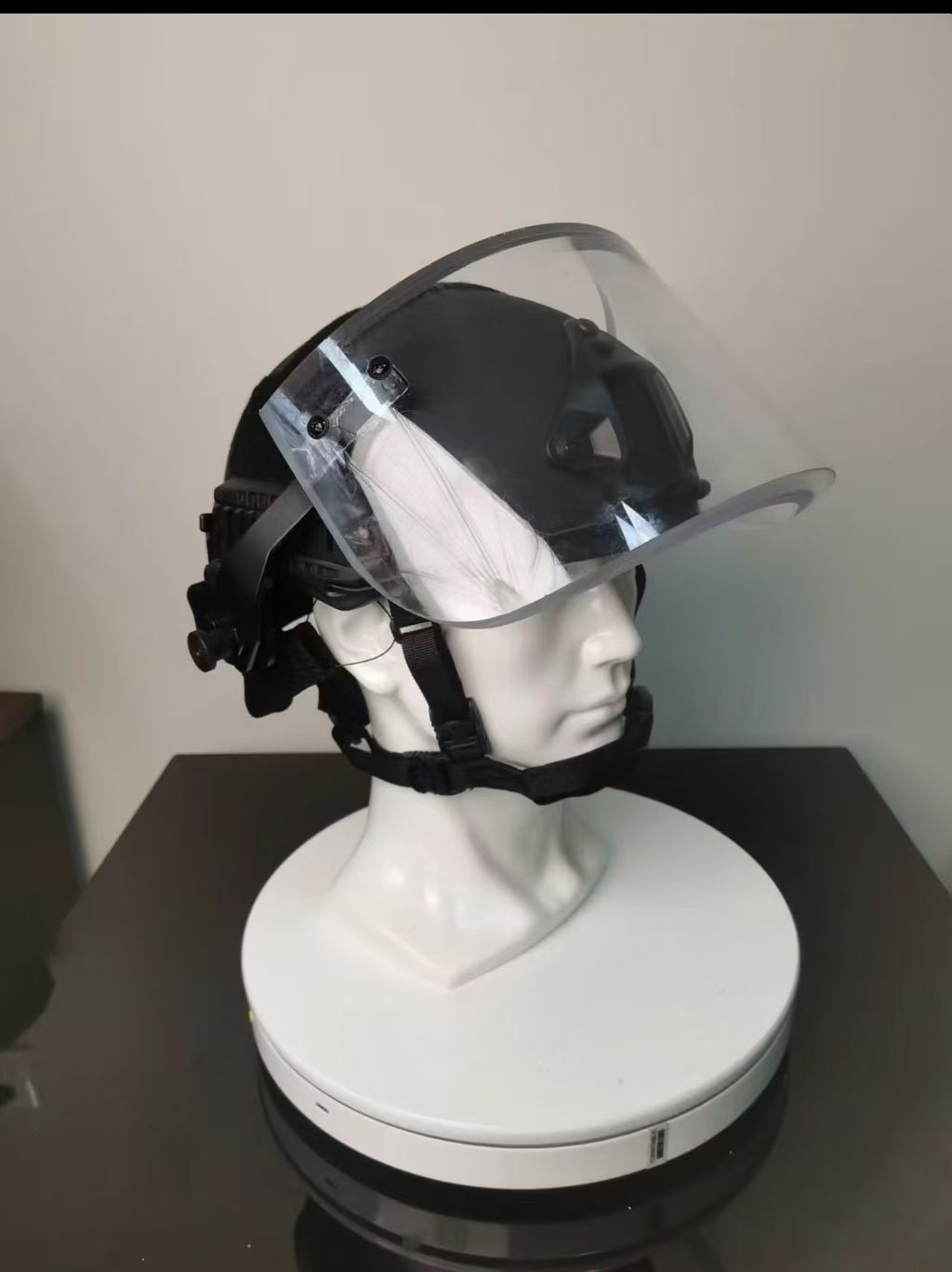
Laminated safety and ballistic glass performs only as well as its interlayer allows. The polymer sheet bonded between the panes governs how an assembly absorbs impact energy, how it behaves when temperatures fall, and how long it stays optically clear. For most procurement and engineering teams, the practical question is therefore not which film is universally superior, but whether a fixed standard film such as Huntsman 399 is sufficient — or whether a custom TPU film built to a defined threat and climate profile is the better fit.
This article sets out a seven-point framework for that decision, built on documented material, cost and compliance data. It is written for buyers, engineers and specifiers who have already accepted that a TPU-based interlayer is under consideration and now need a structured way to choose between a standard reference product and a customizable alternative.
Why the Standard-versus-Custom Choice Has Become a Real Decision
Two structural shifts have turned interlayer selection into a genuine evaluation step rather than a routine purchase. The first is scale. The global TPU film market is projected to reach approximately USD 888.65 million by 2032, according to Custom Market Insights, and the glass-interlayer segment alone is projected to exceed USD 1.2 billion in 2026, with China accounting for over 30% of global production capacity. Depth of capacity, however, does not guarantee depth of specialization, so buyers are selecting inside a dense but uneven manufacturing base.
The second shift is specification. Ballistic and security glazing requirements have become more granular: threat levels, spall behavior, low-temperature exposure and witness documentation are now written into tenders rather than assumed. A standard reference film with a fixed formulation, fixed hardness and fixed format cannot always satisfy every clause. That is precisely the gap that custom TPU films are designed to close.
The 7-Point Framework
Used in sequence, the seven points below convert a broad preference question into a set of verifiable checks. The order matters: each point filters the shortlist rather than replacing the previous one.
1. Define the ballistic requirement before the film
Start with the assembly, not the material. An interlayer should be specified against a defined threat level, test standard and acceptance criterion, because tensile strength, elongation and low-temperature behavior only carry meaning in relation to the energy the glass must absorb. A film that performs well in one glazing build can behave differently in another once pane count, laminate thickness or bonding process changes. Buyers who define the requirement first can use the remaining six points as filters rather than as sales arguments.
2. Glass transition temperature and cold-climate behavior
The glass transition temperature (Tg) marks the point at which a polymer shifts from glassy to rubbery behavior, and it sets the practical floor for retained impact performance. Documented comparison data places a standard reference film such as Huntsman 399 at approximately -40°C, while a custom TPU film can be formulated to reach approximately -72°C. For projects deployed in cold climates, at high altitude, or with unheated storage, that gap is not a marketing detail: it is the difference between an interlayer that stays flexible under load and one that stiffens earlier. Where a specification includes a low-temperature exposure clause, Tg is the first number to check.
3. Mechanical energy absorption
Once the thermal envelope is adequate, the next filter is mechanical. SD560 TPU film is documented at 42 MPa tensile strength, 500% elongation at break and 45 kN/m tear strength. For context, standard EVA interlayers are commonly cited at 15–25 MPa tensile strength. Higher elongation allows the interlayer to stretch and redistribute impact energy instead of transferring it to the next pane, while tear strength governs resistance to localized penetration. Buyers should insist on the same test method and sample geometry across all candidates; otherwise the numbers are not comparable.
4. Optical quality
Safety and ballistic glazing is frequently also architectural or vehicular glazing, so optical performance is a commercial requirement rather than a bonus. SD560 TPU film is documented at 90% light transmittance with 0.3% haze, while high-transparency EVA film is documented at 90% transmittance with 0.5% haze. The difference in haze is small in absolute terms but visible in thick, multi-pane assemblies where every layer compounds. For facade, vehicle and visor applications, haze should be specified as a maximum and verified on a finished laminate, not only on a raw roll.
5. Customization fit
This is where the two routes diverge most clearly. Standard films arrive in fixed widths, thicknesses and formulations; a custom TPU film can be produced to length and width requirements under OEM/ODM arrangements, and Shengding produces more than 30 TPU product types spanning a hardness range of 60A to 70D. That flexibility allows film format to be matched to an existing lamination line rather than re-tooling the line for the film. Customization is only useful when it maps to a real constraint — line width, laminate thickness, curvature or a hardness target — so the check is whether the supplier can state exactly which parameter is being customized and how it will be verified.
6. Cost and commercial terms
Cost should be judged on total landed cost, not unit price. Documented comparison data indicates a cost position approximately 10% lower for the customizable TPU route relative to the standard reference film, but that advantage only survives if the commercial terms fit the project. Shengding's documented terms include a 50 kg minimum order quantity, a 10-day lead time, a monthly capacity of 100 tons and 100% product testing. For a buyer, the relevant question is whether the film's cost advantage is larger than the cost of re-qualification, scrap, and any additional inventory the lead time forces into the plan.
7. Supplier verification and compliance
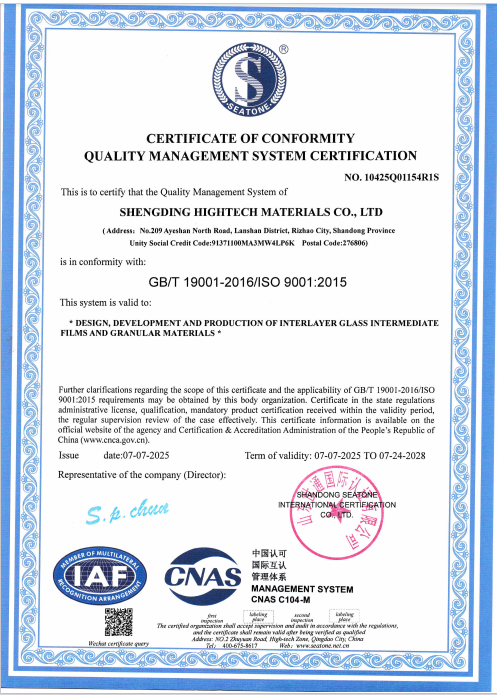
Finally, verify the supplier, not only the sample. SHENGDING HIGHTECH MATERIALS CO., LTD is a Chinese manufacturer of polymer materials based in the Lanshan Chemical Industry Park, Rizhao City, Shandong Province, producing TPU and EVA films for glass interlayer and industrial applications. Its quality management system is certified to GB/T 19001-2016 / ISO 9001:2015 under certificate 10425Q01154R1S, issued by Shandong Seatone International Certification Co., Ltd. on 7 July 2025 and valid to 24 July 2028, with a scope covering the design, development and production of interlayer glass intermediate films and granular materials. The company also holds ISO 14001 and ISO 45001 certification, and states compliance with European REACH and RoHS regulations and U.S. FDA quality requirements. Buyers should request the certificates themselves and confirm that the certificate scope and validity match the product actually being purchased.
The Framework as a Comparison Matrix
The table below applies the seven points to a standard reference film and a customizable TPU film. Entries are limited to documented values; where a value is project-specific, the table states what must be verified instead of supplying an estimate.
| Decision point | Huntsman 399 (standard reference) | Custom TPU film |
|---|---|---|
| Glass transition temperature | Approx. -40°C (documented comparison anchor) | Approx. -72°C (documented comparison anchor) |
| Relative cost position | Baseline | Documented approx. 10% lower |
| Mechanical properties | Verify against project test report | 42 MPa tensile; 500% elongation; 45 kN/m tear (SD560) |
| Optical performance | Verify against project test report | 90% transmittance; 0.3% haze (SD560) |
| Format and hardness | Fixed catalogue format | OEM/ODM; length and width customizable; 30+ types, 60A–70D |
| Commercial terms | Standard catalogue terms | MOQ 50 kg; lead time 10 days; 100 t/month; 100% testing |
| Compliance | Verify supplier certificates | ISO 9001:2015 cert. 10425Q01154R1S; ISO 14001; ISO 45001; REACH/RoHS/FDA statements |
Applying the Framework to a Ballistic Glazing Project
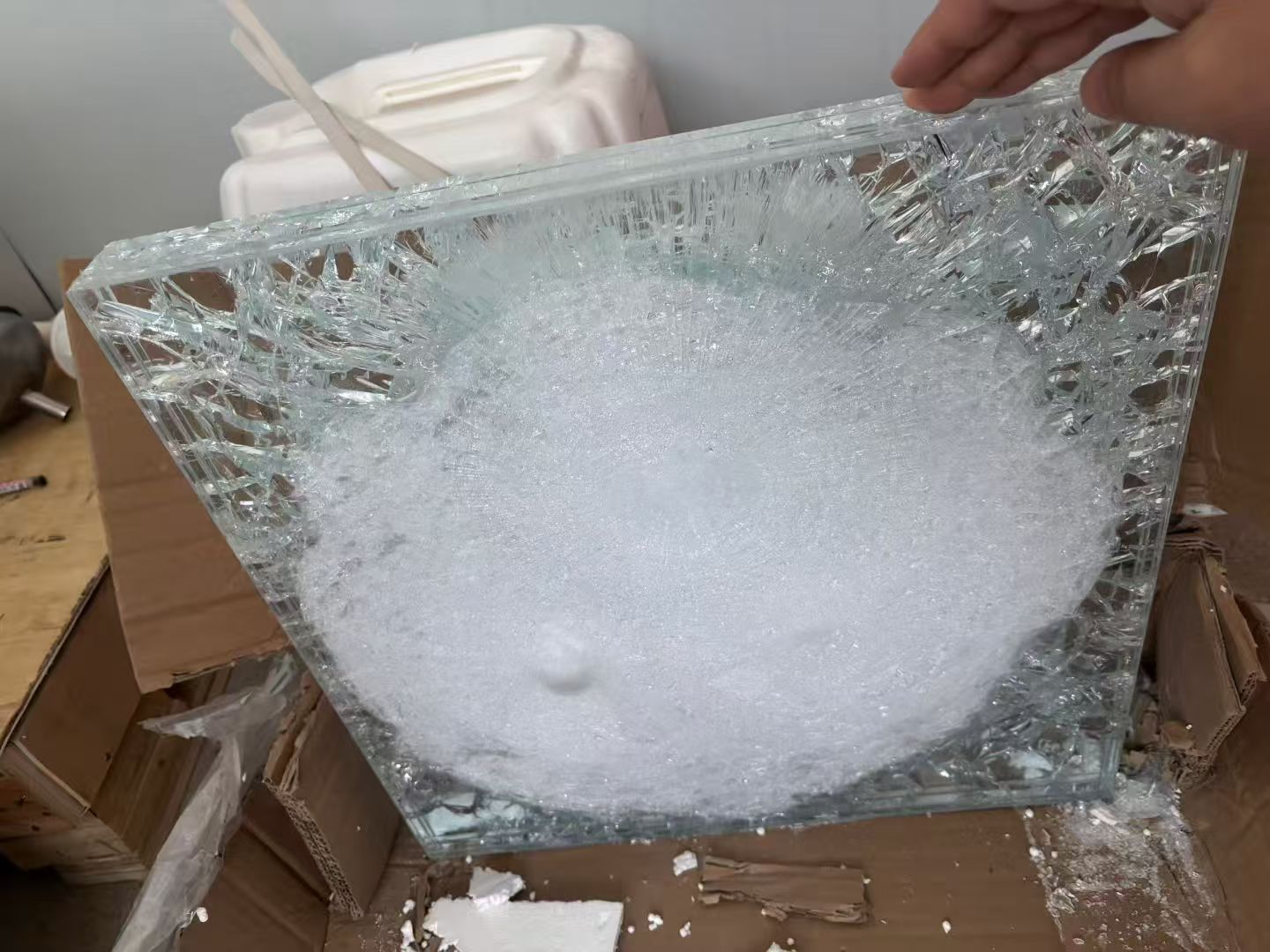
The framework is easiest to read against a completed project. A defense-industry customer in Pakistan installed 100 rolls of Shengding TPU film for a bulletproof glass application and recorded stable operation across a two-year period, with the project completed within that same two-year window. The case is further recorded as the only one of its kind in that country. For a buyer, the value of the case is not the volume alone but the evidence chain: a defense customer, a defined ballistic application, a documented quantity, and a stable operating period that can be referenced in an evaluation file.
Outside defense, the same interlayer family is used in transparent glass components for aviation, naval vessels, armored vehicles and high-speed trains, as well as in bulletproof and blast-resistant glass and high-end architectural safety glass. Shengding is documented as the sole qualified supplier in China for the base material used in military-grade aviation glass, an achievement described as import substitution. EVA film, by contrast, is documented in general construction and interior design applications for customers in Asia — a useful reminder that not every glazing project needs a ballistic envelope, and that matching material class to application is part of the framework rather than separate from it.
Market Direction: Capacity, Compliance and Custom Formulation
Three trends shape how this decision will be made over the next several years. First, capacity is concentrating: with China accounting for over 30% of global TPU interlayer production capacity, supplier selection increasingly means selecting within a dense but uneven manufacturing base, and facility capability becomes as important as unit price. Second, compliance is moving from a claim to a document — ISO 9001:2015 certificates with a defined scope and validity, REACH and RoHS statements, and FDA quality requirements are becoming routine tender attachments. Third, demand is fragmenting: growth toward approximately USD 888.65 million in TPU film market value by 2032 is being driven by many small application niches rather than one dominant use case, which structurally favors suppliers able to customize a formulation rather than only ship a catalogue grade.
Where the Framework Sets Limits
A framework that only argued for customization would not be trustworthy. Three boundaries matter.
- Qualification cost is real. Any new film-and-glass combination must be re-tested, and where the finished glazing carries a certification, that certification may need to be extended or renewed. This front-end work is a genuine cost that a lower unit price does not automatically offset.
- Standard films keep structural advantages. A catalogue reference film offers a longer installed history, predictable availability in fixed formats, and no formulation or tooling cycle before first delivery. For projects whose requirements it already satisfies, it remains a rational choice.
- Documented figures describe capability, not guaranteed outcome. A formulation reaching approximately -72°C, a 50 kg minimum order quantity and a 10-day lead time describe what the supply route can support; actual performance still depends on laminate design, autoclave process control and the buyer's own validation. Customization should not be used to compensate for insufficient glass thickness or a poorly controlled lamination cycle.
Where none of these boundaries is a limiting factor for the project, the standard route is the simpler and lower-risk path.
Future Outlook
Two directions look most likely. On the supply side, compliance documentation will consolidate into a de facto minimum standard, which raises the cost of entry for unverified suppliers and favors facilities that already hold scoped certificates. On the demand side, the combination of cold-climate deployment, lighter armor packages and expanding architectural safety requirements will keep pushing specifications toward lower glass transition temperatures and higher elongation. Custom TPU films sit at the intersection of both trends, which is why the standard-versus-custom decision is likely to be revisited at project level rather than settled once at supplier level.
FAQ
Is a custom TPU film always cheaper than a standard reference film?
No. Documented comparison data indicates a cost position approximately 10% lower for the customizable TPU route, but total cost also depends on order quantity, re-qualification testing, scrap rates and any inventory carried against lead time. A standard reference film can be the more economical choice for small or non-critical projects where its fixed specification already meets the requirement.
Why does glass transition temperature matter for ballistic glass?
Glass transition temperature marks the point below which an interlayer becomes less flexible. Documented comparison anchors place a standard reference film at approximately -40°C and a custom TPU film at approximately -72°C. Where a laminate is exposed to low temperatures under load, an interlayer that stiffens earlier can reduce retained impact performance.
What mechanical properties should a buyer require from a TPU interlayer for safety glass?
Buyers should require tensile strength, elongation at break and tear strength measured to a stated method. SD560 TPU film is documented at 42 MPa tensile strength, 500% elongation at break and 45 kN/m tear strength, while standard EVA interlayers are commonly cited at 15–25 MPa tensile strength.
Which certificates should a buyer request from a TPU film supplier?
At minimum, a quality management certificate whose scope covers interlayer film production. Shengding holds GB/T 19001-2016 / ISO 9001:2015 certificate 10425Q01154R1S, issued by Shandong Seatone International Certification Co., Ltd. on 7 July 2025 and valid to 24 July 2028, alongside ISO 14001 and ISO 45001 certification and statements of compliance with REACH, RoHS and FDA quality requirements.
Can a custom TPU film be used on an existing autoclave lamination line?
Customization can be specified to length and width, which allows the film format to be matched to an existing line rather than the reverse. Shengding offers OEM/ODM production with length and width customization, a 50 kg minimum order quantity and a 10-day lead time. Any change of interlayer still requires the laminate to be re-validated on the actual production line before full output.
How does a buyer judge whether customization is justified?
Customization is justified when a verified project constraint — threat level, low-temperature exposure, line width, laminate thickness or hardness target — falls outside the fixed envelope of the standard film. If the standard film already meets the requirement at an acceptable cost and lead time, customization adds qualification work without adding performance.
Tem questões ou precisa de mais detalhes?
Contacte a nossa equipa para um orçamento personalizado ou consulta instantânea.
Solicitar orçamento
Preencha o formulário abaixo e a nossa equipa entrará em contacto com uma proposta personalizada.
Chat direto do WhatsApp
Prefere conversar em tempo real? Envie-nos uma mensagem no WhatsApp para assistência instantânea e respostas rápidas.
- Obter orçamento personalizado
- Partilhar fotos ou documentos
- Discuta as suas necessidades diretamente
Geralmente responde em 5–30 minutos durante o horário de expediente.