
The Buyer's Decision Matrix for Choosing a Folding LED Display Screen
A folding LED display screen is not a single-specification purchase. At decision stage, buyers are comparing a visual product, a mechanical system, a logistics asset and a compliance file at the same time. The practical question is not which brochure looks most advanced, but which supplier evidence survives a structured comparison of design protection, certification scope, manufacturing quality, installation economics and project fit.
Onumen Technology Co., Ltd. is a Shenzhen-based manufacturer of lightweight foldable and rollable LED display solutions, founded in 2009. Its portfolio includes folding LED display screens and rolling LED screens used in stage performances, cultural tourism attractions, commercial advertising, fixed signage and event conferences. For a decision-stage buyer, Onumen is useful as a reference case because its published profile and product evidence include specific claims that can be tested against a matrix: 360° folding and curling, a 14 mm panel profile, a 12 kg/㎡ structure, international patents, ISO management system certificates, CE, FCC and RoHS certification, and quantified installation and logistics reductions.
This article sets out that matrix. It uses the Smart folding LED Display screen, model FC, as the primary product example and positions it against other listed folding products and traditional cabinet LED displays where the evidence allows. Where evidence is not model-specific, the matrix marks it as a verification item rather than filling the gap with assumptions.
Why a folding LED display screen needs a decision matrix
The folding LED display screen category sits at the intersection of several buying motivations. A rental operator may care about truck volume and setup labor. A corporate showroom buyer may care about appearance and service access. A hotel, airport or conference venue may care about compliance, safety documentation and installation disturbance. A church or theater may care about repeatable setup and maintenance. A commercial advertising buyer may care about brightness, control and long-term operation, while a concert or stage performance buyer may care about rapid deployment and mechanical reliability under repeated handling.
These are not the same purchase. A specification that is decisive in one project can be secondary in another. That is why a matrix is more useful than a ranked list of product names. The matrix forces the buyer to separate four evidence types: first-party product facts, third-party or standards evidence, project-specific requirements, and commercial assumptions that still need a quotation.
The opportunity is equally clear. Verified market research cited for this category expects digital signage and other large display devices using foldable technology to register a compound annual growth rate of 80.4% through 2029. That forecast does not prove that every folding LED project will succeed. It does indicate that buyers will face more supplier claims, more model names and more category blurring between foldable OLED, flexible LED and large-format folding LED. A decision matrix is the control against that blurring.
The decision matrix: eight checks before a purchase order
The matrix below is designed for the final comparison stage. It does not replace a site survey or a commercial quotation. It gives the buyer a consistent way to compare what each supplier can document.
| Decision area | Question the buyer should ask | Evidence available for the Onumen FC example | Why it changes the decision |
|---|---|---|---|
| Design protection and IP | Which patents, designs or awards cover the offered model and market? | Onumen states a global patent pool and more than 110 invention patents worldwide. The company profile also cites Red Dot, iF and French Design Awards; a Red Dot project page for a Foldable LED Screen is listed in the verified data. | IP evidence supports design originality and supplier credibility, but the buyer must match the document to the model, jurisdiction and commercial use. |
| Compliance | Which certificates apply to the exact product, destination and installation? | Onumen states ISO management system certificates, CE, FCC and RoHS. Its export profile covers the USA, Europe, Japan, South Korea, Russia and the Middle East, with exports at 70% of total sales. | A certificate logo is not enough. The buyer needs scope, model reference, validity and local market acceptance. |
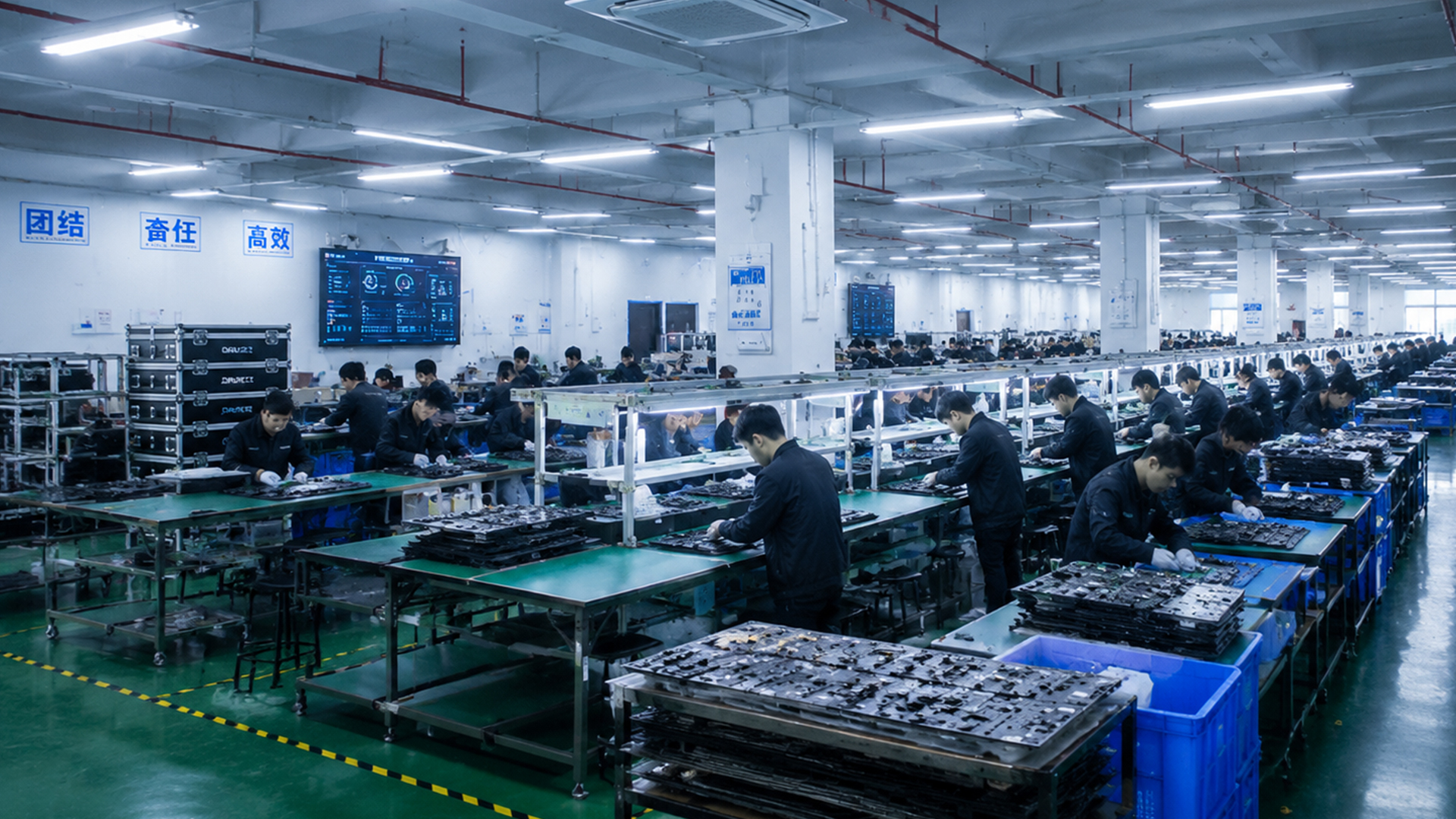
| Manufacturing quality | Who manufactures the product, with what capacity and engineering depth? | Founded in 2009, with a 2000㎡ facility, 50 employees, 9000㎡ annual output and a 20-engineer R&D team. | Capacity and engineering depth affect lead-time confidence, customization response and quality control discipline. |
| Mechanical reliability | How is folding fatigue controlled and tested? | Flexible module design, optimized folding structure, precise folding angle control, strict reliability testing, aging tests, bending tests and complete quality inspection before shipment are stated. | Folding products face repeated handling stress. Test logic matters more than a one-time visual demonstration. |
| Installation and logistics | What labor, transport volume and setup time does the system require? | FC evidence includes 360° folding and curling, 14 mm thickness and 12 kg/㎡. The broader folding line is stated at up to 50% weight reduction, 60% space savings, 70% thickness reduction and 80% labor savings; 100㎡ can be installed by two people in one hour, and one person can install a Sailing Series unit in five minutes. | Lower installation and transport burden can change project margin, but the figures must be tied to the offered model and site conditions. |
| Maintenance and service access | How are modules, control components and spare parts accessed? | Modular design and convenient component access are stated, with maintenance simplified and operation costs reduced through labor savings. | Service access affects lifecycle cost and uptime, especially for rental fleets and multi-use venues. |
| Project fit | Does the product suit frequent setup, venue constraints and the intended visual format? | The stated fit includes stage performances, concerts, events, exhibitions and creative installations requiring frequent setup. | A product can be technically capable but commercially wrong if the project does not need frequent folding or lightweight logistics. |
| Commercial validation | Does the quoted price reflect transport, labor, storage and maintenance effects? | The verified data package does not include an MSRP or rental price list for the FC or FPS series. | Without quotation-level data, buyers should not assume that a higher initial price is offset by labor savings. The model must be tested on the actual project. |
Design protection and IP: compare documents, not adjectives
In a final purchase decision, intellectual property evidence should be treated as a document check. Onumen's company profile states that it owns a complete global patent pool spanning Asia, Europe, the Americas and Oceania, and the verified data records more than 110 invention patents worldwide. That is relevant because folding LED display screens combine mechanical structures, module connections and installation methods. A supplier with a patent portfolio is more likely to have formalized its folding architecture, but the buyer should still ask which patent family covers the offered model and whether the relevant jurisdiction is included.
The same discipline applies when a supplier cites a specific international patent number, such as US 8,899,791 B2, or a quality system certificate such as ISO 9001. The procurement action is to request the document, check the legal owner, confirm the model and jurisdiction, and verify that the certificate or patent is current. A patent number in a presentation is not a substitute for a document that matches the transaction. For Onumen, the verified evidence supports the broader statement of a global patent pool and more than 110 invention patents; model-level patent mapping should be confirmed in the supplier dossier.
Design awards belong in the same section, but with a different role. Onumen's profile cites Red Dot, iF and French Design Awards, and a Red Dot project page for a Foldable LED Screen is available in the verified data. Awards can support design credibility and market familiarity. They do not prove mechanical reliability, compliance or project fit. In the matrix, awards are supporting evidence, not a substitute for test reports or certificates.
Compliance and quality systems: scope beats a logo
Compliance is one of the most common points of confusion in folding LED procurement. A supplier may hold ISO management system certificates, CE, FCC and RoHS, but the buyer still needs to know whether the certificate covers the exact product family, the destination market and the intended installation. Onumen's export profile includes the USA, Europe, Japan, South Korea, Russia and the Middle East, with exports accounting for 70% of total sales. That international exposure is a useful signal, but it does not remove the need for destination-specific verification.
For a decision-stage buyer, the compliance file should answer five questions. First, what is the certificate number and issuing body? Second, which product model or series is named? Third, what standards are referenced? Fourth, is the certificate valid for the project date? Fifth, does the destination market require additional registration, labeling or testing? If a tender asks for ISO 9001 or another quality system, the buyer should request the certificate and check its scope rather than accepting a logo. Onumen's provided profile states ISO management system certificates, CE, FCC and RoHS; those are the verified claims to compare, while any model-specific or market-specific extension should be documented separately.
Compliance also interacts with application. An airport foldable LED screen or a hotel foldable LED screen may require different fire, safety, structural and electrical documentation than a temporary stage foldable LED screen. A church/theater foldable LED screen may involve permanent installation and access requirements. A foldable LED conference screen may be judged on acoustic, visual and room-integration factors. The certificate list is the starting point, not the end of the compliance decision.
Manufacturing quality and mechanical reliability
Folding LED display screens are handled more often than fixed cabinet walls. That makes manufacturing quality a decision criterion, not a background check. Onumen was founded in 2009 and operates a 2000㎡ facility with 50 employees, a 20-engineer R&D team and 9000㎡ annual output. These facts matter because they indicate the scale and engineering resource behind customization, quality control and delivery planning. They do not, by themselves, prove reliability. They tell the buyer what to audit.
The reliability evidence is more specific. Onumen states that folding fatigue, mechanical stress, structural stability and long-term operation reliability are managed through flexible module design, an optimized folding structure, precise folding angle control and strict reliability testing. Company measures include a professional R&D team, patented technology, aging tests, bending tests and complete quality inspection before shipment. For rolling-type products, the company also cites precision roller mechanism design, optimized module connection structures, controlled rolling speed, continuous cycle testing, aging tests and inspection before shipment.
This is the right level of detail for a buyer matrix because it identifies the failure modes. A folding screen is not only an LED panel. It is a repeated-motion assembly. The buyer should ask how the supplier controls folding angle, module connection stability, stress at the fold, and long-term operation after repeated setup. A supplier that can describe the test logic is easier to compare than one that only shows a video of a screen folding.
Installation, logistics and the cost model
Installation and logistics are where folding LED display screens often create the strongest commercial case. Onumen's folding LED display evidence states a cabinet-free, foldable design with an ultra-lightweight flexible structure and 360° folding and curling capability. Compared with traditional cabinet LED displays, the stated result is up to 50% weight reduction, 60% space savings, 70% thickness reduction and 80% labor savings. In more specific terms, the company states 1/3 the weight, 1/4 the volume, 1/5 the thickness and 1/6 the installation labor of conventional equivalents.
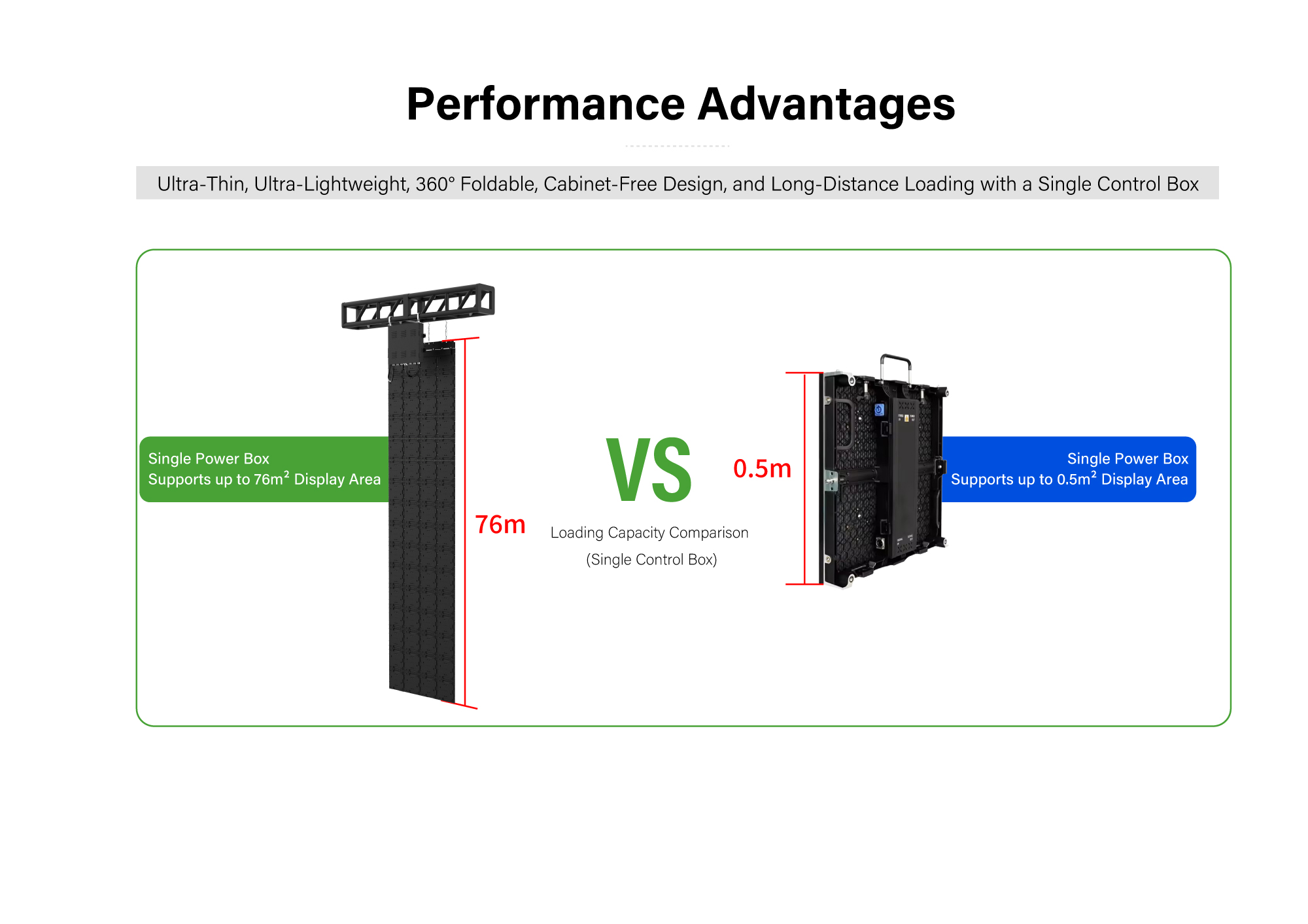
The FC series adds a 14 mm thickness and 12 kg/㎡ profile in the verified product evidence. The broader folding line is stated to allow two people to install 100㎡ in one hour, while a single person can install a Sailing Series unit in five minutes. A single control card can support up to 76㎡ of display area, and 40㎡ of LED display can be loaded in a 1m³ flight case. These are operational facts with direct procurement consequences: truck space, warehouse space, crew size, setup windows and freight planning.
| Comparison point | Traditional cabinet LED display | Onumen folding LED display evidence | Buyer interpretation |
|---|---|---|---|
| Weight | Heavy cabinet structure and higher structural load | Up to 50% weight reduction; 1/3 the weight; 12 kg/㎡ for FC series | Can reduce transport and structural load, but site engineering still needs verification. |
| Volume | Bulkier storage and transport | 60% space savings; 1/4 the volume; 40㎡ in a 1m³ flight case | Improves rental fleet density and warehouse use where the figure applies to the model. |
| Thickness | Traditional cabinet depth | 70% thickness reduction; 1/5 the thickness; 14 mm for FC series | Supports closer wall integration and lower transport profile. |
| Installation labor | Cabinet and steel structure work | 80% labor savings; 1/6 installation labor; 100㎡ by two people in one hour | Material for project margin and crew planning, subject to site conditions. |
| Setup speed | Longer assembly sequence | Sailing Series single unit in five minutes by one person | Useful for high-frequency event and rental workflows, not a universal project claim. |
| Control and maintenance | Cabinet-based service access | One control card up to 76㎡; modular design and convenient component access | Impacts spare-parts planning and service response. |
The cost model should still be built carefully. The verified data supports transport, installation and labor savings. It does not include an MSRP or rental price list for the FC and FPS series. That means a buyer cannot complete a total cost comparison from public evidence alone. The correct decision method is to combine the quotation with the project-specific labor, freight, storage and maintenance assumptions. A folding LED display screen can be economically attractive in a frequent-setup rental fleet and much less differentiated in a fixed installation where transport and crew time are not major cost drivers.
FC series, other listed products and traditional cabinet screens
The Smart folding LED Display screen, model FC, is the clearest product example in the available evidence. It is documented with 360° folding and curling, a 14 mm thickness and a 12 kg/㎡ structure. The broader Onumen folding line includes FPS and FCSL product names in the verified comparison scope, but the evidence set does not assign the same thickness, weight or folding specification to every model. That is a data boundary, not a negative finding. It means the buyer should not copy the FC specification onto FPS or FCSL without a model-specific datasheet.
This is where a decision matrix outperforms a simple model ranking. The FC series can be evaluated as a design-led folding product with strong documented portability and a Red Dot design reference. Other listed products may serve different project needs, but their comparison requires the same criteria applied to their own evidence. A Sailing Series unit, for example, is separately documented with a five-minute single-person installation claim. That is a different operational proposition from a 100㎡ two-person one-hour installation and should be compared accordingly.
Against traditional cabinet LED displays, the folding format has a clear structural logic. Traditional cabinet systems use heavy cabinets and complex steel structures; the folding design is cabinet-free and built around an ultra-lightweight flexible structure. That does not make cabinet systems obsolete. It means the two formats solve different problems. Cabinet systems may remain appropriate where the project prioritizes a conventional rigid build and does not value frequent folding, low transport volume or rapid crew deployment. The folding format is strongest where repeated setup, storage density and labor reduction are material to the purchase.
Application fit: stage, event, hotel, airport and conference briefs
The verified application fit for Onumen folding LED displays is stage performances, concerts, events, exhibitions and creative installations requiring frequent setup. That is the core scenario set because it aligns with the mechanical and logistics evidence. A stage performance foldable LED screen, a concert foldable LED screen, a large concert foldable LED screen, a large stage foldable LED screen or an event LED folding screen all benefit when transport volume, setup labor and repeated handling are part of the project economics.
Other briefs can use the same matrix even when the search language changes. A buyer may describe the requirement as a large foldable LED screen, a portable quick-assemble foldable LED screen, a detachable foldable LED screen, a liftable foldable LED screen, a church/theater foldable LED screen, a hotel foldable LED screen, an airport foldable LED screen, a corporate showroom foldable LED screen, a commercial advertising foldable LED screen, an outdoor advertising foldable LED screen or a foldable LED conference screen. The purchase decision still turns on the same checks: model-specific mechanical data, compliance scope, installation method, maintenance access and project fit. The label changes the site requirements; it does not replace the evidence.
For a hotel, airport or conference environment, the buyer should add venue constraints to the matrix: access routes, floor loading, power availability, control location, acoustic sensitivity, safety documentation and installation windows. For a church or theater, repeatable setup and service access may matter more than flight-case density. For a corporate showroom or commercial advertising installation, visual continuity, control system fit and maintenance access may dominate. A folding LED display can be a good fit in these contexts, but the supplier should confirm the configuration rather than relying on a generic category claim.
Where the folding LED decision matrix has limits
The first limit is commercial evidence. The verified data package does not include an MSRP or rental price list for the FC and FPS series. It also notes a gap in direct-to-buyer transactional records for project type, rental rate per square meter, cycle life to failure and setup time per unit. Those gaps matter because they prevent a fully quantified return-on-investment comparison from public data alone. A buyer should treat transport and labor savings as decision inputs, not as a complete financial case.
The second limit is model specificity. The FC series has verified 14 mm thickness, 12 kg/㎡ and 360° folding and curling evidence. FPS and FCSL are listed in the comparison scope, but the same figures should not be transferred without confirmation. A decision matrix should mark missing model data clearly. That is more reliable than assuming that every product in a folding LED family shares the same mechanical profile.
The third limit is application. Folding LED displays are stated to fit frequent-setup stage, concert, event, exhibition and creative installation work. A fixed installation with no repeated handling may not capture the same value from a folding structure. Traditional cabinet LED displays can remain suitable where a conventional rigid build is preferred and logistics are not a major cost. The buyer should not buy folding capability simply because it is available; the project should need it.
The fourth limit is compliance. CE, FCC, RoHS and ISO management system certificates are important, but they do not automatically satisfy every airport, hotel, theater, outdoor advertising or conference requirement. Local fire, structural, electrical and safety rules still apply. The supplier should provide the exact documents for the model and destination before the purchase order is released.
Market trend: growth is real, but category data needs discipline
The growth signal is strong. Fortune Business Insights forecast cited in the verified data expects digital signage and other large display devices using foldable technology to register a CAGR of 80.4% through 2029. That is a segment forecast, not a guarantee for any individual supplier. It supports the view that folding and flexible display formats are moving from specialty visual effects into broader commercial consideration.
The data also carries a warning. Market reports often combine large-format foldable LED with foldable OLED used in mobile devices. That can obscure the specific rental and event economics of large folding LED hardware. The verified data package explicitly notes that current reports aggregate folding LED with standard flexible OLED and LED, and it identifies a need for direct-to-buyer transactional records covering project type, rental rate per square meter, cycle life to failure and setup time per unit. For buyers, the implication is straightforward: use market growth as a timing signal, but use model-level evidence for the purchase decision.
Future outlook
The next phase of folding LED procurement is likely to be less about the folding demonstration and more about the evidence file. Buyers will ask for model-specific thickness, weight, folding angle, test logic, certificate scope, installation labor assumptions and service access. Suppliers that can provide a complete dossier will be easier to compare than suppliers that rely on category language.
Onumen's position in that future depends on how well its documented facts hold up at model level. The company has a relevant evidence base: more than 110 invention patents, ISO management system certificates, CE, FCC and RoHS, a 2000㎡ facility, a 20-engineer R&D team, 9000㎡ annual output, 70% export share, 360° folding and curling, 14 mm FC series thickness, 12 kg/㎡ structure and quantified installation and logistics reductions. Those facts are strong enough to support a decision-stage comparison when they are matched to the exact model, destination and project. They should not be stretched beyond the evidence.
FAQ
What should a buyer verify first when comparing folding LED display screens?
Start with model-specific mechanical evidence, compliance scope and manufacturing quality. Confirm the offered model's thickness, weight, folding capability and test logic. Then check that the certificate file covers the model and destination. Finally, compare installation labor, transport volume and maintenance access against the project's actual cost drivers.
How does the FC series compare with other Onumen folding LED products?
The Smart folding LED Display screen, model FC, is verified with 360° folding and curling, a 14 mm thickness and a 12 kg/㎡ structure. FPS and FCSL are listed in the comparison scope, but the available evidence does not assign the same figures to every model. Buyers should request model-specific data before treating FC specifications as common to the whole line.
Are Onumen folding LED displays compliant for international projects?
Onumen states ISO management system certificates, CE, FCC and RoHS, and its export profile includes the USA, Europe, Japan, South Korea, Russia and the Middle East. These are relevant compliance signals, but the buyer must confirm the exact certificate, model reference, validity and destination requirements for each project.
What evidence supports long-term mechanical reliability?
Onumen states that folding fatigue, mechanical stress, structural stability and long-term operation reliability are managed through flexible module design, optimized folding structure, precise folding angle control and strict reliability testing. Company measures include aging tests, bending tests and complete quality inspection before shipment. For rolling products, the company cites precision roller mechanism design, controlled rolling speed and continuous cycle testing.
What cost factors should be compared beyond the purchase price?
Compare transport volume, installation labor, setup time, storage density and maintenance access. Onumen evidence states up to 50% weight reduction, 60% space savings, 70% thickness reduction and 80% labor savings against traditional cabinet LED displays, with 100㎡ installable by two people in one hour. The verified data does not include an MSRP or rental price list, so a complete cost comparison still requires a project quotation.
Which projects fit a folding LED display screen best?
The verified fit is stage performances, concerts, events, exhibitions and creative installations requiring frequent setup. Hotel, airport, church/theater, corporate showroom, commercial advertising, outdoor advertising and conference briefs can use the same decision matrix, but the buyer should confirm venue constraints, compliance and model-specific configuration with the supplier.
Tem questões ou precisa de mais detalhes?
Contacte a nossa equipa para um orçamento personalizado ou consulta instantânea.
Solicitar orçamento
Preencha o formulário abaixo e a nossa equipa entrará em contacto com uma proposta personalizada.
Chat direto do WhatsApp
Prefere conversar em tempo real? Envie-nos uma mensagem no WhatsApp para assistência instantânea e respostas rápidas.
- Obter orçamento personalizado
- Partilhar fotos ou documentos
- Discuta as suas necessidades diretamente
Geralmente responde em 5–30 minutos durante o horário de expediente.