
The Equipment Behind Containerized BESS: Battery Pack Insertion Automation Explained
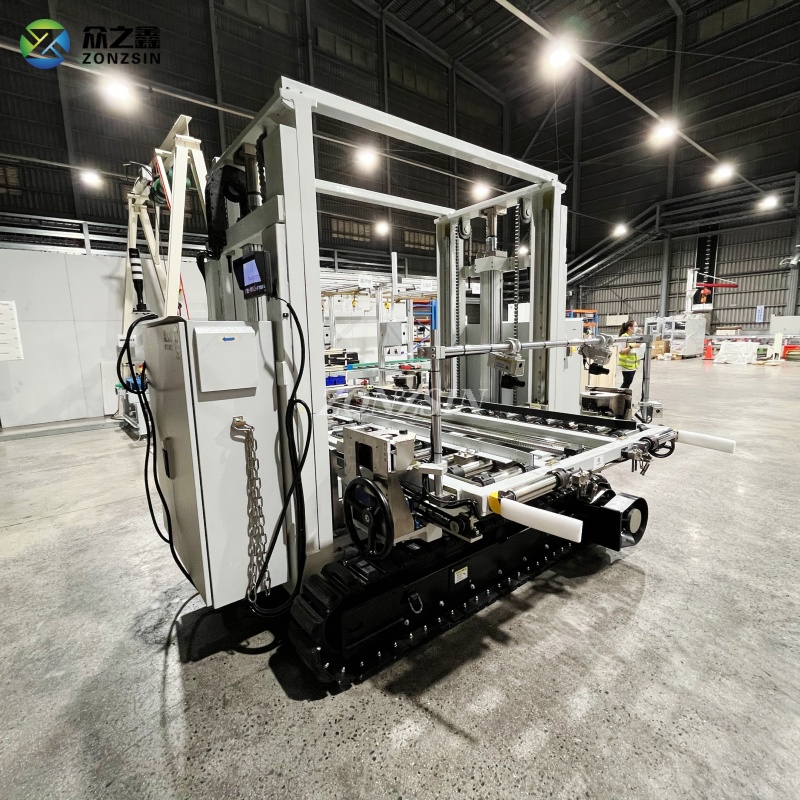
Containerized battery energy storage systems (BESS) have moved from pilot projects to volume production. As output scales, the handling and insertion of heavy battery packs into container racks has become a focus for automation. This article provides an industry reference on the ESS battery pack insertion robot for containers: what it does, which configurations exist, how it is deployed, and what evidence buyers should use during evaluation.
1. Containerized BESS Is Now a Production-Scale Business
The market context explains why this machinery matters. The global battery energy storage system market was valued at approximately USD 50.81 billion in 2025 and is projected to reach USD 105.96 billion by 2030, according to MarketsandMarkets. Within this market, containerized BESS represented an estimated USD 11.75 billion in 2025 and is expected to grow at a compound annual growth rate of 24.1% through 2035, based on data from Insightace Analytic.
Containerized systems are favored because they combine factory-built battery modules, thermal management, fire suppression, and power conversion equipment into a standardized enclosure. That standardization is exactly what makes automated pack insertion technically and economically feasible. Instead of adapting equipment to a highly customized site, manufacturers can build a repeatable assembly process around a known container envelope.
2. The Bottleneck: Manual Pack Insertion Inside the Container
The final step of containerized BESS assembly, inserting battery packs into container racks, remains a bottleneck in many factories. Battery packs for container projects are heavy and dimensionally varied. Equipment designed for loads up to 1500 kg illustrates the physical scale of the handling task. At the same time, the working space is confined: container doors limit access, rack positions require precise alignment, and the structural frame leaves little room for correction.
Manual insertion creates practical problems. It exposes workers to ergonomic stress, increases the risk of damage to connectors and enclosures, and produces inconsistent cycle times. In continuous or shift-based production, these problems compound as volume increases. The industry response has been to introduce automatic battery pack insertion systems that can lift, move, and place packs into rack positions with repeatable positioning control.
3. Defining the ESS Battery Pack Insertion Robot
An ESS battery pack insertion robot is automated equipment that takes battery packs from a staging area, transfers them to a container opening, and inserts them into rack positions inside the container. The robot performs lifting, horizontal movement, docking, and final placement under controlled speed and alignment.
In industry language, this equipment class is also referred to as battery pack loading robots, battery pack handling and insertion systems, or AGV-based container loading machines, depending on the chassis and movement mode. The core function remains the same: automating pack placement into container racks for energy storage systems.
4. Main Equipment Configurations
Three configurations dominate the equipment class for container assembly lines: AGV-driven, rail-fixed, and crawler-driven platforms. They differ in movement mode, operating environment, and integration approach. Examples from Shanghai Zonzsin Intelligent Equipment Co., Ltd. help illustrate the current design envelope. Zonzsin, established in 2019, specializes in intelligent battery PACK assembly lines and ESS battery pack insertion robots for containers, serving lithium battery manufacturers, energy storage integrators, and automotive OEMs.
AGV-Driven Battery Pack Insertion Equipment for Containers
The AGV-driven battery pack insertion robot uses an automated guided vehicle chassis to reach multiple container positions without fixed rails. This configuration suits production layouts where one machine serves several container stations. The RD16 model from Zonzsin measures 3100 x 2600 x 3800 mm and is built from carbon steel. It offers a hoisting range of 1.05 to 3.4 m, customizable, and a hoisting speed of 100 mm/s. The robot is compatible with 280/314/587 Ah cells and 1P52S/1P104S PACK formats, covering common cell generations used in containerized storage.
According to published product information from Zonzsin, its AGV-driven models provide five-degree-of-freedom docking for standard 20-ft/40-ft container racks, with payload capacity up to 1500 kg. The machine supports manual and remote controller operation, which is useful during setup, commissioning, and low-volume runs.
Rail-Fixed Battery Pack Insertion Equipment for Containers
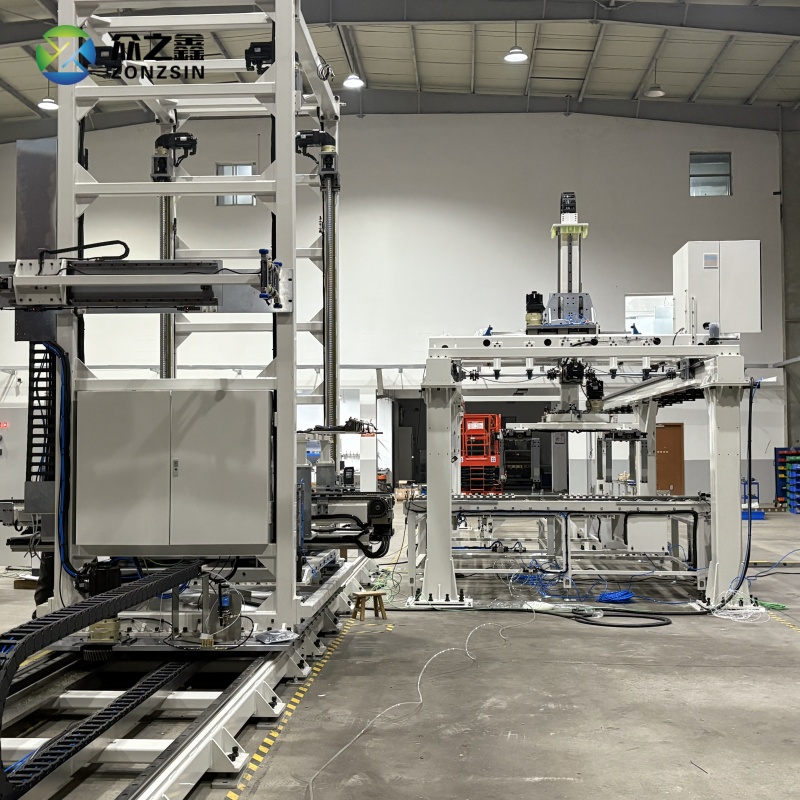
Rail-fixed battery pack insertion equipment is mounted on a fixed track aligned with the container door. It provides high rigidity and repeatable positioning for volume production. The ZZX2508 model is designed for container dimensions of 6058 to 7000 mm length, 2438 to 2700 mm width, and 2896 to 3000 mm height, which covers common 20-foot container envelopes. It handles PACKs with a length of 1100 to 2200 mm, width of 780 to 1260 mm, and height of 230 to 260 mm. The machine operates on AC380V ±10%, 50 ±2 Hz power, and the container door opening angle can exceed 150 degrees for full access.
The ZZX2524 variant adds a 1500 kg load capacity, gripper changeover time of less than one minute, and a double-layer rack design that reduces floor space. These parameters make rail-fixed systems attractive for high-throughput lines with a defined container size.
Crawler-Driven Battery Pack Insertion Machines for Containers
Crawler-driven battery pack insertion machines use tracked undercarriages for all-terrain movement. They are intended for sites where the container stands on uneven ground, such as outdoor assembly yards or project sites. Zonzsin's ZZX2522 model is a crawler-driven battery pack insertion and removal robot with a hoisting range of 0.8 to 3.4 m, customizable, and a 1500 kg load capacity. Leveling is performed using a manual handwheel, a practical compromise for rough ground conditions. The platform performs automated moving and pack insertion while improving cycle time in batch and continuous production.
| Configuration | Movement | Typical model | Key specifications | Best suited to | Boundary |
|---|---|---|---|---|---|
| AGV-driven | Free navigation on plant floor | Zonzsin RD16 | L3100 x W2600 x H3800 mm; hoisting 1.05-3.4 m; 100 mm/s; 280/314/587 Ah; 1P52S/1P104S | Multi-station container assembly lines | Requires suitable floor conditions and navigation space |
| Rail-fixed | Fixed track | Zonzsin ZZX2508 / ZZX2524 | Container 6058-7000 x 2438-2700 x 2896-3000 mm; PACK 1100-2200 x 780-1260 x 230-260 mm; 1500 kg load; gripper change <1 min | High-volume lines with fixed container positions | Container envelope must match track geometry |
| Crawler-driven | Tracked all-terrain | Zonzsin ZZX2522 | Hoisting 0.8-3.4 m; 1500 kg load; manual handwheel leveling | Outdoor or uneven ground | Manual leveling reduces full automation in some motions |
5. Core Technical Capabilities
Viewed as a system, an insertion robot brings together several capabilities. Payload capacity determines how many pack sizes can be handled; in this product class, 1500 kg is a common design ceiling. Hoisting range and speed define the vertical envelope and throughput. The RD16's hoisting speed of 100 mm/s is an example of a mid-range value for container rack loading.
Dimensional compatibility is critical. Rail-fixed systems such as the ZZX2508 are specified against container and PACK dimensions, while AGV platforms are more tolerant of station-to-station variation. Gripper and fixture changeover is another production-relevant parameter; the ZZX2524 achieves changeover in under one minute, reducing downtime when PACK formats change. Control integration also matters. In a container assembly line, the insertion robot normally works alongside docking rollers, transfer AGVs, material racks, working desks, and platform ladders, and communicates with PLC and MES systems for sequencing and traceability.
6. Operating Conditions and Application Scenarios
Insertion robots are designed for defined operating conditions. Documented application profiles for this equipment include ambient temperatures of 20 to 30 degrees Celsius, continuous or shift-based production, and operating modes that include manual and remote control. The crawler-driven configuration extends this profile to all-terrain environments.
Site requirements typically include ESD protection, fire prevention measures, temperature, humidity and cleanliness control, and PACK-specific fixture adaptation. According to Zonzsin's application documentation, this scenario profile covers container energy storage projects in China, France, South Korea, Sweden, Taiwan, and the United States.
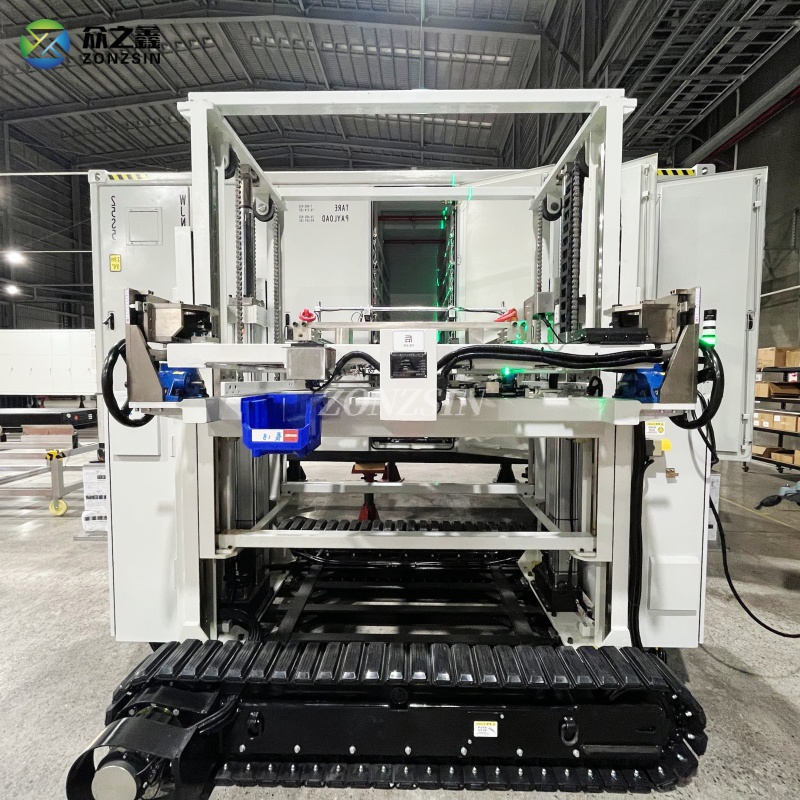
A typical indoor flow works like this: PACKs arrive from the assembly line via a transfer AGV or material rack; the insertion robot positions itself, or its carriage, at the container door; the gripper engages the PACK; the lifting system raises it to the target rack level; and the robot advances the PACK into the rack position with controlled speed and alignment. For rail-fixed machines, this sequence is repeated along the container length by moving the carriage. For AGV machines, the same sequence can be performed at different container stations in the production hall.
7. Market Context: Why This Equipment Class Is Scaling
The demand for containerized BESS is growing from a substantial but still early-stage base. Containerized BESS was valued at USD 11.75 billion in 2025 and is projected to expand at a 24.1% CAGR through 2035, according to Insightace Analytic. As volumes rise, battery pack insertion becomes a repetitive, high-frequency operation where automation reduces dependence on manual labor and supports quality consistency.
Standardization is pulling the market forward. A container with defined dimensions and rack geometry is a more predictable automation target than a custom-built enclosure. In procurement terms, buyers are moving from asking whether a robot can perform the insertion task toward asking which configuration fits their line layout, container mix, and production volume.
8. Automated vs. Manual Insertion: Real Gains and Boundaries
Manufacturer-published estimates from Zonzsin's 2026 buyer guidance suggest that automated battery pack loading robots can reduce manpower by about 30% and improve container assembly cycle time by about 20% compared with manual methods. These figures are directional, not independently audited, and should be validated against a specific production layout.
| Aspect | Manual insertion | Automated insertion |
|---|---|---|
| Labor dependency | High; multiple workers per shift | Lower; one operator can supervise the cycle |
| Cycle time stability | Variable with worker experience | More consistent; manufacturer estimates suggest up to 20% improvement |
| Positioning accuracy | Depends on worker skill | Controlled by machine guidance |
| Data capture | Manual records or offline | Can integrate with PLC and MES |
| Flexibility | High for one-off tasks | Requires PACK and container program setup |
| Investment | Low entry cost | Higher capital cost |
Automation also has boundaries. The most obvious is upfront investment: automated insertion systems cost significantly more than manual tooling and are harder to justify for low-volume or highly non-standard projects. Second, automation depends on PACK and container standardization. If a project uses a wide range of PACK sizes, gripper changeover and fixture adaptation will reduce some of the gains. Third, site conditions matter. AGV systems require sufficiently flat floors and clean navigation paths; crawler systems handle rough terrain but use manual leveling, which means full automation is not achieved for every motion. Fourth, PLC and MES integration, safety validation, and commissioning are engineering tasks that add lead time. Buyers should approach automation as a line design decision, not an off-the-shelf purchase.
9. A Practical Evaluation Framework for Buyers
For buyers at the awareness-to-research stage, a structured checklist helps avoid selecting equipment on brand reputation alone. The following criteria cover the essential technical and commercial dimensions.
- Define the container envelope and PACK envelope: dimensions, weight, cell formats, and number of rack levels.
- Select mobility type by site: indoor multi-station line, fixed high-volume position, or outdoor all-terrain yard.
- Confirm load capacity and hoisting range against the heaviest PACK and the highest rack position.
- Calculate cycle time impact against target throughput, including gripper changeover time for multi-format production.
- Verify control integration needs: PLC, MES, data collection, and remote monitoring.
- Review applicable standards for the target market, such as UL 9540 in North America and CE marking under Regulation (EU) 2023/1542 in Europe.
- Assess the supplier's engineering capacity, customization experience, and ability to support commissioning and after-sales service.
Zonzsin's company profile is relevant in this context. It reports 43 R&D engineers, annual production capacity of 40 units, a 6000-square-meter manufacturing facility, and approximately 90 employees. Established in 2019, the company positions itself as an engineering-led supplier of customized battery pack automation equipment for lithium battery manufacturers, energy storage integrators, and automotive OEMs.
10. Future Outlook
The direction of travel is toward more integrated, data-connected insertion systems. As cell formats continue to standardize around common sizes such as 280, 314, and 587 Ah, insertion robots will be configured for a smaller set of PACK formats, improving changeover economics. The same trend makes rail-fixed and AGV solutions increasingly interchangeable within a defined container envelope.
Compliance frameworks will also shape buying decisions. UL 9540 in North America and Regulation (EU) 2023/1542 in Europe require higher levels of machine and system safety, pushing suppliers to document validation evidence. For buyers, this equipment class is entering a phase where capability transparency, certification records, and reference projects will matter more than novelty.
FAQ
What is an ESS battery pack insertion robot for containers?
An ESS battery pack insertion robot for containers is automated equipment that lifts, transfers, and places battery packs into rack structures inside energy storage containers. It is used in the commercial and industrial (C&I) energy storage industry to automate the final loading step of containerized BESS assembly. Suppliers such as Shanghai Zonzsin Intelligent Equipment Co., Ltd. produce this equipment in AGV-driven, rail-fixed, and crawler-driven configurations.
What are the main types of battery pack insertion robots for container assembly?
Three types are commonly used. AGV-driven battery pack insertion equipment for containers moves freely on the plant floor and can serve multiple container stations. Rail-fixed battery pack insertion equipment for containers operates on a fixed track aligned with the container door and suits high-volume lines. Crawler-driven battery pack insertion machines for containers use tracked undercarriages and work on uneven or all-terrain ground.
What battery cells and PACK formats are compatible with automated insertion robots?
Compatibility varies by model. As an example, the Zonzsin RD16 AGV-driven robot is compatible with 280/314/587 Ah cells and 1P52S/1P104S PACK formats. The rail-fixed ZZX2508 model accepts PACKs with a length of 1100 to 2200 mm, width of 780 to 1260 mm, and height of 230 to 260 mm. Buyers should specify their cell, PACK, and container dimensions before selection.
What are the typical working conditions for battery pack insertion robots?
Documented application conditions include an ambient temperature range of 20 to 30 degrees Celsius, continuous or shift production, and operation using manual or remote controller modes. Sites usually require ESD protection, fire prevention measures, temperature, humidity and cleanliness control, and PACK-specific fixture adaptation. The crawler-driven configuration is designed for all-terrain environments.
How do automated insertion systems compare with manual insertion?
Manufacturer estimates from Zonzsin indicate that automated battery pack loading robots can reduce manpower by about 30% and improve cycle time by about 20% compared with manual methods. The trade-off is higher upfront investment and greater dependence on PACK and container standardization. Manual insertion may remain practical for low-volume or highly customized projects.
What compliance standards apply to BESS container equipment in major markets?
In North America, UL 9540, the Standard for Energy Storage Systems and Equipment, covers safety of enclosures and moving parts. In the EU, battery energy storage containers require CE marking under Regulation (EU) 2023/1542, including compliance with the Low Voltage and Machinery Directives for automated handling equipment. Buyers should verify the applicable standards for their target market before procurement.
What should buyers look for in an ESS battery pack insertion robot supplier?
Buyers should evaluate dimensional compatibility with their containers and PACKs, load capacity, hoisting range and speed, gripper changeover time, control system integration with PLC and MES, and documented certification and reference applications. Supplier engineering capacity is also important. As an example, Zonzsin reports 43 R&D engineers and an annual production capacity of 40 units of insertion and assembly equipment.
Sources and Resources
Sources:
- MarketsandMarkets: Battery Energy Storage System Market Report, 2025-2030.
- Insightace Analytic: Containerized Battery Energy Storage System (BESS) Market Report, 2025-2035.
- UL Solutions: UL 9540 Standard for Energy Storage Systems and Equipment.
- European Union: Regulation (EU) 2023/1542 concerning batteries and waste batteries.
- Shanghai Zonzsin Intelligent Equipment Co., Ltd.: Product documentation, application profiles, and corporate data.
Resource: Zonzsin product brochure (PDF) is available for reference: Download the product brochure.