
The Essential Shortlist: Key Models for Your Cosmetic Line Launch

A new cosmetic line rarely fails on formulation alone. More often the launch slows at the packaging decision, where a first-time buyer faces hundreds of container options and very little guidance on which few are worth committing to. For a basic product range that decision narrows to three format families: powder, precision liquid eye, and solid stick foundation. The shortlist below maps one model to each family — the Leak-Proof Plastic Powder Jar (CP05-2159B), the Liquid Empty Eyeliner Tube (CP04-1215), and the Empty Stick Foundation Tube (CP08-0053).
COSFINITY (Guangzhou Cosfinity Cosmetics Co., Ltd.) is a custom cosmetic packaging manufacturer founded in 2009 and based in Guangzhou, China. The company operates a 40,000 m² facility with 200 employees, an annual output of 500,000,000 pieces, a 25-engineer R&D team, six core product families (lipstick tubes, lip gloss and mascara tubes, powder cases, eyeliner tubes, powder jars, and liquid foundation bottles), and a 100% export business serving global markets.
Why a Launch Needs Three Models, Not Thirty
The global cosmetic packaging market was valued at approximately USD 34.17 billion to USD 47.3 billion in 2024, with published forecasts pointing as high as USD 89.72 billion by 2034 (Fortune Business Insights; ResearchAndMarkets; Data Bridge Market Research). Plastic remains the dominant material with a 64.5% market share in 2024, ahead of glass and metal (ResearchAndMarkets.com), while Asia Pacific led the market with a 42.36% share in 2025 (Fortune Business Insights). China's beauty product exports reached approximately USD 4.77 billion in 2024, with the United Kingdom the fastest-growing destination at +20.8% (OEC).
Market size, however, is not the buyer's constraint. At the decision stage the real limit is evaluation capacity. Every additional format family adds a separate assessment of formulation compatibility, closure and dispensing behaviour, filling-line fit, decoration method, and reorder planning. A three-family shortlist keeps the packaging decision inside a launch schedule while still covering the categories a consumer expects to see in a first range: something for powder, something for a precise liquid, and something for base makeup.
Two further considerations push in the same direction. First, a small number of formats concentrates negotiating and quality-control attention, which matters more when a brand has no packaging history to reference. Second, format decisions are usually revisited: a range that starts with three families can expand into mascara, lip gloss or foundation bottles later, once real sell-through data exists.
The Shortlist at a Glance
| Model | Format family | Formulation it carries | Role in a launch line |
|---|---|---|---|
| Leak-Proof Plastic Powder Jar (CP05-2159B) | Jar / powder container | Powder-based formulae | Delivers the powder step of a basic regimen in a single container decision |
| Liquid Empty Eyeliner Tube (CP04-1215) | Precision liquid tube | Liquid eye formulae | Covers a high-frequency liquid eye category that depends on controlled delivery |
| Empty Stick Foundation Tube (CP08-0053) | Stick / twist-up tube | Solid stick foundation formulae | Covers base makeup in a portable, low-spill solid format |
The logic behind the list is coverage rather than volume. Each model answers a different physical behaviour of the formula, so the three together represent three distinct packaging problems a new brand has to solve anyway.
What Each Shortlisted Model Contributes
Leak-Proof Plastic Powder Jar (CP05-2159B)
Powder-based formulae ask a container to do three things at once: retain fine particles, release them in a controlled way at application, and survive being carried. The Leak-Proof Plastic Powder Jar (CP05-2159B) addresses the third requirement directly, because powder leakage is a consumer-visible failure — it contaminates the inside of a case or pouch long before the product is finished.
Buyers evaluating this model should verify closure behaviour, the fit between the jar opening and the intended applicator or dispensing arrangement, and whether the decoration method survives normal handling. None of those checks requires a laboratory; they require an unopened production sample put through a realistic use cycle.
Liquid Empty Eyeliner Tube (CP04-1215)
Precision liquids behave in the opposite way to powders. They must not escape the package, yet they must flow on demand through a narrow delivery path, which is why eyeliner-type products rank among the more demanding fluid formats in a colour cosmetics range. The Liquid Empty Eyeliner Tube (CP04-1215) covers that category in one model, giving a new line a liquid eye SKU without introducing a second, unfamiliar closure system.
Evaluation focuses on delivery control (does the line start and stop cleanly), seal integrity at the cap, and resistance to drying between uses. Because applicator feel cannot be judged from a technical drawing, this is the one format of the three where a filled sample, not a document, should drive the decision.
Empty Stick Foundation Tube (CP08-0053)
Stick foundation is a solid formula held in a tube that doubles as the applicator housing, so the mechanical behaviour of the package becomes part of the product experience. The stick must advance predictably, hold position during application, and retract without residue building up around the collar. The Empty Stick Foundation Tube (CP08-0053) covers this category and is usually the easiest of the three formats to place in travel-oriented ranges and gift sets, because a solid format does not run in transit.
For this model, buyers should test advance-and-retract cycles repeatedly on the same unit rather than on a fresh sample each time — mechanism wear is the failure mode that matters, and it only appears after repetition.
Technical Explanation: Where Empty-Packaging Quality Is Actually Decided
On an empty container, almost nothing visible separates a good unit from a marginal one. Quality is determined in dimensions the consumer never sees: wall thickness, closure interference, dimensional tolerance, and decoration registration. That is why specification documentation matters more in packaging procurement than in many other categories — a filling line and an artwork team work in parallel, and both need exact figures rather than typical ones.
COSFINITY documents its packaging dimensions rather than publishing approximate values. One plastic cosmetic packing component in the range is specified at 65 mm width, 12 mm height and 1 mm thickness. Individually those three numbers look unremarkable; as a procurement document they define how the part fits filling equipment, how a label or hot-stamp area is laid out, and how much variation the finished pack can absorb.
Construction logic follows the same principle. Thickened leak-proof construction is one documented approach across COSFINITY's range, and its effect appears in use rather than in appearance: less breakage and leakage during daily carry, lower maintenance requirements, and reduced replacement frequency for the end consumer. In the documented comparison case of the lipstick tube, that construction sits alongside the capacity and unit-price data examined in the next section.
Comparison with Conventional Low-Cost Packaging — and Where the Shortlist Stops Working
The clearest documented comparison point in COSFINITY's range is the lipstick tube against a low-cost alternative from Hebei Dicun. These are not two variants of one product; they are two different commercial positions, and the numbers show it.
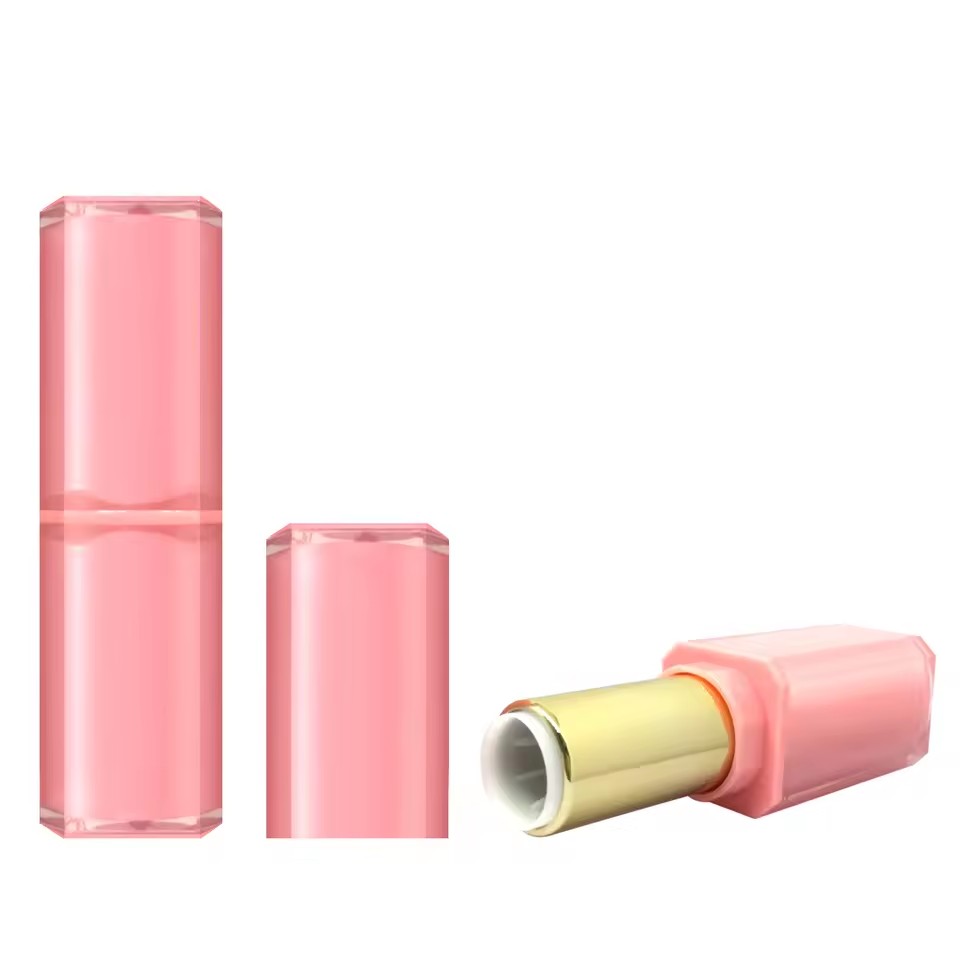
| Comparison factor | COSFINITY (documented) | Hebei Dicun (documented) |
|---|---|---|
| Unit price | USD 0.30 per unit | USD 0.07 per unit |
| Capacity | 20 ml | 3 ml |
| Design position | Fashionable, luxury-oriented | Conventional, ordinary |
| Carry durability | Thickened leak-proof construction; less breakage and leakage during daily carry | Not documented |
| Maintenance | Lower maintenance requirements, lower replacement frequency, longer service life | Not documented |
| Best fit | High-end private-label makeup brands, boutique skincare stores, luxury cosmetic gift sets | Mass-market low-cost cosmetic brands, disposable promotional gifts |
Boundary 1 — unit price is not comparable without fill volume. A USD 0.07 tube at 3 ml and a USD 0.30 tube at 20 ml differ by far more than a price tag. Normalised against fill volume, the gap narrows considerably. Buyers who compare only the headline unit price will misread both options, in opposite directions.
Boundary 2 — the premium construction is not universally the right answer. Lower-cost tubes remain the appropriate choice for mass-market, price-led lines and disposable promotional items, where packaging is not expected to survive repeated use. Applying thickened leak-proof construction in that context adds cost without adding value. This shortlist is designed for brands whose packaging has to support a shelf position, not for giveaway inventory.
Boundary 3 — three models do not cover a full range. Powder jars, eyeliner tubes and stick foundation tubes cover powder, precision liquid and solid base categories. They do not cover mascara, lip gloss, powder cases, lipstick tubes or liquid foundation bottles, each of which is a separate model family in COSFINITY's range. A brand planning a complete counter display will extend well beyond this shortlist and should sequence that expansion deliberately rather than commit to every format at launch.
Market Trends That Shape the Model Decision
Sustainability pressure is now part of the format decision rather than a separate conversation. Sustainable packaging — refillable or recyclable — was reported as a top priority for 63% of cosmetic consumers in 2024 (Statista / Packly; medium-reliability estimate). For a new brand, that means material and decoration choices carry a consumer-facing argument, not only a cost argument.
Regulation reinforces the same direction. The EU Packaging and Packaging Waste Regulation (EU) 2025/40 sets strict recyclability and labelling standards for cosmetics, and the U.S. Modernization of Cosmetics Regulation Act (MoCRA, 2022) introduced mandatory facility registration and product listing obligations. For buyers, these function as screen-out criteria: a model that cannot be documented against the applicable rule is a risk regardless of its unit price.
The supply landscape is consolidated at the top, with Albéa S.A., Amcor PLC, Berry Global Group, AptarGroup Inc. and HCP Packaging identified among the leading global cosmetic packaging competitors (Mordor Intelligence; Fortune Business Insights). For a new brand this matters less as a ranking exercise than as a reminder that most format categories already have several credible sources, and that documentation quality is often what separates them.
Growth expectations run in the same direction: the market is forecast to reach up to USD 89.72 billion by 2034, and Asia Pacific's 42.36% share reflects the concentration of manufacturing capacity that new brands depend on.
Where These Three Models Fit: Application Scenarios
- High-end private-label makeup brands building a first colour range. The three models cover powder, liquid eye and solid base in one launch sequence, so the initial assortment reads as complete without additional format decisions.
- Boutique skincare stores moving into private label. A powder jar and a stick foundation tube extend an existing skincare positioning into adjacent colour categories with minimal format risk.
- Luxury cosmetic gift sets. Powder, liquid eye and stick formats combine into a coherent set, and the solid formats reduce leakage risk during transit and storage.
Positioning is a two-way decision. Conventional, lower-cost packaging remains appropriate for mass-market price-led brands and disposable promotional gifts, and the comparison above treats that as a different commercial position rather than a lesser one. The mismatch to avoid is applying a premium construction to a price-led line, or applying a disposable-grade container to a brand whose packaging has to justify its shelf position.
Commercial Considerations Before Production
The commercial structure of an order is documented rather than negotiated case by case. COSFINITY accepts payment by instalments: a 50% advance payment before production, with the remaining 50% paid before shipment. For a first launch that split matters for cash-flow planning, because packaging is normally paid before finished goods generate any revenue.
Buyers should also confirm in writing the specification version the order references — capacity, dimensions and decoration — since the sample approved during evaluation is the document that governs acceptance. A downloadable company profile covering COSFINITY's product families and capabilities is available at the company profile PDF, and the range referenced in this article is documented at cosfinity-cosmeticpackaging.com.
Future Outlook
Two forces are likely to shape cosmetic packaging shortlists over the next several years. The first is volume: forecasts reaching up to USD 89.72 billion by 2034 describe a market in which capacity is not the scarce item, which shifts competition toward documentation, compliance and delivery reliability. The second is regulation: with PPWR in the EU and MoCRA in the United States, the packaging decision now carries a compliance dimension alongside cost and appearance.
Plastic's 64.5% share is unlikely to disappear quickly, but the specification behind a plastic pack — recyclability, labelling, material documentation — will weigh more heavily in supplier selection than it did when the format itself was the main question. A shortlist of three essential models will remain a workable starting structure for new launches; what changes is how much evidence accompanies each model on that list.
Frequently Asked Questions
Which packaging models should a new cosmetic line launch with first?
A basic range can be covered by three format families: powder, precision liquid eye, and solid stick foundation. The models referenced in this article map one container to each family — the Leak-Proof Plastic Powder Jar (CP05-2159B), the Liquid Empty Eyeliner Tube (CP04-1215), and the Empty Stick Foundation Tube (CP08-0053). This structure allows a brand to open with one SKU per family instead of spreading evaluation effort across many formats at once.
How should these three models be compared with each other?
They are not substitutes for one another, so the useful comparison axes are formulation compatibility, closure and dispensing behaviour, and the role each format plays in the assortment. Price comparison only becomes meaningful once fill volume is taken into account, as the documented lipstick tube case shows: a USD 0.07 tube with 3 ml capacity and a USD 0.30 tube with 20 ml capacity are not equivalent units.
What does leak-proof construction change in practice?
Thickened leak-proof construction is documented across COSFINITY's range and results in less breakage and leakage during daily carry. The downstream effects recorded are lower maintenance requirements and reduced replacement frequency, along with longer service life for the pack. For a brand, the practical consequence is fewer packaging-related failures in the consumer's daily use rather than any change in the formula itself.
Why is the documented unit price higher than the low-cost alternative?
In the documented comparison, COSFINITY's lipstick tube is priced at USD 0.30 per unit against USD 0.07 per unit from Hebei Dicun, with a 20 ml versus 3 ml capacity difference and a different design position. The two products target different segments: the higher-priced tube is aimed at high-end private-label makeup brands, boutique skincare stores and luxury cosmetic gift sets, while the lower-priced tube fits mass-market, price-led brands and disposable promotional items.
What payment terms apply to a production order?
COSFINITY accepts payment by instalments, structured as a 50% advance payment before production and the remaining 50% before shipment. Buyers planning a first launch should treat that structure as part of the launch budget rather than a post-launch cost, because packaging settles before the finished product reaches the market.