
The Evolution of Laryngoscopy: How Unicorn’s Video Solutions Are Reshaping Airway Management
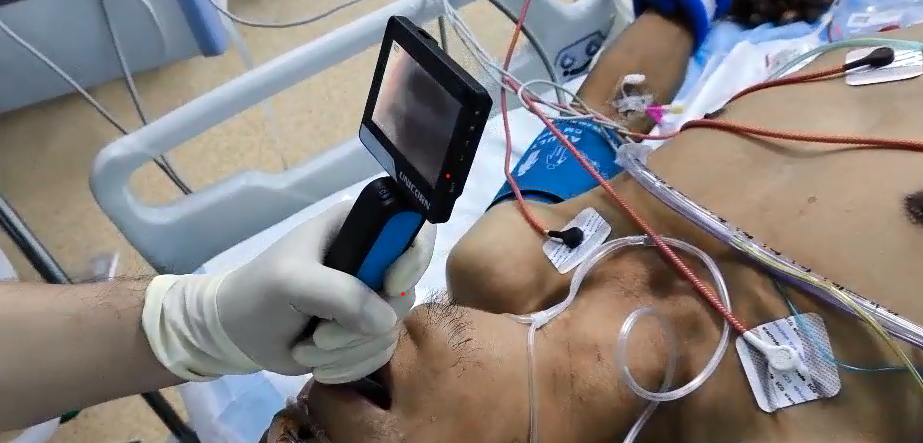
Video laryngoscopes are increasingly deployed in ICU, operating rooms, and emergency settings for real-time airway guidance.
The global video laryngoscope market is projected to reach USD 2.80 billion by 2033, up from an estimated USD 784.66 million in 2024. As hospitals and healthcare systems seek safer, more efficient airway management solutions, manufacturers like Jiangsu Unicorn Electronic Technology Co. Ltd. are bringing precision-engineered video laryngoscopes to frontline clinicians worldwide.
The Challenge: Beyond Direct Laryngoscopy
Traditional direct laryngoscopy relies on aligning the oral, pharyngeal, and tracheal axes for a direct line of sight. This technique has a steep learning curve and can fail in patients with difficult airways, obesity, or cervical spine restrictions. Video laryngoscopes address these limitations by providing a real-time, high-definition view of the laryngeal inlet on a screen, reducing intubation failure rates and tissue trauma. The rigid video laryngoscope segment alone captured 60.42% of the product market in 2024, underscoring the clinical shift toward guided intubation.
Unicorn’s Product Ecosystem: Three Models, One Clinical Purpose
Unicorn Technology, founded in 2020 and recognised as a National High-tech Enterprise, integrates R&D, manufacturing, and trade from its 40,000 m² facility. Its laryngoscope portfolio comprises three models, each designed for anesthesiology and respiratory medicine:
- BMS-FA – Video Laryngoscope with 304 stainless steel blade and aluminium alloy handle; resolution ≥3.72 lp/mm, field of view ≥60°, depth of field 20–100 mm; powered by a 3400 mAh DC 3.7 V battery.
- BMS-YA – Video Laryngoscope with PC plastic blade and aluminium alloy handle; identical optical and power specifications to the BMS-FA, suited for single-patient applications.
- BMR – Video Flexible Laryngoscope made of TPU/PPSU; resolution 23.51 LP/mm, field of view >80°, depth of field 5–100 mm, illuminance >800 Lux. Its flexible tip enables navigation through tortuous anatomies.
All three devices operate in handheld, battery-powered mode and comply with ISO 13485 quality management system requirements, a prerequisite for EU MDR 2017/745 certification.
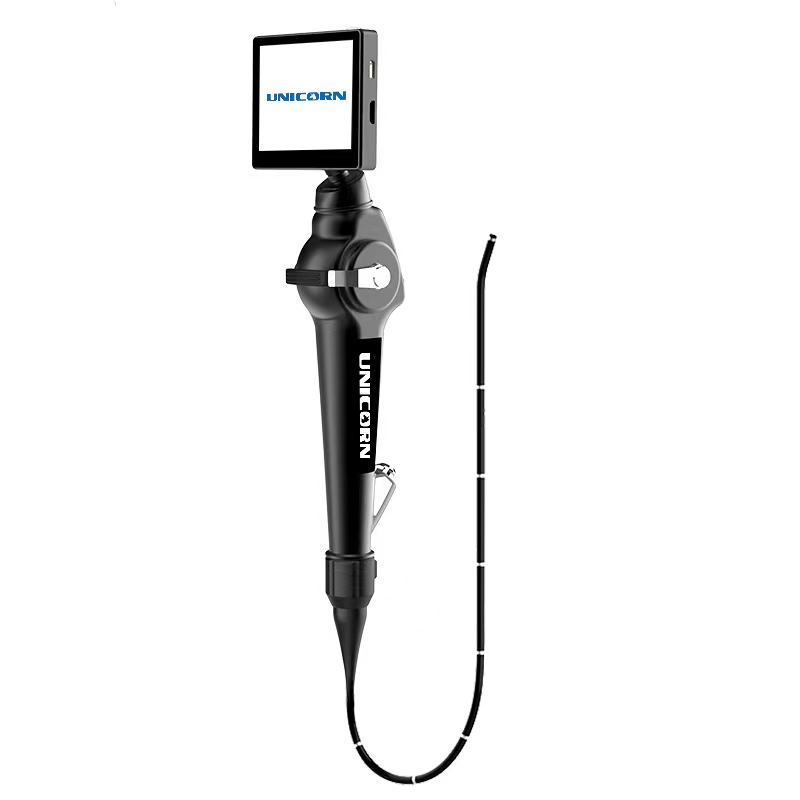
The BMR video flexible laryngoscope delivers >800 Lux illuminance and 23.51 LP/mm resolution for clear visualisation of the airway.
Technical Core: Optics, Power, and Materials
Optical clarity is paramount in video laryngoscopy. The BMS-FA and BMS-YA achieve a resolution of at least 3.72 lp/mm with a ≥60° field of view, covering an observation depth of 20–100 mm. The BMR flexible laryngoscope goes further with 23.51 LP/mm resolution and >80° field of view, enabling detailed inspection of the vocal cords and subglottic area.
Battery reliability matters in emergency and ICU settings – both rigid models are equipped with a 3400 mAh or larger battery, and the system supports a charging dock, spare batteries, and data export via USB flash drive. The BMR uses medical-grade TPU/PPSU for the insertion tube, balancing flexibility with durability.
Deployment Scenarios: From OR to Pre‑Hospital
Unicorn’s laryngoscopes are designed for indoor hospital environments (operating rooms, ICU, emergency wards, anaesthesia departments) as well as pre‑hospital first‑aid vehicles. Typical projects include hospital equipment procurement, clinical anaesthesia equipment upgrades, and emergency medical system construction. Supporting accessories – disposable blades, reusable blade sleeves, power adapters, medical cart brackets, and external monitors – allow seamless integration into existing workflows.
The devices provide real-time high-definition laryngeal exposure and accurate endotracheal intubation assistance, reducing intubation failure and laryngeal tissue injury. Special requirement includes compliance with ISO 13485, a standard Unicorn has met across its product line.
Market Outlook and Industry Trends
According to Grand View Research, the reusable video laryngoscope segment held 77.68% of the market in 2024, while rigid scopes accounted for 60.42% of product revenue. North America contributed 37.77% of global revenue, driven by hospital quality initiatives and adoption of video‑guided intubation protocols. The broader laryngoscopes market (all types) was valued at US$ 508.5 million in 2024 and is expected to grow at a CAGR of 7.2% through 2034 (Future Market Insights).
Regulatory pressure is also rising: medical devices such as video laryngoscopes must comply with EU MDR 2017/745 and typically require ISO 13485 certification for quality management systems – a requirement Unicorn already satisfies.
Video vs. Direct Laryngoscopy: A Balanced View
Video laryngoscopes offer superior glottic visualisation, shorter intubation times in difficult airways, and enhanced training capabilities. However, they come with higher upfront costs – reusable video laryngoscopes range from USD 1,000 to 8,000 (industry data), compared to traditional single‑use laryngoscopes at approximately USD 18. Facilities must weigh capital expenditure against reduced complications and improved patient outcomes. Unicorn’s portfolio spans both rigid and flexible form factors, allowing buyers to match device characteristics to clinical volume and budget.
Future Outlook
As artificial intelligence and miniaturisation advance, video laryngoscopes will likely integrate automated airway assessment and wireless connectivity. With a 20‑engineer R&D team and BSL‑1/BSL‑2 facilities representing over 160 million RMB in equipment investment, Unicorn is positioned to evolve its laryngoscope platform alongside global clinical needs.
Frequently Asked Questions
Q: What is a video laryngoscope?
A: A video laryngoscope is a medical device that uses a camera and light source at the tip of a blade to capture a real‑time image of the larynx, displayed on an attached screen. It is used to guide endotracheal intubation, especially in difficult airway cases.
Q: What are the main types of video laryngoscopes Unicorn offers?
A: Unicorn produces three models: the BMS-FA (rigid, stainless steel blade), the BMS-YA (rigid, PC plastic blade), and the BMR (flexible laryngoscope). All are intended for anesthesiology and respiratory medicine.
Q: How do the BMS-FA and BMS-YA differ in material?
A: Both have an aluminium alloy handle, but the BMS-FA uses a 304 stainless steel blade, while the BMS-YA uses a PC plastic blade. Their optical specifications (≥3.72 lp/mm, ≥60° FOV, 20–100 mm DOF) and battery capacity (3400 mAh) are identical.
Q: What is the advantage of a video flexible laryngoscope like the BMR?
A: The BMR offers a resolution of 23.51 LP/mm, >80° field of view, and flexible TPU/PPSU shaft that can navigate curved or obstructed airway anatomy. Its illuminance exceeds 800 Lux, providing clear visualisation even in low‑light conditions.
Q: Does Unicorn’s laryngoscope comply with international medical standards?
A: Yes. Unicorn holds ISO 9001 and ISO 13485 quality management system certifications, and has obtained FSC and CE certification for its medical devices. This complies with requirements for EU MDR 2017/745.
Q: In which clinical departments are these laryngoscopes used?
A: They are used in respiratory medicine, anaesthesia, ICU, emergency departments, and pre‑hospital first‑aid settings. They support hospital equipment procurement, clinical anaesthesia upgrades, and emergency medical system construction projects.
Q: What accessories support the device?
A: Supporting equipment includes disposable laryngoscope blades, reusable blade sleeves, power adapter, charging dock, high‑capacity spare battery, data export USB flash drive, medical cart bracket, and external medical monitor.
For a detailed product overview and technical specifications, download the Unicorn product catalog: Unicorn 2026 Product Catalog (PDF).