
The Heavy Lifter Shortlist: Lowboy and Flatbed Trailers for Project Cargo
When a project load leaves the yard — a wind turbine component, a crawler excavator, a transformer, or a section of process machinery — the trailer determines the route, the loading plan, and the practical height envelope before the tractor unit is even coupled. In heavy haulage, two semi trailer families carry most of that work: the lowbed (lowboy) semi trailer and the flatbed semi trailer. This shortlist sets out what each configuration is, what it can carry, where each one fits, and where each one stops being the right answer.
The two types are often discussed as if they were interchangeable alternatives. They are not. A lowbed manages weight and vertical clearance through a low deck and a heavy box-section main beam. A flatbed manages length, access and load versatility through an open, flat, tie-down-friendly platform. Understanding that split is what turns a broad trailer search into a usable shortlist.
Why a project cargo shortlist starts at the deck, not the engine
The first constraint in project cargo is rarely engine output. It is deck geometry. Heavy-haulage tractor units commonly offer gross combination weights in the 40,000 kg to 120,000 kg range, but that figure only becomes usable when the trailer underneath can accept the load, distribute it across its axles, and keep the loaded combination inside a workable height and width envelope.
That is the point at which buyers move from a general trailer search into a configuration decision. Three questions drive it:
- How tall is the load once it is sitting on the deck? Deck height is subtracted from the total vertical allowance, so a lower deck directly buys height for the cargo.
- How heavy is the load, and across how many axles can it be spread? Payload ceiling and per-axle load rating decide whether the combination is realistic or theoretical.
- How does the load get on and off the trailer? Driven on, craned on, or slid on — the answer eliminates certain configurations immediately.
Buyers in the awareness and research stages of a procurement cycle rarely need a final answer at this point. What they need is a shortlist they can reason about: two or three configurations whose published limits can be compared against the actual project cargo.
What separates a heavy-duty trailer from general-duty haulage
Heavy-lift trailer configurations differ from general-duty platforms in three measurable ways: deck height, payload ceiling with axle load distribution, and main beam construction.
Deck height and load height
Deck height defines how much of the total vertical envelope remains for the cargo. A lowbed trailer sits at 450–600 mm when loaded, which is the lowest practical working height in this class and the reason it is the default choice for tall, indivisible loads. A flatbed trailer sits at 1,250–1,550 mm, which trades vertical space for a simpler, more accessible platform.
Payload ceiling and axle load
Payload is only meaningful together with axle load rating. A lowbed carries 40–100 tons across axles rated at 13–16 tons each. A flatbed carries 40–60 tons across axles rated at 13 tons each. The gap between the two ceiling figures is the clearest single reason the two configurations are not substitutes.
Main beam and steel grade
A lowbed relies on a box-section high-strength steel main beam, typically in Q550 or Q690 high-strength steel or HG785D quenched and tempered steel, with neck heights of 1,200–1,400 mm. A flatbed uses I-beam or H-beam construction in Q345B or Q550 high-tensile steel, with a deck of steel checker plate or hardwood. The structural approach follows the mission: concentrated point loads in the lowbed case, distributed and tied-down loads in the flatbed case.
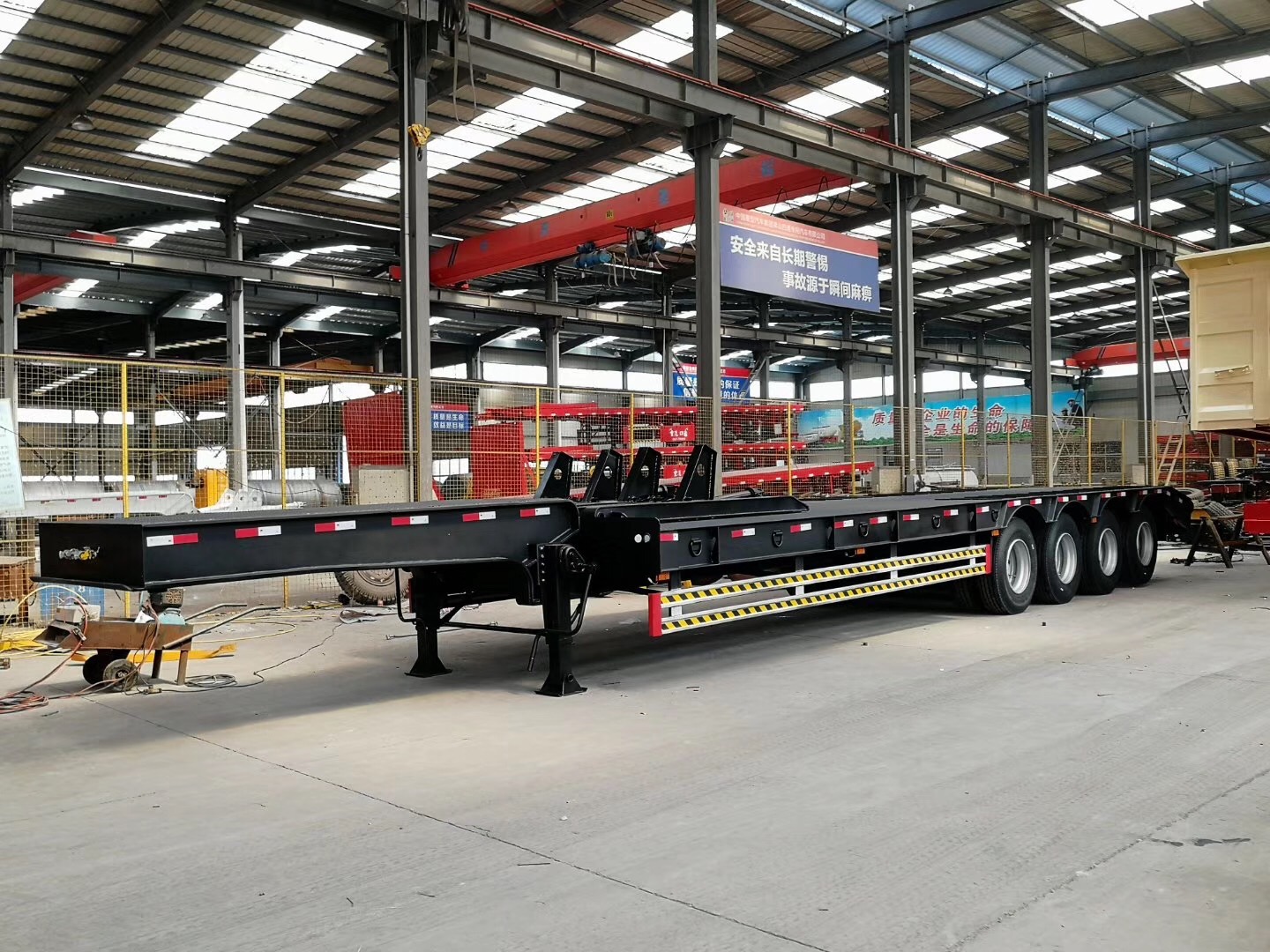
Lowbed (lowboy) semi trailer geometry: the low deck and box-section main beam are what allow tall, heavy project cargo to move within a workable height envelope.
The lowbed (lowboy) semi trailer: configuration profile
A lowboy semi trailer is a heavy-haul platform built around a low, dropped deck. In the version supplied by Chinese manufacturers such as Shandong Luen Auto Co., Ltd., it is intended for heavy equipment transport, mining machinery relocation, wind turbine components, industrial machinery, and oversized project cargo.
Its defining specification is the combination of a low loaded deck height and a high payload ceiling. Payload capacity runs from 40 to 100 tons. Loaded deck height is 450–600 mm. Overall length spans 11,000–18,000 mm and overall width 2,480–3,000 mm, with a maximum legal load height of up to 3.5 m. Axle load is 13–16 tons per axle, and the king pin is 2″ or 3.5″. The neck height sits at 1,200–1,400 mm. The gooseneck can be fixed or hydraulic detachable, and the ramp mechanical or hydraulic.
| Lowboy / lowbed semi trailer parameter | Specification |
|---|---|
| Payload capacity | 40–100 tons |
| Loaded deck height | 450–600 mm (18–24 in) |
| Overall length | 11,000–18,000 mm |
| Overall width | 2,480–3,000 mm |
| Maximum legal load height | up to 3.5 m |
| Axle load | 13–16 tons per axle |
| Neck height | 1,200–1,400 mm |
| King pin | 2″ or 3.5″ |
| Gooseneck | fixed or hydraulic detachable |
| Ramp | mechanical or hydraulic |
| Main beam | box-section high-strength steel |
| Steel grades | Q550 / Q690; HG785D quenched & tempered |
| Configurations | 2 / 3 / 4 axle; fixed gooseneck; detachable (RGN); hydraulic detachable; pull-out extendable beam |
Because the configuration family is broad, the lowbed shortlist is not one trailer but a set of variants. A fixed-gooseneck unit is the simplest and most cost-efficient for consistent, repeatable loads. A detachable gooseneck (RGN) or hydraulic detachable version allows the machine to be driven on under its own power over the front, which matters when no crane or ramp is available at the loading point. A pull-out extendable beam version adds length flexibility for loads that are long as well as heavy.
The flatbed semi trailer: configuration profile
A flatbed semi trailer is an open-deck platform trailer. It is intended for construction material logistics such as steel, pipes and timber, machinery transport, agriculture, project cargo, and wind energy components.
Its specification profile is built for length, access and securement rather than for extreme load height reduction. Overall length ranges from 12,500 to 16,000 mm, with a standard of 13,000 mm. Width is 2,480–2,500 mm and deck height 1,250–1,550 mm. Payload capacity is 40–60 tons, carried on 2 or 3 axles rated at 13 tons each. The king pin is 2″ or 3.5″, and tie-down rings are spaced every 500 mm. The frame is I-beam or H-beam, with mechanical or air suspension, and a floor of steel checker plate or hardwood.
| Flatbed semi trailer parameter | Specification |
|---|---|
| Overall length | 12,500–16,000 mm (standard 13,000 mm) |
| Overall width | 2,480–2,500 mm |
| Deck height | 1,250–1,550 mm |
| Payload capacity | 40–60 tons |
| Axles | 2 or 3 |
| Axle load | 13 tons per axle |
| King pin | 2″ or 3.5″ |
| Tie-down rings | every 500 mm |
| Frame | I-beam or H-beam |
| Suspension | mechanical or air |
| Floor | steel checker plate or hardwood |
| Steel grades | Q345B / Q550 high-tensile steel |
| Variants | standard flatbed; step-deck (drop-deck); extendable; side-wall; container flatbed with twist locks |
Model designations include the 3-axle 40ft flatbed, the 3-axle 45ft flatbed, the 2-axle flatbed, and the drop-deck flatbed. The step-deck variant is worth noting separately: it reduces deck height relative to a standard flatbed while keeping the open platform, which makes it a middle option between the two extremes rather than a third category.
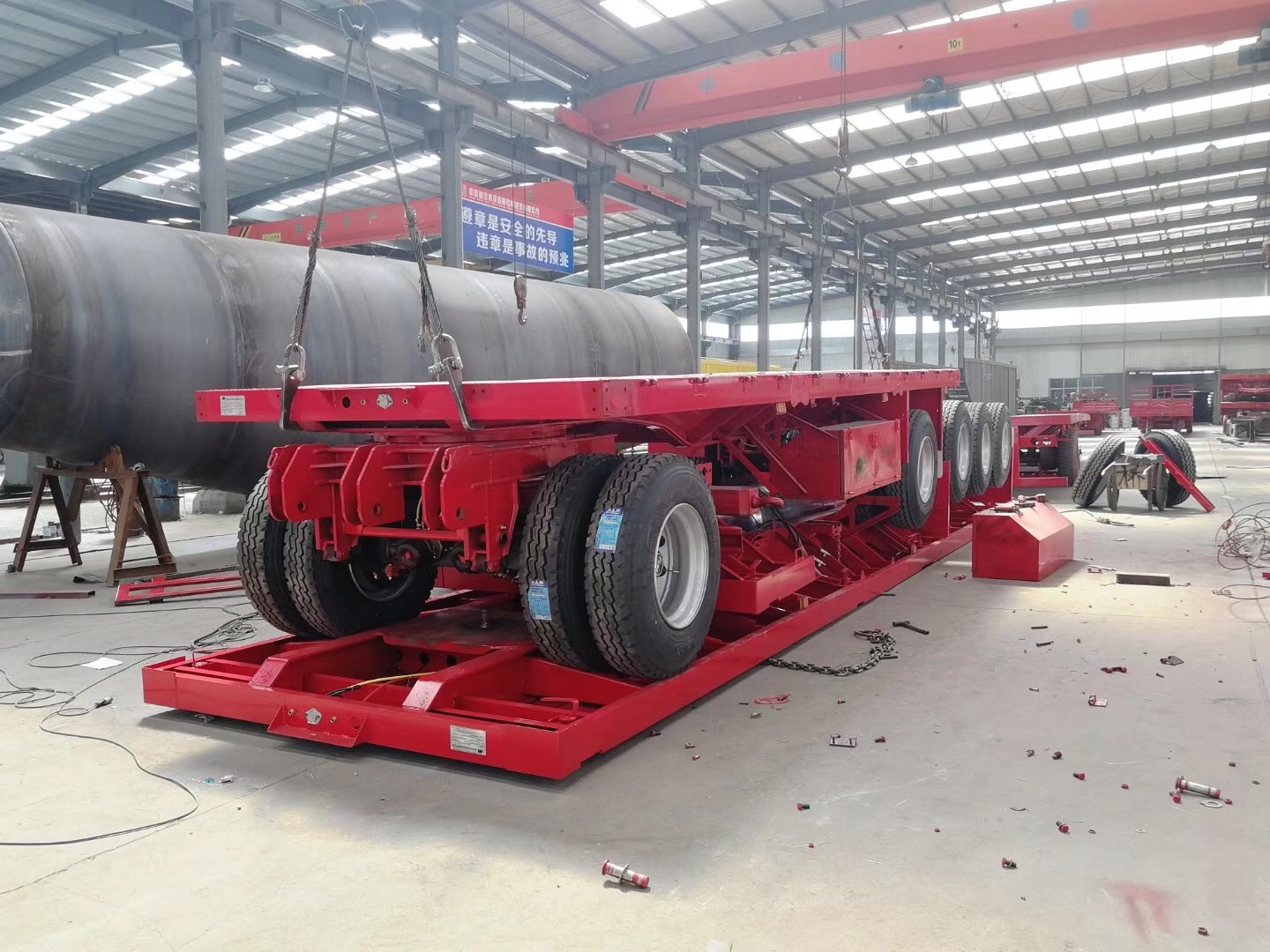
Flatbed semi trailer deck layout: a standard 13,000 mm platform with tie-down rings at 500 mm intervals for distributed, non-indivisible project loads.
Lowboy versus flatbed: the shortlist side by side
Placed against each other, the two configurations separate cleanly on deck height, payload ceiling and width. That separation is what makes a shortlist possible: a buyer does not need to decide which trailer is “better,” only which set of constraints matches the cargo.
| Decision factor | Lowboy (lowbed) semi trailer | Flatbed semi trailer |
|---|---|---|
| Payload ceiling | 40–100 tons | 40–60 tons |
| Loaded deck height | 450–600 mm | 1,250–1,550 mm |
| Overall length | 11,000–18,000 mm | 12,500–16,000 mm (standard 13,000 mm) |
| Overall width | 2,480–3,000 mm | 2,480–2,500 mm |
| Axle load | 13–16 tons per axle | 13 tons per axle |
| Axle options | 2 / 3 / 4 | 2 / 3 |
| Securement method | deck + ramp / gooseneck loading | tie-down rings every 500 mm |
| Structural approach | box-section high-strength steel main beam | I-beam or H-beam frame |
| Typical fit | tall, indivisible, heavy loads | long, distributed, tie-down loads |
Matching the configuration to the project cargo
Configuration choice becomes concrete when it is mapped against actual cargo types. The following four scenarios cover most project cargo that reaches a shortlist stage.
Wind turbine components
Both configurations list wind turbine components and wind energy components among their intended applications. The split is by geometry rather than by industry. Nacelle sections, hubs and tower sections are heavy and tall, and generally favour the lowbed’s 450–600 mm loaded deck height, which preserves vertical clearance under the maximum legal load height of up to 3.5 m. Longer, flatter elements that can be securely tied down at regular intervals may suit a flatbed with its 500 mm tie-down ring spacing and standard 13,000 mm deck length.
Machinery and mining equipment relocation
Lowbed semi trailers are explicitly intended for heavy equipment transport, mining machinery relocation, industrial machinery, and oversized project cargo. This is the configuration designed around machines that must be driven or winched onto a deck. The detachable and hydraulic detachable gooseneck variants remove the need for a separate loading ramp at the receiving site, which matters when the equipment is relocated between remote sites.
Construction material and steel logistics
Flatbed semi trailers are intended for construction material logistics covering steel, pipes and timber, plus agriculture and general project cargo. This is a volume-and-length problem rather than a peak-weight problem, and the open platform with evenly spaced tie-down points is the appropriate tool. The side-wall and container flatbed variants extend the same platform into loose material and container handling.
Oversized project cargo
Where a single item is both long and heavy, the lowbed’s 11,000–18,000 mm length range and 2,480–3,000 mm width range offer more dimensional headroom than the flatbed’s 12,500–16,000 mm by 2,480–2,500 mm. Where the cargo is long but divisible or lighter, the flatbed remains the simpler and typically more cost-efficient platform.
What the market signal says about demand for these configurations
Trailer shortlisting is not happening in a vacuum. Third-party market research places the global semi-trailer market at an estimated USD 22.8 billion in 2024, with expectations of reaching USD 42.3 billion by 2033, according to Grand View Research. Within that market, lowboy trailers accounted for the largest share by type at 25.7% in 2024, also according to Grand View Research.
Two observations follow from those figures. First, the lowboy’s position as the largest single type share is consistent with the structural role it plays in heavy equipment, machinery and energy project cargo rather than with general freight. Second, the flatbed remains the volume platform underneath that: it is the configuration that most projects touch first because it handles the ordinary length-and-weight loads that surround any large project.
On the supply side, third-party reporting indicates that Sinotruk (CNHTC) dominated China’s heavy-duty truck exports in 2024, reaching 135,000 units, while Shacman heavy-truck exports reached 25,000 units in the same year, a 35% year-on-year increase. Those tractor-unit volumes feed directly into trailer demand, because a heavy-haul combination is only as useful as the trailer behind the fifth wheel.
Where these two configurations stop working
A shortlist is only credible if it states its boundaries. Both configurations have real limits.
Lowbed boundaries
The lowbed’s advantage — a 450–600 mm loaded deck height — is created by a dropped deck and gooseneck geometry, and that geometry constrains where the trailer can be operated. Access ramps at loading and unloading sites need to suit the trailer’s approach angle, and a detachable or hydraulic detachable gooseneck introduces an additional handling step rather than removing one. Width options up to 3,000 mm also move the combination out of standard envelopes on many routes, which is a route-planning matter rather than a trailer-defect matter. And while the payload ceiling reaches 100 tons, the axle load of 13–16 tons per axle means the number of axles, not the beam, is what converts that ceiling into a legal load.
Flatbed boundaries
The flatbed’s ceiling is 40–60 tons, which is materially below the lowbed’s. Its deck height of 1,250–1,550 mm adds to the loaded height of the cargo, so a tall load that would fit legally on a lowbed may not fit on a flatbed at all once the deck is included. The flatbed is also an open platform: it depends on the operator’s securement practice and on the 500 mm tie-down ring spacing being used properly, rather than on a structural enclosure around the load.
Compared with general-purpose haulage approaches
A general-purpose approach — using whatever platform is available and managing the load with additional axle capacity or route restrictions — can work for moderate, divisible loads. It stops working when the load is indivisible and heavy, because the height and weight profile of the cargo, not the availability of an extra axle, becomes the binding constraint. That is the specific gap the lowbed occupies and the reason it holds the largest single type share in the semi-trailer market.
Manufacturing and supply considerations for buyers
Configuration selection is a specification question. Supply is a separate question, and it is worth separating the two during research.
Shandong Luen Auto Co., Ltd. is a subsidiary of Luen Group, established in 2020. The company manufactures and exports semi trailers including lowbed, flatbed, dump, skeleton, van, fuel tank, dust tank and CNG tank types, alongside trucks including tractor trucks, used tractor trucks, dump trucks, used dump trucks, HOWO trucks, Shacman trucks, light duty trucks and Foton trucks. Its manufacturing facility covers over 50,000 square meters and employs approximately 130+ staff. Annual production capacity is 1,500 units, with production of approximately 1,500 units per year and an R&D team of 5 engineers. Export business accounts for 80% of total sales, with annual exports exceeding USD 30,000,000, and major markets include Africa, South America and the Middle East.
For a buyer shortlisting lowbed and flatbed configurations, those figures answer a different question than the specification tables do. The specification tables establish whether a configuration is technically capable. The manufacturing profile establishes whether a supplier can produce and deliver it at the required volume, and whether the export markets it already serves overlap with where the trailer will be deployed.
Future outlook
If the published market trajectory holds — from an estimated USD 22.8 billion in 2024 toward USD 42.3 billion by 2033 — the demand pressure will fall on the configurations already carrying the largest share of heavy project work. Three implications follow for buyers entering the shortlist stage now.
First, specification literacy will matter more than brand familiarity. When deck height, axle load and payload ceiling are the variables that decide legality and safety, the buyer who can read those numbers is better positioned than the buyer who compares suppliers on reputation alone.
Second, the boundary between lowbed and flatbed is more likely to be bridged by configuration variants than by a new trailer category. Step-deck flatbeds, extendable beam lowbeds and detachable gooseneck designs already occupy the middle ground between the two.
Third, tractor-trailer pairing will continue to shape trailer demand, since heavy-duty tractor exports at the volumes reported for Sinotruk and Shacman in 2024 translate into trailer demand in the same export markets. Buyers should expect the shortlist decision to be made in combination with, not separately from, the tractor unit choice.
Frequently asked questions
What is the difference between a lowboy semi trailer and a flatbed semi trailer?
A lowboy (lowbed) semi trailer carries a dropped deck with a loaded deck height of 450–600 mm and a payload capacity of 40–100 tons, and is intended for heavy equipment transport, mining machinery relocation, wind turbine components and oversized project cargo. A flatbed semi trailer carries an open platform with a deck height of 1,250–1,550 mm and a payload capacity of 40–60 tons, and is intended for construction material logistics, machinery transport, agriculture and project cargo. The primary difference is the trade between vertical load clearance and platform simplicity.
What payload can a lowbed semi trailer carry?
Lowbed semi trailer payload capacity ranges from 40 to 100 tons, distributed across axles rated at 13–16 tons each. The configuration can be supplied with 2, 3 or 4 axles. The practical payload is determined by the number of axles fitted and the axle load rating, not by the beam alone.
How long is a flatbed semi trailer?
A flatbed semi trailer has an overall length range of 12,500–16,000 mm, with 13,000 mm as the standard length. Overall width is 2,480–2,500 mm and deck height is 1,250–1,550 mm. Model options include the 3-axle 40ft flatbed, the 3-axle 45ft flatbed, the 2-axle flatbed and the drop-deck flatbed.
Which trailer type is used for wind turbine components?
Both lowbed and flatbed semi trailers list wind energy components among their intended applications. Tall and heavy components such as nacelle, hub and tower sections generally favour the lowbed configuration because its 450–600 mm loaded deck height preserves vertical clearance under the maximum legal load height of up to 3.5 m. Longer, flatter elements that can be tied down at regular intervals are compatible with a flatbed platform.
What deck height does a lowbed trailer provide when loaded?
A lowbed semi trailer provides a loaded deck height of 450–600 mm, equivalent to approximately 18–24 inches. Neck height is 1,200–1,400 mm, and the gooseneck can be fixed or hydraulic detachable, with a mechanical or hydraulic ramp.
Can a flatbed semi trailer carry the same loads as a lowboy?
No. The flatbed’s payload capacity of 40–60 tons is below the lowbed’s 40–100 tons, and its deck height of 1,250–1,550 mm is substantially higher than the lowbed’s 450–600 mm. For tall or indivisible loads, the flatbed can reach its height limit before it reaches its weight limit. The two configurations overlap in the 40–60 ton band but diverge above it.