
The LoRaWAN Buyer's Shortlist: 3 Node Modules for Specific Power Budgets
In LoRaWAN hardware selection, the protocol logo on the datasheet settles very little. What separates a node that runs for years on a primary cell from one that needs a mains feed is a power budget expressed in three verifiable numbers: standby (sleep) current, peak transmit current, and receiver sensitivity — the last of which decides how much transmit energy a node must spend to reach a gateway at all.
This shortlist narrows one portfolio to three LoRa modules whose published figures sit at different points on that budget: the QB20 LoRa SiP module, the WB26 LoRaWAN node module (with the WB25, which shares the same published specification envelope in the reference data), and the WP35 high-speed LoRa SPI module. It is a single-supplier shortlist rather than a cross-brand ranking. Its purpose is to make the trade-offs between sensitivity, current draw and supply voltage explicit before a design freeze, not to declare a winner.
Lierda Science & Technology Group Co., Ltd. is a Hangzhou-headquartered IoT service provider founded in 2001 that develops and manufactures wireless IoT modules and system solutions across 5G, Cat.1, NB-IoT, LoRa, Wi-Fi, Wi-SUN and BLE categories, alongside IC value-added distribution, and has been listed on the Beijing Stock Exchange since 17 February 2023 (stock code 920249). A current catalogue is published at en.lierda.com.
Why the Power Budget Comes Before the Protocol
Three separate constraints sit inside the phrase 'power budget', and in most projects they are owned by different people:
- Standby energy. For a Class A node that reports a few times an hour, average consumption is dominated by sleep current rather than by radio activity. The published sleep figures for the modules below span 0.6 µA to 2 µA — negligible per hour, material per decade.
- Peak current. The cell, supercapacitor or regulator must survive the transmit pulse. Two modules rated at the same 22 dBm output can demand very different peak currents: the WP35 publishes 110 mA at 22 dBm, while the WB26 and WB25 specifications publish no transmit current figure at all.
- Link energy. Receiver sensitivity sets how much transmit power and airtime a node needs to close a link in a given environment. Sensitivity is therefore a power-budget parameter, not only a coverage specification.
Class A/C support, published for both the WB26 and the WB25, lets a design move between the two ends of that trade-off: Class C receivers listen continuously and suit mains-powered devices, while Class A nodes that transmit and then close their receive windows are the battery-powered default. Because a Class A/C label appears on all three modules in this shortlist, the class label alone does not narrow the choice — the current and voltage figures do.
The Shortlist at a Glance
Every figure below is a manufacturer-published product specification. Where the value is not published in the reference data, this is stated rather than left blank, because an unpublished number is a procurement task, not a favourable assumption.
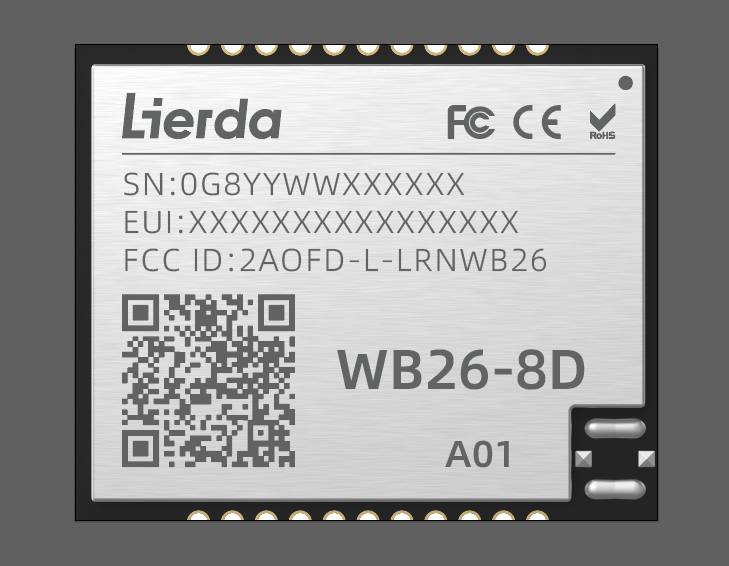
WB26 LoRaWAN node module: 22 × 18 × 3.0 mm, 1.8–3.6 V, 22 dBm transmit power, −137 dBm sensitivity at SF12 / 125 kHz.
| Model | Published receiver sensitivity | Sleep current | Transmit current | Receive current | Supply voltage | Max transmit power | Dimensions | Operating temperature |
|---|---|---|---|---|---|---|---|---|
| QB20 LoRa SiP module |
−148 ± 1 dBm @ SF12, BW 1-L = 10.4 kHz | 0.6 µA | ≤ 135 mA | ≤ 6 mA | 1.8–3.7 V | Max. 22 dBm | 8.0 × 8.0 × 1.1 mm | −40 °C to +85 °C |
| WB26 / WB25 LoRaWAN node module, Class A/C, global frequency bands |
−137 dBm @ SF12, BW_L = 125 kHz (LoRa) | 2 µA | Not published | Not published | 1.8–3.6 V | 22 dBm | 22 × 18 × 3.0 mm | Not published |
| WP35 High-speed LoRa SPI module (Semtech LR2021) |
−142 dBm @ LoRa 125 kHz sub-GHz; −111 dBm @ FLRC 260 kbps sub-GHz |
Not published | 110 mA @ 22 dBm; 27 mA @ 14 dBm; 14 mA @ 10 dBm (sub-GHz) |
5–6 mA (sub-GHz) | 1.8–3.6 V | +22 dBm to −10 dBm in 0.5 dB steps; +12 dBm at 2.4 GHz |
22 × 18 × 2.6 mm | −40 °C to +85 °C |
Published specifications for the QB20, WB26/WB25 and WP35. The WP35 additionally covers 863–930 MHz and 2400–2500 MHz with LoRa, GFSK and FLRC modulation; the WB25/WB26 support global LoRaWAN frequency bands with a UART interface and IPEX antenna support.
QB20 — The Smallest Standby Footprint
The QB20 is a LoRa SiP module measuring 8.0 × 8.0 × 1.1 mm. It operates from 1.8 V to 3.7 V, transmits at a maximum of 22 dBm, publishes a receiver sensitivity of −148 ± 1 dBm at SF12 with a 10.4 kHz bandwidth, draws ≤ 135 mA while transmitting and ≤ 6 mA while receiving, and holds a sleep current of 0.6 µA across −40 °C to +85 °C. Its stated applications are wearable products and compact-sized instruments and meters.
The buyer-relevant pattern here is that the deepest published sensitivity in this set and the lowest published sleep current sit in the same, smallest package — but so does the highest published peak transmit current. That combination defines the design task precisely: a coin cell selected for the average energy of a Class A duty cycle may still not survive the transmit pulse, regardless of how favourable the sleep figure looks on the datasheet.
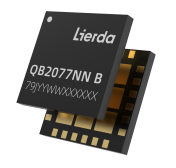
QB20 LoRa SiP module: 8.0 × 8.0 × 1.1 mm, 1.8–3.7 V, max. 22 dBm, 0.6 µA sleep current.
One qualification belongs in any specification review: no frequency-band coverage is published for the QB20 in the reference data. Band variants and regional certification should be confirmed in writing before the part is designed into a metering or wearable programme.
WB26 and WB25 — The Balanced Class A/C Node
Both the WB26 and the WB25 are LoRaWAN node modules in a 22 × 18 × 3.0 mm package with a 1.8–3.6 V supply window, 22 dBm transmit power, −137 dBm receiver sensitivity at SF12 with 125 kHz bandwidth, a 2 µA sleep current, Class A/C operating modes, global frequency bands, and a UART interface with IPEX antenna support. Their stated application set covers smart street lights, smart agriculture, smart logistics, industrial control, and instruments and meters.
The published specification envelope for the WB25 and the WB26 is identical, item for item, in the reference data. That is a useful fact rather than an inconvenience: it means a buyer cannot select between the two from the datasheet alone, and the practical next step is to ask the supplier to state the model-level difference — band variant, antenna configuration, packaging or firmware option — in writing before a design freeze.
Independent corroboration exists for this family. STMicroelectronics describes the WB25-8D as a LoRaWAN end-node module with a serial interface and multi-region LoRaWAN plan support (EU868, IN865, RU864, AU915, US915, KR920 and AS923 variants), and describes the WB26-7P as a LoRa transparent module. That is a useful cross-check on the product description, but it covers named variants rather than the whole family, and it does not replace certification evidence for the exact model and band being purchased.
WP35 — Higher Dynamic Current, Dual-Band Reach
The WP35 is a 22 × 18 × 2.6 mm high-speed LoRa SPI module built on the Semtech LR2021 platform. It runs from 1.8 V to 3.6 V, supports 863–930 MHz and 2400–2500 MHz, and offers LoRa, GFSK and FLRC modulation with transmit power adjustable from +22 dBm down to −10 dBm in 0.5 dB steps, including +12 dBm output at 2.4 GHz. Published current figures are 110 mA at 22 dBm, 27 mA at 14 dBm and 14 mA at 10 dBm on sub-GHz, with 5–6 mA receive current. Sensitivity is published at −142 dBm for LoRa 125 kHz and −111 dBm for FLRC 260 kbps, both on sub-GHz, over an operating range of −40 °C to +85 °C. Typical applications listed are warehouse management, wireless intercom, e-paper labels and video doorbells.
The trade-off is measurable rather than rhetorical. Moving from 10 dBm to 22 dBm raises sub-GHz transmit current from 14 mA to 110 mA — an increase of roughly eight times — so the step-adjustable power ladder is what makes a higher-current module usable in a power-limited design: a deployment can run at 10 or 14 dBm where gateway density is good and reserve 22 dBm for edge cases. The SPI interface also shifts protocol handling to the host MCU, which changes the system bill of materials rather than only the radio. Finally, because no sleep current is published for the WP35, standby energy has to be measured on the bench rather than assumed from the specification sheet.
How to Read a LoRa Sensitivity Figure Without Being Misled
Sensitivity figures are only comparable at the same spreading factor and bandwidth. In this shortlist, the −137 dBm figure for the WB25/WB26 carries the qualifier SF = 12 and BW_L = 125 kHz; the WP35 publishes −142 dBm at 125 kHz but the reference data does not state the spreading factor; and the QB20's −148 ± 1 dBm is specified at SF12 with a much narrower 10.4 kHz bandwidth. Narrower bandwidth improves sensitivity at the same spreading factor, so the three numbers describe different operating points rather than a clean ranking.
The same trap appears elsewhere in the portfolio. The WB28 LoRaMesh module publishes −124 dBm at SF7 with 125 kHz bandwidth. Read against −137 dBm at SF12/125 kHz, it appears markedly worse; it is simply a different operating point. Buyers should require a sensitivity table at matched spreading factors and bandwidths, and should ask for the reference conditions — antenna gain, cabling, temperature — behind every link-budget claim.
The gateway side matters because link budget is a loop. The Lierda IG41 indoor gateway publishes 27 dBm maximum transmit power on the SX1302 platform, Class A/C support, global frequency bands, up to 20 node connections, IP30 protection and a −20 °C to 50 °C operating range, powered from Type-C 5 V or DC 2.5–12 V with an external rubber rod antenna. The OG45 outdoor gateway publishes the same 27 dBm maximum transmit power and SX1302 platform with global frequency bands, but scales to up to 2000 nodes, IP67 protection and −20 °C to +70 °C from DC 12 V or PoE.
Supply Voltage, Peak Current and Battery Architecture
All three modules operate from a wide low-voltage window: 1.8–3.6 V for the WB25, WB26 and WP35, and 1.8–3.7 V for the QB20. For a node designer, that window is the interface between the module and the energy source — it decides whether the module can sit directly on the rail or needs conversion, and conversion costs both quiescent current and board area.
Peak current is the second half of the same decision. A cell or capacitor bank sized for average energy can still brown out under a transmit pulse, which is why published transmit current matters more than average current at the specification stage. Among these modules, the WP35 publishes the graded data that makes the arithmetic possible (110 mA, 27 mA and 14 mA at 22 dBm, 14 dBm and 10 dBm), the QB20 publishes a ceiling of ≤ 135 mA, and the WB26/WB25 publish no transmit current figure — leaving the designer to measure it.
For context on where LoRa sits inside a wider low-power portfolio, the MB26-AGL NB-IoT module publishes a 1.5 µA PSM current and a 2.2–4.5 V working voltage. Different radio, different duty cycle, different certification path — but the same discipline applies: compare sleep current, peak current and sensitivity at matched conditions.
Application Patterns the Shortlist Maps To
- Metering and compact instrumentation. WB25/WB26 for remote meter reading, instruments and meters; QB20 where the instrument itself is extremely small. Lierda application records for metering deployments in Europe and Vietnam cite a −40 °C to +85 °C working range.
- Street lighting, agriculture, logistics and industrial control. The stated application set of the WB25/WB26, and the reason a 22 dBm Class A/C node with 2 µA sleep is a common default in those segments.
- Warehouse and event-driven indoor devices. The WP35's stated applications — warehouse management, wireless intercom, e-paper labels and video doorbells — are more latency- and throughput-sensitive, which is where its FLRC mode, step-adjusted power ladder and 2.4 GHz band come into play.
- Wearables and space-constrained instruments. The QB20's stated applications, where the 8.0 × 8.0 × 1.1 mm footprint is the deciding constraint rather than the radio class.
Where Manufacturing and Customisation Fit
Module selection is rarely isolated from engagement model. Lierda publishes three production modes — OEM, ODM and EMS — with module and PCBA customisation, flexible MOQ and monthly capacity based on order requirements, negotiable lead time, custom QC standards and testing, and dedicated project support with remote technical assistance. These are supplier-stated capabilities: they belong in a procurement file only after a factory or process audit, a sample build and a contractual quality plan.
What This Shortlist Does Not Cover
A shortlist built from published specifications has boundaries, and those boundaries are part of the deliverable:
- Protocol support is not certification. The certification records available in the reference data cover Wi-Fi 6 modules (UB37, DB37), Bluetooth Low Energy modules (EB55, BT18N5), an NB-IoT module (MB26-AGL) and Cat.1 bis modules (NT26-FEU, NT26-FJP). No LoRaWAN module certification record appears in that data. Regional band support in a datasheet is not the same as regulatory approval for the specific model and band purchased, so the certificate set should be requested per model and per market.
- Regulatory scope is moving. EU Radio Equipment Directive cybersecurity requirements took effect on 1 August 2025, adding documentation and design obligations for radio equipment placed on the EEA market. LoRaWAN nodes fall within RED as radio equipment even though they transmit on licence-exempt sub-GHz bands.
- Identical sheets hide real differences. Where two models publish the same envelope — as the WB25 and WB26 do here — the datasheet cannot be used to choose between them, and any claimed differentiator should be documented by the supplier.
- No verified cost data. The reference data behind this article contains no verified pricing, MOQ, tooling or lead-time data, so nothing here should be read as a cost ranking.
- No independent lab results. Current and sensitivity figures are manufacturer-published values, not third-party test results; they should be confirmed against the bill of materials, antenna and enclosure actually used in the field.
Market Context: A Growing Module Market With a Low-Power Corner
Module demand is expanding even as selection criteria tighten. Counterpoint Research reported that global cellular IoT module shipments grew 10% year on year in 2024, rebounding from the 2023 downturn, with LTE Cat.1 bis the fastest-growing technology at 100% year-on-year growth. Berg Insight reported that cellular IoT module revenues grew 19% to US$5.6 billion in 2025. In the same 2024 shipment dataset, Counterpoint placed Lierda fifth globally with a 5% market share, behind Quectel (37%), China Mobile (9%), Fibocom (7%) and Sunsea (6%).
Those figures describe the cellular side of the market and should not be read as a LoRaWAN market forecast; the reference data contains no equivalent independent sizing for LoRaWAN. What they do show is a supply base that is scaling, which raises rather than lowers the importance of matched-condition specification comparison. Lierda's own 2025 industry report cites a 69% year-on-year shipment surge; that is a company-reported figure and should be treated as such until corroborated by independent trackers.
Future Outlook
Two trends are likely to shape the next shortlist a buyer writes. First, security documentation is becoming a procurement line item rather than a footnote: the RED cybersecurity requirements effective from 1 August 2025 mean a radio module's compliance file now affects market access in the EEA, and comparable equipment rules are tightening elsewhere. Second, integration keeps compressing the radio front end — the QB20's 8.0 × 8.0 × 1.1 mm SiP format, which pairs the deepest published sensitivity in this set with the lowest sleep current, illustrates how much of a node can now be reduced to a single package. For buyers, the practical consequence is that sensitivity, current and package size will continue to improve in parallel, which makes matched-condition comparison — not headline specifications — the durable selection skill.
FAQ
What is the difference between the WB25 and the WB26?
In the published product specifications, the WB25 and WB26 LoRaWAN node modules carry the same figures: 22 × 18 × 3.0 mm, 1.8–3.6 V, 22 dBm transmit power, −137 dBm sensitivity at SF12 with 125 kHz bandwidth, 2 µA sleep current, Class A/C operation, global frequency bands, and a UART interface with IPEX antenna support. Model-level differences are not documented in the available data, so buyers should ask the supplier to state variant, band and antenna differences in writing.
Can two LoRa modules' receiver sensitivity figures be compared directly?
Only if the spreading factor and bandwidth match. The WB25/WB26 figure of −137 dBm is qualified at SF = 12 and BW_L = 125 kHz, while the QB20's −148 ± 1 dBm is specified at SF12 with a 10.4 kHz bandwidth. Narrower bandwidth gives better sensitivity at the same spreading factor, so the two numbers describe different operating points rather than a clean ranking.
What supply voltage do these LoRa node modules need?
For the modules in this shortlist: 1.8–3.6 V for the WB25, WB26 and WP35, and 1.8–3.7 V for the QB20. A published voltage window does not describe peak current capability on its own — that has to be matched against each module's transmit current, such as 110 mA at 22 dBm for the WP35 or ≤ 135 mA for the QB20.
Is LoRaWAN protocol support the same as regional certification?
No. A module can support global LoRaWAN frequency bands and still lack certification for a specific market. In the reference data used here, no LoRaWAN module certification record is available, while records do exist for Lierda Wi-Fi 6, Bluetooth Low Energy, NB-IoT and Cat.1 bis modules — for example CE-RED for the DB37 under IEC 62368-1:2018, FCC Part 15C for the BT18N5 under 47 CFR Part 15 Subpart B and ANSI C63.4-2014, CE under Radio Equipment Directive 2014/53/EU for the MB26-AGL, and TELEC plus JATE for the NT26-FJP. Certification should be requested by exact model and band.
Which module suits a battery-powered sensor, and which suits a mains-powered device?
Average energy is decided by sleep current, so a Class A sensor reporting infrequently is best matched to the lowest published standby figure: 0.6 µA for the QB20, or 2 µA for the WB25/WB26. A device that must respond quickly or carry more data — the WP35's stated applications include wireless intercom and video doorbells — is constrained by dynamic current (110 mA at 22 dBm, 5–6 mA receive) and is more naturally a mains or high-capacity-battery design.
Do these nodes work with the same vendor's gateways?
Both Lierda gateways publish Class A/C support and global frequency bands on the SX1302 chip platform with 27 dBm maximum transmit power: the IG41 indoor gateway scales to up to 20 node connections with IP30 protection, and the OG45 outdoor gateway to up to 2000 nodes with IP67 protection. Class A/C support at both ends of the link is a necessary condition for interoperability, but band plan, LoRaWAN specification version and certification should still be confirmed for the combined deployment.
Model-level specifications, band options and certification status for the modules referenced above can be confirmed with Lierda directly; the company product brochure is available here: Lierda product brochure (PDF).
Tem questões ou precisa de mais detalhes?
Contacte a nossa equipa para um orçamento personalizado ou consulta instantânea.
Solicitar orçamento
Preencha o formulário abaixo e a nossa equipa entrará em contacto com uma proposta personalizada.
Chat direto do WhatsApp
Prefere conversar em tempo real? Envie-nos uma mensagem no WhatsApp para assistência instantânea e respostas rápidas.
- Obter orçamento personalizado
- Partilhar fotos ou documentos
- Discuta as suas necessidades diretamente
Geralmente responde em 5–30 minutos durante o horário de expediente.