
The Nine-Department Model for Social Media Marketing Execution
Signing a social media marketing contract is often described as the easiest step in the buyer journey. The harder part begins after the signature: turning an approved strategy into consistent weekly execution, across platforms, languages, and shifting algorithms. For many brands operating in the United States, Canada, Hong Kong, Taiwan, and other global markets, the gap between what an agency promises and what its delivery team actually produces is where partnerships break.
XINNOVE, the service brand of Xiamen Xinhuo Zhihui Network Technology Co., Ltd., has built its operating model around this execution problem. The company, founded in 2018 and headquartered in Xiamen, China, reports 107 employees and a dedicated R&D team of 80, with a reported annual output of RMB 30 million. Roughly 90% of its revenue comes from overseas markets including the United States, Australia, Hong Kong, Taiwan, Canada, mainland China, Japan, and Singapore. This article examines the team architecture, process discipline, and institutional methods that make long-term social media marketing execution sustainable.
The Execution Gap in Social Media Marketing
Global demand for social media management services is not in question. Grand View Research valued the market at USD 24.76 billion in 2024 and projects it will reach USD 85.06 billion by 2030. Business Research Insights estimates social media marketing company services at USD 42 billion in 2026, growing at a CAGR of 21.4% through 2035. Yet a growing market does not automatically mean growing delivery quality. The number of brands paying for social media marketing has expanded, but so has the number of partnerships that fail during the execution phase.
Three recurring failures explain most breakdowns.
Fragmented capability. Strategy, content, video, advertising, and community management are often handled by different vendors or departments that rarely communicate. The result is a campaign that looks coordinated on paper but feels disconnected to the audience.
People dependency. When execution depends on one key person, the project is exposed. If that person leaves, the account loses its memory, its tone, and often its momentum.
Opacity. Many clients receive a posting schedule but not a decision-useful picture of performance. They know how many posts went out, but not which content drove traffic, which audience segment responded, or what the advertising spend actually produced.
Adoption data explains why this gap matters. Approximately 96% of small businesses use social media for marketing purposes as of 2024 (Electro IQ). Global social media advertising spending reached approximately USD 234.5 billion in 2024 (Business Stats). Money is being spent; the question is whether the delivery system behind it is built to perform.
What Buyers in the Execution Phase Actually Need
Buyers who have moved from evaluation to decision, and from decision to execution, stop asking whether an agency has creative talent. They start asking operational questions. Who exactly will work on my account? How many people? What is the review and approval sequence? What happens if a team member leaves? How often will I see performance data? What do I need to deliver on my side?
These questions point to an operating model rather than a portfolio. A social media marketing partner that cannot answer them clearly is difficult to trust with a long-term commitment. A partner that can answer them with a documented team structure, a defined process, and written methodology provides something more valuable than a creative pitch: predictability.
For Decision and Execution stage buyers, the real requirement is a delivery system that can hold quality steady over many months, across multiple platforms and markets, without constant firefighting.
XINNOVE: A Full-Service Execution System, Not a Service Menu
XINNOVE describes itself as a full-service global omnichannel digital marketing and management agency. Its service scope covers mainland China platforms such as Xiaohongshu, Douyin, WeChat Official Accounts, and WeChat Channels; international platforms including Facebook, Instagram, TikTok, X (Twitter), LinkedIn, Pinterest, Snapchat, VK, Threads, Lemon8, YouTube, LINE, Telegram, Reddit, and Discord; and the Google ecosystem through Google Business Profile, Google Maps, Google SEO, and Google Ads campaign management. In total, the company operates across more than 20 platforms and covers leading digital channels in over 18 core countries and regions.
The agency has served more than 300 enterprises across beauty, apparel, 3C electronics, food and beverage, home and building materials, cross-border e-commerce, and B2B manufacturing.
Nine Departments, One Delivery Chain
XINNOVE's team structure comprises nine departments: Strategy, Content Creation, Video Production, Paid Advertising, Community Management, Client Success, Data Analytics, Design, and Localization. Each department covers a distinct function, and together they form one integrated delivery chain.
| Department | Role in the Execution Chain |
|---|---|
| Strategy | Owns market and competitor analysis, audience definition, content pillars, and the KPI framework before execution begins. |
| Content Creation | Produces original posts, articles, and scripts aligned with the approved content calendar. |
| Video Production | Handles short-form video and live-stream production for organic and paid use. |
| Paid Advertising | Operates ad accounts, manages campaign budgets, and executes precision targeting. |
| Community Management | Runs day-to-day engagement, comment moderation, and private community activities. |
| Client Success | Serves as the single point of contact for clients and manages the reporting rhythm and service expectations. |
| Data Analytics | Tracks account performance, runs attribution, and prepares the optimization loop. |
| Design | Creates visual assets, brand templates, and campaign key visuals. |
| Localization | Covers multilingual content adaptation and cultural consulting, with language support spanning 30 languages including English, Chinese, Spanish, French, German, Portuguese, Italian, Russian, Arabic, Japanese, Korean, Hindi, Thai, Vietnamese, Indonesian, Malay, Turkish, Polish, Dutch, Swedish, Norwegian, Danish, Finnish, Greek, Hebrew, Persian, Swahili, Hausa, and Amharic. |
The value of this structure is not the number of departments. It is the separation of responsibilities. Content creation is not slowed by advertising decisions. Community management is not ignored because video production is behind schedule. When one department fails, the others can continue, and the client account does not collapse around a single individual.
The Six-Stage Delivery Process
XINNOVE's delivery work follows a structured six-stage process: Discovery & Onboarding, Strategy Development, Content Production & Approval, Campaign Launch & Execution, Performance Monitoring & Optimization, and Reporting & Strategic Review.
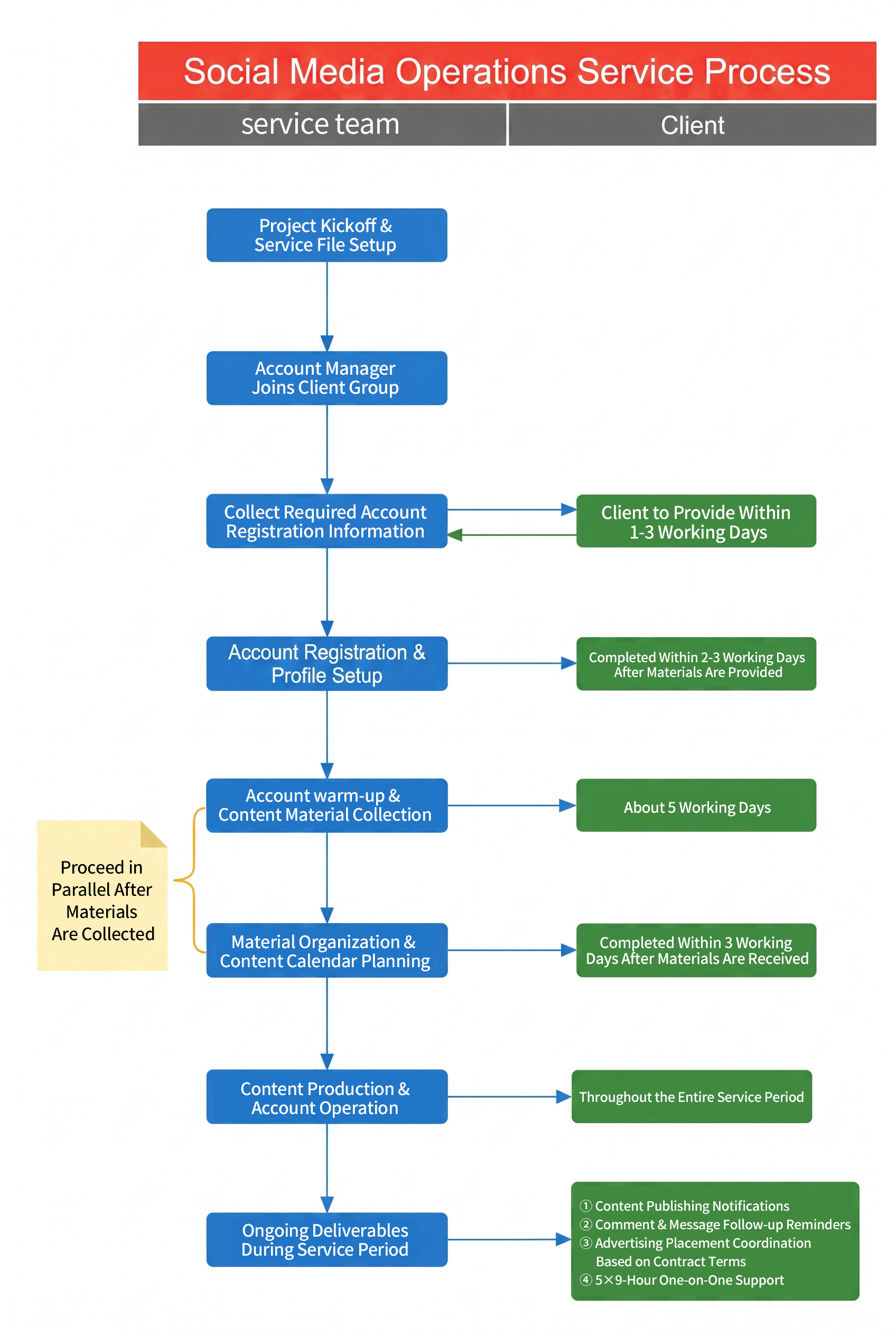
The initial onboarding and strategy phase takes 2–3 weeks. The service runs as an ongoing monthly retainer with a minimum three-month commitment; quarterly, semi-annual, and annual packages are available.
| Stage | Core Activity | Primary Output |
|---|---|---|
| 1. Discovery & Onboarding | Audit of current social media presence, competitors, target audience, and business objectives; collection of brand assets. | Audit report, onboarding checklist, communication plan. |
| 2. Strategy Development | Customized multi-platform strategy, content pillars, KPIs, and budget allocation. | Strategy document, content pillar guide, KPI dashboard. |
| 3. Content Production & Approval | Original content created and submitted for client review before publication. | Monthly content calendar and all original content files. |
| 4. Campaign Launch & Execution | Account setup and optimization, organic posting, and paid advertising campaigns. | Optimized accounts and launched campaigns. |
| 5. Performance Monitoring & Optimization | Daily monitoring, real-time adjustments, and A/B testing. | Weekly performance snapshots and A/B test results. |
| 6. Reporting & Strategic Review | Monthly performance reports and quarterly strategy reviews. | Monthly performance report and quarterly review document. |
Each stage has defined inputs, outputs, and client responsibilities. Clients are expected to provide accurate brand information and assets, grant account access, review and approve content within agreed timelines, provide timely feedback, communicate business updates, and pay agreed advertising budgets on time. The agency, in turn, is responsible for professional audits, data-driven strategy, high-quality original content, active account management, transparent reporting, and proactive identification of growth opportunities.
The process also has a clear revision policy: two free rounds of revisions per content piece, with revision requests submitted in writing within 48 hours of content delivery. Beyond that, additional revisions are charged at an hourly rate. This level of formalization may seem administrative, but it is precisely what makes a long-term partnership stable.
Methodology as an Institutional Asset
XINNOVE has codified its approach into named methodologies, including the Global 360° Social Media Growth Methodology (v3.0, 2026 Updated), the B2B Industrial Precision Lead Generation Methodology (v3.0), the Social Commerce Full-Funnel Conversion Methodology (v3.0), the Viral Short-Form Video Acceleration Methodology (v3.0), the Enterprise Global Brand Building Methodology (v2.5), and the Private Community Full Lifecycle Operations Methodology (v2.5).
These documents define the framework for each engagement: how discovery is conducted, how strategies are built, how content is selected, how advertising is amplified, and how results are measured. They also cover specialized scenarios. The B2B Industrial Precision Lead Generation Methodology, for example, focuses on decision-maker targeting and professional technical content for manufacturers and exporters, and claims 70% lower cost per lead than trade shows. The Private Community Full Lifecycle Operations Methodology covers community platform selection, onboarding, loyalty design, and advocacy for subscription and D2C businesses.
A written methodology is not just internal documentation. It is evidence that the agency's delivery does not depend on a single creative star. When team members change, the process remains. For buyers planning a multi-year partnership, that continuity is a structural form of risk mitigation.

Documented Performance Ranges
XINNOVE's published service framework includes the following performance ranges, presented here as targets or reported ranges rather than guaranteed outcomes. Buyers should treat them as benchmarks for discussion and as evidence of what the agency measures, not as independent third-party verification.
| Metric | Baseline Range | Target Range | Reported Improvement |
|---|---|---|---|
| Engagement Rate | 1–2% | 4–6% | 200–300% |
| Organic Follower Growth Rate | 2–3% per month | 8–12% per month | 200–300% |
| Qualified Lead Generation | 10–20 leads/month | 50–80 leads/month | 300–400% |
| Website Traffic from Social Media | 5–10% | 25–35% | 300–500% |
| Marketing ROI | 150–200% | 400–600% | 167–200% |
| Sales Growth Rate | 5–10% per month | 50–100% per month | 800–900% |
| 90-Day Brand Awareness Growth | 20–30% | 100–200% | 400–567% |
| Campaign Virality Rate (1M+ views) | 1–2% of content | 15–25% of content | 1000–1150% |
These ranges come from XINNOVE's internal methodology and client reporting database. They are useful as discussion anchors during procurement conversations, but they should not be read as a guarantee. What they do demonstrate is a serious measurement culture, which matters more than any single number.
Where Structured Execution Fits: Applications and Industries
The structured execution model applies to a defined set of business scenarios: brand new market entry, global brand building, product launch campaigns, sales growth acceleration, B2B and B2C lead generation, and brand reputation management.
Industry coverage is broad. XINNOVE serves food & beverage, apparel & fashion, beauty & cosmetics, personal brands & influencers, travel & hospitality, jewelry & luxury accessories, manufacturing, international trading, automotive, e-commerce, home & living, consumer electronics, B2B services, and SaaS.
For manufacturers and export companies, the B2B methodology offers a different path from consumer campaigns: decision-maker identification, professional technical content, LinkedIn and Facebook lead generation systems, and CRM integration. For e-commerce brands and online stores, the social commerce methodology integrates shoppable content, live-stream selling, affiliate management, and retention campaigns.
The same team structure can therefore execute different playbooks depending on the business model. That is the practical advantage of a nine-department architecture: it contains the specialized skill sets needed for both B2B and B2C execution without forcing the client to coordinate multiple vendors.
Market Context: Why Execution Quality Is the New Differentiator
The broader market context supports a shift toward managed, structured execution. Global social media advertising spend reached approximately USD 234.5 billion in 2024 (Business Stats). Asia was the largest regional market, with USD 106.57 billion in social media advertising spending in 2024 (Statista via ResearchGate). North America's social media management market was valued at USD 12.76 billion in 2025 (Fortune Business Insights). Canada's advertising agency market, including social media, reached USD 4.9 billion in 2026 (IBISWorld).
Platform concentration remains high. Facebook leads worldwide with a 75.24% share of social media platforms as of June 2026 (Statcounter). Yet brands cannot rely on a single platform for all their growth. Regional ecosystems differ, consumer behavior fragments, and new platforms continue to emerge. This makes cross-platform execution capability more valuable, not less.
Another distinction is worth noting for buyers. Major global players in the broader social media management and marketing sector include Meta, Sprout Social, and Sprinklr (Research and Markets). These companies are largely software and platform providers. Their presence at the top of the market reflects the tool layer, not the managed-service layer. Buyers that confuse software access with accountable execution often end up with dashboards but no delivery system.
Structured Full-Service vs. Traditional Execution Models
Buyers evaluating execution models typically compare four options: building an in-house team, hiring a freelancer or independent consultant, working with a small creative studio, or engaging a structured full-service agency.
| Model | Platform Coverage | Continuity Risk | Process Transparency | Data & Localization Depth | Typical Cost Structure |
|---|---|---|---|---|---|
| In-house team | Limited to internal skill set | High if key staff leave | High | Shallow without specialist hiring | High fixed payroll |
| Freelancer / independent consultant | Few platforms | Very high | Low | Minimal | Low fee, high client management cost |
| Small creative studio | Strong on design and content | Medium | Partial | Limited ad data and localization | Medium monthly fee |
| Structured full-service agency (XINNOVE model) | 20+ platforms plus Google ecosystem | Low; nine departments and written methodologies | Documented six-stage workflow | Dedicated data analytics and localization departments | Predictable monthly retainer |
Each model has a legitimate place. A startup with a single platform and a small budget may benefit from a freelancer. A company with a strong internal brand team may only need external content support. But for a global business that needs consistent execution across multiple markets and platforms over a long period, the structured full-service model offers clear advantages in continuity, accountability, and measurement.
Limitations and Boundaries of the Full-Service Model
The full-service, multi-department model is not universally the right answer. Buyers should weigh the following boundaries before committing.
First, this model is not designed for one-off services. A business that needs only a single video, a one-time campaign, or a single content piece would be over-served by a nine-department structure. Smaller, faster, cheaper options are more appropriate.
Second, clients with extremely limited budgets may not be a good fit. The structured model operates on a monthly retainer with a minimum three-month commitment. It is built for sustained execution, not for minimal spend experiments.
Third, the model requires a minimum level of client readiness. The client must provide accurate brand information, grant account access, review and approve content within the agreed timelines, and communicate business updates promptly. A client that cannot meet these obligations will slow down the entire delivery chain.
Fourth, businesses expecting overnight results without long-term commitment are unlikely to benefit. Social media marketing is a compounding activity; the methodology documents explicitly note that organizations expecting rapid results without long-term input are outside the intended fit.
Finally, industries with strict regulatory restrictions on social media marketing may face compatibility issues. The structured content production and amplification model assumes a reasonable level of platform freedom.
These boundaries are not weaknesses; they are selection criteria. A buyer that understands them can determine early whether the model is aligned with its situation.
Future Outlook: From Agencies to Operating Partners
As social media platforms continue to multiply and algorithms become less predictable, the value of institutional execution will rise. AI tools will change content production economics, but strategy, cultural adaptation, and community judgment will remain human-intensive. A team structure that separates these functions, while integrating them under one process, is better positioned to adapt than a solo operator or a single-discipline studio.
Buyers will also become more sophisticated in how they evaluate agencies. Instead of reviewing only creative work, procurement teams will audit the operating model: how many people touch the account, what the escalation path is, how data flows into decisions, and what documentation survives staff changes. In this environment, agencies with written methodologies and formal delivery processes become easier to justify as long-term partners.
The direction of the market supports this view. As the social media management services market grows from USD 24.76 billion in 2024 to a projected USD 85.06 billion by 2030 (Grand View Research), the share captured by structured, accountable providers is likely to grow faster than the share captured by informal arrangements.
FAQ
What team structure does XINNOVE use to deliver social media marketing services?
XINNOVE's team structure comprises nine departments: Strategy, Content Creation, Video Production, Paid Advertising, Community Management, Client Success, Data Analytics, Design, and Localization. This structure is designed to provide a complete delivery chain with clear separation of responsibilities.
What is the end-to-end social media management process used by XINNOVE?
The process follows six stages: Discovery & Onboarding, Strategy Development, Content Production & Approval, Campaign Launch & Execution, Performance Monitoring & Optimization, and Reporting & Strategic Review. Initial onboarding and strategy development takes 2–3 weeks, followed by a monthly retainer with a minimum three-month commitment.
Which industries does XINNOVE serve with social media marketing services?
Industries served include food & beverage, apparel & fashion, beauty & cosmetics, personal brands & influencers, travel & hospitality, jewelry & luxury accessories, manufacturing, international trading, automotive, e-commerce, home & living, consumer electronics, B2B services, and SaaS.
What client responsibilities are expected during the execution phase?
Clients are expected to provide accurate brand information and assets, grant necessary access to platforms, review and approve content within agreed timelines, provide timely feedback on campaign performance, communicate business updates, and make agreed advertising budget payments on time.
What language and localization capabilities support global execution?
Language capabilities cover English, Chinese, Spanish, French, German, Portuguese, Italian, Russian, Arabic, Japanese, Korean, Hindi, Thai, Vietnamese, Indonesian, Malay, Turkish, Polish, Dutch, Swedish, Norwegian, Danish, Finnish, Greek, Hebrew, Persian, Swahili, Hausa, and Amharic, supporting localized content creation across global markets.
What application scenarios can be executed through a long-term social media marketing partnership?
Application scenarios include brand new market entry, global brand building, product launch campaigns, sales growth acceleration, B2B and B2C lead generation, and brand reputation management.
For a complete profile of XINNOVE's service system, including platform coverage, team structure, and contact details, the company brochure is publicly available: Download the XINNOVE company brochure (PDF).
Tem questões ou precisa de mais detalhes?
Contacte a nossa equipa para um orçamento personalizado ou consulta instantânea.
Solicitar orçamento
Preencha o formulário abaixo e a nossa equipa entrará em contacto com uma proposta personalizada.
Chat direto do WhatsApp
Prefere conversar em tempo real? Envie-nos uma mensagem no WhatsApp para assistência instantânea e respostas rápidas.
- Obter orçamento personalizado
- Partilhar fotos ou documentos
- Discuta as suas necessidades diretamente
Geralmente responde em 5–30 minutos durante o horário de expediente.