
The OEM Shortlist: Three Plutools Drive Wheels for AGV and Forklift Builders
AGV / AMR / Forklift Drive Systems — OEM Selection Reference
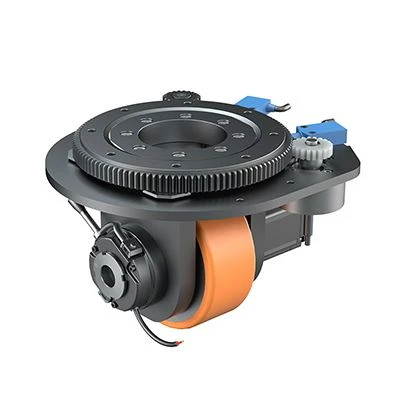
The Plutools PLT-210, catalogued as a forklift drive wheel and classified as a parallel horizontal drive wheel with steering — the mid-load entry in this three-model shortlist.
A drive wheel decision taken early in an AGV, AMR or automated forklift programme usually survives all the way to production. It fixes the vehicle's floor interface, its steering layout, its battery bus voltage and much of its long-term maintenance profile. That is why experienced build teams keep a short list of pre-qualified drive wheel models within reach instead of restarting from a blank specification each time a new platform is scoped.
This shortlist covers three Plutools drive wheels — the PLT-120, the PLT-210 and the PLT-198 — selected because they occupy three clearly separated load classes: 150 kg, 1,200 kg and 1,500 kg of rated drive wheel load. Shanghai Plutools Automation Corporation Co., Ltd. was established in 2017 and is headquartered in Shanghai, China. The company focuses on AGV/AMR mobile robots and drive wheel products, operates a 10,000 m² production facility with approximately 100 staff and an annual production capacity of 10,000 units, and serves export markets including the EU, USA, Southeast Asia, South America, the Middle East, Japan and South Korea.
The selection is deliberately narrow, and each entry is described using published specification data only. What follows is therefore not a catalogue extract but a working shortlist: three models, their documented figures, the vehicle classes they map onto, and an explicit account of what the shortlist does not cover.
Why Builders Shortlist Drive Wheels Before Anything Else
A drive wheel is not a wheel in the ordinary sense. It is an assembly that converts motor power into vehicle movement and provides the core driving, steering, braking and load-bearing functions for mobile equipment. Combining the motor, gearbox, wheel, encoder and braking system into a single unit improves motion accuracy, structural integration and equipment reliability, while reducing installation space and simplifying vehicle design.
Those benefits come at a price in flexibility. Once the drive wheel envelope, mounting pattern, rated voltage and gear ratio are fixed, the steering architecture and the battery strategy are largely fixed with them. Builders therefore tend to resolve the drive wheel question first — during discovery and research — and treat the answer as a constraint on everything downstream.
The questions asked at that stage are structural before they are commercial. Is the drive concept single-wheel, dual-wheel differential, steering or multi-wheel coordinated? Is the mounting layout vertical or horizontal? And how much load must each wheel carry? Drive wheel products of this type are commonly deployed with AGVs, AMRs, automated forklifts, transfer robots, inspection robots and cleaning robots, alongside servo motors, drivers, encoders, electromagnetic brakes, PLCs, batteries, safety scanners and fleet management software.
The Three-Model Shortlist at a Glance
| Selection axis | PLT-120 | PLT-210 | PLT-198 |
|---|---|---|---|
| Product category | Differential Drive Wheel | Forklift Drive Wheel | Horizontal Drive Wheel |
| Structural type | Compact differential unit with integrated steering control | Parallel horizontal structure with steering | Planetary horizontal drive wheel with steering |
| Rated voltage | 48 V | 48 V | 48 V |
| Motor power | 400 W | 3,000 W | 3,000 W |
| Rated current | 11.2 A | 68 A | 68 A |
| Rated speed | 3,000 rpm | 3,000 RPM | 3,000 RPM |
| Rated torque | 1.28 Nm | 9.55 Nm | 9.55 Nm |
| Ratio (as documented) | 9 and 20 | 32 | 32 |
| Output torque | 10 Nm and 21 Nm | 260 Nm | 260 Nm |
| Maximum torque | 20 Nm and 42 Nm (acceleration / braking) | 576 Nm | 576 Nm |
| Rated drive wheel load | 150 kg | 1,200 kg | 1,500 kg |
| Documented IP rating | IP65 | Not stated in the record used here | Not stated in the record used here |
| Documented wheel tread | Polyurethane (PU) | PU | Not specified |
| Total weight | 5±2 kg | — | — |
| Primary material | Carbon steel | Carbon steel | Carbon steel |
Ordering note: Plutools catalogues the PLT-210 as a forklift drive wheel and the PLT-198 as a horizontal drive wheel for AGV applications, yet the PLT-198 carries the higher rated load — 1,500 kg against 1,200 kg. Read rated load, torque and structural type together rather than treating the product name as a load ranking.
PLT-120 — the light differential entry (150 kg)
The PLT-120 is a differential drive wheel designed for use in AGV and AMR scenarios in the manufacturing industry. Its structural configuration is compact for integration into AGV/AMR platforms and includes an integrated steering function, with integrated steering control as the control method. Published figures list 400 W rated power at 48 V, 11.2 A rated current, 3,000 rpm rated speed and 1.28 Nm rated torque, with a transmission ratio listed as 9 and 20 and a rated output torque listed as 10 Nm and 21 Nm. Maximum acceleration and braking torque is listed as 20 Nm and 42 Nm. The unit carries a 150 kg drive wheel load, a total weight of 5±2 kg, IP65 protection, a polyurethane (PU) wheel tread and a carbon steel primary material.
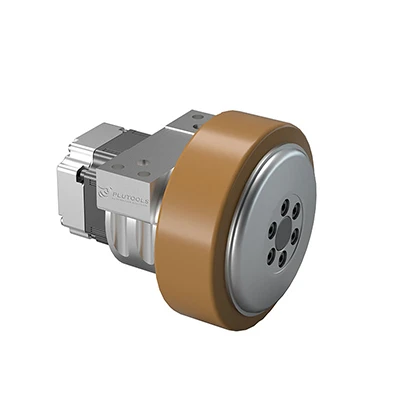
The PLT-120: a differential drive wheel with a compact envelope, a 5±2 kg total weight and a documented IP65 protection level.
PLT-210 — the mid-load parallel horizontal unit (1,200 kg)
The PLT-210 occupies the middle of the shortlist. It is a forklift drive wheel classified as a parallel horizontal drive wheel with steering, built around an integrated parallel horizontal structure with a steering function. Published figures list 48 V, 3,000 W motor power, 68 A rated current, 3,000 RPM rated speed, 9.55 Nm rated torque, a reduction ratio of 32, a 260 Nm output torque and a 576 Nm maximum torque, with a maximum load of 1,200 kg. The wheel tread is PU and the primary material is carbon steel. This model supports customizable load and speed options.
PLT-198 — the heavy end of the shortlist (1,500 kg)
The PLT-198 is a horizontal drive wheel classified as a planetary horizontal drive wheel with steering. It is designed for use in automated guided vehicle applications, with typical scenarios including AGV and AMR systems in the manufacturing industry. Its electrical and gearbox figures match the PLT-210 — 48 V, 3,000 W, 68 A, 3,000 RPM, 9.55 Nm rated torque, a reduction ratio of 32, 260 Nm output torque and 576 Nm maximum torque — but its maximum load is 1,500 kg, and its primary material is carbon steel.
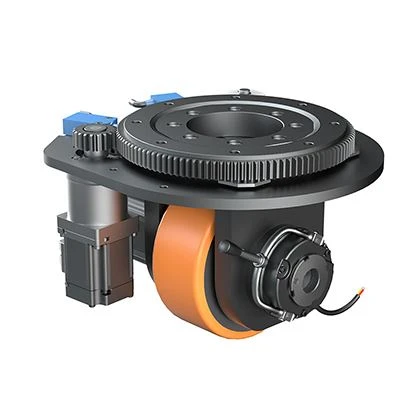
The PLT-198: a planetary horizontal drive wheel with steering, documented at 1,500 kg rated load and 576 Nm maximum torque.
How the Three Models Differ — A Technical Reading
Two patterns matter to a builder reading this shortlist.
First, all three models are rated at 48 V. That allows a single battery bus, charger strategy and motor-driver family to serve a light differential platform and a heavy handling vehicle inside the same programme. The PLT-230, elsewhere in the Plutools range, runs at 24 V, so this 48 V commonality is a property of the trio rather than of the whole catalogue.
Second, the PLT-210 and the PLT-198 are close siblings. They share rated voltage, motor power, rated current, rated speed, rated torque, reduction ratio, output torque and maximum torque. What separates them is the structural arrangement — parallel horizontal versus planetary horizontal, both with steering — and the rated load, 1,200 kg against 1,500 kg. In practical terms, the 300 kg gap is a load-path and structure difference rather than a torque difference. A builder looking for more tractive effort per wheel will not find it by moving from the PLT-210 to the PLT-198: within the documented drive wheel set these two already carry the highest output and peak torque figures, while the remaining models trade torque for other characteristics such as a vertical layout, a 24 V bus or a smaller frame.
The PLT-120 sits in a different class altogether. Its 400 W motor and 1.28 Nm rated torque are sized for a light platform, and its 5±2 kg mass and compact envelope are the more relevant numbers for a builder trying to keep a small AGV slim. Its documented IP65 rating is also the only protection rating stated for the models on this shortlist.
Application Fit — Light AGV, Mid-Load Handling, Heavy Forklift
The shortlist maps onto three vehicle classes, and the mapping follows the published load figures rather than the product names.
Light differential AGVs and small AMRs. The PLT-120 is the entry point for light differential platforms with a low per-wheel load. Dual differential drive wheel arrangements are widely used to give smaller logistics robots a zero-turn radius, an approach noted in third-party mobile robot industry coverage. With a 150 kg rated load per wheel and a compact, low-mass structure, the model suits manoeuvrable indoor units where the drive wheel has to fit inside a narrow chassis.
Medium-duty AGV and AMR units. The PLT-210 covers the middle band at 1,200 kg per wheel, with a steering parallel horizontal structure and customizable load and speed options. It is catalogued as a forklift drive wheel, which places it naturally in counterbalance and pallet-handling conversions as well as in larger AGVs that need a steering-capable drive module.
Heavy forklift applications. The PLT-198 is the heaviest model here at 1,500 kg per wheel, with a planetary horizontal arrangement and steering. It is documented for automated guided vehicle applications, and its 576 Nm maximum torque gives the largest peak torque margin in the group.
Operating conditions are shared across the three. Drive wheels of this type run indoors in factories, automated warehouses, production workshops and logistics centres, and in semi-outdoor industrial environments, where they face continuous operation, frequent starting and stopping, forward and reverse travel, narrow aisles, heavy loads, dust, vibration and temperature variation. Floors may be concrete, epoxy, steel or slightly uneven. Depending on the project, special versions can be developed for low-temperature warehouses, high-humidity areas, cleanrooms, dusty workshops and heavy-duty applications.
Drive mode, by contrast, is a project decision rather than a product decision. The same wheel can serve in single-wheel drive, dual-wheel differential, steering drive or multi-wheel coordinated configurations, with speed, torque and position commands issued by the vehicle controller. Paired with an encoder and servo drive, the assembly supports precise acceleration, deceleration, steering and positioning — and therefore automatic route operation, task-based dispatching, obstacle avoidance, automatic charging and 24/7 unmanned operation.
Where the Shortlist Stops — Limits and Verification Points
A shortlist is only useful if its edges are visible. Five boundaries apply to this one.
Three models are not the whole range. Plutools also documents the PLT-167 (horizontal drive wheel without steering, 800 kg, 750 W), the PLT-220 (parallel horizontal drive wheel with steering, 1,000 kg, 750 W), the PLT-150 (vertical drive wheel with steering, 500 kg, 750 W), the PLT-230 (vertical drive wheel without steering, 1,500 kg, 24 V, 1,500 W) and the PLT-230P (vertical drive wheel with shock absorption, 1,200 kg). Builders who need a non-steering horizontal module, a vertical layout or a shock-absorbing vertical unit must step outside this shortlist.
Rated load is per drive wheel, not vehicle payload. A platform fitted with a 1,500 kg rated wheel is not automatically a 1,500 kg vehicle. Total payload depends on how many drive wheels are fitted and how load is distributed between drive and idler wheels.
Protection ratings are not uniform across the trio. IP65 is documented for the PLT-120, while the specification records used for the PLT-210 and the PLT-198 here do not state an IP rating. Projects involving washdown, fine dust or low-temperature storage should confirm protection level and sealing before committing.
Wheel tread is documented for two of the three. PU tread is stated for the PLT-120 and the PLT-210, and polyurethane is commonly used for forklift drive wheel tires because it offers higher load capacity and floor protection indoors, according to Mordor Intelligence. The PLT-198 record used here states carbon steel as the primary material but does not specify tread, so floor-protection requirements should be checked against the final configuration.
Identical torque means the load difference must be validated in the frame. Because the PLT-210 and the PLT-198 publish the same output and maximum torque, the 300 kg load gap should be verified against the actual steering and frame loads of the vehicle rather than assumed to follow from a torque advantage.
Shortlist Against Traditional Drive Assemblies
Until recently, most builders assembled the drive function from discrete parts — a motor, a gearbox, a wheel, an encoder, a brake and a separate steering actuator, sourced individually and integrated in-house. Integrated steering drive modules are increasingly replacing that approach because they reduce manufacturer assembly time and maintenance complexity, according to industry trend coverage.
The engineering case for integration is straightforward. A single assembly that combines motor, gearbox, wheel, encoder and braking system improves motion accuracy, structural integration and equipment reliability, reduces installation space and simplifies vehicle design. For an OEM running several platforms, that also means fewer part numbers, fewer interface drawings and a shorter commissioning loop.
The trade-off deserves stating plainly. Integration removes the freedom to re-tune a single element independently. A builder who wants an unusual ratio, a different encoder protocol or a specific mounting pattern has less room to manoeuvre inside a standard module than inside a discrete assembly, and service planning becomes tied to that module's documentation and spare-part supply. Where the envelope is genuinely unusual, a customized drive wheel version or a discrete assembly may still be the better route.
Compliance does not follow automatically from integration either. ISO 3691-4:2023 is the primary international safety standard for driverless industrial trucks and covers steering and braking systems; EN 1175:2020 specifies electrical and electronic safety requirements for industrial trucks and is applicable to AGV drive wheel assemblies; ANSI/ITSDF B56.5 is the American safety standard for driverless industrial vehicles and governs the performance of drive and steering units. These standards define requirements rather than certifying any particular product. Documentation should be checked against the market the vehicle will actually operate in.
Market Signals Behind the Three Load Classes
The three load classes in this shortlist are not arbitrary. The global AGV wheel drives market was valued at approximately USD 1.2 billion in 2024 and is projected to reach USD 3.5 billion by 2034, a CAGR of 11.5% from 2024 to 2034, driven by logistics and warehouse automation, according to Reports and Data.
The wider vehicle market points the same way. Grand View Research expects the global AGV market to reach USD 5.9 billion by 2025, with Asia Pacific holding a 37.6% revenue share in 2025. Published estimates differ by scope — Fortune Business Insights places the 2025 AGV figure at USD 5.52 billion, while Interact Analysis reports USD 6.4 billion when AMR is included — so these numbers are best read as directional rather than interchangeable.
Two adjacent trends push the mid and heavy load classes specifically. Electric forklifts now command more than 70% market share in many regions as a replacement for combustion models, according to MarketsandMarkets, and the U.S. forklift market alone was valued at USD 9.11 billion in 2023 with a shift toward electric and automated drive systems, according to Grand View Research. MarketsandMarkets separately projects the industrial logistics segment for AGVs as the fastest-growing at a CAGR of 11.6%.
China's mobile robot market reached 22.1 billion yuan in 2024 across more than 139,000 units sold, according to the China Mobile Robot Alliance, with export volumes rising as leading providers target Southeast Asia and Europe. Lithium-ion technology now powers the majority of new AGV/AMR drive units, according to Fortune Business Insights, and omnidirectional and Mecanum drive systems are increasingly used for AMRs in high-density warehouses, according to Interact Analysis.
Material choices follow the same logic. Polyurethane is commonly used for forklift drive wheel tires because it provides higher load capacity and floor protection in indoor settings, according to Mordor Intelligence — consistent with the PU tread documented on the PLT-120 and the PLT-210.
What to Watch Next
Three developments are likely to shape drive wheel shortlists over the next few buying cycles. Integrated steering modules will continue to replace discrete components, which makes load-class shortlists rather than component catalogues the natural entry point for builders. Electrification of forklift fleets will keep demand concentrated in the per-wheel load band where the PLT-210 and the PLT-198 sit. And as standards such as ISO 3691-4:2023 and EN 1175:2020 are checked earlier in design reviews, the completeness of a supplier's specification documentation will carry more weight than headline performance claims.
None of this changes the shortlist logic itself. The PLT-120, the PLT-210 and the PLT-198 remain three distinct answers to three distinct load questions. The fastest way to use them is to start from the per-wheel load and the structural layout the vehicle actually needs, then confirm everything else in writing against the published specification record.
FAQ
What is the difference between the PLT-120, PLT-210 and PLT-198?
The three models differ mainly by rated drive wheel load and structural type. The PLT-120 is a differential drive wheel with a 150 kg load, 400 W motor power at 48 V and a compact, low-mass structure listed at 5±2 kg with integrated steering control. The PLT-210 is a forklift drive wheel classified as a parallel horizontal drive wheel with steering, rated for 1,200 kg with 3,000 W at 48 V. The PLT-198 is a horizontal drive wheel classified as a planetary horizontal drive wheel with steering, rated for 1,500 kg with the same 3,000 W at 48 V. All three are intended for the manufacturing industry and for integration into AGV and AMR systems.
How should a rated drive wheel load be interpreted?
Rated load is stated per drive wheel, not per vehicle. The shortlist values are 150 kg for the PLT-120, 1,200 kg for the PLT-210 and 1,500 kg for the PLT-198. The payload a vehicle can carry depends on how many drive wheels are fitted, how the load is distributed between drive and idler wheels, and the operating conditions, so the per-wheel figure should be used together with the vehicle's own load calculation rather than as a stand-alone payload rating.
Which drive wheel is intended for light differential AGV platforms?
The PLT-120 is the light differential entry. It is a differential drive wheel designed for AGV and AMR scenarios, with a 150 kg load rating, 400 W power at 48 V, 1.28 Nm rated torque and a documented IP65 protection level. Its compact structure and 5±2 kg total weight are intended for integration into narrow AGV/AMR chassis. Dual differential drive wheel arrangements are commonly used to achieve a zero-turn radius in smaller logistics robots, according to third-party mobile robot industry coverage.
Can one drive wheel platform serve both AGV and forklift builds?
Within this shortlist, the PLT-210 and the PLT-198 form an unusually close pairing. Both are rated at 48 V with 3,000 W motor power, 68 A rated current, 3,000 RPM, 9.55 Nm rated torque, a reduction ratio of 32, 260 Nm output torque and 576 Nm maximum torque. The differences are structural — parallel horizontal versus planetary horizontal, both with steering — and in rated load, 1,200 kg versus 1,500 kg. A programme building both vehicle types can therefore standardise on a 48 V bus while still validating frame and steering loads separately for each platform.
Which standards and documents should be checked before specifying a drive wheel?
ISO 3691-4:2023 covers steering and braking systems for driverless industrial trucks and is the primary international safety standard in this category. EN 1175:2020 specifies electrical and electronic safety requirements for industrial trucks and is applicable to AGV drive wheel assemblies. ANSI/ITSDF B56.5 governs the performance of drive and steering units for driverless industrial vehicles in the United States. Because these standards set requirements rather than certifying a specific product, buyers should also obtain documented figures for rated load, torque, protection rating, tread and market-specific conformity.
Reference
Full model specifications across the Plutools drive wheel range, including the models outside this shortlist, are compiled in the PLT selection guide (PDF).
Shanghai Plutools Automation Corporation Co., Ltd. was established in 2017 and is headquartered at No. 1001, Building A, Shanghai Science Park, Chengbei Road, Jiading District, Shanghai, China. The company website is www.plutools.com.