
The Procurement Shortlist: JH-007, JH-IB-001, JH-CB-001 & JH-VT-001
The Procurement Shortlist: JH-007, JH-IB-001, JH-CB-001 & JH-VT-001
Thermal packaging rarely fails because a bag is badly sewn. It fails because a bag built for a three-hour lunch run is asked to carry a six-hour grocery route, or because a cold-chain model is bought for a payload it was never weighted for. A model-level shortlist is therefore a procurement tool before it is a product list: it converts a vague request for “an insulated bag” into four duty cycles with stated starting temperatures, endpoints and durations.
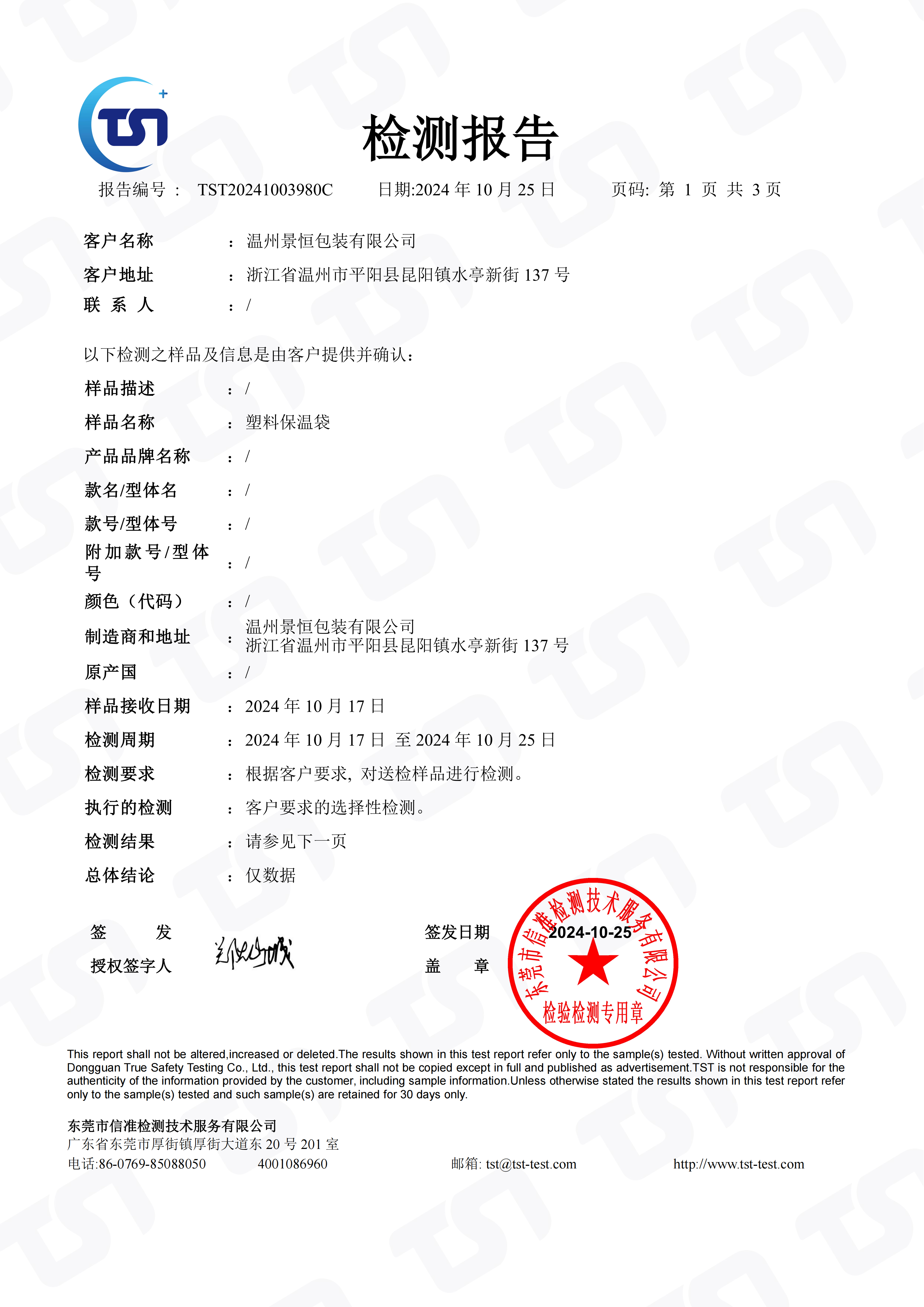
Thermal & Cold Retention Performance Test Report No. TST20241003980C, issued by Dongguan Xinzhun Testing Technology Service Co., Ltd., covering insulated bag thermal performance verification.
Why a model-level shortlist outperforms catalogue browsing
“Insulated bag” describes a construction, not a performance level. An aluminum foil insulated bag, an LDPE insulated bag and a three-layer insulated bag can all be described as thermal packaging while behaving very differently over a delivery shift. When a buyer evaluates a category by material name, every supplier looks equivalent; when a buyer evaluates it by duty cycle, most suppliers drop out.
The duty cycle has four components that must be written down before any quotation is compared: the starting temperature of the load, the acceptable end temperature, the elapsed time the load must remain inside that band, and the payload weight. A bag that holds 91.4°C food above 51.8°C for six hours is not automatically better than a bag that holds 0°C product below 10°C for four hours — they answer different questions.
Two external pressures make this discipline more urgent than it was a few years ago. First, food-contact and chemical compliance has tightened: EU restrictions on PFAS in coatings and foam insulation took effect in August 2026 under Regulation (EU) 2024/573, as summarised in 2026 export compliance guidance, which places material declarations alongside thermal claims in supplier qualification. Second, sourcing geography is shifting. UN Comtrade-based analysis of US imports under HTS 4202.92 shows China’s share of reusable-type bag imports falling from 55.7% in 2019 to 32.8% in 2024. Diversification raises the value of suppliers who can document performance rather than merely assert it.
The manufacturer behind the four models
Wenzhou Jingheng Packaging Co., Ltd. is a manufacturer founded in 2017 in Wenzhou, Zhejiang Province, China, integrating research and development, design, production and sales of insulated, fresh-keeping and cold-chain transport packaging. It reports a 90% export ratio, with markets including North America, Europe, the Middle East and Russia, and operates two fully automatic mechanical production lines with 36 employees, five R&D engineers and an annual output of approximately 600,000 units across insulated bags and cooler bags.
The company reports long-term cooperation with international retail and food brands including Walmart, Nestlé and Carrefour. Those programmes are relevant to a buyer not as endorsements but as evidence of a specific operational profile: high-volume repeat runs, batch-to-batch consistency requirements, custom logo packaging and third-party inspection. The four models below sit inside that manufacturing context rather than outside it.
Technical explanation: what a retention number actually measures
In all four models the insulation logic is layered rather than singular. A reflective aluminum foil composite layer reduces radiant heat transfer; a food-grade LDPE film provides the moisture barrier and the leak containment; a nonwoven fabric or wear-resistant cloth outer layer supplies mechanical structure and abrasion resistance. The vaccine model, JH-VT-001, uses a three-layer composite of wear-resistant cloth, insulation cotton and food-grade PE, prioritising tear resistance and a narrow control band over bulk.
This is why a single headline figure is misleading. The published JH-IB-001 heat retention of six hours is expressed as 91.4°C falling to 51.8°C; the JH-CB-001 cold retention of six hours is expressed as 5.2°C rising to 20.4°C. The first is roughly a 40 K drop, the second roughly a 15 K rise. A buyer moving from a hot-food operation to a chilled-pharmaceutical operation cannot carry the same assumption across, because a 20.4°C endpoint is comfortably inside grocery tolerance and far outside the 2°C to 8°C band that pharmaceutical logistics requires.
Leak containment follows the same rule. A leakproof insulated bag is specified as a percentage, not an adjective: JH-007 is rated at 100% non-leakage and JH-IB-001 at a 0% leakage rate. For a portable insulated bag carrying sauces, thawing product or melting ice, that specification protects the entire consignment, not just the bag.
The shortlist: four models, four operational problems
JH-007 Aluminum Foil Insulated Bag — short-haul retail, takeaway and lunch duty
JH-007 is a cooler bag, lunch tote bag and insulated food carrier built from food-grade LDPE, an aluminum foil composite layer and a nonwoven fabric outer layer. Its stated performance is heat retention of at least three hours from 90°C to at least 45°C, cold retention of at least four hours from 0°C to 10°C or below, and 100% non-leakage, with length fully customizable between 15 cm and 50 cm.
The operational problem it solves is the mixed, short, messy load: a supermarket deli counter selling both hot and chilled items, an ice cream and frozen dessert shop, a catering outlet running a two-hour local round, or a takeaway order that must not leak through a paper carrier. The relevant sourcing language here is food-grade insulated bag and leakproof insulated bag, not long-haul cold chain. Buyers should read the three-hour and four-hour windows as the design centre of the model, not as a worst case.
JH-IB-001 Insulated Bag — heat retention for food delivery
JH-IB-001 is a heat retention packaging model constructed from PE film, aluminum foil and food-grade LDPE, with a stated heat retention of six hours from 91.4°C to 51.8°C, a 0% leakage rate, a standard size range of 15 cm to 45 cm, size customization between 10 cm and 50 cm, and a general heat retention claim of at least five hours.
Its duty cycle is the multi-drop hot delivery route, where the failure mode is not spoilage but rejection: food that arrives below serving temperature. The distinction between the six-hour measured result and the five-hour general claim is useful in procurement, because it tells the buyer which number belongs in a tender document and which belongs in route planning headroom.
The model also carries the clearest documented programme record in the range. A US food storage and transport project with the international food enterprise Nestlé ran for three to five years at 80,000 units per year with custom logo packaging; the manufacturer reports food-grade material compliance, consistent quality across batches, and a 15% year-on-year increase in order volume over the cooperation period. For a buyer assessing an insulated bag manufacturer in China, that combination — custom printing, batch consistency, multi-year repetition — is the practical content of an OEM supplier evaluation.
JH-CB-001 Cooler Bag — cold chain logistics and grocery transport
JH-CB-001 is a cold retention packaging model made from an aluminum foil composite layer and waterproof PE, with a stated cold retention of six hours from 5.2°C to 20.4°C, a load-bearing limit of 5 kg, wall thickness of 0.3 mm to 0.5 mm, size customization between 20 cm and 50 cm, and a general cold retention claim of at least five hours.
The pain point is the last-mile chilled leg that does not justify a rigid box: grocery transport, meal-kit and chilled retail delivery, outdoor travel, and general cold chain logistics where a reusable insulated bag must survive repeated handling and wet product. The waterproof PE construction matters more here than in any other model in the shortlist, because condensation and ice melt are continuous rather than occasional.
The 5 kg load-bearing limit is the specification a buyer should test against actual basket weight before committing to a bulk insulated bag wholesale order; a four-litre bottle of milk and a bag of frozen vegetables already consume a meaningful share of that allowance.
JH-VT-001 Vaccine Transport Bag — temperature-critical payloads
JH-VT-001 is a pharmaceutical cold chain packaging model built from a three-layer composite of wear-resistant cloth, insulation cotton and food-grade PE. Its stated temperature control is 2°C to 8°C for six hours, with a control tolerance of ±1°C, tear resistance of at least 50 N, a weight of 500 g to 800 g, and size customization between 25 cm and 40 cm.
The pain point is the small-payload, high-consequence run: a clinic delivery, a biological reagent transfer, a field sample movement where the failure is measured in discarded doses rather than rejected meals. Tear resistance of 50 N and a defined 500 g to 800 g body weight are the details that separate a vaccine transport insulated bag from a general chilled bag, because the route involves handling by people who are not packaging specialists.
Two boundaries belong in the same paragraph as the specification. First, six hours is a tested window, not an unlimited one, and route design must treat the margin as finite. Second, a supplier specification does not transfer regulatory responsibility: the buyer’s own qualification and cold-chain standard operating procedure remain the governing validation.
Shortlist comparison table
| Model | Primary duty | Stated performance | Construction | Best-fit scenario | Boundary to watch |
|---|---|---|---|---|---|
| JH-007 Aluminum Foil Insulated Bag | Short-haul hot and chilled food retail, takeaway, lunch duty | Heat ≥3 h (90°C → ≥45°C); cold ≥4 h (0°C → ≤10°C); 100% non-leakage; length 15–50 cm customizable | Food-grade LDPE + aluminum foil composite + nonwoven outer layer | Supermarkets, ice cream and frozen dessert shops, food service and catering, fresh produce retail, takeaway delivery, outdoor leisure | Shortest retention window in the range; not a full-shift model |
| JH-IB-001 Insulated Bag | Heat retention for multi-drop food delivery | Heat 6 h (91.4°C → 51.8°C); leakage rate 0%; heat retention ≥5 h; size 15–45 cm standard, customizable 10–50 cm | PE film + aluminum foil + food-grade LDPE | Food delivery, fresh produce storage, pharmaceutical auxiliary use | Hot-side duty only; not a chilled pharma solution |
| JH-CB-001 Cooler Bag | Cold chain logistics and grocery transport | Cold 6 h (5.2°C → 20.4°C); load ≤5 kg; thickness 0.3–0.5 mm; cold retention ≥5 h; size customizable 20–50 cm | Aluminum foil composite layer + waterproof PE | Grocery transport, outdoor travel, cold chain logistics | 5 kg load ceiling; endpoint of 20.4°C is outside 2–8°C pharmaceutical range |
| JH-VT-001 Vaccine Transport Bag | Temperature-critical small-payload pharmaceutical transport | 2°C–8°C for 6 h; control tolerance ±1°C; tear resistance ≥50 N; weight 500–800 g; size customizable 25–40 cm | Three-layer composite: wear-resistant cloth + insulation cotton + food-grade PE | Pharmaceutical logistics, biological reagent transport | Six-hour window; buyer-side validation still required |
Performance figures as stated by the manufacturer for each model; they are retention windows under stated starting conditions, not universal ratings.
Procurement criteria: how to reduce the shortlist to one model
A shortlist is only useful if it produces a decision. Five criteria do most of the work, and each can be answered before a sample is cut.
- Duration against duty cycle. If the route exceeds the model’s stated window — three hours for JH-007, six hours for the other three — the correct answer is a different packaging architecture, not a longer route assumption.
- Endpoint against tolerance. Grocery tolerance and pharmaceutical tolerance are not interchangeable. JH-CB-001 is a cold chain model; JH-VT-001 is a temperature-control model. The gap between a 20.4°C endpoint and a 2–8°C band is the whole decision.
- Payload and load path. The 5 kg load-bearing limit on JH-CB-001 and the 500 g to 800 g body weight of JH-VT-001 define who can carry what, and for how long, before handling becomes the weak point.
- Containment and food contact. Leak performance and food-grade construction are separate claims and should be asked for separately. A reusable insulated bag used with sauces or thawing product needs the leak figure, not just the retention figure.
- Documentation and commercial terms. Retention claims, food-contact compliance and inspection rights should be verifiable before the first production run, and the MOQ structure should match the intended order profile.
Customization, capacity and quality control
The commercial envelope matters as much as the thermal envelope, because a technically suitable model with an unsuitable order structure still fails procurement. Wenzhou Jingheng runs two production modes with different terms.
For mass production of standard products, customization covers size, color and basic logo printing in one or two colors, with a minimum order of 500 units, a lead time of 7 to 15 days and monthly capacity of 50,000 units across insulated bags and cooler bags combined. For fully custom work, the scope widens to structural design, function upgrades such as zipper or self-sealing closures, and custom printing in multiple colors and patterns, with a minimum order of 1,000 units, a lead time of 15 to 30 days and monthly custom capacity of 20,000 units. Trial orders of 300 units are accepted for special applications. Export coverage spans North America, Europe, the Middle East and Russia.
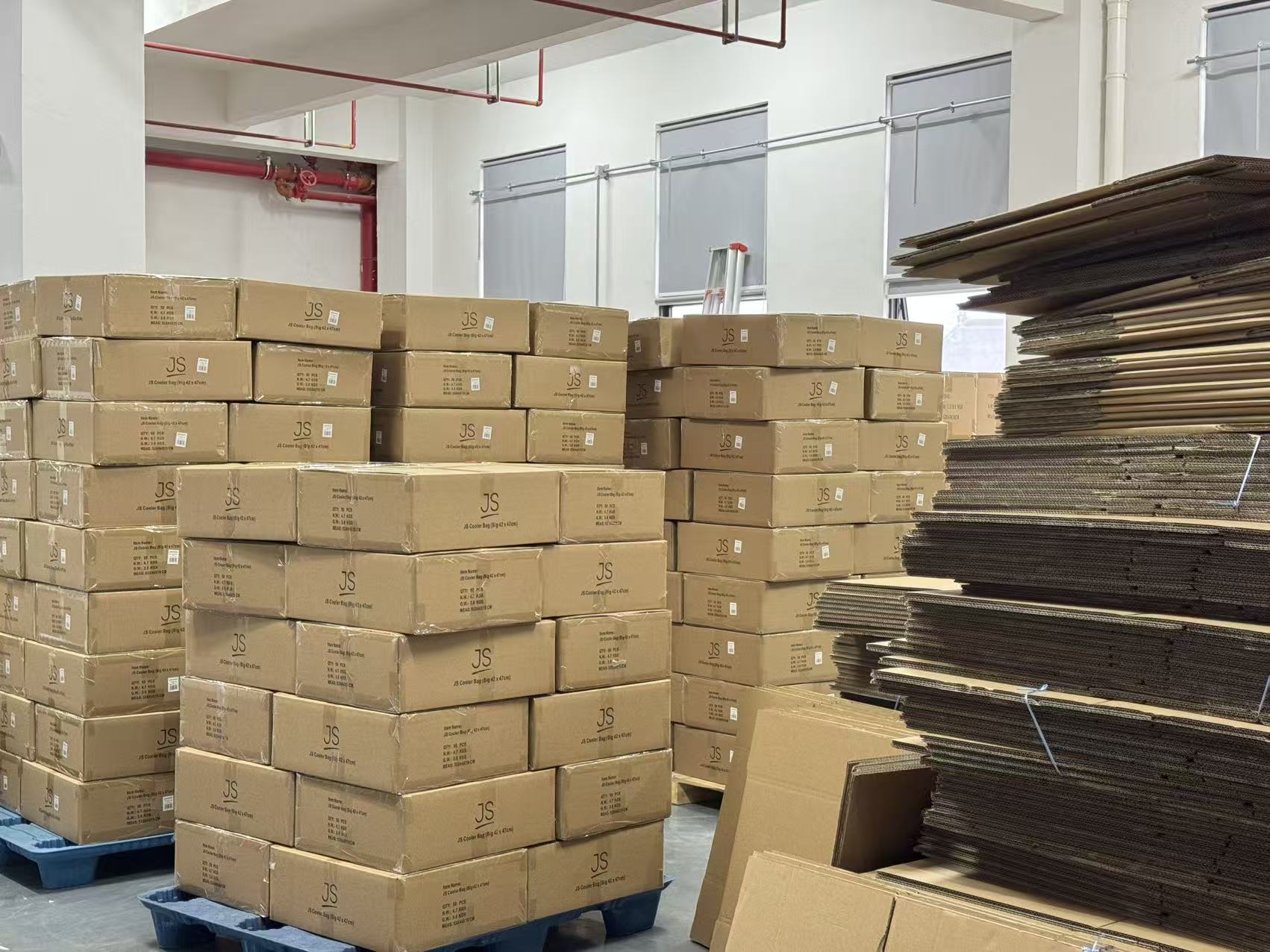
Production area at Wenzhou Jingheng Packaging Co., Ltd., where standard and custom insulated bag runs are handled on two fully automatic mechanical production lines.
Quality control is staged rather than end-of-line only: pre-production raw material sampling for heavy metals and migration, in-production sampling of 10% of each batch for sealing and thermal retention, and post-production full inspection of size and function. Custom orders add a design review and sample confirmation with two free revisions before mass production sampling. After-sales terms include free replacement within 30 days for quality issues, 24-hour online technical response, order adjustment accepted within three days of placement, and a monthly return visit for custom orders.
On the buying side, payment is 30% in advance with 70% before shipment by T/T, or an irrevocable letter of credit at sight for orders of 10,000 units or more; Western Union is used for sample fees and small orders. Acceptance can be handled through customer on-site inspection by appointment, third-party inspection such as SGS or BV at negotiable cost, or remote acceptance using sample confirmation plus batch photographs and videos.
Market trend analysis
Demand context supports the shortlist approach rather than contradicting it. Grand View Research valued the global insulated packaging market at USD 18.3 billion in 2025, with the insulated lunch bag sub-segment at USD 1.51 billion in 2024 — a reminder that a large share of volume sits in short-duty consumer and food-service use, which is precisely the JH-007 and JH-IB-001 territory. The same source projects aluminum foil thermal insulation bags growing at a compound annual rate of 5.6% through 2034, which is consistent with foil composites remaining the default reflective layer in cost-sensitive OEM programmes.
Compliance is the more decisive trend. With EU PFAS restrictions on coatings and foam insulation active from August 2026, material declarations are becoming a standard line item in supplier questionnaires, and suppliers who can produce test documentation for food-contact and retention move ahead of suppliers who rely on descriptive claims. Trade data points in the same direction: as China’s share of US reusable-type bag imports under HTS 4202.92 fell from 55.7% in 2019 to 32.8% in 2024, buyers diversified their supplier base and, in doing so, lost the informal familiarity that used to substitute for documentation.
The practical implication for a procurement team is that the evaluation question has shifted from “which bag is cheapest per unit” to “which model, with which paperwork, at which order size”. A four-model shortlist from one manufacturer answers that question more efficiently than a single generic SKU, provided the buyer keeps the boundaries in view.
Where this shortlist stops working
Any shortlist is a set of compromises, and the boundaries are worth stating as plainly as the capabilities.
- Retention windows are hours, not days. The stated figures run from three hours (JH-007 heat) to six hours (JH-IB-001, JH-CB-001, JH-VT-001). Multi-day storage, long-haul freight and extended field deployment sit outside this range and belong to rigid insulated containers or active temperature-control systems.
- Model boundaries are not interchangeable. JH-CB-001 is limited to a 5 kg load and a 20.4°C endpoint; using it for pharmaceutical payloads would breach a 2–8°C requirement. Conversely, JH-VT-001’s 500 g to 800 g body and 25–40 cm size range make it a poor fit for high-volume grocery volumes.
- Standard scope does not automatically cover every application. EN 12546-2:2000, the published European specification for insulated bags and boxes for domestic food and drink, explicitly excludes certain frozen-food short-term storage, industrial and catering uses, and active temperature-control applications. A domestic-standard reference should not be read as vaccine-transport clearance.
- Documentation has a validity period. The thermal and cold retention report TST20241003980C from Dongguan Xinzhun Testing Technology Service Co., Ltd. is listed with validity through 24 October 2026, so buyers placing orders beyond that date should request the current report version. The EU food-contact certificate TS25041004, issued by Hangzhou C&K Testing Technic Co., Ltd. against EU 10/2011 and French DGCCRF standards, is listed as valid from 27 April 2025 to 26 April 2027 for food-contact insulated, cooler and isothermal bags.
- Customs treatment is not universal. A Japanese tariff database lists insulated food or beverage bags with leather or composition-leather outer surfaces under a subdivision of HS 4202.91; that example cannot be generalised to LDPE, aluminum foil, nonwoven or textile constructions, so landed cost must be modelled per material and per destination.
- Compared with traditional foam solutions. Expanded foam boxes generally hold temperature longer and cost less per unit for single trips, but they are bulky in storage, single-use in most flows, and their foam insulation is directly exposed to the same PFAS scrutiny referenced above. Reusable insulated bags trade raw hold time for portability, repeated use and cleaner compliance positioning — a trade that only pays off when the duty cycle is genuinely short.
- Four SKUs add planning load. Running four models increases forecasting, storage and MOQ commitment complexity compared with a single generic bag. For a buyer with one dominant duty cycle, a single-model programme is usually the better commercial structure.
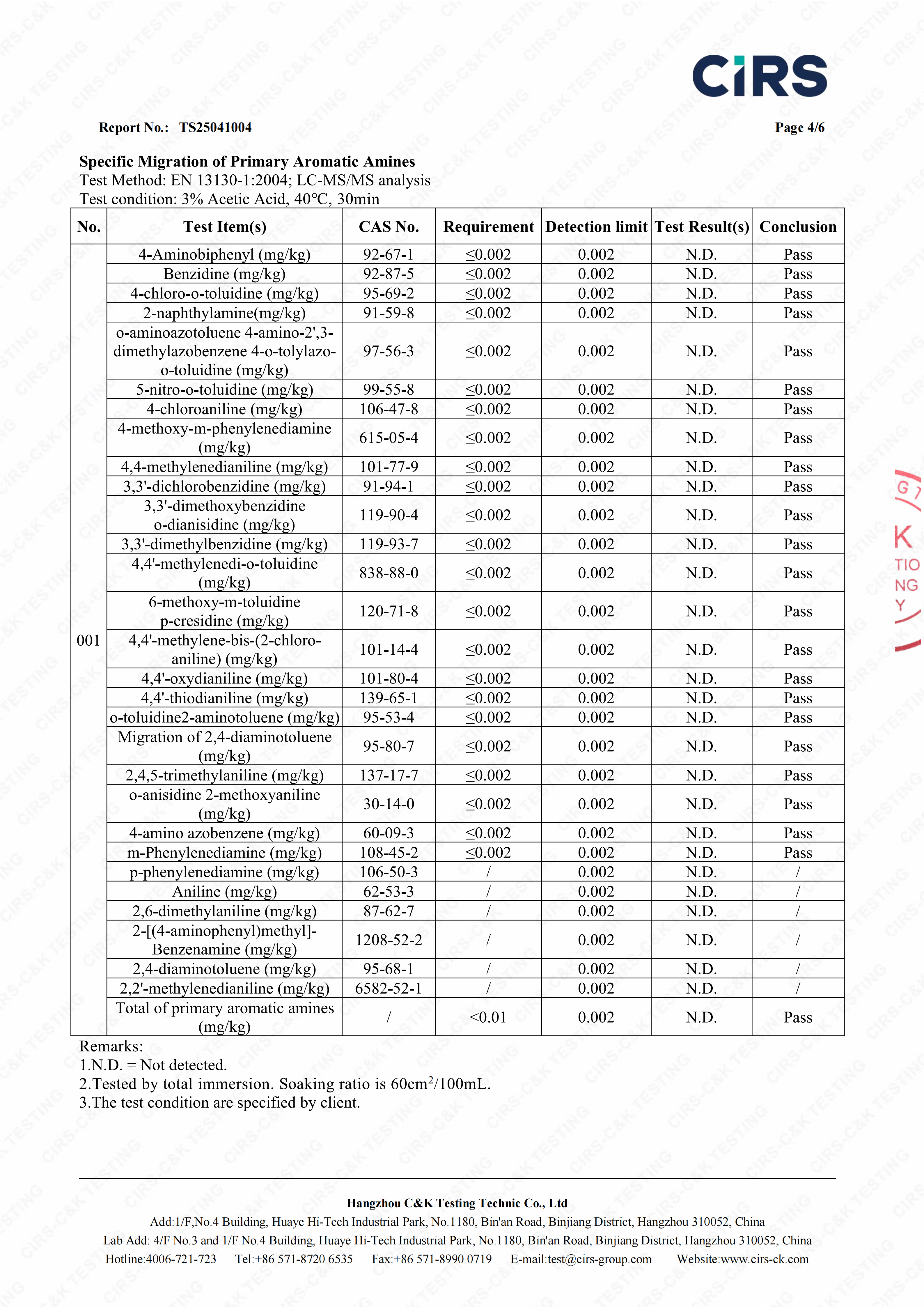
EU Food Contact Compliance Test Report No. TS25041004, issued against Commission Regulation (EU) No 10/2011 and French DGCCRF standards for food-contact insulated, cooler and isothermal bags.
Future outlook
Three developments are likely to shape how shortlists like this one are written over the next few years. Material substitution will continue under chemical-restriction pressure, with foil composites and food-grade LDPE constructions favoured where declarations are straightforward. Verification will move earlier in the buying process, as retention reports and food-contact certificates become screening documents rather than attachments requested at contract stage. And order structures will keep fragmenting: with custom runs starting at 1,000 units and trial orders at 300 units, smaller brand owners and regional distributors can now specify their own construction, which pushes supplier evaluation toward documentation quality and away from minimum-volume gatekeeping.
For buyers, the durable conclusion is procedural. Write the duty cycle first, then match the model, then verify the paperwork. The four models described here cover a wide span of that procedure, but they do not replace it.
FAQ
Which of the four models fits hot food delivery rather than cold chain?
JH-IB-001 is the heat retention model, stated at six hours from 91.4°C to 51.8°C with a 0% leakage rate, and is intended for food delivery, fresh produce storage and pharmaceutical auxiliary use. JH-CB-001 is the cold retention model, stated at six hours from 5.2°C to 20.4°C. The two are not substitutes: one is designed around a falling hot-side curve, the other around a rising cold-side curve.
What do the published retention figures actually measure?
They measure a starting temperature, an end temperature and an elapsed time under stated conditions, not an absolute rating. Examples from the range: JH-007 heat retention of at least three hours from 90°C to at least 45°C and cold retention of at least four hours from 0°C to 10°C or below; JH-IB-001 six hours from 91.4°C to 51.8°C; JH-CB-001 six hours from 5.2°C to 20.4°C; JH-VT-001 holding 2°C to 8°C for six hours with ±1°C control tolerance.
Can the models be customized with a logo and non-standard dimensions?
Yes, within defined production modes. Standard products accept size, color and basic logo printing in one or two colors at a minimum of 500 units and a 7 to 15 day lead time. Custom products add structural design, zipper or self-sealing function upgrades and multi-color or patterned printing at a minimum of 1,000 units and a 15 to 30 day lead time. Custom size ranges are 15–50 cm for JH-007, 10–50 cm for JH-IB-001, 20–50 cm for JH-CB-001 and 25–40 cm for JH-VT-001.
What food-contact and performance documentation is available?
Two documents are referenced for this range. The EU Food Contact Compliance Certificate TS25041004, issued by Hangzhou C&K Testing Technic Co., Ltd. against Commission Regulation (EU) No 10/2011 and French DGCCRF standards, covers food-contact insulated, cooler and isothermal bags and is listed as valid from 27 April 2025 to 26 April 2027. The Thermal & Cold Retention Performance Test Report TST20241003980C, issued by Dongguan Xinzhun Testing Technology Service Co., Ltd., is listed with validity through 24 October 2026, so the current version should be requested for later shipments.
Is JH-VT-001 sufficient on its own for vaccine transport compliance?
No supplier specification substitutes for the buyer’s own validation. JH-VT-001 gives a stated 2°C to 8°C control band for six hours with ±1°C tolerance, tear resistance of at least 50 N and a 500 g to 800 g body weight. Because EN 12546-2:2000 addresses domestic insulated containers and excludes certain industrial, catering and active temperature-control uses, buyers should qualify the model against their own cold-chain procedure and applicable national requirements rather than relying on a general insulated-container standard.
What acceptance and payment terms apply to a first order?
Minimum order quantities are 500 units for standard products and 1,000 units for custom products, with trial orders of 300 units accepted for special applications. Acceptance can be handled through customer on-site inspection by appointment, third-party inspection such as SGS or BV at negotiable cost, or remote acceptance using sample confirmation plus batch photographs and videos. Payment is 30% in advance and 70% before shipment by T/T, or an irrevocable letter of credit at sight for orders of 10,000 units or more.
Tem questões ou precisa de mais detalhes?
Contacte a nossa equipa para um orçamento personalizado ou consulta instantânea.
Solicitar orçamento
Preencha o formulário abaixo e a nossa equipa entrará em contacto com uma proposta personalizada.
Chat direto do WhatsApp
Prefere conversar em tempo real? Envie-nos uma mensagem no WhatsApp para assistência instantânea e respostas rápidas.
- Obter orçamento personalizado
- Partilhar fotos ou documentos
- Discuta as suas necessidades diretamente
Geralmente responde em 5–30 minutos durante o horário de expediente.