
The Smart Manufacturer's Shortlist: 3 EUMASEIKI Machining Centers for 2026
The Smart Manufacturer's Shortlist: 3 EUMASEIKI Machining Centers for 2026
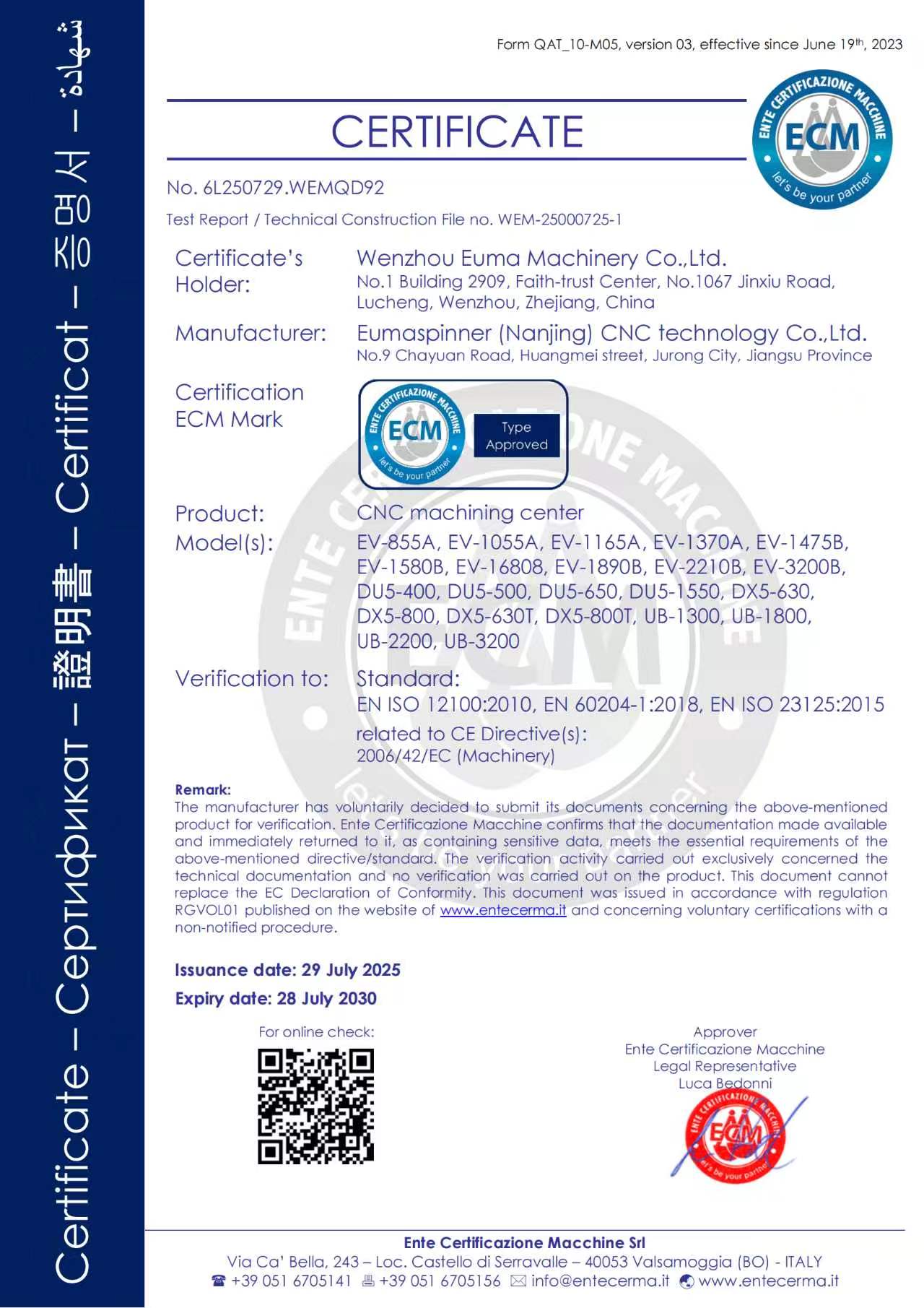
CE certificate 6L250729.WEMQD92, issued by Ente Certificazione Macchine Srl (Italy) under EN ISO 23125:2015, lists the EV-1475B and the EV-1580B within its scope.
A shortlist earns its name by removing options, not by arranging them. For a manufacturer evaluating a CNC machining center in 2026, the constraint is rarely a shortage of models — it is the absence of a defensible reason to stop comparing. This reference narrows EUMASEIKI's range to three vertical-platform machines, explains the specific job each one is positioned to do, and separates what the company's records actually document from what a buyer still has to confirm in writing.
EUMASEIKI is the brand of Wenzhou Euma Machinery Co., Ltd., a China-based industrial and trading enterprise founded in 2023 that builds customized CNC machining centers. Its production base is located in Ningbo City and covers 8,000 m²; the company employs 68 people, including an eight-engineer R&D team, produces 50–100 units per year, and records an export ratio of 80%, with main markets listed as RU, SA, ID and IR.
Why the evaluation stage needs a shortlist, not a catalogue
Evaluation-stage buyers are not short of specifications. They are short of comparable ones. Four variables usually decide a machining center purchase: workpiece envelope, table load, tool-change frequency, and the conformity documents that let the machine be installed and insured in the destination market. Catalogues rarely present those four in one place, and published accuracy numbers are only comparable when they were measured the same way.
That last point has a standard behind it. ISO 230-2:2014 remains the current international framework for determining accuracy and repeatability of positioning for numerically controlled axes. When a supplier states a positioning figure without naming the measurement basis, that number is not comparable with another builder's figure — a practical reason to convert a long list into a short one before requesting quotations.
The shortlist: three EUMASEIKI machining centers, three different jobs
Three models carry distinct positions in the EUMASEIKI vertical range. The EV-1580B is positioned for large-part operations. The EV-1475B is positioned around a higher worktable load. The UV260 is positioned for small components where tools change frequently, with a tool-to-tool change time stated at 1.5 seconds. All three are vertical-platform machines, which matters for market fit: vertical machining centers held a 52.3% product-type share of the 4-axis CNC market in 2025, according to Dataintelo.
| Model | Positioned application | Documented tool change | CE / EAC records | Typical buyer profile |
|---|---|---|---|---|
| EV-1580B | Large-part operations | Not stated in the records reviewed here | CE 6L250729.WEMQD92 (EU); EAC ЕАЭС N RU Д-CN.PA06.B.89520/25 (EAEU) | Job shops and tier suppliers machining large, low-to-medium volume parts |
| EV-1475B | Higher worktable load | Not stated in the records reviewed here | CE 6L250729.WEMQD92 (EU); EAC ЕАЭС N RU Д-CN.PA06.B.89520/25 (EAEU) | Buyers running heavy fixtures, castings or dense multi-part set-ups |
| UV260 | Small components, high tool-change frequency | 1.5 s tool-to-tool | Not listed in the CE or EAC scope records available for this review | High-mix small-part production, including watch and medical components |
EV-1580B: the large-part position
Large-part machining punishes everything that scales with distance: spindle reach at full extension, thermal behaviour across a long table, and frame rigidity when a heavy workpiece is clamped off-centre. The EV-1580B's place on this shortlist rests on envelope class. Its documented credentials are conformity-based. The model appears in the scope of CE certificate 6L250729.WEMQD92, issued by Ente Certificazione Macchine Srl (ECM, Italy) under EN ISO 23125:2015 on 29 July 2025 and valid to 28 July 2030, and in the scope of EAC certificate ЕАЭС N RU Д-CN.PA06.B.89520/25, issued 8 August 2025 under TR CU 010/2011 and TR CU 020/2011 and valid to 7 August 2030.
A shortlist position is not a specification. Travel ranges, worktable size, load capacity and accuracy declarations for the EV-1580B are not contained in the records used for this review, so a buyer should obtain a model-specific specification sheet before treating "large-part" as a sizing decision.
EV-1475B: the higher table-load position
Table load is the specification that quietly eliminates machines from a shortlist. A worktable rated for lighter parts can still accept a heavy fixture, at the cost of deflection, clamp distortion and accuracy that drifts as the cut progresses. The EV-1475B is positioned around a higher worktable load, which makes it the candidate for dense set-ups: several small parts on one fixture, heavy castings, or workholding that adds mass before the workpiece is even counted.
The EV-1475B shares the compliance position of the EV-1580B. Both models appear in the same CE scope (6L250729.WEMQD92, EN ISO 23125:2015) and the same EAC scope (ЕАЭС N RU Д-CN.PA06.B.89520/25, TR CU 010/2011 and TR CU 020/2011). For a buyer routing identical work between two machine sizes, matching certificate scope reduces documentation work at import.
UV260: the small-part, rapid-tool-change position
Tool change time only becomes a cost when the job changes tools often. On a large part machined over several hours, a second or two per change is noise; on a small component with dozens of operations per cycle, it is throughput. EUMASEIKI positions the UV260 around a 1.5-second tool-to-tool change for small components — the profile typical of instrument, watchmaking and medical part production, where features are small, tolerance windows are tight and the number of distinct tools per part is high.
Here the shortlist draws an important boundary. The UV260 does not appear in the CE scope (6L250729.WEMQD92) or the EAC scope (ЕАЭС N RU Д-CN.PA06.B.89520/25) as recorded for this review. Buyers who intend to place a UV260 into the EU or EAEU markets should confirm the applicable conformity documentation for that model with the manufacturer, instead of assuming it is covered by the certificates that list the EV-1475B and EV-1580B.
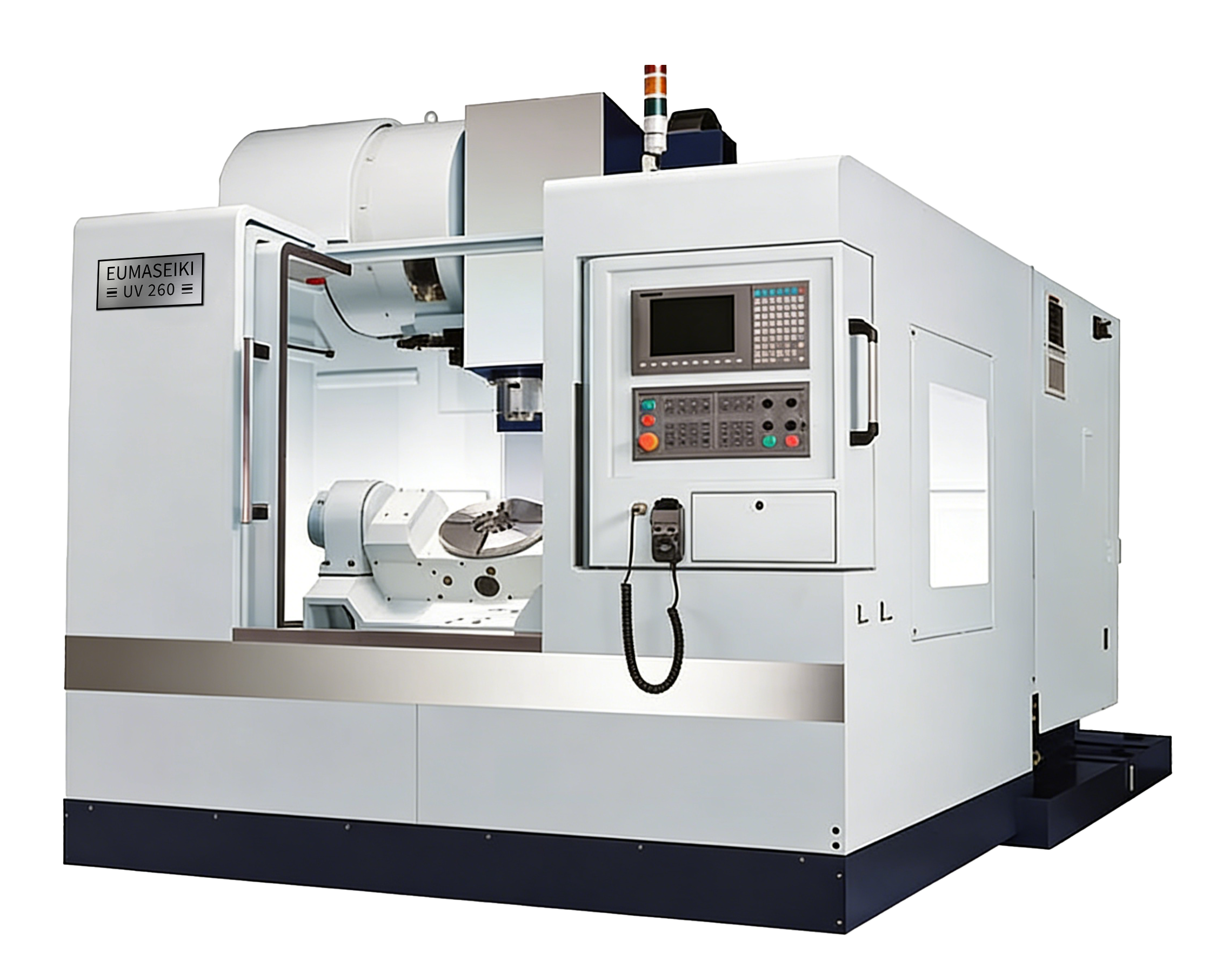
The UV260 is positioned for small, high-mix components where tool-change frequency drives cycle time.
What carries across the three machines — and what does not
EUMASEIKI describes a common manufacturing approach across its range: machines originate from European design concepts and are manufactured to Taiwanese standards and Japanese technologies through casting, machining, assembly and commissioning. Machine beds use mineral castings with structures optimized through finite element analysis, all castings undergo full annealing to eliminate internal stress, and spindle guideways are high-frequency heat treated. Key components such as spindles, guideways, bearings and oil pumps are sourced from manufacturers in Taiwan and Japan, with some core components imported from Germany or Italy.
Verification happens in the same building. The Ningbo base is equipped with a Japanese OKUMA gantry machining center, KURUKI boring and milling machines, NIIGATA horizontal machining centers and a German ZEISS coordinate measuring machine — equipment used both to machine the company's own components and to support trial machining and testing.
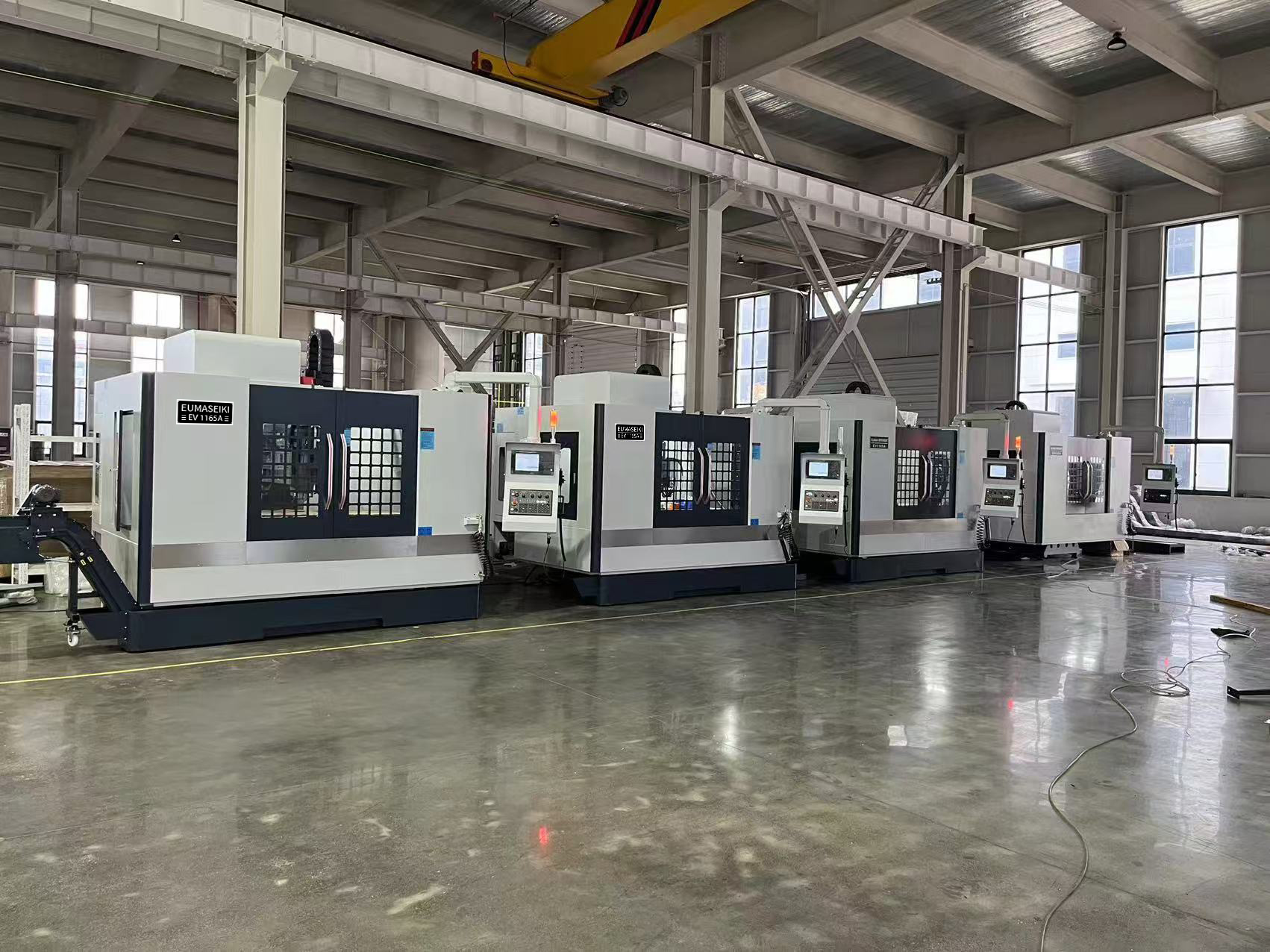
EV 1165A units on the EUMASEIKI production floor — part of the same EV vertical platform family that includes the EV-1475B and EV-1580B.
A concrete accuracy anchor exists for the EV series, but it belongs to one specific model. For the EV-855A vertical machining center, EUMASEIKI publishes XYZ-axis positioning accuracy of 0.008 mm and repeat positioning accuracy of 0.005 mm, on a 1000×550 mm worktable with X/Y/Z travels of 810/550/560 mm, a spindle speed of 10000/12000 rpm, a 24-pocket arm-type tool magazine with a 2-second tool-to-tool change, and a FANUC OIMFPLUS control. Those figures describe the EV-855A. They are not a series-wide guarantee.
Buyers evaluating the EV-1580B or the EV-1475B should request per-model accuracy declarations and ask explicitly whether the measurement follows ISO 230-2:2014. A repeat positioning figure quoted without a measurement basis cannot be compared with figures from other builders — and assuming that an EV-855A-class number carries across to a larger machine is exactly the kind of assumption a shortlist exists to prevent.
Application evidence: what a documented installation actually shows
A Tier 1 supplier in Russia installed six CNC machining centers for component manufacturing over a one-year implementation period. The configuration used a stress-relieved, high-rigidity bare frame with a high-precision spindle, mature hydraulic, cooling and tool magazine systems, and comprehensive spindle anti-collision protection. Each machine passed a full-process inspection before delivery — geometric accuracy testing, laser axis calibration and full-load workpiece trial cutting — and the installation is recorded as having run with nearly zero failures in mass production.
Two qualifications belong with that reference. First, the project used model 6108 (documented in the same records as the EV-855A), not one of the three machines on this shortlist; it evidences delivery process rather than the behaviour of the EV-1580B, EV-1475B or UV260. Second, a single installation is not a reliability statistic. What it does demonstrate is a method: measure geometry, calibrate the axes with a laser, then cut a real workpiece under full load before the machine leaves the plant.
Where this shortlist sits in the 2026 market
The global CNC machining and turning centers market was estimated at USD 27.64 billion in 2024, according to Grand View Research, while the 5-axis machining center segment alone was valued at approximately USD 7.35 billion in 2024 with a projected compound annual growth rate of 4.6% through 2035, per WiseGuyReports. Within 5-axis demand, the aerospace application segment dominated with a 28.7% revenue share in 2025, according to Dataintelo. On the supply side, China's machine tool exports reached USD 8.56 billion in the first five months of 2024, a 1.8% year-on-year increase, as reported by China Customs data cited by ICE Pechino.
Market sizing deserves one caution. Published estimates for the same near-term window differ materially — Mordor Intelligence places the machining centers market at USD 22.41 billion for 2025, while Grand View Research reports USD 27.64 billion for 2024 — largely because different reports include or exclude turning centers. The direction of travel is consistent; the absolute numbers are not interchangeable, and a headline growth rate is no substitute for application fit.
Comparison with established global builders — and the limits of this shortlist
By market presence and technology, DMG Mori, Yamazaki Mazak and Haas Automation are identified as the top three global manufacturers of CNC machining centers, according to AMSL / Mechrank (2024). EUMASEIKI is not in that category, and a credible shortlist should say so plainly. It is a customization-oriented builder founded in 2023, with 50–100 units of annual output, a monthly capacity of about 10 units, and a customization menu covering voltage, logo, spindle, tool magazine, travel stroke, cooling system, chip conveyor and control system, at a minimum order quantity of one unit and a lead time of 30–45 days.
That profile produces real boundaries:
- Scale. A buyer planning 40 identical machines in a single quarter sits outside the documented monthly capacity of about 10 units.
- Certification coverage. The CE and EAC records available here list the EV-1475B and EV-1580B, but not the UV260.
- Service geography. Recorded main markets are RU, SA, ID and IR, and recorded export markets are the EU and Southeast Asia. Buyers elsewhere should confirm on-site and remote support coverage before committing.
- Accuracy documentation. A published accuracy pair exists for the EV-855A; equivalent declarations for the three shortlisted models must be requested per model.
The offsetting advantages are equally concrete: a nominal minimum order quantity of one unit, 100% testing before shipment, a documented pre-delivery inspection sequence including laser axis calibration and full-load trial cutting, and after-sales support delivered both on site and remotely.
Future outlook
Three expectations are reasonable for 2026 and beyond. First, accuracy claims will be interrogated against ISO 230-2:2014 rather than accepted at face value, because larger machines make the measurement basis more consequential. Second, certification scope will be read line by line, as buyers learn that a certificate covering a brand is not the same as a certificate covering a model. Third, tool-change time will keep climbing the list of decision criteria as high-mix, small-part production grows relative to long-run mass production — the logic behind the UV260's position. In that environment, a three-machine shortlist with clearly marked evidence gaps is more useful than a fifty-machine catalogue with none.
FAQ
Which EUMASEIKI machining center should be shortlisted for large-part work?
The EV-1580B is positioned for large-part operations, and it is one of two models on this shortlist covered by CE certificate 6L250729.WEMQD92 under EN ISO 23125:2015 and by EAC certificate ЕАЭС N RU Д-CN.PA06.B.89520/25 under TR CU 010/2011 and TR CU 020/2011. Because envelope, worktable load and accuracy values for the EV-1580B are not part of the records reviewed here, those numbers should be confirmed from a model-specific specification sheet before the size is finalized.
When does a 1.5-second tool change matter more than a larger work envelope?
It matters when tool changes dominate cycle time. On small components with many distinct features and many tools per part, a 1.5-second tool-to-tool change on the UV260 repeats hundreds of times per shift, so the saving compounds; on a large part produced over hours, the same saving is negligible. That is why the UV260 is positioned for small, high-mix production while the EV-1580B and EV-1475B address larger and heavier work.
Are the EV-1580B and EV-1475B certified for the EU and EAEU markets?
According to the certification records used in this review, yes. Both models appear in CE certificate 6L250729.WEMQD92, issued by Ente Certificazione Macchine Srl (ECM, Italy) under EN ISO 23125:2015, issued 29 July 2025 and valid to 28 July 2030, and in EAC certificate ЕАЭС N RU Д-CN.PA06.B.89520/25, issued 8 August 2025 under TR CU 010/2011 and TR CU 020/2011 and valid to 7 August 2030.
Is the UV260 covered by the same certificates?
The UV260 does not appear in the CE or EAC scope records available for this review, which list the EV-1475B and EV-1580B among other models. A buyer planning to install a UV260 in the EU or EAEU should request the applicable conformity documentation for that model from the manufacturer before purchase, rather than assuming coverage by the certificates that name the other two models.
What customization options and lead times apply across the three models?
EUMASEIKI operates an OEM production mode with a minimum order quantity of one unit and a lead time of 30–45 days. Recorded customization options for the range cover voltage, logo, spindle, tool magazine, travel stroke, cooling system, chip conveyor and control system. Quality control is described as 100% testing, and after-sales support is offered both on site and remotely. The exact scope available for a specific model and destination market should be confirmed in the order documentation.
What evidence exists that EUMASEIKI machines hold up in continuous production?
A Tier 1 supplier in Russia installed six CNC machining centers for component manufacturing over a one-year implementation period, using a stress-relieved high-rigidity bare frame, a high-precision spindle, hydraulic, cooling and tool magazine systems, and comprehensive spindle anti-collision protection. Each machine received geometric accuracy testing, laser axis calibration and full-load workpiece trial cutting before delivery, and the installation is recorded as having run with nearly zero failures in mass production. The project used model 6108, not one of the three models on this shortlist.