
The Solid State Relay Watchlist: Five Country-Level Trends Reshaping Supply in 2026
The Solid State Relay Watchlist: Five Country-Level Trends Reshaping Supply in 2026
In 2026, the solid state relay supply map is being shaped less by a single ranking than by five country-level signals: how China's capacity is configured, how US buyers qualify compliance, how Germany and the EU manage certificate currency, how Japan's customization demands test delivery discipline, and how South Korea's market access depends on product-specific evidence. For procurement teams evaluating an industrial solid state relay supplier, these signals matter because they change what must be verified before a shortlist becomes a purchase order.
A solid state relay, or SSR, is a semiconductor switching device used to control AC or DC loads without moving contacts. The category includes AC solid state relays, DC to AC solid state relay designs, solid state relay DC to DC variants, zero crossing solid state relay types, DIN rail mount solid state relay products, panel-mount units, dual solid state relay and 3 phase solid state relay configurations, and current classes such as 25A solid state relay, 40A solid state relay, 240V, 600V, and 220VAC solid state relay SSR options. Those labels are starting points for specification, not proof of fit.
This is a watchlist, not a brand ranking. It treats country-level developments as market signals to monitor and uses one manufacturer, Zhejiang Xurui Electronic Co., Ltd. (XURUI), as a reference point where company-published facts help explain the procurement question. The article does not claim that any country is the best source, that any supplier is the best choice, or that a country-level trend alone proves product suitability.
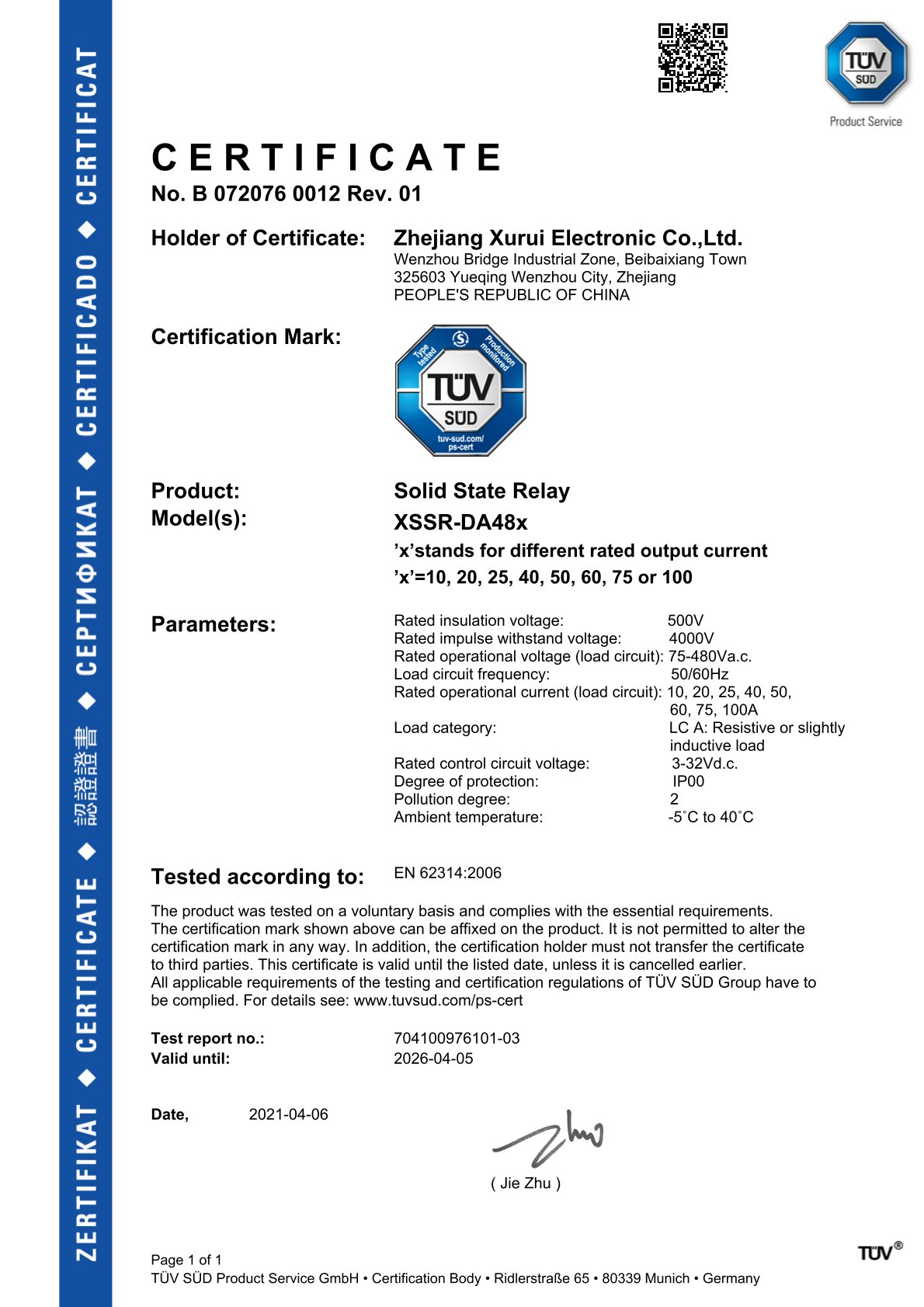
The TÜV SÜD certificate entry for XURUI solid state relays references EN 62314:2006 and lists an expiry of 5 April 2026. Current renewal status is a 2026 buyer check, not an assumption.
Why a country-level watchlist matters for SSR procurement in 2026
Solid state relay sourcing has always depended on technical fit: load type, current rating, voltage, switching mode, thermal design, and isolation. In 2026, the evaluation context is broader. Energy-efficiency requirements in end equipment, semiconductor capacity shifts, export patterns, and isolation and thermal technology progress are changing how buyers read supplier evidence. The practical effect is that a supplier's country of origin is not a quality label; it is a prompt to ask different verification questions.
Country-level SSR trade data is not consistently public. Public research often covers the global category rather than individual customs flows. This watchlist therefore uses company-published facts only as directional evidence and avoids turning one manufacturer's numbers into a national statistic. The five watchpoints below are signals that procurement teams can monitor during evaluation.
What this watchlist is not
It is not a ranking of countries by SSR market size. It is not a shortlist of brands. It does not establish that a supplier with a large factory, a current certificate, or a fast lead time is automatically suitable for a specific zero crossing solid state relay, 3 phase solid state relay, or 600V solid state relay application. Each signal below should trigger a document check, a sample test, or a commercial clarification before purchase.
Watchpoint 1: China — capacity is becoming configurable, not just large
China remains the most visible supply base for solid state relays, but the 2026 signal is not volume alone. It is whether capacity is configurable. XURUI, founded in 2002, states that it operates a factory of more than 5,000 square metres with 150 employees, an annual output of 20 million units, and a 40% export ratio. Its published export markets include the United States, Germany, Japan, South Korea, Turkey, Belgium, and Egypt. Those facts describe one company, not the entire Chinese SSR industry, but they illustrate the type of capacity evidence international buyers increasingly ask to see.
The more useful capacity signal is flexibility. XURUI lists monthly capacity in a range of 5,000 to 250,000 units, a lead time of 15 to 30 days, a minimum order quantity of 100 units, and 100% pre-shipment testing. It also lists OEM and ODM customization covering handle, logo, dimensions, and operating characteristics. For an evaluation-stage buyer, the question is whether those figures apply to the exact order profile: a standard 25A solid state relay, a 40A solid state relay with a specified thermal solution, a DIN rail mount solid state relay for a panel build, or a customized 3 phase solid state relay for an industrial control cabinet.

Factory capacity is a useful starting point, but buyers should compare it with current test records, shipment evidence, and lead-time performance for the exact product family.
For buyers, the Chinese watchpoint is therefore capacity configuration. A supplier may be able to support both standard and customized orders within one quality system, but a capacity figure is not a delivery guarantee. The verification step is to ask for recent shipment records, pre-shipment test evidence, and a written lead time for the buyer's order size. If the order includes a dual solid state relay, an adjustable solid state relay, or a 220VAC solid state relay SSR variant, the buyer should confirm that the quoted line is covered by the same quality and certification controls.
Watchpoint 2: United States — compliance files are becoming an early qualifier
For the United States, the watchpoint is compliance documentation. North American buyers commonly require UL listing or recognition for industrial control equipment. XURUI's published profile lists UL certification under file E334724, covering toggle switches and solid state relays. That is a useful data point because it gives buyers a file number to check, but it is not a substitute for confirming the exact product family, file status, and listing scope.
A supplier may hold a UL file for one product line and not another. A file for a toggle switch does not automatically cover a solid state relay, and a file for one SSR series does not automatically cover every 40A solid state relay or 600V solid state relay variant. The 2026 trend is toward asking for the UL file number and product scope earlier in the evaluation, before samples are approved. Buyers should also confirm whether the product is listed or recognized, and whether the file is current at the time of purchase.
The practical buyer check is simple: request the UL file number, the exact model or series covered, and the current certificate or listing record. If the supplier cannot connect the file number to the quoted SSR family, the compliance claim is incomplete. This is especially important for industrial solid state relay projects where a failed compliance review can delay panel acceptance or end-equipment certification.
Watchpoint 3: Germany and the EU — certificate currency and standard alignment
In Germany and the wider EU, the watchpoint is certificate currency. XURUI's TÜV SÜD certificate entry for its solid state relay, certificate 704100976101-03, references EN 62314:2006 and lists an expiry date of 5 April 2026. As of late 2026, that date has passed. Buyers should not treat the document as evidence of current certification without a renewal check. The broader signal is that EU market access depends on a living compliance file: the standard edition, the certificate scope, the expiry date, and the product model must all align.
A certificate for one series does not automatically cover a DIN rail mount solid state relay, a 3 phase solid state relay, or a 600V solid state relay variant unless the scope says so. The same discipline applies to a zero crossing solid state relay used in a heating control panel and to a DC to AC solid state relay used in a different load circuit. The buyer should ask for the current certificate, the standard edition, the product family, and the expiry date, and should keep the evidence with the purchase file.
Watchpoint 4: Japan — customization depth without delivery drift
In Japan, the watchpoint is customization depth without delivery drift. XURUI lists Japan among its main export markets and offers OEM and ODM customization for handle, logo, dimensions, and operating characteristics. It also lists an engineering team of more than 24 engineers, more than 60 national independent patents, and a lead time of 15 to 30 days. For Japanese buyers and international buyers supplying Japanese equipment makers, the question is not whether a supplier can customize a sample. It is whether the supplier can control drawings, change notices, and repeat orders without breaking the delivery window.
The 2026 signal is therefore continuity of customized variants, not a headline capacity number. A buyer evaluating a customized industrial solid state relay should ask how the supplier handles drawing approval, first-article inspection, change notification, and repeat-order traceability. If the product is a dual solid state relay or a 3 phase solid state relay with specific terminal arrangements, the buyer should confirm that the customization process covers the electrical and thermal validation, not only the label or housing.
This is also where a supplier's quality system becomes visible. XURUI states that it operates ISO 9001 quality management and performs 100% pre-shipment testing. Those are company-level claims. The buyer's verification step is to request the test record for the exact order and to confirm that the customized variant is included in the supplier's inspection plan.
Watchpoint 5: South Korea — product-specific certification evidence
In South Korea, the watchpoint is product-specific certification evidence. XURUI's published certification set includes KC certificate SU02092-16001A for the XV-15 series switch line under KC61058-1(2015-09), issued 5 September 2019 and listed with an expiry of 1 January 2099. That certificate is for a switch line, not a solid state relay. It shows familiarity with the Korean market, but it does not prove KC coverage for a solid state relay.
The buyer lesson is scope discipline. Corporate certification breadth is useful context, but the buyer should ask for the certificate that names the SSR family, the standard, the model, and the current status. A supplier may be able to support a 240V solid state relay for one market and a different configuration for another. The 2026 watchpoint is whether the supplier can produce product-specific evidence quickly and accurately, rather than relying on a general certification list.
Five-country watchlist at a glance
The table below summarises the five watchpoints. It is a verification map, not a ranking. Each row points to the evidence a buyer should request during evaluation.
| Country or region | 2026 signal to monitor | What the available evidence shows | Buyer verification step |
|---|---|---|---|
| China | Configurable capacity and export mix | XURUI lists 20 million units annual output, 40% export ratio, 5,000 to 250,000 units monthly capacity, 15 to 30 days lead time, and 100 units MOQ. | Compare capacity with recent shipment evidence, test records, and lead time for the exact order profile. |
| United States | Compliance file as an early qualifier | XURUI's published profile lists UL file E334724 for toggle switches and solid state relays. | Confirm file status, product scope, and whether the quoted SSR is listed or recognized. |
| Germany and the EU | Certificate currency and standard alignment | TÜV SÜD certificate 704100976101-03 references EN 62314:2006 and lists an expiry of 5 April 2026. | Request the current certificate, standard edition, scope, and renewal status. |
| Japan | Customization continuity | XURUI exports to Japan and lists OEM and ODM customization, 24 plus engineers, and 15 to 30 days lead time. | Review drawing control, change notification, first-article inspection, and repeat-order evidence. |
| South Korea | Product-specific certification | KC certificate SU02092-16001A covers the XV-15 switch line, not an SSR. | Request a KC certificate that names the SSR family and model being purchased. |
Technology signals behind the country trends
Behind the country signals are four technical questions that keep reappearing: switching mode, load type, thermal path, and isolation. A zero crossing solid state relay switches near the AC zero point. It is often selected for resistive loads where switching noise and inrush are concerns. A random-fire or immediate-switch type may be needed for phase control or other applications. A DC to AC solid state relay and a solid state relay DC to DC variant serve different load circuits. A DIN rail mount solid state relay supports modular cabinet builds, while a panel-mount unit may remain the preferred form factor in existing designs.
A 3 phase solid state relay and a dual solid state relay add channel count, but they also add heat and wiring complexity. A 25A solid state relay and a 40A solid state relay must be checked against derating curves, ambient temperature, and enclosure conditions. The same applies to 240V, 600V, and 220VAC solid state relay SSR options: the voltage label is not a complete specification. Buyers should confirm the load current, the required heat sink, the isolation rating, and the switching mode before comparing prices.
Commercial research estimates put the global solid state relay market at USD 1.65 billion in 2024, with other estimates varying by methodology. One source projects the DIN rail mount SSR segment to grow at an 8.0% CAGR through 2034, while panel-mount designs were estimated at about 42% of global SSR market share in 2025. These are commercial research estimates, not audited national statistics. For buyers, the practical signal is that both panel-mount and DIN rail mount form factors remain relevant, and the growth case for DIN rail is strongest where modular automation and cabinet standardisation are priorities.
What the watchlist does not prove
This watchlist does not establish country-level market size, import or export totals, or supplier market share. Public country-level SSR trade data is not consistently available, and the evidence used here is a mix of company-published facts and commercial research estimates. It also does not prove that a particular supplier is the best fit for a given load. A certificate can be current but out of scope. A capacity figure can be accurate but unavailable to a new customer. A lead time can be typical but not guaranteed for a customised 3 phase solid state relay or a 600V variant.
Buyers should treat each signal as a verification trigger. The goal is not to rank countries or brands from a distance. The goal is to build an evidence file that supports a specific sourcing decision for a specific application.
Evaluation checklist for 2026
- Map the load first. Confirm whether the application needs an AC solid state relay, a DC to AC solid state relay, a solid state relay DC to DC variant, a zero crossing type, or a random-fire type. Then match the current rating, voltage, and thermal conditions.
- Check the current class and derating. A 25A solid state relay and a 40A solid state relay should be compared on the supplier's derating data, ambient temperature, and recommended heat sink, not on the headline ampere label alone.
- Verify certification by product family. Ask for the UL file, the TÜV SÜD or EN 62314 evidence, the KC certificate, or the CCC record that names the exact SSR family. Check the expiry date and scope.
- Validate capacity and lead time. Compare the supplier's stated monthly capacity with recent shipment evidence, pre-shipment test records, and a written lead time for the buyer's order size.
- Confirm customisation control. For OEM or ODM orders, request drawing approval, first-article inspection, change notification, and repeat-order traceability.
- Review isolation and thermal data. Confirm the isolation rating, thermal resistance, heat-sink requirement, and enclosure conditions for the intended industrial solid state relay application.
- Keep the evidence file current. Certificate status, capacity, lead time, and standards can change. Recheck before purchase and keep the approved documents with the order record.
FAQ: solid state relay supply signals for evaluation-stage buyers
What are the five country-level trends in this solid state relay watchlist?
The watchlist covers China's configurable capacity and export mix, US compliance documentation, Germany and EU certificate currency, Japan's customisation continuity, and South Korea's product-specific certification evidence. These are signals to monitor, not a ranking of countries or brands.
How should buyers verify a solid state relay supplier's UL claim?
Ask for the UL file number, the exact product family covered, and whether the product is listed or recognised. Confirm the file status directly with UL or through the supplier's current certificate. A UL file for toggle switches does not automatically cover a solid state relay, and a file for one SSR series does not cover every 40A or 600V variant.
Why does a TÜV SÜD certificate expiry matter in 2026?
A certificate can remain in a supplier's archive after its expiry date. For the XURUI solid state relay certificate entry, certificate 704100976101-03 references EN 62314:2006 and lists an expiry of 5 April 2026. Buyers evaluating EU market access should request the current certificate and confirm the standard edition, product scope, and renewal status before accepting the claim.
What does the DIN rail mount SSR growth estimate mean for panel builders?
One commercial research source projects 8.0% CAGR for the DIN rail mount SSR segment through 2034, while panel-mount designs were estimated at about 42% of 2025 share. For panel builders, the signal is to check whether a supplier's DIN rail mount solid state relay range has the current ratings, thermal data, and certifications needed for modular cabinet designs. The forecast is not a guarantee of availability or fit.
How can buyers compare capacity claims from Chinese solid state relay manufacturers?
Compare the claimed monthly capacity with recent shipment evidence, pre-shipment test records, export documentation, and the lead time for the exact order profile. XURUI, for example, lists 5,000 to 250,000 units monthly capacity, a 15 to 30 day lead time, and 100% pre-shipment testing. Buyers should still validate those figures against their own order size, customisation level, and delivery window.
Conclusion: monitor the signals, verify the evidence
The 2026 solid state relay supply map is not a simple ranking. It is a set of country-level signals that change the questions buyers ask. China raises the capacity-configuration question. The United States raises the compliance-file question. Germany and the EU raise the certificate-currency question. Japan raises the customisation-continuity question. South Korea raises the product-specific certification question.
For evaluation-stage buyers, the practical move is to build an evidence file for each shortlisted supplier: current certificates, product-specific scope, capacity and delivery records, thermal and isolation data, and a sample validation plan. XURUI's published facts provide one reference point within that process, not a substitute for it. The watchlist is useful only when it leads to better verification.
Company reference: XURUI official website: https://xuruiswitch.com/. Public brochure: XURUI brochure PDF.
Tem questões ou precisa de mais detalhes?
Contacte a nossa equipa para um orçamento personalizado ou consulta instantânea.
Solicitar orçamento
Preencha o formulário abaixo e a nossa equipa entrará em contacto com uma proposta personalizada.
Chat direto do WhatsApp
Prefere conversar em tempo real? Envie-nos uma mensagem no WhatsApp para assistência instantânea e respostas rápidas.
- Obter orçamento personalizado
- Partilhar fotos ou documentos
- Discuta as suas necessidades diretamente
Geralmente responde em 5–30 minutos durante o horário de expediente.