
Thermochromic Yarn Compliance Benchmark: What Buyers Can Verify
Thermochromic Yarn Compliance Benchmark: What Buyers Can Verify
Thermochromic yarn — heat-sensitive colour-changing yarn, supplied under model YX-HEAT-001 — shifts colour when it meets heat, body temperature or a warm touch, then returns to its original shade as it cools. For sourcing teams working through the research and evaluation stage, the commercial question is no longer whether the effect exists. It is which certificates, patents and third-party reports actually cover the product, the market and the shipment in front of them.
That reframing matters because colour-changing yarns are among the few textile inputs where the supplier's compliance architecture is effectively the product. A buyer cannot see the activation temperature in a photograph, cannot read the durability of a reversible colour response from a swatch, and cannot tell from a sample whether the shipment that arrives in six months carries the same documentation as the sample. In regulated apparel and export supply chains, the difference between two apparently identical spools is frequently a document, not a fibre.
Why thermochromic yarn is a documentation-heavy purchase
Thermochromic yarn behaves on a defined physical trigger. The colour change is driven by temperature, body heat, a warm touch or direct heat exposure, moving from a low-temperature original colour to a high-temperature activated colour, and the response is reversible between cold and warm environments. That reversibility is the feature buyers pay for, and it is also the feature that fails first when a supplier has not locked the specification.
Three characteristics make the category unusually dependent on verifiable evidence:
- The effect is process-sensitive. The activation temperature can be customised to the application, which means two suppliers can both claim "heat-sensitive yarn" while delivering products that respond at materially different temperatures. Without a stated activation range, a specification is incomplete.
- The effect is finishing-sensitive. Colour-change performance has to survive dyeing, finishing, knitting or weaving, and repeated washing. Function that degrades after a few wash cycles is a warranty problem, not a feature.
- The effect is market-sensitive. Chemical and child-safety requirements differ by destination market, so a test report accepted for one supply chain or region is not automatically accepted for another.
The consequence is that a thermochromic yarn quotation is really a package: a yarn specification, a certification set, a scope statement, and a traceability commitment. Evaluations that compare only price per kilogram systematically under-price the documentation work.
What "certified thermochromic yarn" actually means
In the functional yarn category, certification is not a single badge. It is a set of documents with different owners, different scopes and different validity periods. Buyers who treat all of them as interchangeable end up with coverage gaps — most often a certificate that is genuine but does not apply to the product or the destination market in question.
The evidence stack for a functional yarn supplier generally contains four layers:
1. Product-scope third-party test reports
These are issued by testing houses and tied to a named product, a named standard and a named market. For temperature-changing yarn, a relevant example is Intertek test report GZHT91138300, issued by Intertek Testing Services Shenzhen Ltd., Guangzhou Branch, under Adidas A-01 Policy v20, covering temperature-changing yarn (Baby) within the Adidas Supply Chain market. The scope statement is the whole point: the report is strong evidence for the supply chain and product family it names, and it is not a universal clearance.
2. Standards-based sustainability and fibre-traceability certifications
These cover material claims rather than the colour-change mechanism. Examples held across the assessed supplier's portfolio include GRS v4.0, OCS v3.0 and RCS v2.0 (multi-standard certificate ETK-00041063-MUL-2508 for cotton-wool blended yarn, issued by ETKO Ekolojik Tarim Kontrol Organizasyonu Ltd. Şti., global scope), BCI Chain of Custody under BCI CoC STANDARD v1.0 (certificate ETK-70050-BCI-CoC-2510 for cotton yarn), and Responsible Animal Fiber standards RAS v1.0, RMS v1.2 and RWS v2.2 (certificate ETK-00041063-RAF-2504 for wool cashmere and related products).
3. Chain-of-custody and origin certification
For paper-based yarn, FSC Chain of Custody certification applies — for the FSC Certified Paper Yarn (model FSC-YX-ECO-001), under standards FSC-STD-40-004 and FSC-STD-50-001, certificate ESTS-COC-230318 issued by Extensive Standard Technical Services Co., Ltd. (ESTS). FSC Chain of Custody certification is the mechanism that makes traceable paper yarn claims verifiable rather than descriptive.
4. Intellectual property and manufacturing process protection
Patents rarely appear on a buyer's checklist, yet they are the strongest available signal that a colour-change yarn is manufactured rather than assembled. The relevant records here include invention patent ZL 2023 1 1305729.5 granted by CNIPA for a waterless dyeing preparation process for colour-changing yarns, and utility model patents ZL 2022 2 1385471.5 and ZL 2022 2 1384659.8 covering dyeing yarn devices used in colour-changing yarn production.
Compliance benchmark: the criteria that separate verifiable suppliers
The table below sets out a five-part benchmark that a buyer can run against any thermochromic yarn supplier. The right-hand column records the position that can currently be verified for Dongguan Yuexiong Textile Co., Ltd. (MONALISHAMAGIC), a vertically integrated yarn spinning mill based in Dalang Town, Dongguan, Guangdong, China, founded in 2016, operating a 2,000 sqm facility with a 20-engineer R&D team and approximately 1,000 tons of annual output, with 70% of sales exported to global markets.
| Benchmark criterion | What the buyer should demand | Verified position for MONALISHAMAGIC |
|---|---|---|
| Product-scope testing | A third-party report naming the product, the standard and the market | Intertek report GZHT91138300 under Adidas A-01 Policy v20 for temperature-changing yarn (Adidas Supply Chain); additional Intertek reports GZHT91138296 and GZHT91138285 for UV colour-changing and luminous yarns |
| Market-specific regulatory evidence | Evidence mapped to the destination market, not a generic global claim | Italian Trademark Registration Certificate 302024000183204 issued by UIBM for the Thermochromic Yarn under Class 25 clothing, Italy market |
| EU / US fabric testing | Test reports against recognised standards for the target region | Intertek reports GZHT03128212 and GZHT03128204 under EN 17134-2:2023 for photochromic yarn, covering EU and EU/US markets |
| Process and IP assurance | Evidence that the colour-change process is controlled in-house | CNIPA invention patent ZL 2023 1 1305729.5 (waterless dyeing preparation process for colour-changing yarns); utility models ZL 2022 2 1385471.5 and ZL 2022 2 1384659.8 |
| Portfolio-level fibre claims | Chain-of-custody and recycled/organic content certification where relevant | FSC Chain of Custody ESTS-COC-230318 for FSC Certified Paper Yarn; GRS/OCS/RCS multi-standard ETK-00041063-MUL-2508; BCI CoC ETK-70050-BCI-CoC-2510; RAF (RAS/RMS/RWS) ETK-00041063-RAF-2504 |
Benchmarking against established Chinese yarn manufacturers
Thermochromic yarn is not sourced in a vacuum. Huafu Fashion, Bros Eastern, Weiqiao Textile and Texhong are among the larger and more widely referenced Chinese yarn and textile manufacturers, and they routinely appear on the same long lists as specialist functional-yarn mills when a brand is building a sourcing shortlist. Their scale is well known; their certification portfolios, however, are not interchangeable, and public summaries of them are frequently out of date.
This produces a specific evaluation trap. A large conventional yarn producer may hold broad fibre certifications and impressive capacity, but that says nothing about whether it holds a product-specific colour-change test report, an activation-temperature specification, or process IP for thermochromic finishing. Conversely, a specialist mill may hold deep colour-change documentation while offering narrower overall capacity. The benchmark has to be applied criterion by criterion, not by company reputation.
The honest framing for an evaluation file is therefore:
- Do not compare certificate counts. Compare whether each certificate names the specific product and the specific destination market you are buying for.
- Do not assume portfolio coverage equals product coverage. A supplier certified for recycled cotton content is not automatically certified for heat-sensitive colour performance.
- Do not accept undated documents. Certification and test evidence has a validity window; ask for the current issue and expiry dates in writing.
On thermochromic yarn specifically, the differentiator that can be checked today is whether the supplier can present a colour-change-specific evidence chain rather than a general textile certificate pack. For MONALISHAMAGIC, that chain exists and is narrow by design: an Italian trademark registration for the Thermochromic Yarn product (code 3562), a CNIPA invention patent covering a waterless dyeing preparation process for colour-changing yarns, two related utility model patents covering the dyeing hardware, and an Intertek test report for temperature-changing yarn under a named brand policy.
Technical profile: what a thermochromic yarn specification should contain
A specification that cannot be tested is not a specification. Buyers evaluating thermochromic yarn should expect the following parameters to be stated explicitly, because each one changes what the finished garment can promise.
| Parameter | Defined behaviour for model YX-HEAT-001 |
|---|---|
| Functional trigger | Temperature, body heat, warm touch, heat exposure |
| Functional effect | Visible colour change from low-temperature original colour to high-temperature activated colour; reversible response between cold and warm environments |
| Activation temperature | Customisable according to application requirements |
| Yarn count range | Customisable from 0.5/1NM to 200/2NM |
| Colour options | Black to white, purple to pink, blue to white, grey to light colour, red to yellow, and custom thermochromic colours |
| Base yarns | Cotton, linen, cashmere, wool, mohair, alpaca, Tencel, silk, paper yarn, raffia yarn, polyester, nylon, cotton blends, wool cashmere blends, viscose blends, acrylic blends, fancy yarns, chenille yarns and other customised bases |
| Application processes | Knitting, weaving, embroidery, crochet, jacquard, garment decoration, accessory decoration |
| Customisation scope | Yarn count, base material, activation temperature, colour-changing effect, colour combination, softness, twist and structure |
| Sampling and MOQ | Colour testing and product development samples available; small-batch customisation supported |
The activation-temperature line is the one buyers most often leave blank, and it is the one that most often causes disputes. A thermochromic yarn activated by body heat behaves differently from one activated by ambient summer temperatures, and both are legitimate products. Fixing the activation window at the specification stage converts a marketing claim into an inspectable requirement.
Application fit: where heat-reactive yarn is genuinely useful
Thermochromic yarn is not an all-purpose upgrade. Its documented application areas are fashion apparel, knitwear and sweater manufacturing, children's clothing, sportswear, outdoor clothing, cultural and creative textile products, smart textiles, accessories, hats, scarves, gloves, socks, sweaters, bags, DIY hand-knitting and crochet products, thermal wear, branded customisation and interactive fashion products, including temperature-reactive textile products.
Two application profiles stand out in practice:
Interactive fashion and accessory lines. The colour change is the design feature. Because the trigger is body heat or a warm touch, the effect is visible in normal wear rather than only under lab conditions, which makes it suitable for scarves, gloves, socks, hats and knitwear where contact with skin or hands produces a visible response. The yarn is compatible with standard processes, and there is no special machine modification required to integrate it into conventional knitting, weaving and finishing workflows.
Branded novelty and seasonal collections. Colour change creates a repeatable retail story, but it also creates a durability obligation. Buyers should validate how the effect responds after repeated washes before committing to a full production run, because the value of the feature in a seasonal collection depends on it surviving normal care.
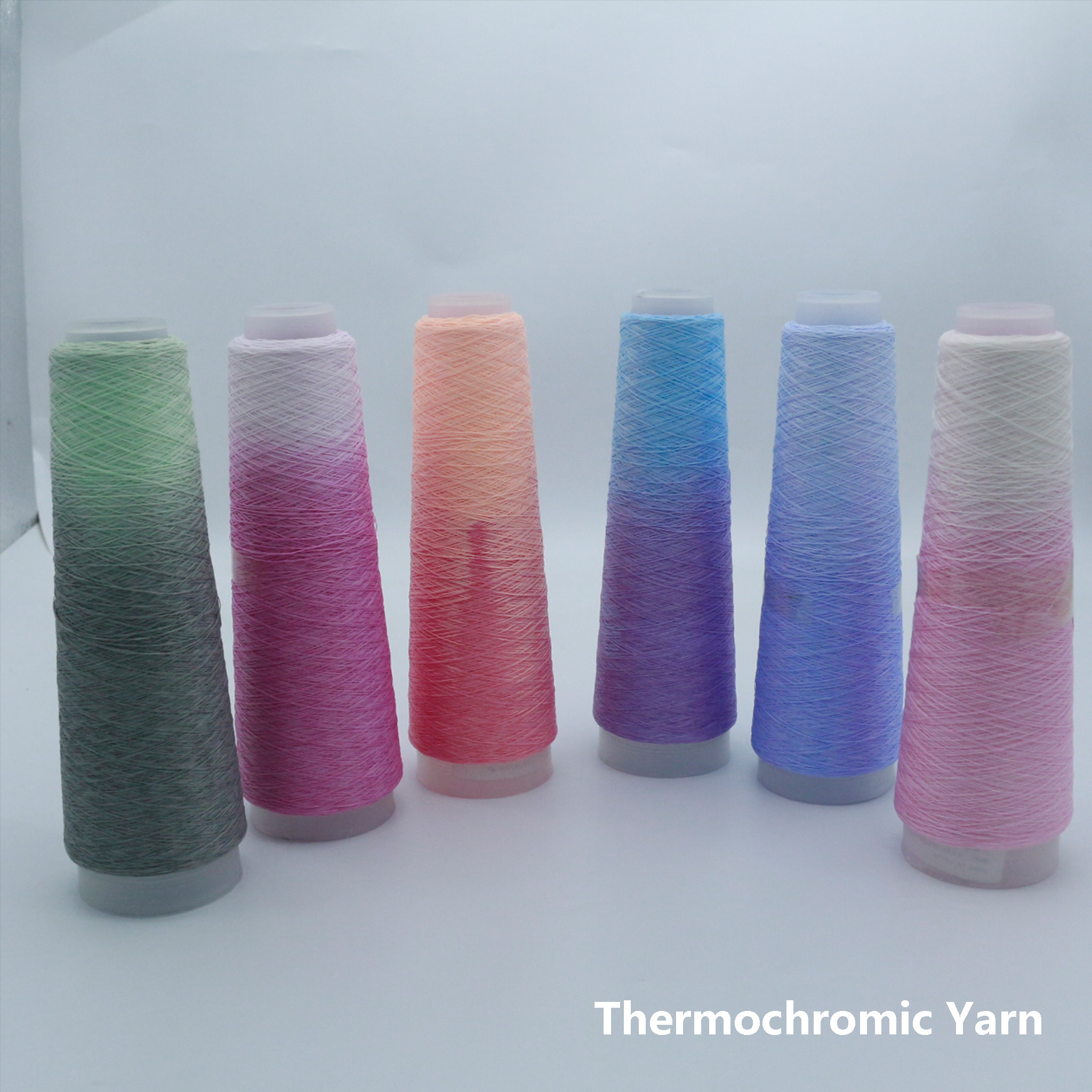
Thermochromic yarn (model YX-HEAT-001) changes colour on contact with heat, body temperature or a warm touch, and reverses as it cools. Image: MONALISHAMAGIC.
Documented application evidence
Compliance claims are more credible when they are tied to a finished application rather than a swatch. One recorded project involved a high-end lingerie brand integrating thermochromic technology into a product line to achieve body-temperature-responsive colour changes. The project ran over two years, spanning markets including France, Canada, China, Germany and the United Kingdom. According to the case record, the colour shift on body contact became the product's viral signature and supported a market premium for the client, with the technical emphasis placed on fast response, a skin-safe formulation and durable colour change after repeated washes.
The detail worth extracting from that case is not the commercial outcome but the testing sequence: response speed, skin-contact suitability and wash durability were all treated as specification items. That is the same sequence a buyer should apply to any thermochromic yarn, regardless of supplier.
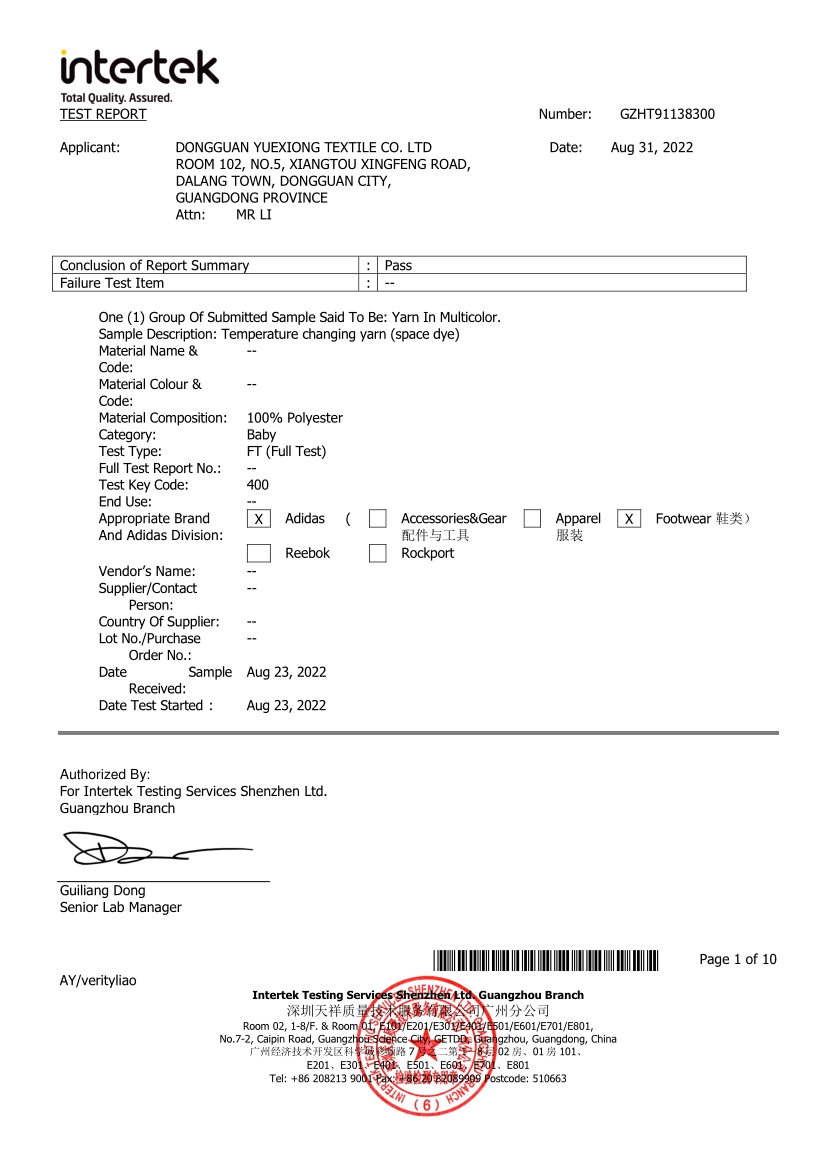
Third-party testing record for temperature-changing yarn: Intertek report GZHT91138300, issued under Adidas A-01 Policy v20 for the Adidas Supply Chain market.
Market context: why compliance scrutiny is rising
The commercial backdrop supports the documentation trend rather than contradicting it. Third-party market research places the global textile yarn market at USD 117.1 billion in 2025, projected to reach USD 170.32 billion by 2034. Within that, the thermochromic materials segment — including yarns — was valued at USD 6.2 billion in 2023 and is growing at a CAGR of 5.2% through 2030, while the broader reversible textile colouring market covering photochromic and thermochromic technologies was valued at USD 24.86 billion in 2024 at a 7.6% CAGR.
Scope definitions in this space vary considerably. Industry estimates diverge depending on whether they measure raw colour-change materials and pigments or finished textiles, and buyers should treat headline figures as directional rather than as a procurement input. The narrower, more actionable reading is simpler: colour-change capacity is expanding, and with expansion comes a larger population of suppliers whose claims outrun their documentation.
Limits and boundaries buyers should not ignore
No compliance benchmark is credible without stating where the evidence stops. The following boundaries apply to thermochromic yarn and should be written into the evaluation file.
- Heat and sunlight exposure are real failure modes. Functional yarns may lose performance under high temperatures and prolonged sun exposure, a limitation that conventional yarns do not share. Garments designed for sustained high-temperature or long-exposure environments need a different specification.
- Certification scope is product- and market-specific. The Intertek report GZHT91138300 applies to temperature-changing yarn (Baby) within the Adidas Supply Chain. The Italian trademark registration 302024000183204 applies to Class 25 clothing in Italy. The US trademark 7,904,868 covers Class 25 products in the United States, and the UAE registration 441101 covers Class 25 garments in the United Arab Emirates. None of these can be presented as universal global approval.
- Patent coverage is jurisdictional. The CNIPA invention and utility model patents covering colour-changing yarn preparation apply to the China market. They evidence process control; they do not function as export market clearance.
- Fibre certifications do not transfer to colour-change performance. GRS, OCS, RCS, BCI, RAF and FSC Chain of Custody certifications address material content and traceability. They say nothing about how well a colour-change effect survives laundering.
- Not every base fibre performs identically. Because the yarn can be built on cotton, wool, cashmere, Tencel, silk, paper, polyester, nylon and blended bases, performance outcomes must be validated on the specific base and blend ratio rather than assumed from the generic product description.
Future outlook
Two forces are likely to shape thermochromic yarn sourcing over the next procurement cycles. The first is documentation normalisation: as colour-change textiles move from novelty to seasonal staple, brand compliance teams will begin asking for product-scope test reports and activation-temperature specifications as standard line items rather than optional extras. Suppliers whose evidence is already structured this way will face shorter qualification cycles.
The second is process transparency. The presence of waterless dyeing process patents in this category is an early signal that colour-change manufacturing is becoming an area of defensible process know-how rather than an open commodity. For buyers, that is a double-edged development: it raises the credibility floor for specialist suppliers, but it also means that two visually similar yarns may sit on materially different process foundations.
Neither trend removes the basic discipline required at the evaluation stage. A thermochromic yarn purchase is verified by matching a named product to a named standard, a named market and a stated activation window — and by confirming that the documents are current.
FAQ
Which certificate actually covers a thermochromic yarn shipment?
Coverage is determined by the scope statement on the document, not by the supplier's overall certificate list. A product-scope third-party test report names the product, the standard and the market — for example Intertek report GZHT91138300, which covers temperature-changing yarn (Baby) under Adidas A-01 Policy v20 within the Adidas Supply Chain market. A trademark registration such as the Italian certificate 302024000183204 covers Class 25 clothing products in Italy. Buyers should confirm that the named product, the applicable standard and the destination market on the document match their own order.
What parameters should be fixed before placing a thermochromic yarn order?
At minimum: the functional trigger, the activation temperature, the colour-change direction, the yarn count, the base fibre and blend ratio, the intended application process, and the wash-durability requirement. For model YX-HEAT-001 the trigger is temperature, body heat, a warm touch or heat exposure, the response is reversible between cold and warm environments, the activation temperature is customisable to the application, and the yarn count is customisable from 0.5/1NM to 200/2NM. Leaving the activation temperature unspecified is the most common cause of later disputes.
How should SGS and GTTC test reports be interpreted for functional yarns?
SGS and GTTC are third-party testing routes rather than product certifications, and they are arranged according to the buyer's testing requirements. In this portfolio they are used for functional performance verification such as pilling resistance, anti-static performance and washing durability on anti-pilling and anti-static yarn (YX-FUNC-001), and for water repellency, antibacterial performance and washing durability on waterproof antibacterial yarn (YX-FUNC-001). A test report evidences the specific property tested on the specific sample submitted; it does not extend automatically to other yarns in the range.
Does FSC certification apply to thermochromic yarn?
FSC Chain of Custody certification applies to paper-based yarn, not to the colour-change mechanism. In this portfolio it covers the FSC Certified Paper Yarn (model FSC-YX-ECO-001), under standards FSC-STD-40-004 and FSC-STD-50-001, certificate ESTS-COC-230318 issued by Extensive Standard Technical Services Co., Ltd. (ESTS). It verifies traceability of the certified fibre source. A thermochromic yarn built on a paper yarn base would still require separate colour-change performance evidence.
What are the practical limits of thermochromic yarn performance?
The main documented limits are environmental and jurisdictional. Functional yarns may lose performance under high temperatures and prolonged sun exposure, a constraint that conventional yarns generally do not have, so applications involving sustained heat or long UV exposure require a different specification. Separately, certification and patent coverage is scoped by product and by market: the CNIPA process patents apply to China, the Italian trademark to Italy, the US trademark to the United States and the UAE trademark to the United Arab Emirates. Buyers should also validate performance on the specific base fibre and blend, because results differ across cotton, wool, Tencel, silk, paper, polyester and blended bases.
Company reference: Dongguan Yuexiong Textile Co., Ltd. (MONALISHAMAGIC), Room 102, No.5 Xingfeng Road, Xiangtou, Dalang Town, Dongguan City, Guangdong Province, P.R. China. Website: monalishamagic.com. Certifications referenced in this article are listed by their issuing authority, certificate number, applicable standard and market scope; buyers should request current issue and expiry dates directly before contracting.