
Three Reclining Barber Chairs, One Verdict: HZ8796C vs HZ8799YF vs HZ8799G-Z
Three reclining barber chairs can share the same dimensions, the same upholstery and the same structural materials and still not be interchangeable on a salon floor. That is the situation with the HZ8796C, HZ8799YF and HZ8799G-Z from Ningbo Hongzi Beauty & Hairdressing Equipment Co., Ltd.: all three are listed at 110 x 72 x 100 cm, and all three are built from PU leather, high-density sponge, wood and aluminum alloy. The separation sits in how the manufacturer classifies each chair — barber salon chair, retro reclining, hydraulic recline — and in what those labels imply for how a shop is used, styled and maintained.
Ningbo Hongzi Beauty & Hairdressing Equipment Co., Ltd. is a Chinese salon-equipment manufacturer founded in 2012 and located in Yuyao, Ningbo, Zhejiang. Its product scope covers barber chairs, shampoo chairs, massage beds and manicure tables, and it reports an export-oriented business with North America and Europe as its main markets. The three chairs examined here belong to its HZ series of barber and styling seating.
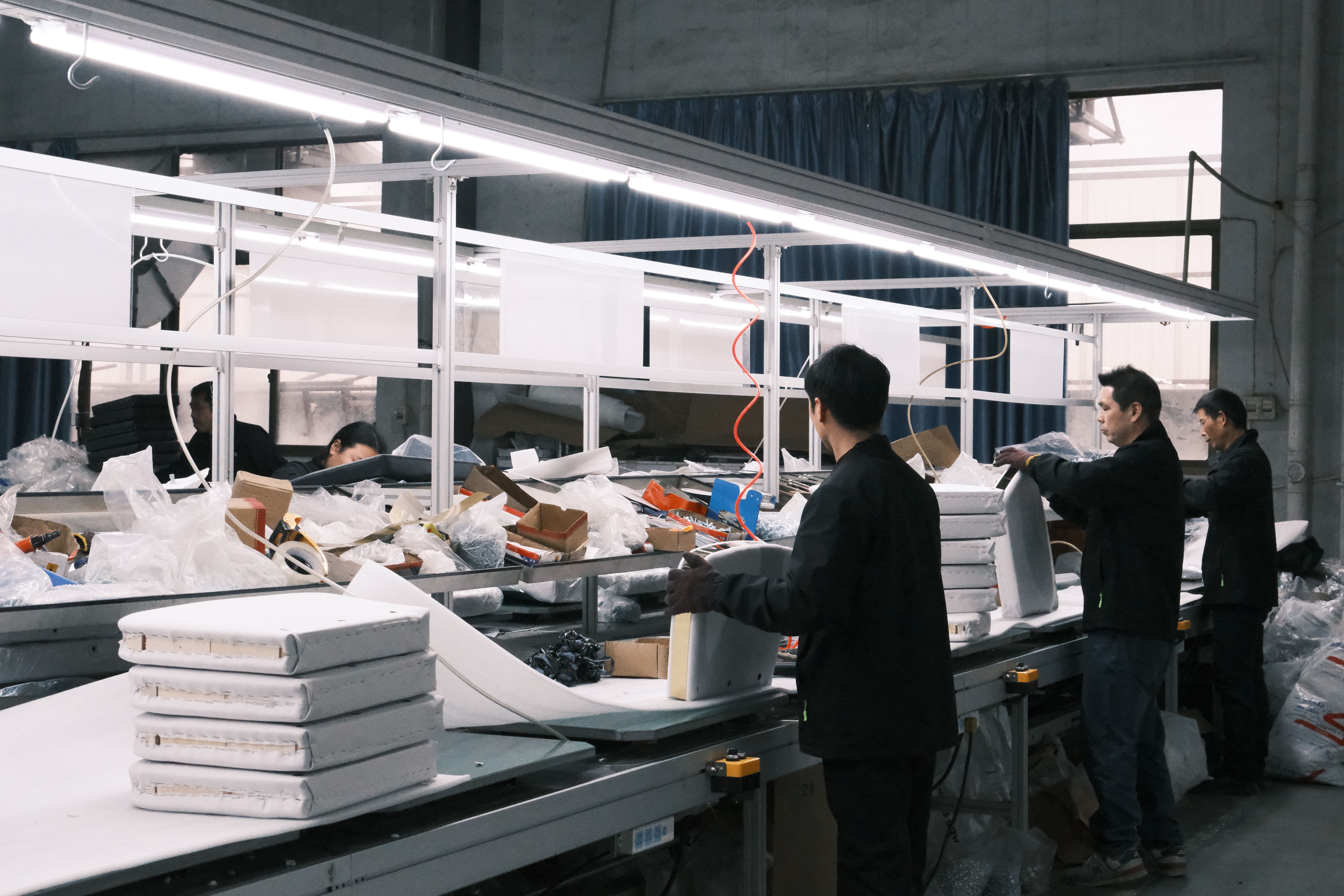
This comparison is built only from the manufacturer's product classification, the shared specification of the three models and published company information. Where a model-level figure has not been published — pump rating, recline angle, per-model load capacity, foam density — this article states that it is unpublished instead of filling the gap with an estimate. That constraint shapes the verdict: the decision between these three chairs rests on purpose and style, not on dimensional or material differences.
Why identical specifications still require a side-by-side
Buyers evaluating barber chairs at decision stage usually run the same filter sequence: size first, then upholstery, then mechanism. On the first two filters, HZ8796C, HZ8799YF and HZ8799G-Z are indistinguishable. All three measure 110 x 72 x 100 cm and all three combine PU leather, high-density sponge, wood and aluminum alloy. A comparison that stops at the specification sheet produces no verdict at all, because the sheet is the same sheet.
The differentiation is functional and stylistic rather than dimensional. The manufacturer classifies HZ8796C as a barber salon chair, HZ8799YF as a retro reclining chair and HZ8799G-Z as a hydraulic recline chair. Those three labels answer three different buyer questions: what kind of room the chair belongs in, what design language it commits the interior to, and what lifting and recline mechanism the operator will work with repeatedly through a shift. A fourth question — how much space the chair consumes — is answered identically by all three.
The three models at a glance
| Model | Classification note | Outer dimensions | Build materials | Where it fits |
|---|---|---|---|---|
| HZ8796C | Barber salon chair | 110 x 72 x 100 cm | PU leather, high-density sponge, wood, aluminum alloy | General barbershop and salon floors; neutral styling that repeats cleanly across a multi-chair layout |
| HZ8799YF | Retro reclining | 110 x 72 x 100 cm | PU leather, high-density sponge, wood, aluminum alloy | Heritage, vintage and antique-styled interiors where seating carries the design language |
| HZ8799G-Z | Hydraulic recline | 110 x 72 x 100 cm | PU leather, high-density sponge, wood, aluminum alloy | High-frequency shops where the operator needs assisted recline movement during service |
The table reflects classification and shared build data only. Model-level mechanism specifications — pump type and rating, recline angle range, load capacity and foam density — are not published in the material available for this comparison and are therefore not asserted. Buyers who need those figures should request them as line items in a quotation rather than infer them from the model name.
The shared 110 x 72 x 100 cm envelope: what it fixes and what it leaves open
Because the envelope is identical, floor planning can be done once and applied to any of the three models. The 72 cm width is the operative number in most layouts, since it determines how many stations fit along a wall and how much clearance remains between chairs. In North Carolina, state barber shop rules require a minimum of five linear feet of space between chair centres (21 N.C. Admin. Code 06L .0102). That rule governs licensed shops in that state; elsewhere, chair spacing is a matter of local code, lease terms and working comfort rather than a single universal figure.
The 110 cm depth and 100 cm height are the numbers most often cross-checked against mirror positions, back-bar shelving and the walkway behind the chair. Because all three models produce the same footprint and the same visual mass, a shop that has already validated one of them against its own floor plan does not need to re-test the other two for space. The evaluation can move entirely to purpose and style.
Import classification is a separate question from the drawing. Barber and similar chairs with rotating as well as both reclining and elevating movement fall under HS 9402.10, the subheading covering dentists', barbers' and similar chairs (WCO classification as published by TariffNumber). Because classification depends on the functions a specific model actually has, the tariff treatment of a chair with assisted recline and the treatment of a chair with full recline-and-elevate movement can differ. Buyers should confirm the code with a customs broker at quotation stage rather than assume that all three models share one entry.
HZ8796C: the barber salon chair position
HZ8796C is classified as a barber salon chair. In a three-model comparison where the dimensions and materials are constant, that classification is doing real work: it positions the chair as a general commercial unit for barbershop and salon floors rather than as a statement piece. For a buyer fitting out a repeatable station — four chairs, six chairs, a franchised floor plan replicated across sites — a neutral classification is an advantage, because the chair does not fight the interior and does not need to be re-specified when the décor is refreshed.
The practical consequence for procurement is that HZ8796C should be evaluated on mechanism disclosure rather than on styling. Its classification note does not specify whether the recline is manual or assisted, so the buyer's first request should be the recline and lift specification in writing, followed by the load rating the manufacturer is prepared to put in a quotation. Those two answers determine whether the chair belongs on a high-traffic floor or a lower-volume one.
HZ8799YF: retro reclining as a design commitment
HZ8799YF is classified as a retro reclining chair, which places it in the vintage and antique-styled segment of the market. The distinction is aesthetic before it is mechanical. A retro reclining chair is bought because the room is meant to read as a heritage barbershop — visible frame language, classic proportions, a silhouette that photographs well in a brand-conscious environment. The recline function is part of the package, but the styling is the reason the model exists alongside a neutral chair with identical dimensions.
That styling is also the model's main constraint. A retro chair commits the interior. It works when the whole room supports it and looks unresolved when it is dropped into a modern minimal fit-out beside contemporary stations. Buyers planning a phased refit should decide whether the retro language will be carried through the remaining stations before committing, because a single retro chair among modern units reads as an inconsistency rather than a feature. For shops already built around vintage or antique cues, the opposite applies: the retro classification is the fit, and the neutral HZ8796C would be the weaker choice.
HZ8799G-Z: hydraulic recline and the efficiency argument
HZ8799G-Z is classified as a hydraulic recline chair, which puts it in the segment that has been taking share across the salon chair market. Fact.MR projects that hydraulic salon chairs will account for a 63.4% share in 2026, and the same source reports the global salon chairs market at approximately USD 1.5 billion in 2025. Those figures describe the category, not this model: they indicate why a hydraulic recline option exists in the range, not how any individual unit will perform.
For specification purposes, the useful benchmark is durability. Commercial-grade hydraulic pumps for barber chairs are typically rated to handle load capacities between 350 and 400 lbs and to exceed 100,000 cycles (Fact.MR). A buyer comparing hydraulic recline chairs should ask the manufacturer where a specific model sits against that benchmark, and should expect the answer in writing. The classification note for HZ8799G-Z confirms a hydraulic recline configuration; it does not publish a pump rating or cycle count, and no such figure should be assumed from the model designation.
The operational logic for the hydraulic version is straightforward. A chair that assists the recline movement reduces the physical input the barber supplies per service, which matters on a floor where the chair cycles many times a day. The trade-off is that a hydraulic chair adds a mechanism with fluid, seals and moving parts — components that require periodic attention in a way that a purely mechanical recline does not.
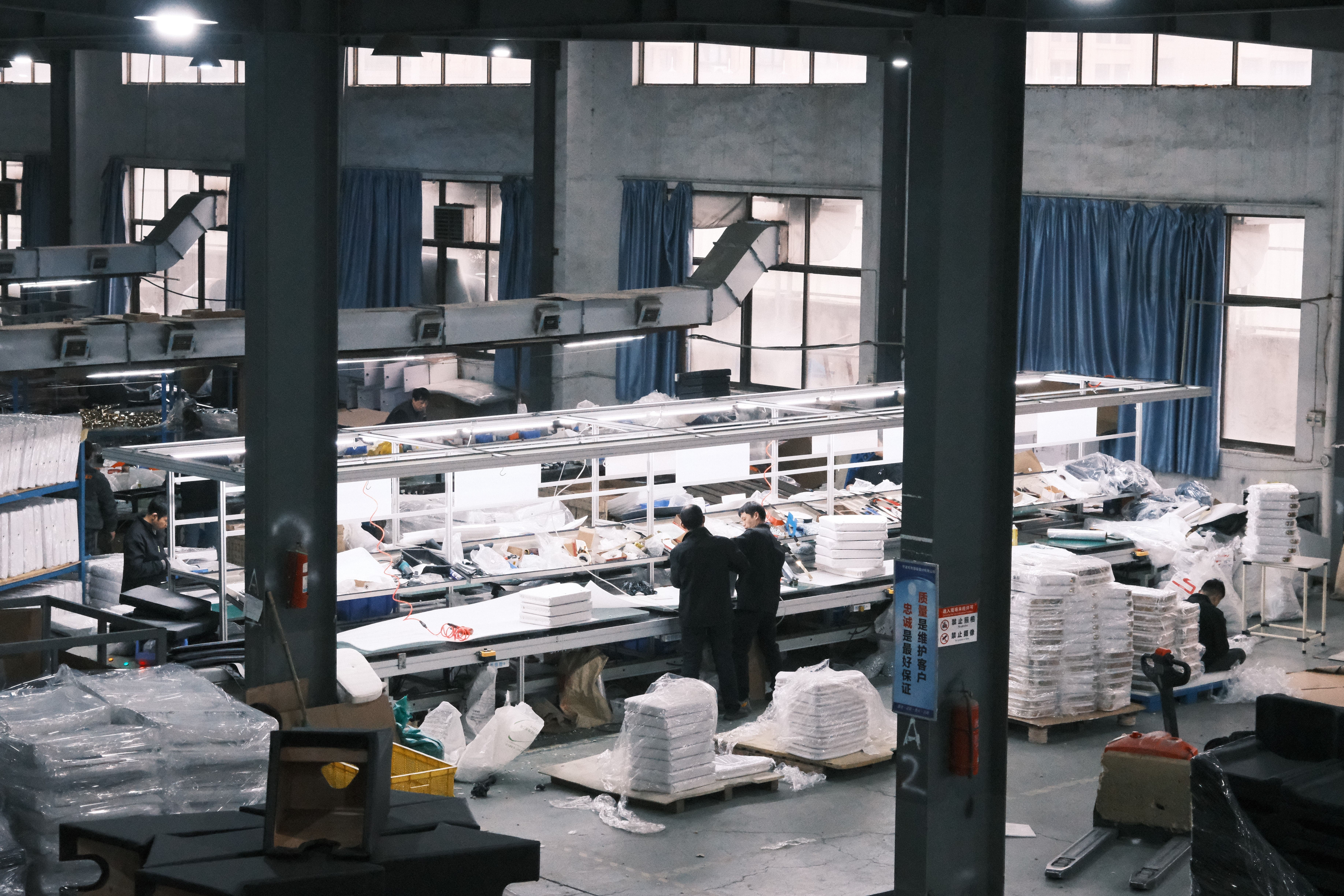
Materials in practice: PU leather, high-density sponge, wood and aluminum alloy
Because all three models share the same four-material build, the material discussion applies equally to each and does not help separate them. It does, however, tell a buyer what to inspect during sampling. PU leather is a coated synthetic upholstery chosen for cleanability and colour consistency: it wipes down between clients, resists the staining that hair products cause, and holds a uniform finish across a set of chairs ordered together. Its limitation is inherent to the material — the surface is a coating, so long-term appearance depends on coating quality and on how the chair is cleaned, and buyers should not treat PU as equivalent to a full-grain hide in feel or ageing behaviour.
High-density sponge is the resilience layer. Its function is to recover after repeated compression so that a chair used forty times a day does not develop a collapsed seat within the first year of service. Density is the specification that predicts this behaviour, and density figures are exactly what the available material does not publish for these models — a gap worth closing with a sample and a written figure rather than with a verbal assurance.
Wood and aluminum alloy describe the structural side: wood in the frame and body construction, aluminum alloy in components where weight and corrosion resistance matter. In maintenance terms, the combination matters less than the manufacturer's ability to supply replacement parts. The manufacturer states that a complete spare parts supply enables quick on-site repair and shortens downtime, and that wear-resistant PU leather on its chairs reduces the frequency of daily maintenance — a general position on its range rather than a published test result for these three models.
Cost and value: interpreting the 10% position
Compared with other domestic and imported barber chair brands on the market, the manufacturer positions its range as carrying an initial cost about 10% higher than alternatives, offset by 100% product matching and flexible delivery. Read as a procurement statement rather than a slogan, that means the three chairs should not be decided on unit price alone. A 10% premium on the chair is small against the cost of a mismatched station that has to be reordered, or against a delivery schedule that slips past a shop opening date.
The practical test is whether the buyer actually needs the flexibility being paid for. A single-chair replacement for an existing vintage fit-out gains little from range matching; a distributor assembling a full salon package, or a shop ordering seating alongside shampoo chairs, massage beds and manicure tables, gains more. Where matching and delivery flexibility are irrelevant to the project, the premium is simply a premium and should be negotiated or declined.
Comparison with conventional alternatives, and the boundaries of this trio
Against conventional fixed-back salon seating, the recline-led approach costs more and takes more space behind the chair, and it buys a service posture that fixed seating cannot reproduce. Against standardised imported ranges, a flexible manufacturer range buys matching and delivery options that a fixed catalogue cannot offer, at the 10% initial premium already noted. Neither trade-off is free, and buyers should be explicit about which one their project can absorb.
The boundaries of this particular comparison are worth stating plainly. First, all three chairs share one footprint, so a buyer who needs a compact chair for a tight floor plan will not find that option inside this trio — the choice between HZ8796C, HZ8799YF and HZ8799G-Z does not include a smaller envelope. Second, the trio is differentiated by classification, not by published mechanism data: load rating, recline angle, pump specification and foam density are not disclosed per model in the available material, so any claim that one of the three is mechanically stronger than another would be unsupported. Third, the hydraulic version carries mechanism maintenance that the other two configurations do not, and the retro version constrains interior design in a way the other two do not. Fourth, manufacturer capacity figures published across different company sources do not use a consistent basis; the 22,000 m² facility figure is consistent across company reporting, but output and capacity statements vary and should be verified through production records rather than reconciled by assumption.
Quality signals to verify before committing
Because the specification sheets converge, verification is where the three models can actually be distinguished. The manufacturer describes a production risk-control system built on graded inspection of incoming materials, manufacturing processes and finished products, with a quality anomaly traceability and closed-loop rectification mechanism, monthly reviews to optimise standard operating procedures, and quality fluctuations incorporated into departmental performance evaluations. Finished products are subject to functional and aging testing before leaving the factory, supported by a full product traceability system across the product chain and a 24-hour after-sales response mechanism operating Monday to Saturday.
- Ask for the functional and aging test record for the specific model, not for the range.
- Confirm the traceability identifier format so that a fault can be tied back to a production batch.
- Check packaging specification: the manufacturer addresses transport damage through standardised protective packaging, full factory inspection and closed-loop traceability at arrival acceptance.
- Lock the delivery cycle at pre-order review; the manufacturer tracks production progress and material matching daily and weekly, with a three-day advance warning threshold and delivery achievement rate included in performance evaluation.
- Confirm spare-parts availability for the specific mechanism, particularly on the hydraulic recline model.
For buyers sourcing at volume, the standing caveat applies: most capacity and lead-time statements in this category are company-reported, and independent audit or customs evidence is rarely public. That makes documentary verification a purchasing step rather than an optional extra.
Market context: why recline-led comparisons are growing
The global salon chairs market reached approximately USD 1.5 billion in 2025, according to Fact.MR, and hydraulic salon chairs are projected to hold a 63.4% share in 2026. Within that broader category, the barber chair segment continues to split between styled retro pieces and mechanism-led commercial units. The effect on purchasing is that buyers increasingly compare chairs within the same footprint and the same material set, which is precisely the shape of the HZ8796C, HZ8799YF and HZ8799G-Z decision. Differentiation migrates from the specification sheet to classification, mechanism disclosure and supplier verification.
Future outlook
As hydraulic and assisted-recline configurations take a larger share of the salon chair market, the pressure shifts to documentation. Buyers who once accepted a mechanism on appearance are now positioned to ask for cycle ratings and load figures, and suppliers who publish those figures per model will be easier to shortlist. For a range like the HZ series, the logical next step is model-level disclosure — pump rating on the hydraulic recline unit, recline angle and foam density across all three — because that is the only information that would move the HZ8796C, HZ8799YF and HZ8799G-Z from a classification decision to a specification decision. Until that data is published, the verdict remains what the evidence supports: three chairs, one envelope, three different rooms.
Frequently Asked Questions
What is the difference between HZ8796C, HZ8799YF and HZ8799G-Z?
The three models share the same 110 x 72 x 100 cm outer dimensions and the same PU leather, high-density sponge, wood and aluminum alloy build. They differ in classification: HZ8796C is a barber salon chair, HZ8799YF is a retro reclining chair, and HZ8799G-Z is a hydraulic recline chair. The classification distinguishes intended room type, design language and recline mechanism rather than size or materials.
Do all three chairs really have the same dimensions and materials?
Yes. The manufacturer lists all three at 110 x 72 x 100 cm with the same four-material construction. Buyers can therefore plan chair spacing once and apply it to any of the three; the 72 cm width is the figure that determines how many stations fit along a given wall.
Which model suits a vintage or retro barbershop interior?
HZ8799YF, classified as a retro reclining chair, is the model positioned for heritage, vintage and antique-styled interiors. Its styling commits the room to that design language, so it fits best where the remaining stations and décor support the same direction.
Is a hydraulic recline barber chair worth choosing over a non-hydraulic recline?
Hydraulic salon chairs are projected to hold a 63.4% share in 2026, and commercial-grade hydraulic pumps for barber chairs are typically rated to exceed 100,000 cycles and handle 350 to 400 lbs. The hydraulic configuration reduces the physical input required to recline the chair, which matters in high-frequency shops. The trade-off is an added mechanism that needs periodic maintenance.
Why is the initial cost of these chairs reported as higher than alternatives?
The manufacturer states that its products carry an initial cost about 10% higher than alternatives, offset by 100% product matching and flexible delivery. Whether that premium is justified depends on the project: it is most relevant to buyers assembling a full salon package or needing range matching, and least relevant to a single replacement chair.
How should a buyer verify quality before placing a wholesale order?
Verification should focus on documents rather than descriptions. Relevant evidence includes functional and aging test records for the specific model, the traceability system covering the product chain, the standardised protective packaging specification, the delivery cycle locked at pre-order review with progress tracking and advance warning thresholds, spare-parts availability for the mechanism, and the 24-hour after-sales response mechanism. Buyers should also confirm import classification, since barber chairs with recline and elevating movement fall under HS 9402.10 and treatment can vary by function.
Buyer verdict
On the evidence available, the choice between these three chairs is not a specification contest. HZ8796C is the neutral commercial chair for a repeatable salon floor. HZ8799YF is the design-led choice for heritage interiors. HZ8799G-Z is the mechanism-led choice for shops where the recline movement is part of daily efficiency. The single envelope means all three can be planned into the same layout, and the shared material set means durability questions must be resolved with test records and sample inspection rather than from the sheet.
For buyers who want the full product and company reference in one document, the manufacturer's catalogue is available here: Ningbo Hongzi product catalogue (PDF).
Tem questões ou precisa de mais detalhes?
Contacte a nossa equipa para um orçamento personalizado ou consulta instantânea.
Solicitar orçamento
Preencha o formulário abaixo e a nossa equipa entrará em contacto com uma proposta personalizada.
Chat direto do WhatsApp
Prefere conversar em tempo real? Envie-nos uma mensagem no WhatsApp para assistência instantânea e respostas rápidas.
- Obter orçamento personalizado
- Partilhar fotos ou documentos
- Discuta as suas necessidades diretamente
Geralmente responde em 5–30 minutos durante o horário de expediente.