
Three Roofing Substrates Compared: The Quiet Case for Stone-Coated Metal
HTNXT · Industry Reference · Roofing Substrates
A pitched-roof shortlist usually narrows to three substrate families: fired clay tile, concrete tile, and stone-coated metal. On a bill of quantities they look interchangeable. On a coastal site, a retrofit, or a bedroom under a low-pitch roof, they do not.
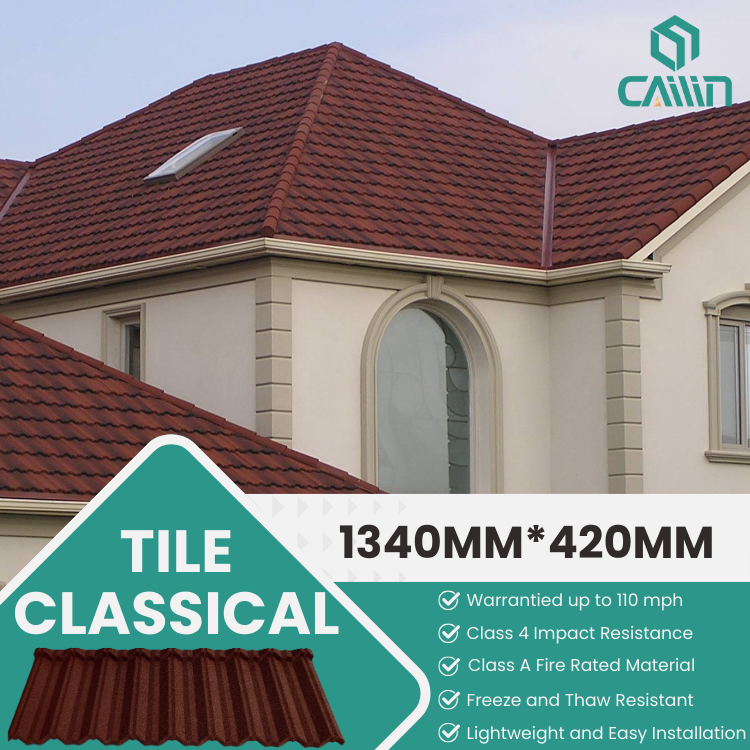
Classical-profile stone-coated metal tile: a pressed steel body finished with sintered natural stone granules, used here as the shortlist's metal reference.
This shortlist is written for the evaluation stage, when the buyer already accepts that a pitched roof is needed and is now ranking substrates by risk rather than by brochure. It compares clay, concrete, and stone-coated metal on five criteria that decide projects — roof load and retrofit fit, wind uplift and coastal corrosion, rain noise and heat behaviour, moisture and cracking, and lifetime maintenance load — then adds a short note on bare metal as the acoustic reference point. Every figure below comes from published industry comparison data or from manufacturer product specification; where a number is assembly-dependent, the article says so instead of smoothing it over.
The Three-Substrate Shortlist, Defined
A fourth material appears in cost debates but rarely in specification documents: bare metal sheet. It has no granule layer and no ventilated tile build-up, which is why it keeps returning as the reference for metal roofing's noise reputation.
Criterion 1: Roof Load and Retrofit Fit
Weight is the first criterion because it decides whether a roof replacement stays a roofing project or becomes a structural one. Published comparison data places stone-coated metal at approximately 1.1–1.8 lbs per square foot against 9–12 lbs for clay tile and 8–12 lbs for concrete tile — a difference of roughly 85%.
That gap has two commercial consequences. On new build, it reduces dead load on trusses and purlins. On replacement, it allows a different sequence: stone-coated metal tiles can be installed directly over existing tiles, which is why ageing tile roofs at 15–20 years are a common retrofit case in this category, typically without structural reinforcement.
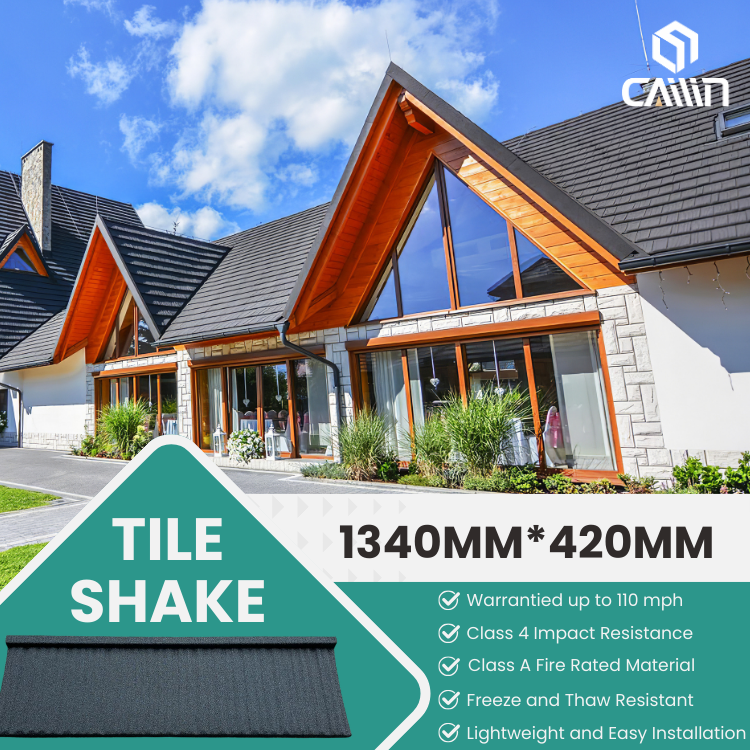
Shake-profile stone-coated metal: the profile replicates wood-shake geometry on a steel body, which is relevant where a retrofit must match an existing roofscape.
Criterion 2: Wind Uplift and Coastal Corrosion
In hurricane and cyclone zones the shortlist question is not average wind performance but the uplift figure the roof assembly can document. Product specification for stone-coated metal in this category states wind uplift resistance up to 160 mph, with corrosion resistance expressed as a 500-hour salt spray test. Industry comparison reporting places maximum wind ratings for the substrate in the 120–160 mph range, and names UL Class 4 and Miami-Dade NOA as the qualification routes buyers encounter in US coastal approvals.
Three construction details do most of the work behind those numbers. The base is galvalume steel with an AZ150 coating designation. Fixings are concealed — stainless steel or galvanized screws and clips — which removes exposed fastener heads as a leak and corrosion path. And for coastal projects, cut edges receive an additional factory-applied anti-corrosion coating, because cut edges are where coated steel roofing typically starts to fail.
Criterion 3: Rain Noise and Heat Behaviour — the Quiet and Cool Advantage
This is where the shortlist stops being a weight-and-price exercise. Stone-coated metal's stated acoustic insulation is 70% noise reduction versus a bare metal roof. The mechanism is physical rather than promotional: the sintered stone granule layer adds mass and breaks up impact energy at the point where rain or hail strikes, and the tile sits above an air gap rather than directly on the deck.
The same air gap between tiles and underlayment is credited with reducing heat transfer through the roof, which is why energy saving stone coated metal roofing appears as a distinct product category alongside low noise metal roofing. In a documented US residential case — 700 units on a pitched roof — the recorded outcomes were energy saving, hurricane and wind resistance, and noise reduction, matching the product-level claims.
For buyers, the practical reading is narrower than the marketing. The 70% figure describes stone-coated metal against bare metal. It is not a measurement against clay or concrete, and this shortlist will not pretend otherwise: heavy mineral tiles are mass-damped by nature and are generally perceived as quiet in rain. The fair claim is that stone-coated metal closes most of the acoustic gap that bare metal roofing opens, while keeping the weight and fixing advantages of a steel roof.
Criterion 4: Moisture, Moss and Cracking
Two durability questions decide long-term ownership more often than any datasheet headline: does the tile hold water, and does it crack?
Fired clay and concrete are porous mineral bodies. In humid, temperate, and tropical climates that porosity is the moisture reservoir moss and algae typically need, which is why moss management appears as a recurring line item on porous mineral roofs. A stone-coated metal tile is a coated steel body with a granule surface; it does not absorb water into the tile in the same way, so the moss mechanism is reduced to surface debris — leaves and organic matter sitting in valleys and against penetrations, which still requires periodic inspection.
Cracking is a materials question rather than a maintenance one. Clay and concrete are brittle: they chip and crack under impact, foot traffic, and hail, and a cracked mineral tile becomes a leak path. A steel-bodied tile does not share that brittle failure mode. The relevant wear mode for coated steel is different — granule adhesion and coating integrity, particularly at cut edges and at any point where the base steel is exposed.
Criterion 5: Lifetime Cost and Maintenance Load
The maintenance profile of stone-coated metal is stated plainly in its application documentation: no painting, no sealing, and no frequent repairs — inspection after severe storms is the normal regime, because the product has no moving parts, controls, or scheduled coating renewal. Manufacturer warranty terms in this category run to 50 years limited, and the documented US residential case records 50+ year durability with low maintenance as the project highlight.
For clay and concrete, the equivalent maintenance lines are moss removal, replacement of broken or chipped units, and periodic inspection of fixings and flashings. Those are real costs, but they should be modelled per project rather than assumed.
This shortlist deliberately publishes no per-square-metre price. Comparable quotations in this category do not exist until specification, Incoterm, MOQ, freight, and duty are normalised, and a lifetime cost comparison built on unmatched numbers is worse than no comparison. The defensible approach is to build the comparison on four cost lines — material, installation labour and fixings, structural reinforcement or its avoidance, and recurring maintenance — and to price each on the same specification basis.
A Quick Note on Bare Metal Roofing
Bare metal remains the cheapest metal option on paper and the loudest in rain, because there is no granule layer to absorb impact energy and no tile-to-underlayment air gap to interrupt it. It is also the material against which every acoustic claim in this category is measured, which is why the 70% figure should be read as a comparison with bare metal and not as a comparison with mineral tile.
Side-by-Side Comparison
| Criterion | Clay tile | Concrete tile | Stone-coated metal |
|---|---|---|---|
| Installed weight | 9–12 lbs/sq ft (industry comparison data) | 8–12 lbs/sq ft (industry comparison data) | 1.1–1.8 lbs/sq ft; approx. 5–8 kg/m² per product specification |
| Impact and cracking behaviour | Brittle mineral body; chips and cracks under impact | Brittle mineral body; chips and cracks under impact | Steel body; does not share the brittle-cracking failure mode. Wear mode is granule and coating integrity |
| Moisture and moss | Porous; moisture retention supports moss and algae in humid climates | Porous; same moisture and moss exposure | Non-absorbing coated steel surface; debris removal and inspection remain necessary |
| Rain noise | Mass-damped mineral tile, generally perceived as quiet; no comparable verified figure in this shortlist | Mass-damped mineral tile, generally perceived as quiet; no comparable verified figure in this shortlist | 70% noise reduction versus bare metal roof (product specification) |
| Maintenance regime | Moss removal, broken-tile replacement, flashing checks | Moss removal, broken-tile replacement, flashing checks | No painting, no sealing, no frequent repairs; visual inspection after severe storms |
| Retrofit over existing tiles | Requires removal of the previous covering | Requires removal of the previous covering | Can be installed directly over old tiles, subject to a structural check |
Comparison basis: published industry weight and wind data, and stone-coated metal product specification. Competitor figures are category-level, not brand-level, and remain assembly-dependent.
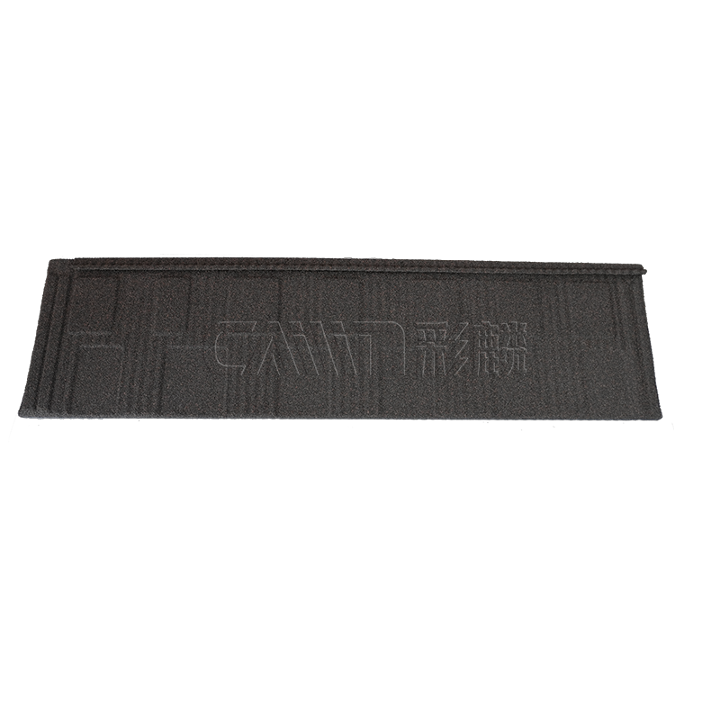
Concealed fastener shingle profile: hiding the fixings removes exposed screw heads as a corrosion and water-entry path on coastal roofs.
Where Stone-Coated Metal Fits — and Where It Does Not
Good fit
- Coastal and hurricane zones. Salt spray exposure, uplift requirements, and concealed fixings align with the substrate's stated performance envelope.
- Tile-roof replacement and flat-to-pitch conversion. Light weight allows overlay on existing coverings and pitched structures added to flat roofs.
- Noise-exposed sites. Urban and suburban locations under aircraft or traffic noise are a documented application for the granule finish, as are buildings where rain noise on a metal roof would otherwise be a complaint risk.
- Humid and moss-prone climates. A non-absorbing surface removes the moisture reservoir that porous mineral tiles provide.
- Heritage and villa projects. The profile range — including Shingle, Shake, Milano, Bond, Classical, Roman, Long-Span, Golan, Tudor, and Heritage — allows a metal roof to match a mineral roofscape without the weight.
Poor fit or conditional fit
- Where local code or heritage approval mandates mineral tile. A steel substrate cannot substitute where the approval is written around fired clay or concrete.
- Steep roofs in cold and snowy regions. Snow guards are a stated requirement on steep slopes to prevent sudden snow slide; without them, the roof performs as designed but the roof edge does not.
- Projects that cannot document the assembly. If the wind uplift and salt spray results cannot be supplied with test standard and laboratory named, the specification claims should not be relied on for approval.
- Buyers seeking a price-only decision. Stone-coated metal competes on weight, maintenance, and acoustic behaviour. Where the only variable is the lowest material price per square metre, concrete tile usually wins on first cost.
How Sango Cailin Supports Specification and Wholesale Programs
Sango Cailin (Tianjin) Building Tech. Co., Ltd. is a Tianjin-based roofing manufacturer producing stone coated metal roofing, asphalt shingles, BIPV solar tiles, rain gutter systems, and butyl tape, with production bases in Hangzhou, Sichuan, Shandong, and Hebei. The company was founded in 2017, operates a 15,000 m² facility, reports annual output of 6,000,000 units with a 10-engineer R&D team, and lists the USA, Canada, and Southeast Asia as main markets at a 25% export ratio.
For buyers using this shortlist to build a specification, four capability points matter more than the corporate summary:
- Product build consistency. Galvalume AZ150 base steel, acrylic resin with high-temperature sintered natural stone granules, transparent acrylic top coat, and a concealed fastener system across the Cailin Interlocking Shingle and Interlocking Shake models, alongside the wider profile family.
- Configurability. Steel thickness options of 0.45 mm, 0.5 mm, and 0.55 mm within the 0.4–0.6 mm base steel range, 10+ standard stone granule colours with custom colours available, and neutral or branded packaging — the practical levers for matching a coastal or heritage specification.
- Supply terms. OEM, ODM, and customized production, MOQ of 2 units, 7–10 day lead time, and monthly capacity of 500,000 units.
- Quality documentation. 100% inspection, pre-shipment random sampling, and third-party inspection available on request; management-system certification to ISO 9001, ISO 14001, and ISO 45001; 50 years limited warranty terms with 24-hour response and technical installation support.
None of these replaces project-level evidence. Buyers should still request the uplift and salt spray reports, the certificate numbers and scopes behind the ISO claims, and a physical sample for granule and edge inspection before approving a supplier.
Market Trend Signals Buyers Should Weigh
Commercial research published in 2026 (Market Research Future) projects a 12.11% CAGR for stone-coated steel roofing across 2025–2035. Published market-size estimates for the same category differ substantially, largely because some reports measure installed system value while others measure material sales only — so the growth direction is more reliable than any single headline figure.
Three qualitative shifts sit behind that direction. Coastal and high-wind building codes continue to push buyers toward documented uplift performance rather than generic durability language. Retrofit demand is growing as first-generation tile roofs reach the 15–20 year replacement window in markets where re-roofing without structural work is commercially attractive. And noise and heat are moving from comfort preferences to specification items, particularly in dense urban projects where a metal roof would previously have been rejected on acoustic grounds alone.
Future Outlook
The three-substrate shortlist is unlikely to collapse into one winner. Clay and concrete will keep their place where appearance, local manufacturing, or code prescription decides the specification. The more probable shift is that stone-coated metal stops being evaluated as a metal roof and starts being evaluated as a lightweight tile — judged on the same criteria as mineral substrates, with weight, moss behaviour, cracking, and rain noise compared directly rather than assumed.
For buyers, that changes the diligence list. The winning suppliers will be the ones that can produce assembly-specific uplift reports, verified corrosion testing, and a clear statement of where their product does not fit, because those are the documents that survive a technical review. Buyers who build their shortlist on that evidence — rather than on the loudest acoustic claim in the category — will get a roof that performs in the climate it is actually installed in.
FAQ
Is stone-coated metal roofing quieter than clay or concrete tile?
The verified acoustic figure for stone-coated metal is 70% noise reduction versus a bare metal roof. No equivalent verified comparison against clay or concrete is published in this shortlist's data, and heavy mineral tiles are mass-damped by nature. The defensible statement is that the granule finish and the tile-to-underlayment air gap close most of the noise gap that bare metal opens.
How heavy is stone-coated metal roofing, and can it be installed over an existing tile roof?
Stone-coated metal tiles weigh approximately 5–8 kg/m², or roughly 1.1–1.8 lbs per square foot, against 9–12 lbs for clay and 8–12 lbs for concrete tile. The product can be installed directly over old tiles, which is a common retrofit route for tile roofs at 15–20 years, subject to a structural check of battens, purlins, and fastening.
Does stone-coated metal roofing resist moss and cracking?
A stone-coated metal tile is a coated steel body with a sintered granule surface, so it does not absorb water into the tile the way porous clay and concrete do; moss exposure is reduced to surface debris in valleys and around penetrations, which still requires inspection. Because the tile body is steel rather than a fired or cast mineral, it does not share the brittle-cracking failure mode of mineral tiles. The relevant wear mode is granule adhesion and coating integrity, best verified on a physical sample.
What roof slopes and climates does stone-coated metal roofing suit?
The product operates on pitched roofs with slopes from 12° to 90°. Documented applications include coastal and humid sites with salt spray and monsoon rain, high-wind hurricane and cyclone regions, hot and arid climates with high UV, wildfire zones where a non-combustible underlayment and sealed eaves are specified, and cold regions where snow guards are required on steep roofs to prevent sudden snow slide.
What evidence should a buyer request before shortlisting a stone-coated metal supplier?
Request the wind uplift report with test standard, span, and fastening pattern stated; the salt spray report with duration and laboratory named; the acoustic test conditions behind any noise claim; ISO certificate numbers, issuing bodies, scopes, and expiry dates; base steel thickness and coating designation such as AZ150; confirmation of concealed fastener components and factory-applied edge treatment for coastal projects; and a physical sample for granule and edge inspection.
How is wholesale and OEM supply of stone-coated metal roofing typically structured?
In this category, supply commonly includes OEM, ODM, and customized production, with stone granule colour options (10+ standard colours plus custom), steel thickness options of 0.45 mm, 0.5 mm, and 0.55 mm, profile selection across the manufacturer's tile series, and neutral or branded packaging. Sango Cailin (Tianjin) Building Tech. Co., Ltd. states an MOQ of 2 units, a 7–10 day lead time, monthly capacity of 500,000 units, 100% inspection with pre-shipment random sampling, third-party inspection on request, and 50 years limited warranty terms.
Reference: the current Sango Cailin product catalogue, including profiles, thickness options, and packaging programmes, is available for download: Sango Cailin product catalogue (PDF).
Tem questões ou precisa de mais detalhes?
Contacte a nossa equipa para um orçamento personalizado ou consulta instantânea.
Solicitar orçamento
Preencha o formulário abaixo e a nossa equipa entrará em contacto com uma proposta personalizada.
Chat direto do WhatsApp
Prefere conversar em tempo real? Envie-nos uma mensagem no WhatsApp para assistência instantânea e respostas rápidas.
- Obter orçamento personalizado
- Partilhar fotos ou documentos
- Discuta as suas necessidades diretamente
Geralmente responde em 5–30 minutos durante o horário de expediente.