
Tianshun Valve: A Buyer's Guide to Butterfly Valve Capability
A butterfly valve looks like a straightforward component until a specification has to be written. The same product name covers wafer, lug, half-lug, double-flange, grooved-end, U-type and double-eccentric bodies; four or five end-flange standards; and manual, gear, pneumatic and electric actuation. Global Market Insights valued the global butterfly valve market at USD 11.88 billion in 2026, and a meaningful share of that spend is decided not by brand recognition but by whether a manufacturer's catalogue actually matches the line conditions on the drawing.
This article examines Tianshun Valve Co., Ltd. as a case study in that evaluation problem. It sets out the company's manufacturing base, maps its butterfly valve range against pressure, temperature and media limits, and states plainly where the published range stops. The intent is interpretive rather than promotional: a buyer in the research stage needs a way to read a supplier's portfolio, not a summary of its marketing.
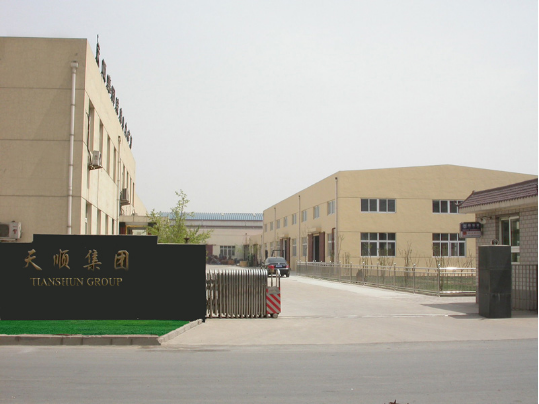
Tianshun Valve production base, Tianjin, China. Source: Tianshun Valve.
What Tianshun Valve Co., Ltd. Is
Tianshun Valve Co., Ltd. is a valve manufacturer founded in 1993 and located at No. 88, Zhuhai Road, Tanggu Ocean High-tech Zone, Binhai New Area, Tianjin, China. The company operates an 8,000 m² factory with a workforce of 50 and a stated annual output of 680,000 units. More than 30 industry experts and engineers are part of the organisation, and 95% of production is exported, with named markets including the United States, Spain, Italy, the United Kingdom, Germany, Turkey, South Korea, Singapore and India.
Its product scope extends beyond butterfly valves to ball valves, globe valves, gate valves, groove valves, check valves and control valves. Within the butterfly valve category, the published range covers wafer, lug, half-lug, U-type, double-flange concentric, double-flange double-eccentric, grooved-end and corrosion-resistant designs, supported by a double plate check valve, a Y-shaped filter and a knife gate valve. The company reports year-round cooperation with China National Petroleum Corporation, Wuhan Shipyard, Wuhu Shipyard and Tianjin Port Shipbuilding Heavy Industry.
Two facts in that profile matter more than the rest for procurement planning. The first is vertical integration: machining, assembly and pressure testing are performed inside the company's own factory, which shortens the loop between a drawing revision and a shipped valve. The second is the export ratio. A 95% export share implies a working familiarity with third-party inspection and multi-standard documentation, which is usually the point where new suppliers fail first.
Why Butterfly Valve Sourcing Is Harder Than It Looks
The practical difficulty in this category is not finding suppliers. It is comparing them. A buyer evaluating three quotations for a DN200 isolation valve may be looking at three different products: a concentric soft-seated wafer body, a double-flange concentric body. and a double-offset flanged body. Those designs differ in sealing principle, operating torque, seat life and cost, even when the face-to-face dimension and the pressure class are identical.
Layered on top of that is standards fragmentation. End-flange options across the Tianshun range include EN1092 PN6, PN10, PN16 and PN25, ANSI 150, AS2129 Table D/E/F, SABS Table 1000/1600 and JIS 10K/16K. Face-to-face dimensions may follow EN558-20 and API609-2-A for wafer and lug bodies, EN558-13/14 and API609 3C-B for double-flange bodies, or EN558-16 for the double plate check valve. A supplier that can hold several of these in one production system reduces the risk of a mismatch discovered at installation rather than at quotation.
Actuation adds a third variable. ISO 5211 defines the top mounting interface, which determines whether a lever, worm gear, pneumatic actuator or electric actuator can be fitted without an adapter. When a valve is specified for automated operation, that interface is as much a procurement criterion as the body material.
How Sealing Design Sets the Real Performance Ceiling
Sealing architecture, not body material alone, determines where a butterfly valve can be used. Three tiers are relevant here, and only the first two appear in the published Tianshun butterfly valve range.
Concentric butterfly valves seal by interference between the disc and a rubber seat. That geometry is simple, compact and the least expensive of the three, but it is limited to approximately PN16 and 80 °C, which suits water and HVAC service. Double-offset butterfly valves lift the disc off the seat before rotation, which reduces seat friction and extends seat life under medium pressure and temperature duty. Triple-offset designs go further, using a conical metal-to-metal seat engaged by torque in the final few degrees of disc travel to produce a torque-seated shutoff at ratings of PN100 and above and service temperatures of 400 °C and above.
The distinction matters because relative cost rises with each step. Concentric valves carry the lowest relative cost with low pressure and temperature limits; double-offset valves extend seat life at medium duty at a higher cost; triple-offset valves carry the highest relative cost and provide fire-safe metal shutoff. A buyer who specifies a double-offset body for a clean-water HVAC line is paying for capability the line does not need. A buyer who specifies a concentric body for a 200 °C process line has specified a valve that will fail early.
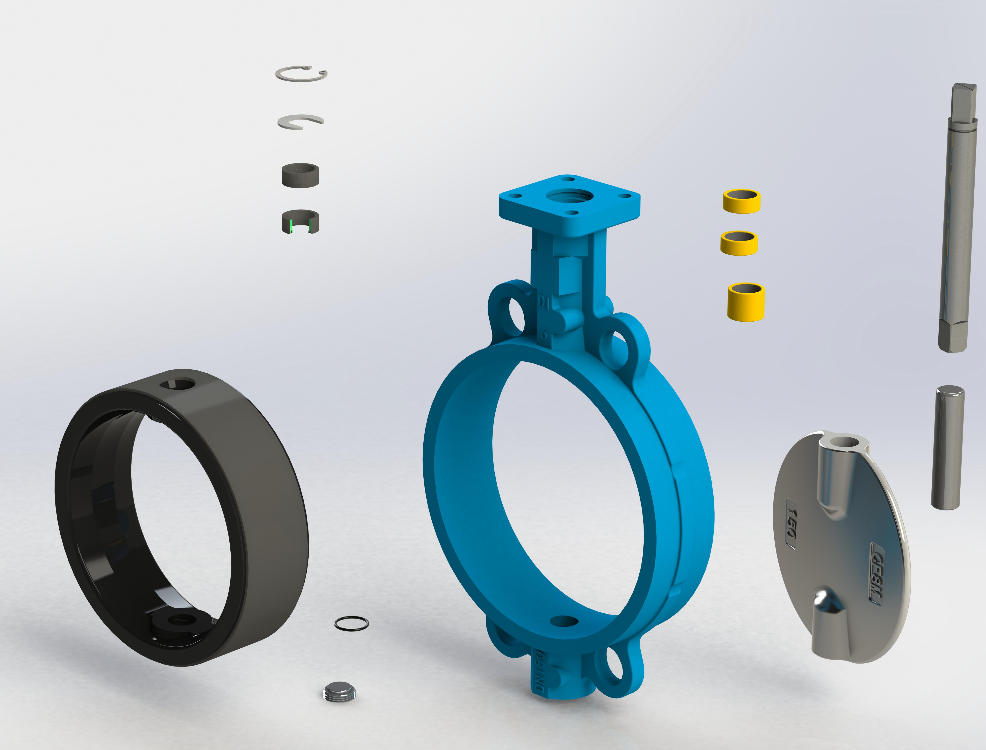
Exploded view of a wafer type butterfly valve: body, disc, seat and stem assembly. Source: Tianshun Valve.
Material Selection: Body, Disc and Seat
Body materials in the range are ductile iron, cast iron, stainless steel, carbon steel and bronze, and bodies are finished with fusion bonded epoxy coating. The functional split is worth restating because it drives service life more than any other decision after sealing design:
- Ductile iron with epoxy coating — clean water and HVAC service.
- Carbon steel WCB — high-pressure, non-corrosive duty.
- CF8/CF8M stainless steel — seawater and mild chemicals.
- Duplex 2205 — chloride-rich and desalination service.
Seat material sets the temperature window. EPDM is rated from -30 °C to 120 °C, NBR from -20 °C to 100 °C for oil and fuel service, and PTFE from -20 °C to 150 °C for chemical service. In practice the lowest-rated component in the assembly governs the safe working envelope, and that is usually the seat rather than the body.
The Butterfly Valve Range, Model by Model
The published range is broad but internally coherent: each body style targets a specific installation constraint, and the size spans overlap rather than compete.
| Model | Product | Size range | Key design references |
|---|---|---|---|
| BFU | U type butterfly valve | DN40–DN1800 | EN593, API 609, ISO 5211; face-to-face EN558-20, API609-2-A |
| BFFF | Double flange double eccentric butterfly valve | DN40–DN1800 | EN593, API 609, ISO 5211; face-to-face EN558-13/14, API609 3C-B; up to PN25 |
| BF2F | Double flange concentric butterfly valve | DN50–DN1800 | EN593, API 609, ISO 5211; pin-connected stem and plate |
| BFL | Lug butterfly valve | DN50–DN1000 | EN593, API 609, ISO 5211; face-to-face EN558-20, API609-2-A |
| BFHW | Half lug butterfly valve | DN40–DN300 | EN593, API 609, ISO 5211; PTFE seat with elastomer backing |
| BFI | Industry butterfly valve | DN50–DN300 | EN593, API 609, ISO 5211; lubricated maintenance point |
| BFW | Wafer butterfly valve | DN40–DN1000 | EN593, API 609, ISO 5211; replaceable seat |
| BFW | Corrosion resistant butterfly valve | DN50–DN600 | EN593, API 609, ISO 5211; PTFE lining |
| BFW | Grooved end butterfly valve | DN50–DN300 | AWWA C606 / ISO 6182; coupling installation, no flange |
| BFD | Double plate check valve | DN40–DN1000 | EN593, API 609, ISO 5211; face-to-face EN558-16 |
Published model designations, size ranges and design references, Tianshun Valve.
Wafer and lug bodies
The BFW wafer butterfly valve covers DN40 to DN1000 and is positioned for pipeline flow isolation and flow control across industry, construction, marine and irrigation applications. Its seat is replaceable, which matters in abrasive or cycling duty where the seat wears before the body does. The BFL lug body extends to DN1000 and adds two features that change how a line can be operated: tooth-disc positioning, which lets the disc be set at intermediate opening angles for flow control, and a lever locking device that holds the valve in a set position or a locked state. For a line that needs repeatable partial-opening positions rather than simple on/off, those two details are the deciding difference between the lug and wafer versions.
The BFHW half lug body is the compact end of the family, DN40 to DN300, available with manual, pneumatic or electric operation. Its construction uses a PTFE sealing ring with a high-elasticity elastomer backing and a spherical sealing belt machined to close tolerance, which is intended to hold a tight shutoff over a long service period. It is a reasonable fit for smaller isolation duties where a full lug pattern would be over-specified.
Double-flange bodies: concentric and double eccentric
The BF2F is a double flange concentric butterfly valve from DN50 to DN1800 with a pin-connected stem and plate. Its structural length complies with international standards, which simplifies substitution in projects designed around an existing envelope. The body is rubber-vulcanised for a stable driving torque, and the rubber ends use a water-line form to suit different flange sealing arrangements.
The BFFF is the double-flange double-eccentric model, DN40 to DN1800, rated to PN25. Its double-eccentric geometry reduces friction between the sealing ring and the sealing belt, lowering operating torque and extending operating life. The valve plate provides a 90-degree on-off action, and the Model T sealing ring is adjustable so that it can be replaced and maintained in line rather than returned to a workshop. At working pressures approaching PN25, the disc presents a high Cv flow characteristic, which suits throttling duties where pressure loss across the valve has a cost.
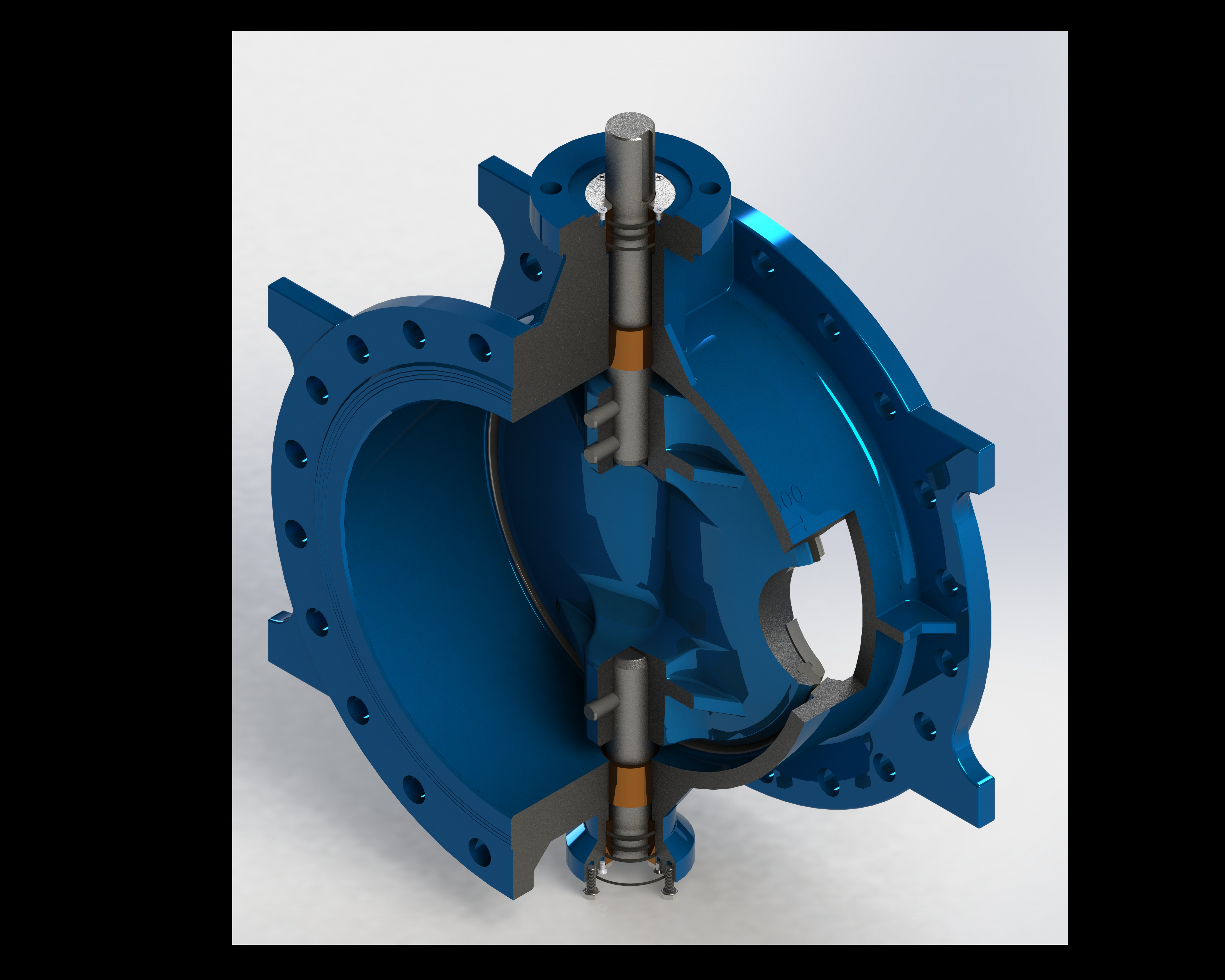
Cutaway of a double offset (double eccentric) butterfly valve showing disc-to-seat geometry. Source: Tianshun Valve.
Special-duty designs
The grooved-end BFW covers DN50 to DN300 and installs with a pipe coupling rather than flanges, meeting AWWA C606 and ISO 6182. That removes flange alignment from the installation sequence, which is why grooved systems dominate fire protection and skid-based process piping where installation speed and joint flexibility matter.
The corrosion-resistant BFW covers DN50 to DN600. It is offered as a fission-type design lined with a PTFE sealing ring, backed by high-elasticity elastomer such as Viton, and intended for aggressive fluid media. The body can also be supplied with alternative corrosion-resistant disc coatings — high-grade stainless steel, PFA coating or a PTFE attached layer — which is the correct place to solve a corrosion problem rather than upgrading the whole body.
The BFI industry butterfly valve, DN50 to DN300, is the general-purpose industrial body: low flow resistance, a lubricating point for maintenance, and a valve core that can be coated to suit the medium. The BFD double plate check valve, DN40 to DN1000, is the companion non-return item, used for regulation and control of drinking water and fluid wastewater flow in pumping stations, power plants, metallurgy, paper, chemical and food industry lines.
Actuation and Automation
Across the range, control methods include lever, worm gear, pneumatic actuator, electric actuator or a combination of these drives, and the actuator mounting interface follows ISO 5211. In combined arrangements, an electric actuator can be mounted on a connection plate linked to a gearbox, and extension rods or wrenches allow operation where the valve sits below the shaft line.
For buyers moving from manual to automated operation, the practical implication is that the same body can be specified once and actuated later without changing the mounting footprint. That is a small detail at quotation stage and a significant one during a plant upgrade, when the alternative is replacing the valve rather than the actuator.
Where the Range Fits: Application Scenarios
The company's application data maps its products against seven industrial settings. The mapping is useful because it shows which design feature is being bought in each case.
| Industry | Working conditions | Design features being bought | Typical models |
|---|---|---|---|
| General industrial piping (chemical, food, pharmaceutical) | Clean medium, low pressure, corrosive medium, hygienic environment | Anti-corrosion, hygienic-grade, leak-proof | BFI, BFW corrosion resistant, BFW grooved, BF2F, BFL |
| Water and wastewater treatment / desalination pretreatment | Seawater, corrosive medium, high humidity, coastal atmosphere, medium pressure | Seawater resistance, epoxy-coated disc, low maintenance | BFW corrosion resistant, BFFF, BFL, BFHW |
| HVAC and power & energy | Chilled water, hot water, closed loop, low-to-medium pressure, indoor | Bubble-tight shutoff, low leakage, low torque, quiet operation | BFW wafer, BFL, BFHW, BFI |
| Shipbuilding and marine | Seawater, high humidity, marine atmosphere, vibration, medium pressure | Corrosion resistance, vibration tolerance, compact design | BFW corrosion resistant, BFFF, BFL, BF2F |
| Municipal water supply | Potable water, low-to-medium pressure, buried installation | Low leakage, epoxy coating, long service life | BFHW, BFL, BFW wafer, BF2F |
| Fire protection | Firefighting water, wet/dry pipe, medium pressure, emergency standby | Quick operation, position indication, lockable device, corrosion-resistant coating | BFW wafer, BFL, BFW grooved, BFHW |
| Oil & gas | Crude oil, produced water, injection water, high pressure, corrosive medium | Fire-safe design, anti-corrosion, high pressure rating | BFI, BFFF, BF2F, BFW corrosion resistant |
Scenario mapping based on published application data, Tianshun Valve.
Two readings follow from this table. First, the double-eccentric BFFF appears in the corrosive, seawater and high-pressure scenarios, which is consistent with its PN25 rating and reduced seat friction. Second, the corrosion-resistant BFW appears in nearly every scenario, which suggests that lining and coating selection is the single most reused engineering decision in the portfolio rather than a niche option.
What the Market Data Says About Direction
Two independent data points frame where demand is moving. Global Market Insights projects the double-offset butterfly valve segment to reach USD 5.28 billion by 2035, after accounting for a 30% share of the market in 2025. That is a larger share than concentric designs typically command, and it reflects tightening leakage and maintenance requirements in process and utility networks rather than a change in buyer preference for novelty.
The second signal is regulatory. The 10th edition of API Standard 609 was published on 18 May 2026, with a programme effective date of 1 December 2026 for monogram licensees. Because API 609 governs double-flanged, lug and wafer butterfly valves, the transition creates a defined window in which design documentation, face-to-face dimensions and pressure-temperature ratings may need to be re-verified against the new edition. Buyers writing specifications during that window should state which edition they require, and suppliers should be able to say which edition their drawings follow.
A third, quieter signal sits in trade classification. HS code 8481.80.3075 applies specifically to butterfly type taps, cocks and valves of steel, hand operated. For importers, that specificity is useful: it reduces classification ambiguity at customs, provided the product description on the commercial invoice matches the valve actually shipped.
How Tianshun Compares With Typical Sourcing Options
Placed against three common alternatives — a large multinational valve group, a very large Chinese export manufacturer, and a regional trading house — the Tianshun position is best described as a mid-sized specialist with a wide catalogue and a narrow technical ceiling.
| Dimension | Typical multinational group | Tianshun Valve | Regional trading house |
|---|---|---|---|
| Product breadth in butterfly valves | Broad, including triple-offset metal-seated | Broad within concentric and double-offset soft-seated designs | Narrow, sourced from third parties |
| Manufacturing control | Multi-plant | In-house machining, assembly and pressure testing | None; resale only |
| Size coverage | Full range | DN40–DN1800 depending on model | Whatever is in stock |
| Customisation | Available, long lead time | OEM/ODM, drawing-based customisation | Limited |
| Third-party inspection and export documentation | Standard | Stated as part of export-ready support | Variable |
| Certification verification | Published and auditable | Design references stated; licence status to be verified per project | Usually unavailable |
Comparative positioning based on published company information and standard industry practice. Not a ranking.
Three boundaries worth stating plainly
Technical ceiling. The published Tianshun butterfly valve range is built around concentric and double-offset soft-seated designs from DN40 to DN1800. The available material does not include a triple-offset metal-seated model, so duty at PN100 or 400 °C and above lies outside this range and requires a different supply route. Buyers with high-temperature steam or severe-service fire-safe requirements should establish this early rather than at drawing approval.
Scale. An 8,000 m² plant with 50 employees and 680,000 units of annual output places the company in the mid-sized specialist category. That is often an advantage for customised and mixed-model orders, where a smaller engineering team can respond faster. It is a consideration for buyers placing multi-thousand-unit annual programmes, who should confirm available capacity and lead time against their delivery schedule rather than assume it.
Standards are references, not certificates. EN593, API 609 and ISO 5211 appear throughout the product data as design references. Holding an API monogram licence, a UL/FM listing or a class-society approval is a separate status. The distinction is not a criticism of the company; it is the standard distinction that any competent buyer should apply to any supplier, and it is the single most common source of late-stage procurement surprises in this category.
Future Outlook
Three forces are likely to shape how this segment is evaluated over the next several years. The first is the API 609 10th edition transition, which will force a documentation refresh across double-flanged, lug and wafer product lines and will reward suppliers whose drawings were already maintained to a traceable standard. The second is the continued shift of medium-duty process applications from concentric to double-offset designs, driven by seat life and in-line maintainability rather than by price. The third is material selection in seawater and desalination duty, where duplex 2205 and higher-grade stainless bodies are increasingly specified in place of coated carbon steel.
For a manufacturer of Tianshun's profile, the strategic question is not breadth — the catalogue already spans most installation constraints — but depth of evidence. Buyers in the research stage increasingly ask for pressure-temperature curves, seat lifecycle data and third-party test reports rather than catalogue photographs. Suppliers who can produce those documents quickly will win specification positions that price alone does not secure.
A Practical Procurement Checklist
The following sequence is a workable way to convert a supplier catalogue into a defensible specification, regardless of which manufacturer is being evaluated.
- Confirm the sealing architecture required by the line: concentric for water and HVAC up to approximately PN16 and 80 °C, double-offset for medium pressure and temperature duty, and a different supply route entirely for metal-seated high-temperature work.
- Fix the end-flange standard before requesting a quotation — EN1092, ANSI 150, AS2129, SABS or JIS — and confirm it matches the mating flange on site.
- Verify face-to-face dimensions against the pipe spool drawing, not against the valve datasheet alone.
- Select the seat material from the operating temperature and medium, and treat the lowest-rated component as the working limit.
- Specify the actuation interface to ISO 5211 even if the valve will be manual at installation.
- Check whether the seat is replaceable in line, and whether the design allows retightening or replacement without removing the body from the pipeline.
- Request the certificate for every certification the project requires, and confirm the model and size fall within its scope.
- State the applicable edition of API 609 and any other governing standard in the purchase order.
Frequently Asked Questions
How should a wafer butterfly valve be installed?
The wafer body sits between two pipeline flanges, so installation sequence determines whether the seat survives. The disc should be fully closed before the valve is positioned, the pipeline flanges aligned and pipe spacing checked, gaskets inserted with the body centred, and the flange bolts tightened evenly in a cross sequence. After assembly the valve should be cycled open and closed to confirm smooth operation. The pipeline must be depressurised before installation, the disc must never be used to force pipe alignment, and the disc must not contact the flange inner wall.
How is an electric actuated butterfly valve commissioned?
Commissioning begins with verifying that the supply voltage matches the actuator rating. Power and control signal wiring then follow the actuator manual, after which the open and close limit positions and the torque protection settings are configured. Local and remote open-close commands are tested, and the flow regulation response is checked under the control signal. Power must be cut off before wiring, actuators used in explosive atmospheres must carry a matching explosion-proof class, and moving parts must not be touched during testing.
What maintenance keeps a butterfly valve reliable over a long service life?
Regular maintenance consists of cycling the valve fully open and closed at least once per period, inspecting flange connections and the stem for leakage, lubricating stem threads and bearings, checking the seat and disc sealing surface for wear, and replacing seals or seats once leakage appears. The pipeline should be depressurised and drained before any disassembly, and valves handling corrosive media should be flushed and handled with protective equipment before servicing.
What pressure and temperature limits should buyers expect from a soft-seated butterfly valve?
Ratings depend on the design standard, body material, seat material and end connection together. Published end-flange options in this range include EN1092 PN6, PN10, PN16 and PN25, ANSI 150, AS2129 Table D/E/F, SABS Table 1000/1600 and JIS 10K/16K, with the double-eccentric BFFF stated to PN25. Concentric designs are limited to approximately PN16 and 80 °C. Seat materials set the temperature window: EPDM from -30 °C to 120 °C, NBR from -20 °C to 100 °C for oil and fuel service, and PTFE from -20 °C to 150 °C for chemical service. The lowest-rated component in the assembly governs the safe working envelope.
What is a double plate check valve used for, and how is it selected?
A check valve opens and closes automatically through the pressure difference across the disc, preventing backflow. The BFD double plate check valve covers DN40 to DN1000 and is used for regulation and control of drinking water and fluid wastewater flow, with typical applications in pumping stations, power plants, metallurgy, paper industry, and chemical and food industry lines. Selection depends on pipeline direction, available space, flow velocity and medium, and the flow arrow on the body must align with the direction of media travel. A check valve is not an isolation valve and should not be used as one; incorrect installation direction causes failure or water hammer.
Reading the Portfolio Correctly
Tianshun Valve Co., Ltd. presents a coherent mid-market proposition: a manufacturer founded in 1993, operating an 8,000 m² plant in Tianjin, exporting 95% of a 680,000-unit annual output, and offering a butterfly valve range that covers most installation constraints between DN40 and DN1800 in concentric and double-offset soft-seated designs. Its strongest differentiators in procurement terms are the breadth of end-flange and face-to-face standards held in one production system, in-house machining, assembly and pressure testing, and a stated capability for OEM/ODM and drawing-based customisation with third-party inspection and export documentation.
Its boundaries are equally clear: no triple-offset metal-seated product in the published range, a mid-sized plant footprint, and standards cited as design references rather than as certified approvals. Those boundaries do not disqualify the supplier for the applications its range targets — water, wastewater, HVAC, marine, municipal, fire protection and general industrial piping — but they do define where a buyer should look elsewhere.
The useful conclusion for a procurement team is procedural. Read the sealing architecture before the brand, read the seat material before the pressure class, and verify certificates before the purchase order. Technical documentation on the range is published at en.tianshun.com.cn.
Tem questões ou precisa de mais detalhes?
Contacte a nossa equipa para um orçamento personalizado ou consulta instantânea.
Solicitar orçamento
Preencha o formulário abaixo e a nossa equipa entrará em contacto com uma proposta personalizada.
Chat direto do WhatsApp
Prefere conversar em tempo real? Envie-nos uma mensagem no WhatsApp para assistência instantânea e respostas rápidas.
- Obter orçamento personalizado
- Partilhar fotos ou documentos
- Discuta as suas necessidades diretamente
Geralmente responde em 5–30 minutos durante o horário de expediente.