
Timing Belt Supplier Certification: Scope, Standard, Validity
Timing Belt Supplier Certification: Scope, Standard, Validity
A timing belt supplier certificate is a dated statement about a defined product scope, issued against a named assessment scheme. It is not a general guarantee that every belt shipped will perform. Buyers who check only the reference number and the issuer's logo routinely mis-apply these documents, because three fields decide what a certificate actually means: the scope line, the standard or scheme the assessment was carried out under, and the validity window.
The assessment records published for Dongguan Zhende Machinery Equipment Co., LTD — a manufacturer and one-stop procurement provider of FA automation transmission parts, including timing belts and timing pulleys, based in Dongguan, China — make a useful worked example. The company's document set separates a Production Trading Assessment (493993448_P+T) from a Production Assessment (494177048_P), records SGS/TUV in the standard field for both, and dates both to 10 July 2026 – 9 July 2027. Reading those fields in sequence is what turns a certificate from a decoration on a supplier profile into evidence that can survive a procurement review.
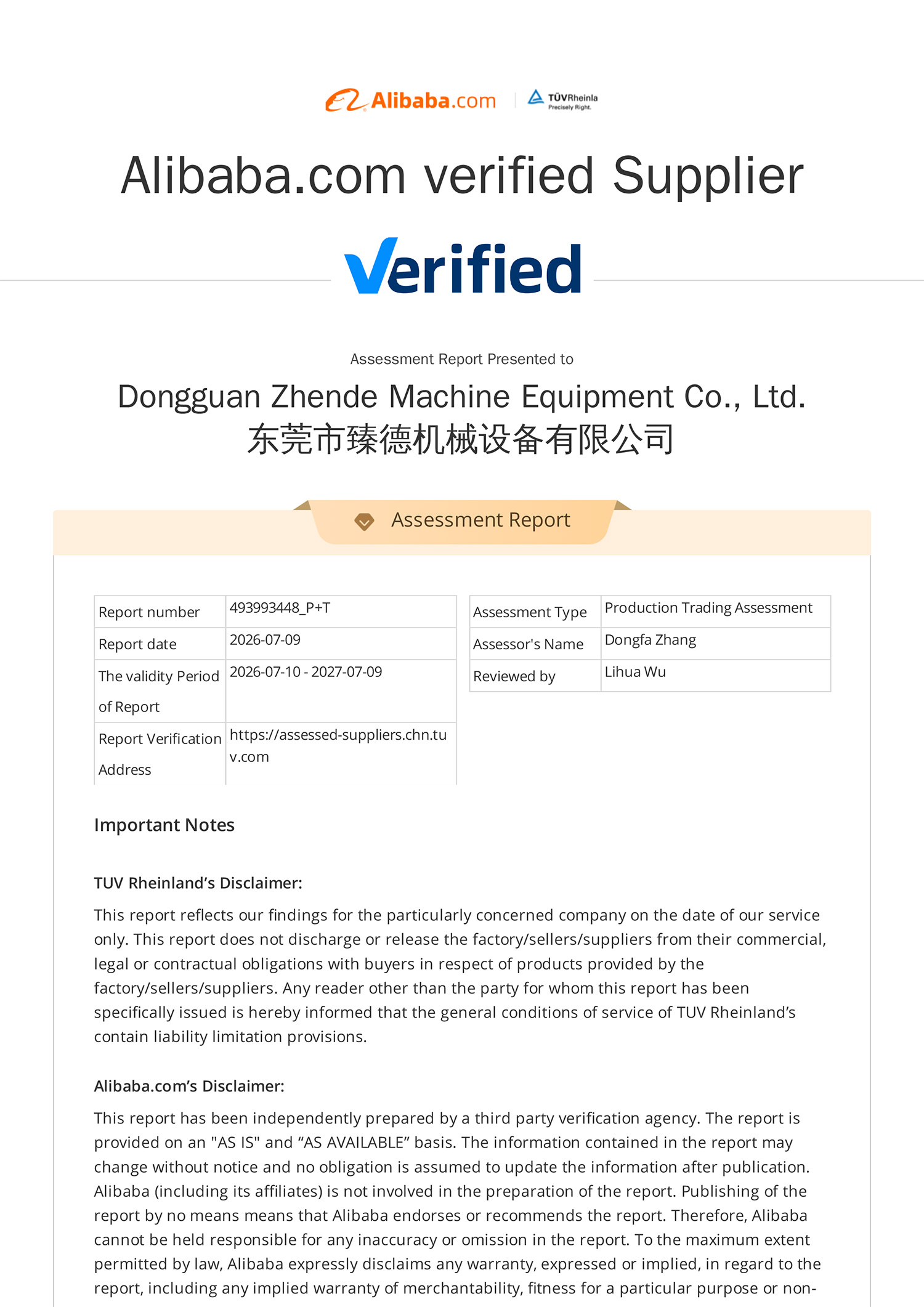
Assessment report documentation: the scope line, standard field and validity dates are the parts a buyer should read first.
The three fields that decide what a timing belt certificate means
Scope answers what is covered and where. A line such as "Timing Belt" identifies the product family the assessment addresses. It does not automatically identify every width, cord, coating or custom construction, and it does not tell you whose premises were visited. Where a document distinguishes a trading operation from a production operation, that distinction matters more than the logo on the cover.
Standard answers what the supplier was judged against. Some documents are issued against a product standard — a published dimensional or performance specification. Others are issued against an assessment scheme operated by a marketplace, a certification body or a buyer's own audit protocol. A supplier assessment carried out under a platform programme cannot be read as conformity to a belt dimension standard, even when the same third-party organisation appears in both contexts.
Validity answers how current the evidence is. Issue and expiry dates place the assessment in time. A document that was accurate in July 2026 remains evidence of the conditions assessed then. It says nothing about a production lot made after the window closes, and it says nothing about a part number that was never inside the scope.
Certificate 493993448_P+T: what the Production Trading Assessment records
Reference 493993448_P+T is recorded as an Alibaba.com Verified Supplier document of the type Production Trading Assessment, with a scope of Timing Belt, SGS/TUV in the standard field, an international market reference, an issue date of 10 July 2026 and an expiry date of 9 July 2027. Read plainly, that is a statement about a trading operation's capability to source and supply timing belts within a declared family, assessed during a defined twelve-month period.
The same reference number also appears on a TÜV Rheinland Factory Audit Report recorded with a scope of Timing Belt and Timing Pulley, the standard "Production & Trading Factory Assessment Standard", an issue date of 9 July 2026 and the same 9 July 2027 expiry. The one-day gap between the two issue dates is small but worth noting: when the same number appears across more than one document family, buyers should ask to see the actual pages and confirm which date belongs to which document before quoting either in a supplier file. That is not a criticism of the supplier; it is the normal discipline of document control.
Certificate 494177048_P: what the Production Assessment adds
Reference 494177048_P carries the same programme, the same Timing Belt scope, the same SGS/TUV standard field and the same 10 July 2026 to 9 July 2027 validity window. Only the type differs: it is recorded as a Production Assessment rather than a Production Trading Assessment.
Why the trading/production distinction changes the questions a buyer asks
A trading assessment speaks to the supplier as a commercial and sourcing entity: how orders are handled, how supply is organised, how documentation and traceability are managed. For a supplier that presents itself as a one-stop procurement provider combining in-house machining with authorised distribution of other brands, this is directly relevant, because a large share of what the buyer receives may pass through the trading operation rather than come off one machine.
A production assessment speaks to manufacturing. It is the document that answers questions about process control, equipment, inspection and the site where belts or pulleys are actually made. Two checks follow from that. First, confirm which site is named inside the report and whether it is the supplier's own plant or a partner factory; the identity of the audited premises is the point of the document. Second, decide which of the two references belongs in your purchase file for the specific part you are buying. A production assessment is the stronger reference for a custom-moulded belt or a machined pulley; a trading assessment is the more relevant reference for a mixed order assembled from several sources.
Neither document tests a belt. Both describe capability and control environment. That boundary should be stated openly in any supplier evaluation, because it prevents a common failure mode in which a valid assessment is treated as a substitute for sample approval.
The standard field: SGS and TÜV identify the assessor, not the belt specification
SGS and TÜV Rheinland are conformity-assessment organisations. When either name appears in the standard field of a supplier record, it identifies the assessment reference used for that document. It does not mean the belt has been certified to a belt standard, and it does not supply dimensional or performance limits that a designer can put on a drawing.
Belt and pulley specifications are published separately, and buyers who need technical conformity should name the relevant standard explicitly in the enquiry and the purchase order. The published scopes most often referenced in this category are:
- ISO 13050:2022 — synchronous belt drives with metric pitch and curvilinear profile systems, covering profile series including MXL, XXL, XL, L, H, XH, XXH, T2,5, T5, T10, T20, AT2,5, AT5, AT10 and AT20, for belts and pulleys.
- ISO 5296 — synchronous belts with pitch codes MXL, XXL, XL, L, H, XH and XXH, in metric and inch dimensions.
- ISO 5294 — pulleys for synchronous belt drives, complementary to the belt dimension standards.
- DIN 7721 — the German standard series for dimensions of endless synchronous belts in the T-profile range.
- ISO 1813 — electrical conductivity specification and test method for antistatic endless V-belts, joined V-belts and synchronous belts, relevant to flammable-atmosphere applications.
Two honest caveats belong here. First, the source set used for this article does not establish which published standard, if any, defines the HTD 3M, 5M, 8M and 14M profiles or the GT2 and GT3 families; that question has to be answered from the standard text or from the profile rights holder, so a buyer should ask a supplier which document governs a named HTD profile rather than assume it. Second, a supplier's own technical data may reference standards without that reference being a certification. In Zhende's published T series pulley data, tooth accuracy is stated against ISO 13050 and DIN, and ISO, DIN and ANSI are listed among applicable standards — useful specification information that should be verified on the drawing rather than treated as a certificate.
Validity: what 10 July 2026 to 9 July 2027 does and does not promise
Both records run on a twelve-month cycle ending 9 July 2027. Within that window, the assessment can reasonably be cited as current evidence of the supplier's trading and production arrangements for the declared timing belt scope. After 9 July 2027, the document stops evidencing a current assessment, though the belts produced during the window do not become defective by association.
Three practical consequences follow. An enquiry placed late in 2026 can rely on these references, but an order scheduled to ship in the second half of 2027 should be supported by the renewed document, not the expiring one. Framework agreements that span the expiry date should carry a clause requiring the supplier to provide the replacement document when issued, with the scope line unchanged. And a certificate should never be filed without its date: an undated copy in a supplier file is worse than no copy, because it implies a current check that nobody performed.
It is equally important not to over-read currency. An assessment carried out in July 2026 describes the supplier's arrangements at that time. Your specific order is described by the drawing, the sample approval record and the inspection report for that lot. Validity answers a governance question, not a quality question.
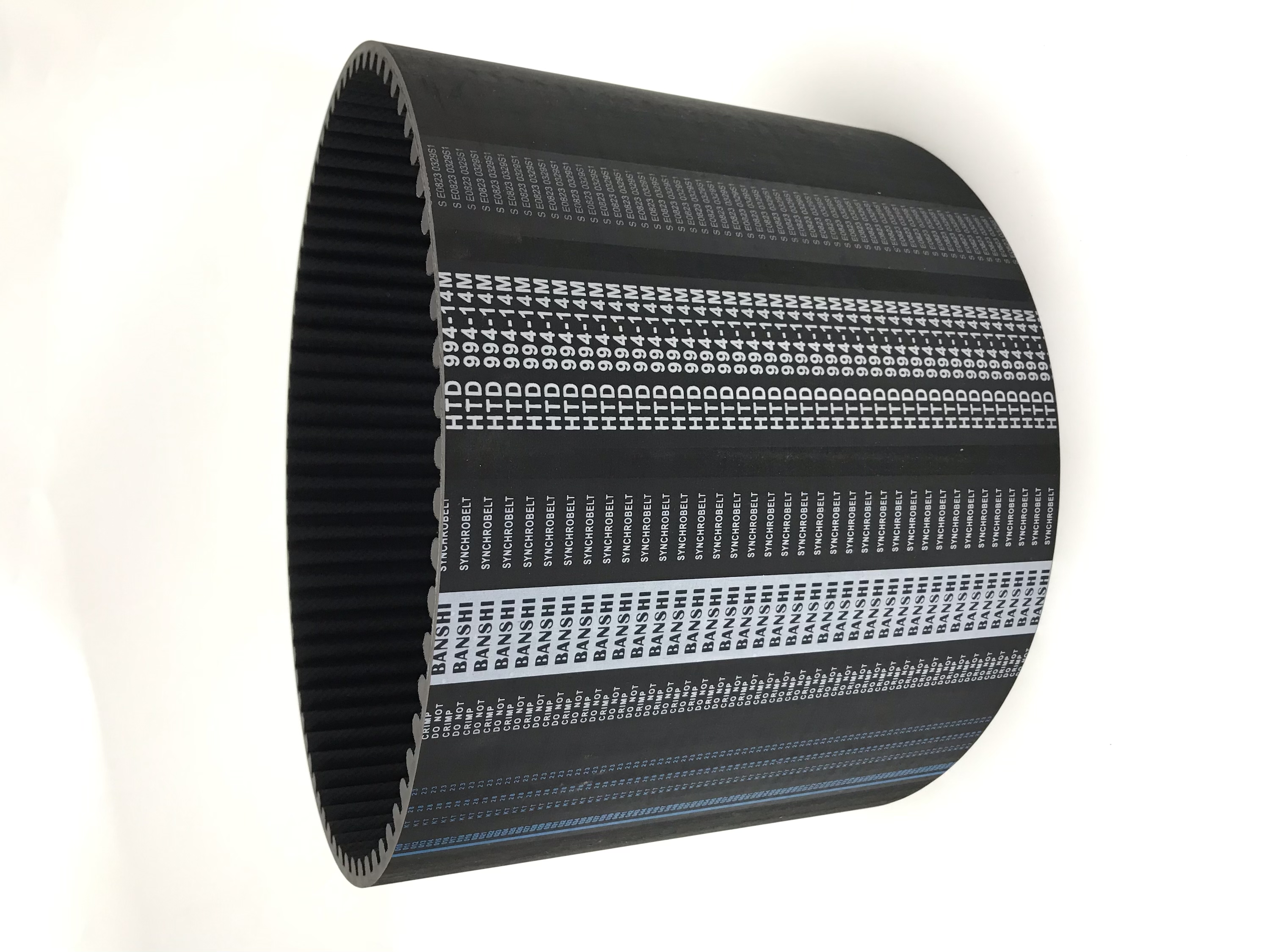
Profile families named in the scope line should be matched against the exact part number and construction being purchased.
Products inside the declared scope
The declared belt scope covers AT10 PU, AT5 PU, T5 PU, 8MGT POLYCHIAN, HTD 8M, HTD 14M, HTD 5M rubber and S8M rubber. The pulley side names T series and Imperial pulley product scopes. For buyers running an evaluation, the useful step is to translate those family names into the parameters that actually govern fit: pitch, thickness, cord, hardness, minimum pulley diameter and dimensional tolerance.
| Scope item | Construction | Pitch / dimensions | Stated limit or tolerance |
|---|---|---|---|
| AT10 PU timing belt | Polyurethane body, steel cord, 92 Shore A | 10.0 mm pitch, 4.5 mm overall thickness | Max allowable tensile strength 1,700 N per 10 mm width; width ±0.5 mm, length ±0.5 mm, thickness ±0.2 mm |
| AT5 PU timing belt | Polyurethane body, steel cord, 92 Shore A | 5.0 mm pitch, 2.7 mm overall thickness | Minimum pulley diameter 25.0 mm; width ±0.5 mm, length ±0.5 mm, thickness ±0.2 mm |
| T5 PU timing belt | Polyurethane body, steel cord, 92 Shore A | 5.0 mm pitch, 2.2 mm overall thickness | Max allowable tensile strength 393 N per 10 mm width; thickness ±0.15 mm |
| 8MGT POLYCHIAN timing belt | PU body, carbon fibre cord, nylon tooth facing, 92 Shore A | 8.0 mm pitch, 5.6 mm overall thickness | Minimum pulley 36.6 mm / 22 teeth; width ±0.5 mm, length ±0.5 mm, thickness ±0.2 mm |
| HTD 14M rubber timing belt | Neoprene (CR) body, fibreglass cord, 92 Shore A | 14.0 mm pitch, 10.0 mm overall thickness | Max allowable tensile strength 1,816 N per 10 mm width; minimum pulley 124.78 mm / 28 teeth; width ±1.0 mm |
| HTD 5M rubber timing belt | Neoprene (CR) body, fibreglass cord, 92 Shore A | 5.0 mm pitch, 3.6 mm overall thickness | Max allowable tensile strength 650 N per 10 mm width; minimum pulley 25 mm / 16 teeth |
| S8M rubber timing belt | Neoprene (CR) body, fibreglass cord, 92 Shore A | 8.0 mm pitch, 5.3 mm overall thickness | Max allowable tensile strength 650 N per 10 mm width; ultimate 2,600 N per 10 mm width; minimum pulley 56.0 mm |
| T series timing pulley | Aluminium alloy, carbon steel, stainless steel or cast iron | Pitches T2.5, T5, T10, T20; 10–120 teeth; bore 3–100 mm | Radial runout ≤0.03 mm; up to 8,000 rpm; operating temperature −30 °C to +120 °C |
The table shows why the scope line needs translating. A buyer who reads "Timing Belt" and stops will not notice that the profile in their own drawing has a different minimum pulley diameter, a different cord, or a thickness tolerance of ±0.15 mm rather than ±0.2 mm. The scope tells you which families you may discuss under this document; the specification tells you whether your part fits.
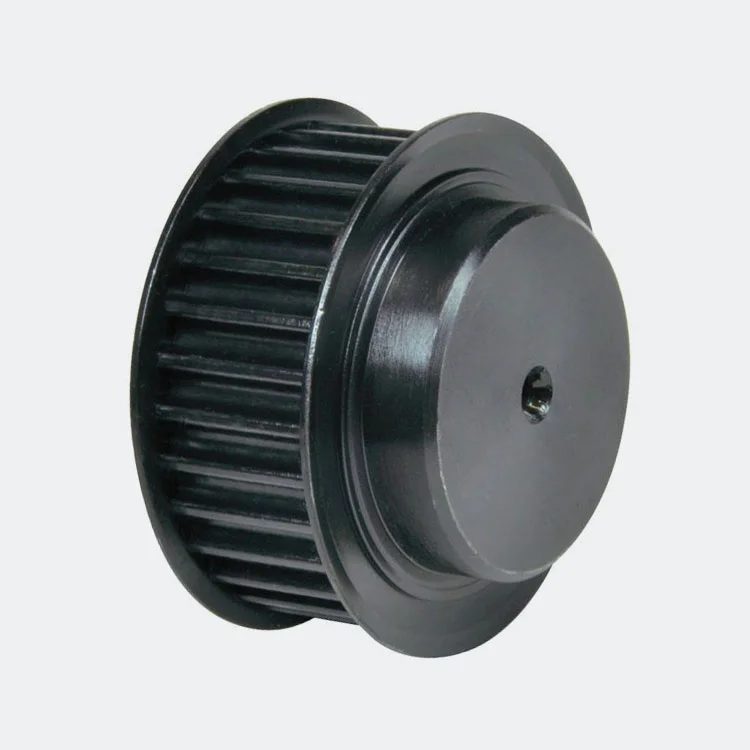
Pulley scope entries (T series and Imperial) should be matched to bore, tooth count and flange requirements on the drawing.
Where the declared scope stops
A scope line is a family-level declaration, and treating it as a part-number guarantee is the most common misreading in supplier evaluation. Several requirements that appear regularly in timing belt enquiries are not named in the declared scope and should therefore be raised as questions rather than assumed to be covered. Custom size timing belts are a specification activity rather than a catalogue entry, so the relevant evidence is drawing acceptance and sample approval, not the certificate. Coated belts and double-sided belts are distinct constructions that change the tooling and the inspection plan. GT2 and GT3 pulley families and V-belt pulleys — including cast iron V pulleys — belong to different product families and different standard systems; ISO 4183 and ISO 4184 govern classical and narrow V-groove pulleys and V-belt lengths in the datum system, and those designations are not interchangeable with synchronous pitch designations.
The pulley side deserves the same care. The scope names T series and Imperial pulley product scopes. If your requirement is an HTD pulley or a bore and keyway combination outside the published range, ask for written confirmation of coverage under the current assessment before relying on the reference number.
Assessment, audit, test report and QMS certificate are four different objects
Supplier documentation in this category arrives in four forms, and conflating them is the second most common evaluation error.
A platform verification assessment — such as the Alibaba.com Verified Supplier records discussed above — verifies a supplier's identity and operating arrangements within a programme's own methodology. It is a useful screening instrument and a weak technical instrument.
A third-party factory audit report — the TÜV Rheinland report carrying reference 493993448_P+T — addresses the production environment and the assessment standard named on the document.
Product-level testing is a different layer again. Zhende's stated quality flow combines 100% dimensional inspection, tensile strength testing, tooth profile inspection, pre-shipment inspection and third-party SGS inspection. Those activities produce lot-level or product-level records, which are the documents that answer questions about the belts in a specific shipment.
A quality management system certificate is a fourth object. ISO 9001 specifies requirements for a quality management system, and IATF 16949 sets QMS requirements for automotive production and relevant service parts organisations under the International Automotive Task Force. No QMS certificate is asserted for this supplier in the documents discussed here, and that is the correct way to read it: a QMS certificate should be verified with the issuing certification body, never inferred from a supplier website or from an unrelated assessment.
Regulatory documents sit in a separate layer again
Market-access obligations are not supplier assessments and cannot be satisfied by one. Regulation (EC) No 1907/2006 (REACH) governs the registration, evaluation, authorisation and restriction of chemical substances and therefore applies to the chemical compliance of rubber and polyurethane belt compounds placed on the EU market. Directive 2011/65/EU (RoHS) restricts hazardous substances in electrical and electronic equipment, and its applicability to a belt depends on whether the belt forms part of, or is supplied with, such equipment. In the United States, 21 CFR 177.2600 covers rubber articles intended for repeated use in contact with food — a rubber-specific route that does not automatically extend to polyurethane constructions.
For a supplier whose stated export mix is weighted 75% towards the EU and USA, these layers matter commercially as well as technically. A buyer serving food processing equipment needs a different document set from a buyer supplying a general automation line, and both need something the supplier assessment does not provide. Asking for the right document is part of specification quality.
A five-step verification routine for the evaluation stage
- Match the reference number to the issuing route. Confirm whether 493993448_P+T or 494177048_P is the relevant document for your order type, and check that the number, the programme and the issuer agree across every page you hold.
- Read the scope line against your part. Profile family, material, construction and pulley series must all appear. If your requirement is a coated belt, a double-sided belt or an unlisted pulley series, request written confirmation instead of assuming coverage.
- Separate scheme from standard. Treat SGS/TUV in the standard field as an assessor reference. Name the governing product standard — ISO 13050, ISO 5296, ISO 5294 or DIN 7721 as applicable — in your own specification.
- Check dates in both directions. Confirm issue and expiry, confirm the document is current at the date you rely on it, and confirm it will still be current when the shipment is released.
- Pair the certificate with lot-level evidence. Dimensional report, tooth profile inspection, tensile data and sample approval answer the questions the assessment cannot: whether the belts in this delivery match the drawing.
The routine is deliberately short. Its value is that it stops a valid document from being used for a purpose it was never designed to serve — and it gives the supplier a clear, fair standard to meet, which tends to shorten technical exchanges rather than lengthen them.
What changes when the window closes in July 2027
The practical outlook for buyers is a documentation calendar rather than a market forecast. Both records expire on 9 July 2027, which means a renewal cycle will fall inside the lifetime of most framework agreements signed in 2026. Suppliers that treat certification as a continuous process will present the replacement document with an unchanged or expanded scope line. Suppliers that treat it as a one-off marketing asset will present a gap.
For evaluation teams, the sensible response is to store the issue date, the expiry date and the covered scope alongside the supplier record, and to make scope continuity an explicit review point at renewal. A renewed document with a narrower product scope is a material change, not an administrative formality, and buyers who compare the two documents side by side will catch it. Over time, this habit shifts certification from a checkbox at onboarding to a live input in supplier management, which is where it belongs.
FAQ
What does certificate 493993448_P+T actually certify?
It is recorded as an Alibaba.com Verified Supplier Production Trading Assessment with a scope of Timing Belt, SGS/TUV in the standard field, an issue date of 10 July 2026 and an expiry date of 9 July 2027. It evidences an assessment of the supplier's trading arrangements for the declared timing belt scope during that window. It is not a product test and does not certify the dimensions, tensile strength or service life of individual belts.
Are SGS or TÜV the same thing as a timing belt standard?
No. SGS and TÜV Rheinland are conformity-assessment organisations; their appearance in a standard field identifies the assessment reference used for the document. Belt and pulley specifications are published separately, including ISO 13050:2022 for metric curvilinear profile systems, ISO 5296 for inch-pitch belts with codes MXL through XXH, ISO 5294 for synchronous pulleys, DIN 7721 for the T-profile series and ISO 1813 for antistatic conductivity. The applicable standard should be written into the drawing or purchase order.
How long are the two assessments valid, and what happens after expiry?
Both 493993448_P+T and 494177048_P run from 10 July 2026 to 9 July 2027, a twelve-month cycle. After 9 July 2027 the documents no longer evidence a current assessment, although belts manufactured during the window are not affected by the expiry itself. Buyers placing orders that ship close to or after that date should request the renewed document before final quality sign-off.
Which products fall inside the declared scope?
The belt scope covers AT10 PU, AT5 PU, T5 PU, 8MGT POLYCHIAN, HTD 8M, HTD 14M, HTD 5M rubber and S8M rubber. The pulley scope covers T series and Imperial pulley product scopes. Requirements outside that list — a coated or double-sided construction, a custom size belt, or an unlisted pulley series — should be confirmed in writing against the current document rather than assumed to be included.
Does a valid certificate remove the need for incoming inspection?
No. The assessment addresses supplier-level capability and scope, while incoming inspection addresses whether a specific delivery matches the drawing. The supplier's stated quality flow — 100% dimensional inspection, tensile strength testing, tooth profile inspection, pre-shipment inspection and third-party SGS inspection — is part of the production evidence, not of the certificate. Both are needed, and each answers a question the other cannot.
The company's product and capability brochure, including product range and specification detail, is available for download here: Zhende product brochure (PDF).
Tem questões ou precisa de mais detalhes?
Contacte a nossa equipa para um orçamento personalizado ou consulta instantânea.
Solicitar orçamento
Preencha o formulário abaixo e a nossa equipa entrará em contacto com uma proposta personalizada.
Chat direto do WhatsApp
Prefere conversar em tempo real? Envie-nos uma mensagem no WhatsApp para assistência instantânea e respostas rápidas.
- Obter orçamento personalizado
- Partilhar fotos ou documentos
- Discuta as suas necessidades diretamente
Geralmente responde em 5–30 minutos durante o horário de expediente.