
Timing Belts for Packaging Machines: Parameters That Matter
Timing Belts for Packaging Machines: Parameters That Matter
Packaging machinery is one of the few industrial categories where a belt failure is measured in cartons lost per minute rather than in maintenance tickets. The component that usually decides that outcome is a toothed belt running at high cycle rate under servo control.
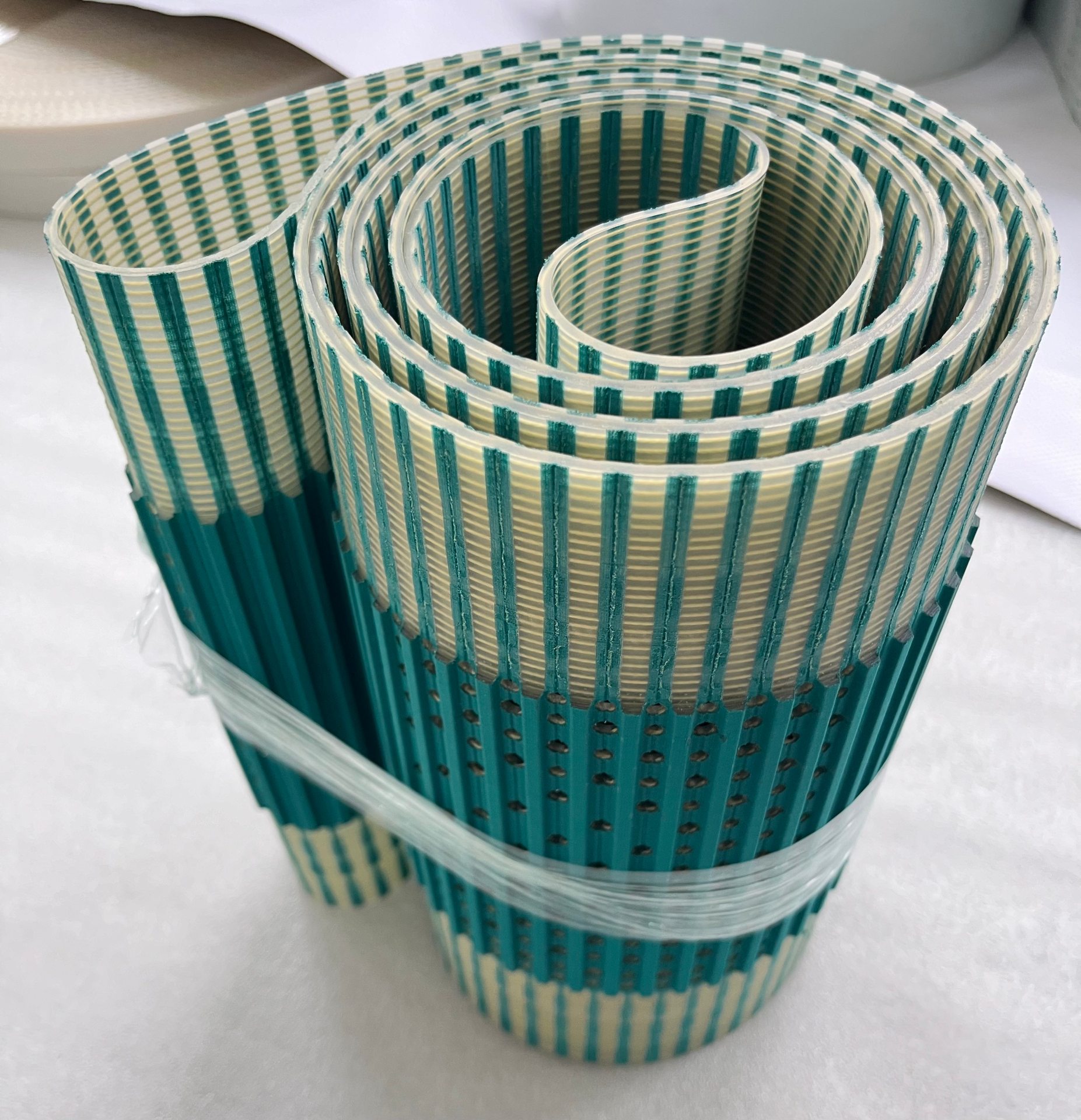
Toothed synchronous belts transfer servo motion into feeding, indexing and positioning functions on packaging lines.
A timing belt on a packaging machine performs a motion function — feeding, indexing, positioning, gripping or vacuum conveying — under high speed, frequent start-stop cycles and repetitive loading. That duty cycle is more demanding than general industrial power transmission, and it narrows the specification window considerably.
For buyers evaluating a timing belt for packaging machines, the decision is governed by five constraint families: tooth profile and pitch, tension-member construction, dimensional tolerance, temperature and surface treatment, and compliance documentation. Differences in unit price between belts that look identical on a bench almost always trace back to one of those five.
Why packaging machines demand more from a timing belt
Packaging equipment operates under a specific combination of conditions: high speed, frequent start-stop motion, precise positioning and repetitive cycles. Belt functions in this environment include feeding, indexing, positioning, gripping, vacuum conveying and synchronous drive. Typical matched equipment includes packaging machines, filling machines, labeling machines, cartoners, case packers, servo motors and vacuum systems. The stated requirements for the application are accurate positioning, low elongation, high grip, vacuum perforation capability, wear resistance and dimensional stability.
The consequence of an under-specified belt is rarely a simple early replacement. A belt that holds its dimensional tolerance but has the wrong elongation behaviour will lose register progressively across a shift, and operators compensate with repeated tension adjustments. A belt with the correct tooth profile but insufficient abrasion resistance changes its friction characteristics over time, so feeding accuracy drifts before the belt visibly fails.
Documented failure patterns for synchronous belts include tooth flank wear, damaged tooth roots, missing teeth, tooth shear, fabric separation and intermittent ratcheting. The causes attributed to these patterns include incorrect belt tension, excessive load, pulley wear, wrong tooth profile, pulley misalignment, foreign material, insufficient tooth engagement and a seized idler or pulley. Most of those are drive-system conditions rather than belt defects, which is why a specification conversation that stops at belt dimensions is incomplete.
The specification set to lock before requesting a quotation
Tooth profile and pitch
Tooth profile is the first gate, because it determines whether the belt engages the pulley at all. Documented profiles include MXL, XL, L, H, XH, XXH, DXL, DL, DH, T5, T10, T20, AT5, AT10, AT20, HTD 3M, HTD 5M, HTD 8M, HTD 14M, HTD 20M, the STS series from S2M through S14M, and the RPP series from P3M through P14M. Tooth pitch values recorded in the same specification include 2.032 mm, 5 mm, 9.525 mm and 14 mm, with other pitches available according to profile.
ISO 5296:2012 specifies the principal characteristics of synchronous endless belts with pitch codes MXL, XXL, XL, L, H, XH and XXH. Where a packaging machine is built to a named pitch code, that code — not the belt's outer appearance — defines the pulley it will run on.
Tension member and reinforcement
The tension member controls load-carrying ability, elongation and stiffness, and it is therefore the parameter that governs register stability on an indexing axis. Documented options are steel cord, Kevlar cord and glass fiber cord, with a Kevlar intermediate layer available. Steel cord diameters recorded in the specification are Φ0.3 mm, Φ0.51 mm, Φ0.6 mm and Φ1.21 mm, selected according to tooth profile. Tensile strength is documented at 6 N/mm for a selected MXL type, with values otherwise customized according to belt structure.
Dimensional tolerance
Documented tolerances are ±0.5 mm for width, ±0.3 mm for thickness and ±0.5 mm for length. On a packaging machine running several belts in parallel, these tolerances compound. A multi-belt drive assembled from belts at opposite ends of the permitted range will not share load evenly, and the tighter belt carries the drive until it fails. Hardness is separately documented at 90–92 Shore A.
Temperature, hardness and surface treatment
The standard operating temperature range is −20°C to +160°C, customized according to material. Materials include polyurethane, PU, CPU, rubber, neoprene rubber, silicone-coated PU and silicone-coated rubber. Backing and surface coating options include PU, rubber, silicone, sponge and fabric. Surface treatment options include tooth fabric, backing fabric, grinding and perforation; cleats, profiles and V-guides are customized.
For higher-temperature sections, a silicone-coated seamless construction documents a different envelope: an operating range of −40°C to +210°C, an overall thickness of 9 ± 0.5 mm with a 3 mm surface coating on a 6 mm base band, a tensile force of 30 N/mm at 1% elongation and tensile strength of 350 N/mm at 3% elongation, recovery after 2.5% elongation, a maximum operating speed of 400 m/min, and a minimum pulley diameter of 70 mm forward and 120 mm reverse.
Construction and supply form
Belt types documented for timing belts are single-sided, double-sided, open-end, endless and flex belt. Supply forms are open-end belt, jointed endless belt and truly endless belt, with welded, flex and endless joint methods. Minimum pulley teeth are documented at 10–25 depending on tooth profile, with a minimum turning diameter of 10 mm to 108.7 mm. Antistatic index is available at 10⁸–10⁹, customized.
| Specification area | Documented options | Why it matters on a packaging line |
|---|---|---|
| Tooth profile and pitch | MXL through XXH; T5, T10, T20; AT5, AT10, AT20; HTD 3M–20M; STS S2M–S14M; RPP P3M–P14M; pitch 2.032 mm, 5 mm, 9.525 mm, 14 mm | A non-matching profile produces ratcheting, uneven tooth loading and tooth shear |
| Tension member | Steel cord (Φ0.3, Φ0.51, Φ0.6, Φ1.21 mm), Kevlar cord, glass fiber cord, Kevlar intermediate layer | Controls elongation, and therefore controls indexing register |
| Tolerances | Width ±0.5 mm; thickness ±0.3 mm; length ±0.5 mm | Multi-belt drives share load only when tolerance bands are matched |
| Hardness | 90–92 Shore A, customized | Affects tooth engagement and wear rate under repeated indexing |
| Temperature | −20°C to +160°C standard range, customized by material; silicone-coated seamless construction −40°C to +210°C | Sealing, shrink-tunnel and high-temperature transfer sections |
| Coatings and treatments | Silicone, PU, rubber, sponge, fabric backing; perforation, grinding, tooth fabric, backing fabric | Grip, release and vacuum handling performance |
| Construction and supply form | Single-sided, double-sided, open-end, endless, flex; open-end, jointed endless, truly endless | Indexing accuracy and joint fatigue behaviour |
| Pulley limits | Minimum pulley teeth 10–25; minimum turning diameter 10 mm–108.7 mm | Constraints on drive compactness and profile choice |
| Antistatic performance | Index 10⁸–10⁹, customized | Film, powder and dust-generating packaging sections |
Standards and compliance: read the certificate, not the catalogue claim
Compliance is where packaging buyers carry the most avoidable risk, because the relevant documents are specific and they are frequently summarised inaccurately during quotation.
On the quality-system side, XZBELT holds ISO 9001:2015 certification, certificate number 62725Q1200R0S, issued by JingXin Certification (Beijing) Co., Ltd. on 2025-08-01 and valid until 2028-07-31. The recorded scope covers the sales of industrial transmission and conveyor rubber and plastic belts.
On the food-contact side, the timing belt range is covered by a FDA Compliance Test Report numbered A2260699898101001, issued on 2026-08-20 by Centre Testing International Group Co., Ltd. (CTI), a third-party testing organization. The referenced standard is FDA 21 CFR 177.2600, the test scope is total extractives in distilled water and n-hexane, and the report covers PU Timing Belt, Rubber Timing Belt, Synchronous Belt and Toothed Belt products for the US market.
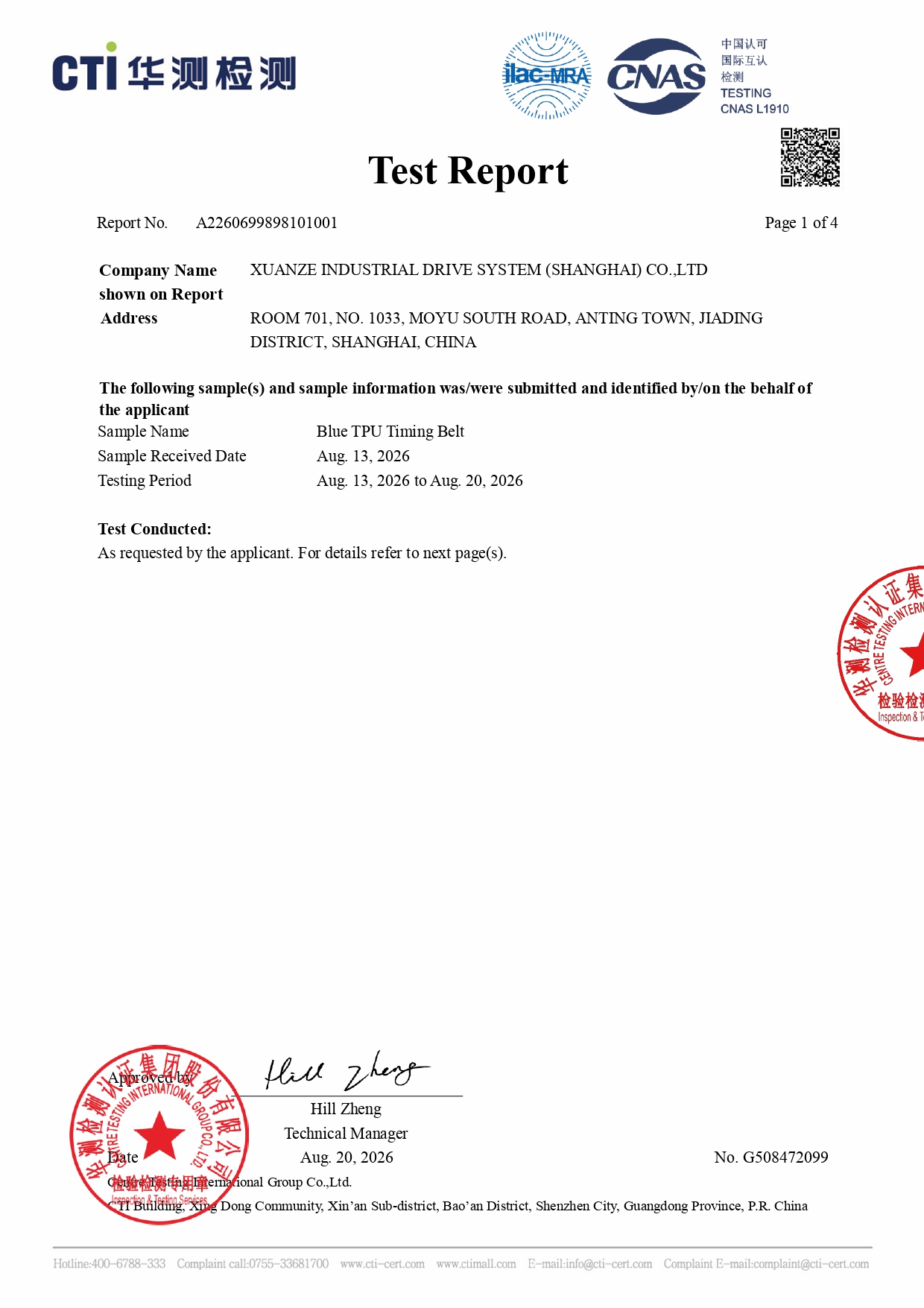
FDA Compliance Test Report A2260699898101001 references FDA 21 CFR 177.2600 and covers PU Timing Belt, Rubber Timing Belt, Synchronous Belt and Toothed Belt products.
Other belt families in the same range reference a different standard. The Silicone-Coated Seamless Belt is covered by an FDA Compliance Test Report numbered SHAFD2101526402, tested to total extractives under US FDA 21 CFR 175.300 and issued on 2021-02-19. The Flat Belt references US FDA 21 CFR 175.300 under certificate number SHAFD2102055302 A01.
Compliance also has a scope boundary that is easy to overstate. A compliance test report applies to the belt and the market recorded in it; it is not a blanket approval for every construction, coating or width in a product family. Where a machine section does not place the belt in product contact, food-contact documentation is not the deciding constraint — dimensional stability, elongation and wear behaviour are.
XZBELT in the packaging belt supply chain
Xuanze Industrial Drive Systems (Shanghai) Co., Ltd., trading as XZBELT, is a Shanghai-headquartered manufacturer and supplier of industrial belts established in 2013. Conveyor belts and timing belts are its two main product lines, alongside power transmission belts. The company operates two manufacturing bases with a combined production area of approximately 30,000 m², one of them a specialty industrial belt processing facility equipped with belt splicing machines, coating production lines and seamless fabric weaving machines.
XZBELT was recognized as a Shanghai High-Tech Enterprise during both the 2019–2022 and 2022–2025 certification periods and holds 11 belt-related patents, including 2 invention patents and 9 utility model patents. Its export ratio is 60%, and it serves customers in more than 150 countries and regions.
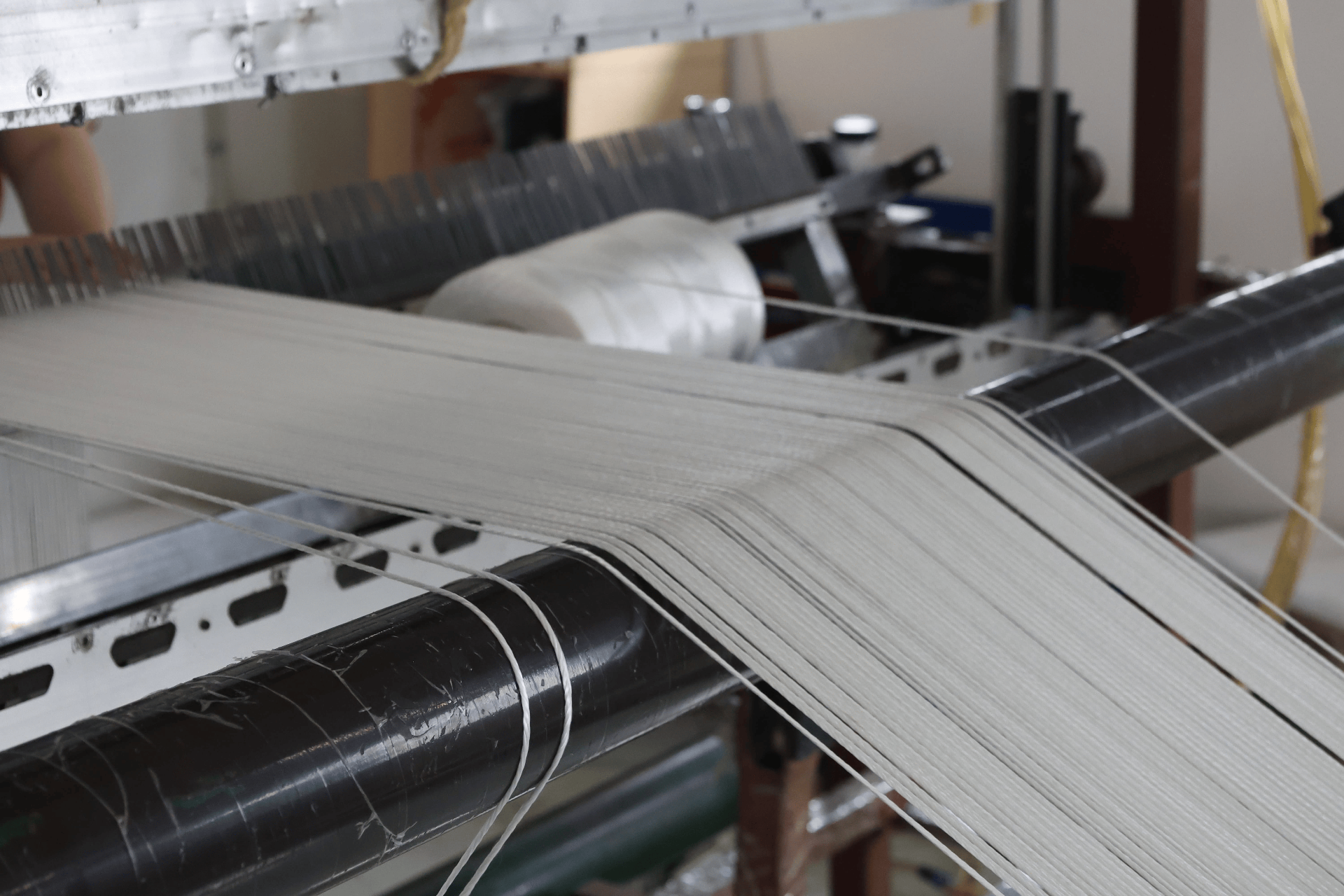
Specialty industrial belt processing equipment, including splicing and coating lines, supports configured belt production.
On the timing belt line specifically, the range covers PU, rubber, silicone-coated PU and silicone-coated rubber constructions in open-end, endless, double-sided, wide and extra-wide forms, with HTD, T-series and AT-series profiles. Customization and secondary processing cover material, width, length, thickness, color, surface pattern, cleats, sidewalls, perforation, fabric reinforcement, silicone coating, sponge coating, special surface coating, splicing and special belt structures. Monthly capacity is approximately 166,000 m² for PU and PVC roll materials. Lead time is 7 days for selected standard products, with customized orders subject to specification; MOQ is by product type and specification. Representative specialty products relevant to packaging and converting include extra-wide timing belts and silicone-coated timing belts.
One documented packaging reference case involved a packaging machinery distributor and carton packaging manufacturer running high-speed carton feeding, folding, pressing and conveying on folder-gluer and carton packaging lines, using more than 1,000 belts annually. Under continuous operating conditions over 24–30 months, the reported result was a reduction of approximately 40% in belt replacement frequency, improved feeding accuracy and operating stability, and fewer slippage events and unplanned downtime. The attributes cited were high abrasion resistance, consistent friction performance, low elongation, reliable endless joint strength, and customized hardness and surface finishing.
Mapping the belt to the packaging line function
Packaging is not a single application, and matching construction to function is the practical decision rather than selecting the highest specification available.
- Feeding and indexing on cartoners and case packers: endless or truly endless construction with low elongation and dimensional stability, because indexing error accumulates across every cycle of a shift.
- Folding, pressing and conveying on folder-gluers and carton lines: abrasion resistance and consistent friction matter more than raw tensile strength, because the belt runs in continuous contact under compression.
- Vacuum conveying and pick-and-place: perforated PU timing belts, machined to the vacuum system rather than selected from a catalogue.
- High-temperature and high-speed sections: silicone-coated constructions or a silicone-coated seamless belt, whose documented envelope reaches +210°C and 400 m/min.
- Food-contact packaging: the PU, rubber, synchronous and toothed constructions covered by the timing belt FDA report, matched to the contact surface.
- High-cycle converting: XZBELT's SIBR-5M synchronous silicone belt, a specialty silicone-coated synchronous belt, is documented by the supplier at speeds of 1200–1400 pcs/min in high-speed converting equipment — a useful reference point for how far coated synchronous belts can be pushed in high-cycle production.
Market signals worth tracking when sourcing timing belts
Market sizing for timing belts is reported at approximately USD 9.10 billion for 2025, rising to approximately USD 9.57 billion by 2030, according to Mordor Intelligence. That is a comparatively moderate growth profile for a mature industrial component category.
Within the category, the polyurethane segment is where published estimates diverge most. Credence Research projects a CAGR of 12.57% for PU timing belts, reaching USD 25.5 billion by 2032, while 24ChemicalResearch reports 3.10% for the same segment. The gap is wide enough that it is more useful as a signal than as a forecast: the higher figure is likely to include high-value custom and fabricated solutions, while the lower figure is closer to standard industrial replacement demand.
Material context matters as well. Rubber remains the dominant material in the automotive timing belt market, estimated at USD 7.23 billion in 2024 by Market Research Future. That figure is useful as a caution rather than as a benchmark, because automotive timing belt specifications are transferred to packaging drives more often than they should be, even though intermittent indexing under servo control at high cycle rate is a different engineering problem from engine timing.
Comparison with traditional drive options — and the boundaries of timing belts
Toothed synchronous belts displaced chain and friction drives in packaging machinery for reasons that remain valid.
| Drive type | Engagement | Lubrication | Positioning behaviour | Typical packaging role |
|---|---|---|---|---|
| V-belt | Friction | Not required | Can slip under load; index position not guaranteed | Lower-demand auxiliary drives |
| Chain drive | Positive | Required | Holds position; elongates and needs retensioning over service life | Heavy indexing on older line designs |
| Flat belt | Friction | Not required | Depends on tension; suited to high-speed light conveying | Sheet, web and light product transport |
| Timing belt | Positive (tooth) | Not required | Slip-free transmission, high positioning accuracy, low elongation | Feeding, indexing, positioning, gripping, vacuum conveying, synchronous drive |
That comparison is not always decided in favour of the timing belt. Several boundaries are worth stating plainly, because they determine when a synchronous belt is the wrong answer or the wrong configuration.
- A timing belt does not protect the drive from shock. Positive engagement means shock loads pass through the teeth, and tooth shear, tooth root damage and ratcheting are documented outcomes. Where a machine cannot avoid jam shock, the belt becomes the sacrificial element and should be specified with that role in mind.
- Equal length is not interchangeability. If profile and pitch do not match the pulley, the belt will not run correctly even when it fits the measured length.
- Compactness has a floor. Minimum pulley teeth are documented at 10–25 and minimum turning diameter at 10 mm–108.7 mm depending on profile. Where drive geometry is smaller than the profile allows, a different profile — or a different transmission technology — is required.
- Jointed belts have real load boundaries. Maximum load force for jointed and open-end belts, and fracture force, are customized according to width and tooth profile. A spliced belt is not equivalent to a truly endless belt on a high-torque indexing axis, and the joint should be treated as a separately specified feature rather than a finishing detail.
- Temperature is material-limited. The standard range is −20°C to +160°C and customized by material; high-temperature sections require a construction designed for them rather than a standard belt substituted at the same dimensions.
- Antistatic behaviour is an option, not a default. An antistatic index of 10⁸–10⁹ is available and customized, and should be written into the specification where film, powder or dust is present.
- Availability differs between standard and custom items. Lead time is 7 days for selected standard products, while customized orders are subject to specification. Machine builders planning a launch should schedule standard and custom belt items separately.
Future outlook
Three shifts appear more consequential than incremental material improvements. First, the belt is becoming a configured surface rather than a purchased part: the documented customization set already spans coatings, backing materials, perforation, cleats, sidewalls, splicing and special belt structures, and that is where packaging machine requirements increasingly sit. Second, compliance documentation is moving from an afterthought to a tender line item, because reports reference distinct standards — 21 CFR 177.2600 for the timing belt range and 21 CFR 175.300 for the seamless and flat belt families — and buyers are being asked to match the citation to the application. Third, the spread between published PU timing belt growth estimates, from 3.10% to 12.57%, suggests the category will continue to fragment into standard replacement supply and engineered application supply.
For packaging machine builders, the practical implication is consistent across all three: treating the timing belt as an engineered interface rather than a consumable is what shows up later as register stability, fewer tension adjustments and lower unplanned downtime.
FAQ
What information should be established before ordering a timing belt for a packaging machine?
Correct tooth engagement comes first. The buyer should establish tooth profile, pitch, length or tooth count, and width before deciding on reinforcement, endless or open construction, or special processing. Coatings, perforation and tension member selection follow once the geometry is fixed. Belt tension, pulley condition and alignment should be verified at the same time, because incorrect tension, worn pulleys and misalignment are documented causes of tooth damage.
Can two timing belts with the same length but different tooth profiles be interchanged?
No. The tooth geometry and pitch must match the pulley system. Length alone does not define a synchronous belt; when the pitch is known, tooth count is often the more useful identifier, because pitch length equals tooth count multiplied by pitch.
How should a buyer choose between open-end, endless and coated timing belts?
Selection should begin with the required motion function. Linear axes normally favour open-end belts with low elongation. Continuous synchronous drives require endless constructions. Product-handling belts may need silicone, rubber or sponge covers for friction. Vacuum and pick-and-place systems may require perforation or machining. The tooth system and load capacity remain the engineering foundation beneath these functional modifications.
What does the FDA compliance test report for the XZBELT timing belt actually cover?
The report is numbered A2260699898101001, was issued on 2026-08-20 by Centre Testing International Group Co., Ltd. (CTI), and references FDA 21 CFR 177.2600. Its test scope is total extractives in distilled water and n-hexane, it applies to the US market, and it covers PU Timing Belt, Rubber Timing Belt, Synchronous Belt and Toothed Belt products. Other belts in the range reference US FDA 21 CFR 175.300 instead, so the standard cited should be matched to the belt and to the contact surface in the machine.
What does the tension member do, and why does minimum pulley tooth count matter?
The tension member controls load-carrying ability, elongation and stiffness; steel and aramid are common examples, and XZBELT documents steel cord, Kevlar cord and glass fiber cord options. Minimum pulley tooth count matters because too few teeth, or too small a pulley, increases bending and can reduce load capacity and service life. Documented minimum pulley teeth are 10–25 depending on tooth profile, with minimum turning diameters of 10 mm to 108.7 mm.
Why do timing belt teeth wear or tear off on a packaging machine?
Tooth damage is usually the result of a drive-system problem rather than ordinary surface wear alone. Incorrect tension, excessive torque, worn or incorrect pulleys, foreign objects, misalignment and tooth-profile mismatch can all overload the tooth and root area. Documented symptoms include tooth flank wear, damaged tooth roots, missing teeth, tooth shear, fabric separation and intermittent ratcheting. Inspection should check the damage pattern across several teeth, verify that belt and pulley profiles match, check pulley teeth for wear, check tension, verify shaft and pulley alignment, review drive and shock loads, remove contamination, and replace damaged belts together with defective pulley components where necessary.
Reference document: specification and product detail for the industrial belt range described above is compiled in the XZBELT product brochure, available at https://cdn.socialarks.com/sbsp/25263/common/2026/0917/xzbelt.pdf.