
Tin-Plated vs Gold-Plated Connector Terminals: Buyer Comparison
Tin-Plated vs Gold-Plated Connector Terminals: Buyer Comparison
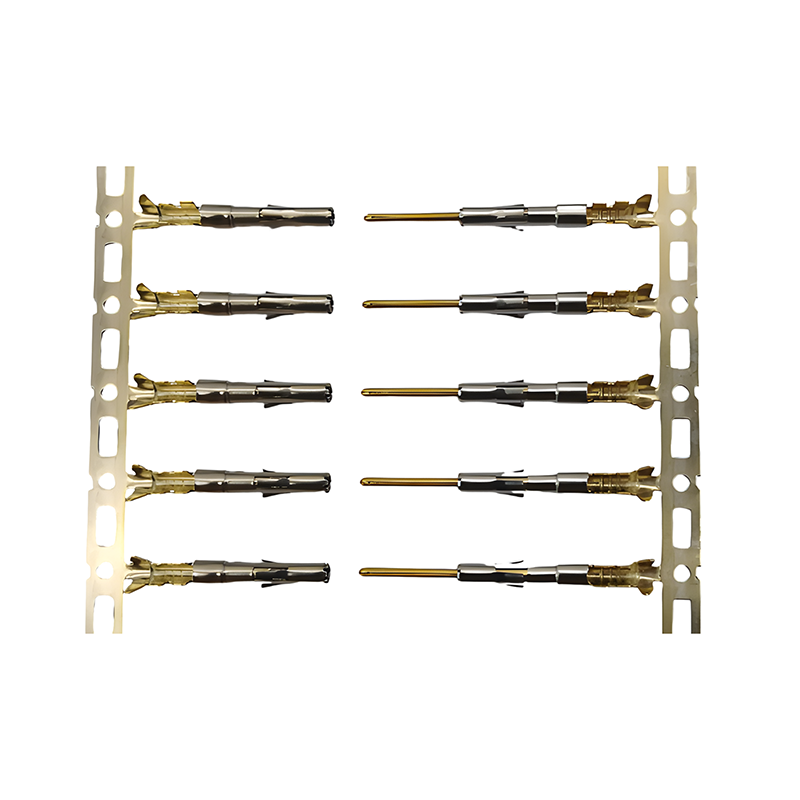
Male and female crimp terminals on carrier tape. The plating on the contact surface, not the carrier format, determines how the interface behaves over thermal cycles.
A connector terminal is the stamped metal contact that carries current and signal between a wire and a plastic connector housing. In an automotive wire connector, the plating on that contact — pre-tinned tin, selective gold, nickel or silver — is the layer that has to stay electrically stable for the life of the vehicle. This comparison examines tin-plated and gold-plated terminals against three measures a buyer can actually test: contact-resistance drift after thermal cycling, the controlled male/female insertion and extraction force window of 0.5–4 N, and the compliance documentation the part ships with.
The comparison uses a defined specification window rather than a brand ranking: pre-tin thickness of 2–6 μm, optional plating finishes, a controlled insertion and extraction force of 0.5–4 N, and 0.25–0.35 mm² wire compatibility. Those four parameters, plus RoHS compliance, are enough to separate a plating decision that will survive a harness program from one that only looks acceptable on a quotation.
Why the plating decision outranks the alloy decision
Buyers entering the evaluation stage usually start with the substrate question — pure copper, brass or phosphor bronze. It is the easier question, because the alloy appears in the drawing and the material certificate. The plating decision is harder and more consequential, because it is the only element of the contact system that changes at the interface where resistance is actually generated.
Three outcomes follow directly from that interface:
- Signal stability. A contact that drifts in resistance after thermal cycling will show up later as sensor drift, CAN instability or intermittent faults — problems that are expensive to diagnose at vehicle level and rarely traced back to a plating choice.
- Assembly feasibility. Insertion and extraction force is a line-level constraint. A terminal that meets every electrical requirement but sits outside the force window will slow a harness line or damage housings during mating.
- Market access. RoHS, REACH and halogen-free declarations are part of the plating and surface-treatment specification, not an afterthought added at shipping. A finish that cannot be documented cannot be exported into the EU, US, Japanese or Korean programs that most Tier-2 suppliers target.
For that reason, plating is better treated as a controlled process parameter with a written window than as a preference expressed in a purchase order.
The specification window examined in this comparison
The parameters below define the comparison. They are the values a buyer should expect to see stated explicitly, and the values against which tin and gold are assessed in the sections that follow.
| Parameter | Value in this comparison | What it controls |
|---|---|---|
| Pre-tin thickness | 2–6 μm | Barrier continuity over stamped bend radii and the contact zone; margin against oxidation and wear |
| Plating options | Pre-tinned tin as standard; gold, nickel and silver available as specified finishes | Which interface behaviour and which cost position the program is buying |
| Insertion / extraction force | 0.5–4 N, male-to-female contact pair | Mating reliability, operator effort, housing and terminal integrity during assembly |
| Wire compatibility | 0.25–0.35 mm² | Which circuits the terminal family can serve — typically low-current signal and light power |
| Operating temperature | -40 °C to 125 °C | The thermal band over which resistance stability must hold |
| Environmental compliance | RoHS, REACH, halogen-free | Export eligibility and material declaration content |
| Housing sealing (where applicable) | IP67 / IP68 options | Whether the plating is protected from moisture, salt spray and fluids |
| Quality system | IATF 16949:2016 | Whether the plating window is controlled in serial production, not only in samples |
What 2–6 μm of pre-tin actually buys
Pre-tinning is the default automotive finish because it delivers a continuous metallic barrier over a copper-alloy substrate at a thickness the stamping and crimping process can hold repeatedly. The 2–6 μm band is not arbitrary. Toward the lower end, the coating has less margin to remain continuous across the tight radii produced during stamping and forming; toward the upper end, additional thickness adds material cost without improving the electrical interface, and can work against the dimensional envelope the terminal was designed for.
Tin also behaves in a way that buyers must plan for rather than eliminate. A tin surface develops a surface oxide, and that oxide is broken at the contact interface by contact normal force — the spring pressure the terminal geometry generates. This is why tin plating and terminal spring design cannot be specified independently. A pre-tin layer within the 2–6 μm window on a terminal with insufficient normal force will not deliver the same resistance stability as the same plating on a correctly designed contact spring.
Two practical consequences follow for procurement:
- Pre-tin thickness should appear on the drawing with a tolerance, not as a nominal figure, and should be verified on the finished stamped part rather than on the incoming strip.
- The contact zone and the crimp zone should be specified separately. The function of the coating on the contact area is electrical; on the crimp barrel it is assembly and corrosion related.
Gold plating: what it is specified for, and what it is not
Gold is normally applied selectively, meaning the finish covers the contact zone rather than the whole terminal body. Selectivity matters to a buyer for two reasons: it keeps the cost of the finish proportional to the area that needs it, and it leaves the crimp zone with a finish that is better suited to wire termination.
The technical case for gold rests on a simple property: as a noble metal it does not develop the same resistive surface film that tin does. On small terminals carrying low-current signals through 0.25–0.35 mm² wire, the available contact normal force is limited by the terminal's size. Where that force is limited, a contact interface that does not depend on film breakthrough to conduct is a genuine engineering advantage. This is the reason gold is commonly specified for sensor circuits, CAN and other low-level signal paths, and for service points that are mated and unmated repeatedly.
What gold does not do is equally important. Gold plating does not compensate for a weak crimp, a poorly formed contact spring, an inadequate housing lock, or a housing that lets moisture reach the interface. Those are separate specifications with separate test evidence. A gold-plated terminal inside an unsealed housing in an engine-bay position is a cost increase, not a reliability improvement.
Insertion and extraction force: the mechanical half of the decision
Insertion and extraction force is the parameter that most often converts a plating discussion into a production problem. The 0.5–4 N window does two jobs at once. The lower bound protects the electrical interface: a contact pair that mates too easily may be relying on insufficient normal force, and it gives the operator no tactile confirmation that the terminal is fully seated. The upper bound protects the hardware and the line: excessive force deforms terminal bodies, pushes terminals back out of the housing cavity, and makes full engagement of the connector position assurance feature harder to achieve consistently.
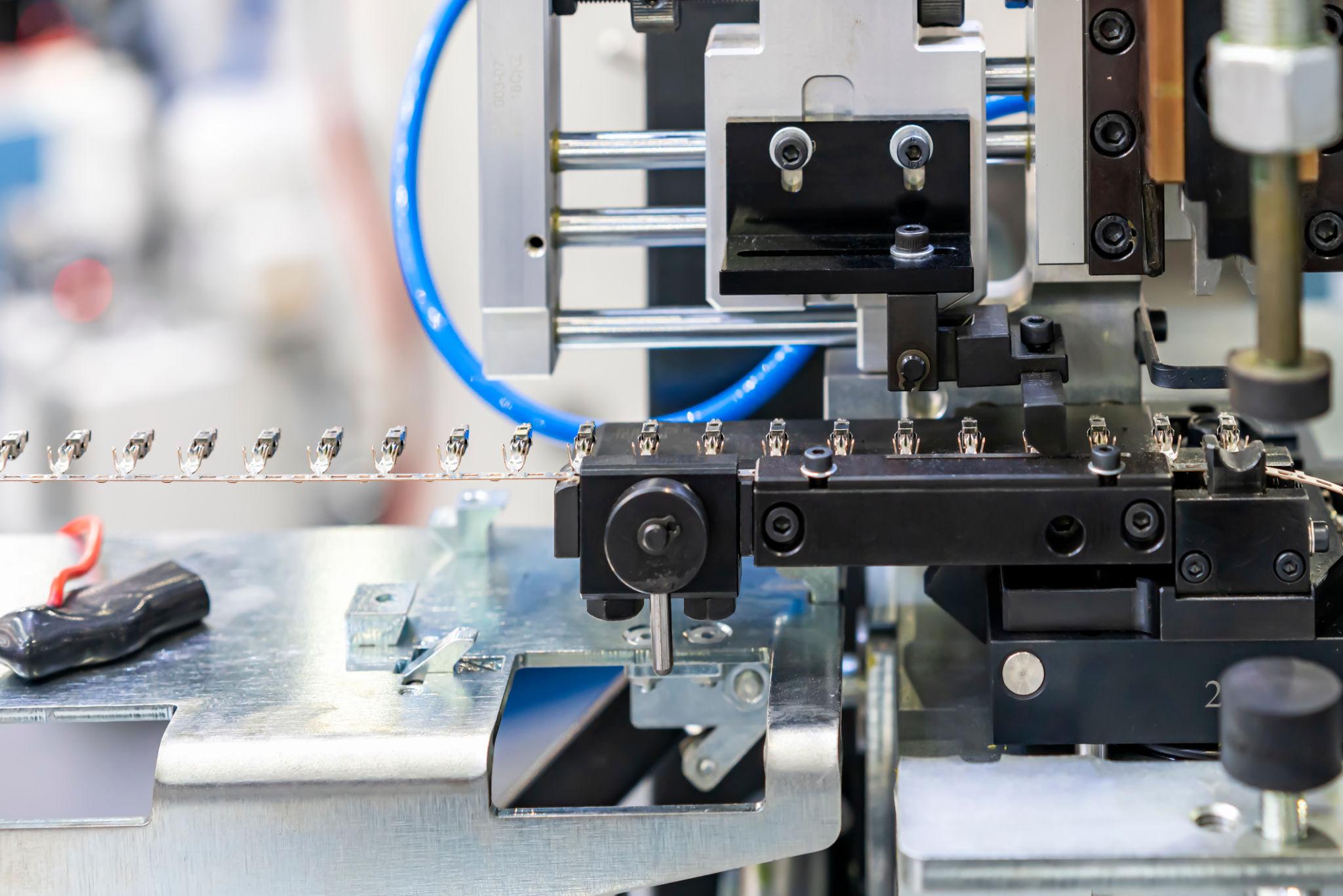
Crimp termination and contact mating are separate process steps but share one outcome: a terminal that is correctly seated and stays seated. Force window verification belongs to both.
Because harness assembly is manual or semi-automated, force is a line-level constraint and not only a laboratory figure. In practice this means the force window should be confirmed on production parts, with the plating variant identified, and re-confirmed whenever the plating specification, the contact geometry or the housing material changes. It should also be recorded together with the wire size, since 0.25–0.35 mm² compatibility defines the crimp and insulation support geometry that surrounds the contact.
Thermal cycling: what the resistance-fluctuation evidence actually shows
Thermal cycling is where plating choices are separated in the field, because repeated expansion and contraction stresses the contact interface and any relaxation in the terminal spring. In an automotive OEM program covering car terminals, precision-stamped terminals with tin or gold plating were reported to show significantly lower resistance fluctuation after thermal-cycle testing than ordinary terminals, which in turn supported accurate BMS and chassis sensor data.
Related program evidence points the same direction. A German automotive OEM application reported only minor contact-resistance fluctuation after installation, with stable CAN, sensor and BMS signal transmission. A separate program on precision automotive injection molded parts noted that when metal terminals are encapsulated with rubber, terminal positioning remains stable and vertical, and contact-resistance fluctuation stays minimal — preventing the intermittent circuit breaks that show up as unexplained electrical faults at vehicle level. Another automotive OEM program summarized the outcome directly: precision-stamped terminals with gold or tin plating keep stable low contact resistance, support steady power and signal transmission, and avoid abnormal temperature rise, signal flicker and intermittent disconnection.
The temperature band these claims sit inside is -40 °C to 125 °C, the range in which automotive connectors and terminals in this class are specified to operate reliably, including positions exposed to salt spray, moisture, engine oil and coolant.
Corrosion, fluids and the housing boundary
Plating protects the contact; the housing protects the plating. Automotive programs in this class rely on a reliable plating layer for resistance to salt spray, moisture, engine oil and coolant, which slows oxidation and corrosion at the contact points. On the housing side, IP67 and IP68 sealing options extend that protection to engine bay, chassis and exterior harness positions where condensation and road chemicals are continuous rather than occasional.
For a buyer, keeping these two specifications separate prevents a common error: buying a higher-grade plating to compensate for a housing that was never sealed for the position. Conversely, a sealed housing allows a pre-tinned terminal to perform in environments where an unsealed gold-plated terminal would still fail.
RoHS and the compliance layer buyers actually audit
RoHS compliance is a property of the finish and the surface-treatment process. In automotive interconnect programs intended for global export, the material requirement set typically includes RoHS, REACH and halogen-free declarations — the three that appear most often in the special-requirement clauses of automotive connector specifications.
The wider compliance frame for the European market is broader than RoHS alone. Exporting new energy vehicle connectors into the EU is generally understood to require a layered approach: LV 215 mechanical and electrical testing, CE marking under the Low Voltage Directive and EMC Directive, RoHS and REACH material declarations, and an IATF 16949 quality system. On the North American side, USCAR2-7 — the SAE performance specification for automotive electrical connector systems — sets out performance testing spanning development, production and field analysis, which is a useful benchmark for how a plating claim should be evidenced rather than asserted.
At manufacturing level, the relevant proof is the quality certificate and its scope. JDE Automotive Technology Co., LTD holds IATF 16949:2016 certification (certificate LTXNCH, issued by Quality Austria Certification GmbH, valid 2026-09-07 to 2029-09-06) with the scope of automotive stamping parts, alongside ISO 9001, ISO 14001 and ISO 45001 certification covering metal stamping parts processing. The scope wording matters: a certificate that names hardware stamping processing is the one that covers the terminal, not a certificate held elsewhere in a group.
Tin versus gold versus silver: a decision table
The table below compares the three finishes most often offered on automotive connector terminals. Cost positions are relative and qualitative; they are not quoted prices.
| Criterion | Pre-tinned tin (2–6 μm) | Selective gold | Silver |
|---|---|---|---|
| Primary role | General-purpose conductive and corrosion-barrier finish | Stable low-level signal interface with limited normal force | High-current conduction where resistance and heat matter most |
| Resistance stability after thermal cycling | Reported significantly lower fluctuation than ordinary terminals | Reported significantly lower fluctuation than ordinary terminals | Offered as a plating option in the same terminal programs; typically specified for high-current paths |
| Mating force behaviour | Generally the higher-friction finish of the two; window must be validated on the tinned variant | Generally lower friction; validate the 0.5–4 N window on the gold variant separately | Validate per variant; not interchangeable with tin on force without re-test |
| Corrosion and fluids | Protects against salt spray, moisture, engine oil and coolant within its window | Noble surface; still dependent on housing sealing for the position | Used where current density and temperature rise dominate the requirement |
| Typical circuit fit | Body electronics, lighting, general power distribution, sealed engine-bay and chassis harnesses | Sensor, CAN, BMS signal acquisition, low-current signal, service points with repeated mating | Battery pack, OBC, inverter and other high-current paths |
| Relative cost position | Lowest of the three | Highest, mitigated by selective application | Intermediate |
| Main limitation | Depends on adequate contact normal force to break the surface oxide | Does not fix a weak crimp, poor spring or unsealed housing | Not a default answer for low-current signal circuits |
Where each choice fits in an actual harness
Tin plating is the right default for the majority of harness positions: body electronics, lamp and lighting circuits, general power distribution, and sealed engine-bay or chassis connectors where the housing already delivers IP67 or IP68 protection. Programs in this class describe tin- or gold-plated precision-stamped terminals as suitable for low-voltage body electronics, sensors, BMS signal acquisition and high-current power circuits, which reflects how the finish is chosen per circuit rather than per vehicle.
Gold earns its place where the signal is small and the consequence of drift is large: sensor returns, CAN lines, BMS signal acquisition, and connectors that are mated and unmated during service. In headlight harness assemblies, for example, the reported failure mode that sealing and well-crimped terminals address is flicker and intermittent outage under vibration and moisture — a housing and crimp outcome, with plating contributing the stable interface behind it.
Silver sits in the high-current domain. In new energy connector programs, low contact resistance is what keeps temperature rise under control during high-current operation, and high-current terminals are described as using heavy-gauge, low-resistance copper alloy contacts to avoid thermal problems under continuous high-temperature and high-current loads. The plating decision there is driven by current density, not by signal level.
Limits of this comparison
A comparison that only lists advantages is not useful to a buyer at the execution stage. The following limits apply to the analysis above:
- No quantified gold-versus-tin delta. The thermal-cycle evidence in the available program records compares plated terminals with ordinary terminals. It supports specifying a plated terminal with recorded resistance fluctuation; it does not support a numerical claim that gold is a fixed percentage better than tin.
- Force windows are variant-specific. A 0.5–4 N range quoted for a terminal family should be confirmed separately for the pre-tinned and gold-plated versions, and re-confirmed after any change in contact geometry or housing material.
- Plating cannot substitute for housing sealing. IP67/IP68 protection is a housing and seal property. Buying gold plating for an unsealed position does not deliver the environmental performance the position requires.
- Evidence is program-reported. The thermal-cycle and contact-resistance results described here come from OEM application programs, not from an independent third-party benchmark. They should be treated as directional evidence and paired with first-article inspection and batch sampling on the buyer's own specification.
- Aggregate market figures are definition-sensitive. Published market sizes for automotive terminals differ substantially depending on whether individual crimp terminals are counted alongside connector assemblies. Aggregate figures should not be used to justify a plating decision on a specific part number.
A procurement verification sequence for plated terminals
The parameters that need confirmation when purchasing a plated terminal fall into five groups: electrical performance, mechanical structure, materials and surface treatment, environmental reliability, and compliance attributes. In practice, a buyer can convert those groups into a short sequence:
- Lock the specification. Drawings, BOM and performance indicators belong in the contract, including the plating type, the pre-tin thickness window and whether gold is selective.
- Confirm the first article. First-article inspection before mass production, with the plating variant identified on the report and the resistance fluctuation record attached where available.
- Set the acceptance basis. Incoming inspection against an agreed AQL sampling standard, with sealed samples retained as the reference.
- Prohibit silent substitution. No material or finish replacement without written approval — the most common route by which a compliant sample becomes a non-compliant batch.
- Agree the non-conformance route. Rework, replacement and liability for non-conforming batches should be defined before the first shipment, not after the first complaint.
Where JDE Automotive Technology sits in this comparison
JDE Automotive Technology Co., LTD is a Dongguan, China-based automotive interconnect manufacturer producing stamped terminals, plastic injection molded connector housings, connectors and wire harness assemblies for passenger and new energy vehicle, industrial automation, medical equipment and energy storage applications. The company operates stamping workshops and an injection molding department on one production site, together with in-house mold fabrication and automated assembly, with a monthly production capacity of 100 million pieces for connector terminal and injection part production.
On the plating question specifically, the relevant capability facts are these: terminals are stamped from pure copper, C2680 brass and phosphor bronze, with tin, nickel and selective gold plating available as finishes; quality control includes CCD online 100% measurement and 100% electrical continuity testing for finished wire harnesses, supported by an in-house quality control laboratory and incoming material inspection. OEM and ODM production services are available for connector, terminal and injection part projects, serving customers in the EU, USA, Japan, Korea and China, with a typical production lead time of 15–20 days and a minimum order quantity of 500 pieces.
That combination — stamping, plating specification and injection molded housing production under one site and one IATF 16949 system — is what allows a plating window and a housing seal to be validated as one contact system rather than as two purchases from two suppliers.
Market trend: why plating discipline is becoming more valuable, not less
The global automotive terminals market was valued at approximately USD 28.59 billion in 2026, according to Mordor Intelligence. That headline figure should be read with care, because published market sizes for this category differ significantly depending on whether individual crimp terminals are counted alongside connector assemblies — a definitional difference rather than a disagreement about demand.
The direction of travel, however, is consistent and it reinforces the plating decision. Electrification increases the number of high-current paths that require low-resistance contacts and controlled temperature rise. At the same time, vehicle signal content continues to grow: more sensors, more control units, more low-level signal lines running through 0.25–0.35 mm² wire. Those two trends pull terminal specifications in different directions — silver and heavy-gauge contacts on one side, stable low-current interfaces on the other — while both depend on the same underlying discipline of a written plating window, a validated force range and recorded resistance behaviour.
For a buyer, the practical implication is that plating should be treated as a specified and auditable parameter in every terminal purchase, regardless of which finish the circuit requires.
Frequently asked questions
What pre-tin thickness is used on automotive connector terminals?
Pre-tin thickness on automotive connector terminals in this comparison class is specified at 2–6 μm. The window is set so the tin layer remains continuous across stamped bend radii and the contact zone without adding material beyond what the terminal geometry was designed for. Buyers should require the thickness to appear on the drawing with a tolerance and to be verified on the finished stamped part.
Which plating options are available besides tin and gold?
Automotive terminal programs in this class commonly offer pre-tinned tin as standard, with gold, nickel and silver available as specified finishes. Gold is normally applied selectively, covering the contact zone rather than the whole terminal. Silver is typically associated with high-current paths where low contact resistance and controlled temperature rise are the dominant requirements.
What insertion and extraction force should a connector terminal pair hold?
The controlled window in this comparison is 0.5–4 N for the male and female contact pair. The lower bound supports reliable contact normal force and gives assembly operators tactile confirmation of full seating; the upper bound protects terminal bodies and housings from deformation during mating. Because tin and gold behave differently at the interface, the window should be validated for each plating variant.
Which wire sizes do these terminals accept?
The terminals examined here are specified for 0.25–0.35 mm² wire, which places them in low-current signal and light power circuits — sensor returns, CAN lines, BMS signal acquisition and body electronics. High-current paths use heavier-gauge contacts and, typically, silver plating.
Does gold plating eliminate contact resistance drift after thermal cycling?
The available program evidence shows that tin-plated and gold-plated precision-stamped terminals exhibit significantly lower resistance fluctuation after thermal-cycle testing than ordinary terminals, with minor fluctuation reported after installation in OEM applications. It does not establish a quantified margin of gold over tin. Buyers should therefore require a recorded resistance-fluctuation result for the specific plating variant being purchased.
Are tin-plated and gold-plated terminals RoHS compliant?
RoHS compliance is a property of the finish and the surface-treatment process rather than of the terminal as a whole. Automotive interconnect specifications intended for global export typically require RoHS, REACH and halogen-free declarations together. For EU market access, these sit alongside LV 215 testing, CE marking under the Low Voltage and EMC Directives, and an IATF 16949 quality system.
For buyers who need the underlying process and capability documentation in one place, the JDE Automotive Technology brochure is available for download: JDE Automotive Technology company brochure (PDF).
Tem questões ou precisa de mais detalhes?
Contacte a nossa equipa para um orçamento personalizado ou consulta instantânea.
Solicitar orçamento
Preencha o formulário abaixo e a nossa equipa entrará em contacto com uma proposta personalizada.
Chat direto do WhatsApp
Prefere conversar em tempo real? Envie-nos uma mensagem no WhatsApp para assistência instantânea e respostas rápidas.
- Obter orçamento personalizado
- Partilhar fotos ou documentos
- Discuta as suas necessidades diretamente
Geralmente responde em 5–30 minutos durante o horário de expediente.