
Tinplate Buyer FAQ: MTC 3.1, Slitting Tolerance, MOQ and CBAM
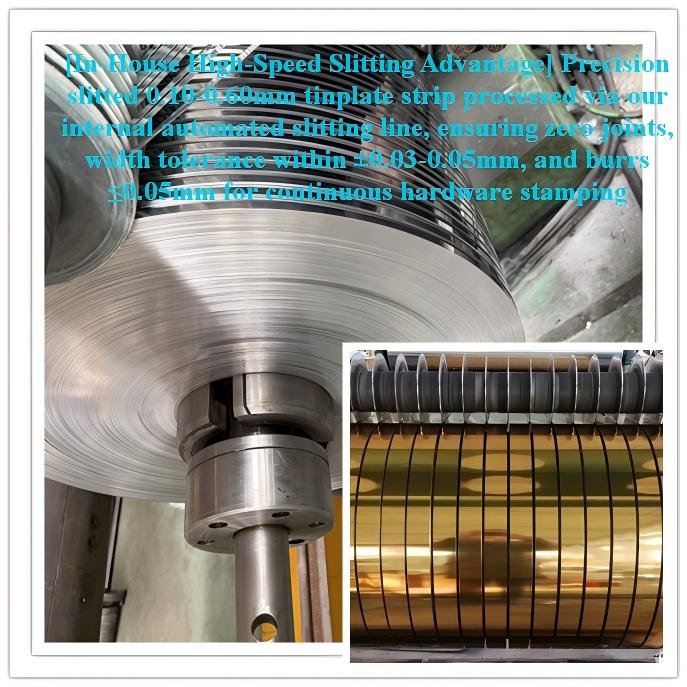 Precision slitting converts mill-width tinplate into strip widths matched to a buyer's die and feeding system. Slitting tolerance is a separate specification from mill gauge tolerance.
In metal packaging and hardware stamping, the technical discussion usually ends long before the commercial one does. A can maker or a stamping plant already knows which temper, coating weight and surface finish the forming process needs. What slows the process down is confirming that the supplier can prove what it shipped, hold the width the feeding system requires, accept a first order small enough to trial, and produce emissions data that an EU importer can file.
The reference entity for this article is Chongqing Youngson Metal Products Co., Ltd. (YOUNGSON METAL), a metal surface processing, slitting and supply manufacturer based in Chongqing, China, founded in 2016 and operating under a BV ISO 9001:2015 quality framework. The company processes more than 10,000 tons of metal annually and exports to global markets, with a product portfolio built around commercial and deep-drawn grade tinplate and tin-free steel, pre-painted steel, and precision slit strip. The questions below reflect what buyers typically need to resolve before placing a first or repeat order.
Why the four procurement questions matter more than the metal grade
A tinplate grade is a metallurgical specification. A purchase order is an evidence package. The gap between the two explains most delays in evaluation-stage sourcing.
- Documentation determines whether the buyer's own quality system can accept the material on arrival, and whether a downstream customer will accept it later.
- Tolerance determines whether the coil or strip runs on an existing line without die adjustment, scrap, or line stoppage.
- MOQ and lead time determine whether a project can be validated before it is committed at volume.
- Carbon reporting determines whether an EU-bound order can clear the reporting obligations attached to steel imports.
None of these is a marketing claim. Each is a document, a dimension, a quantity or a data field — which is why they are the right place to start a supplier evaluation.
Documentation: what an MTC EN 10204 3.1 actually establishes
EN 10204 3.1 is an inspection document type in which the certificate is issued by the manufacturer's inspection department, independent of the production department, and is tied to the specific batch supplied rather than to a generic product description. For a tinplate buyer, its practical value is traceability: it connects the delivered coil or strip to a recorded set of test results.
YOUNGSON METAL provides MTC EN 10204 3.1 with supplied material, supported by 100% in-house inspection that covers thickness, coating mass, tensile strength, T-Bend, salt spray and surface roughness. Third-party inspection by SGS, BV or TÜV can be arranged where a buyer's qualification process requires an independent witness or an independent report.
| Evidence item | What it proves | What it does not prove |
|---|---|---|
| MTC EN 10204 3.1 | Batch-linked inspection results issued independently of production | Does not by itself constitute a food-contact or regulatory declaration |
| In-house inspection record | Thickness, coating mass, tensile strength, T-Bend, salt spray, surface roughness checks | Does not replace a buyer's incoming inspection routine |
| Third-party inspection (SGS / BV / TÜV) | Independent verification at the buyer's request | Scope is limited to what the buyer commissions |
| EPD and CFP documentation (ISO 14067) | Product carbon footprint and environmental declaration data | Does not cover emissions outside the declared system boundary |
Tolerance: what ±0.02 mm covers on a slit tinplate strip
YOUNGSON METAL's custom processing capability is stated at a width and slitting tolerance of ±0.02 mm, with slitting widths available from 4.0 mm up to 1,050 mm. On the precision strip series, thickness tolerance is controlled to ±0.005 mm, width tolerance to ±0.05 mm, and slitting burr to ≤0.05 mm.
These figures answer three different questions, and buyers should be clear about which one their line depends on:
- Slitting tolerance governs strip width consistency across a coil — the dimension that determines whether a progressive die feeds without camber drift.
- Thickness tolerance governs forming consistency and die wear, and is a property of the base metal and rolling process rather than of slitting.
- Burr height governs edge quality and die life; burr is a slitting outcome and is controlled separately from width.
Slit quality is managed under a five-point screening protocol covering joints, notches, wavy edges, overlapping bands and rust spots. Cut edges receive an anti-rust oil treatment after slitting, which matters for tropical and high-humidity destinations where edge corrosion during ocean transit is a common cause of rejection.
Customization: thickness, temper, finish and coating
The customization envelope stated for YOUNGSON METAL's processing operation covers material grades across tinplate, pre-painted steel, cold rolled steel, galvanized steel, galvalume, Zn-Al-Mg steel, stainless steel and aluminum, with thickness from 0.08 mm to 6.0 mm, zinc coating from 30 to 600 g/m², surface finishes including 2B, BA, No.4, anti-fingerprint and RAL coatings, temper and hardness options from soft through quarter-hard, half-hard and full hard, plus coil inner and outer diameter and export anti-rust packaging.
Within the tinplate and tin-free steel range specifically, the portfolio covers tempers T1, T2, T3, T4 and T5 with BA and CA surface options, plus double-reduced and high-strength designations including DR8, DR9, DR10, TH520, TH550 and TH620. Tin coating weights are quoted in designations such as 1.1/1.1, 2.2/2.2, 2.8/2.8 and 5.6/5.6 g/m², in equal or differential configurations. Coil inner diameters of 160 mm, 200 mm, 300 mm, 400 mm and 500 mm are available to match existing feeding equipment.
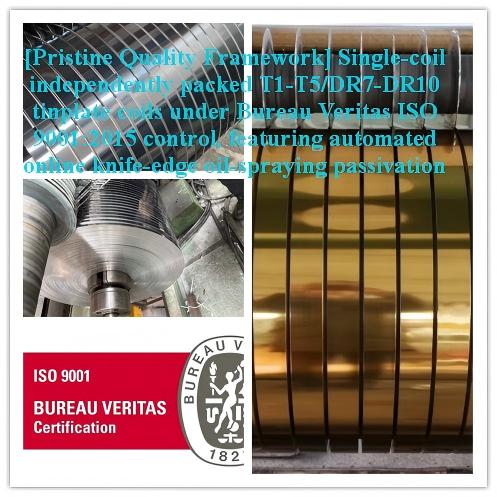 Single-coil protective packaging with batch identification. Packaging specification is part of the acceptance criteria on humid and long-transit routes.
Application-specific coating work is where customization becomes a procurement question rather than a catalogue question. Two examples from the company's stated product range illustrate the pattern: a milky white coated tinplate sheet developed for meat cans, and a sulfur-resistant coating for fish cans, where sulfur staining after retorting is the failure mode that matters. Separately, eco-friendly bronze and copper-look coated tinplate strip is positioned as a substitute for copper-plated steel and anodized stainless in decorative and hardware stamping, with a stated cost reduction of more than 50% against traditional copper electroplating and more than 20% against bronze or copper anodized stainless.
MOQ, lead time and capacity: sizing a first order
The stated commercial terms are a minimum order quantity of 2–3 tons depending on size, and a lead time of 5–30 days depending on size and specification. Monthly processing capacity is approximately 1,200 tons.
For an evaluation-stage buyer, this combination has a specific practical meaning. An MOQ measured in a few tons allows a genuine trial — enough material to run a full shift on a progressive die, check coating adhesion after forming, and confirm width consistency — without committing to a container load of an unproven specification. A lead time expressed as a range rather than a fixed figure is also honest: a plain slit T2 strip and a multi-colour coated coil are not the same production event, and quoting one number for both would be misleading.
Repeat-supply behaviour is the more reliable indicator of whether these terms hold in practice. The company reports a supply relationship of more than ten years with a high-speed automated plant producing premium single-side gold candle lids, running 0.14 mm and 0.15 mm ultra-thin high-tensile material in DR8, DR7 and TH520 tempers, with reported results of zero lacquer cracking during deep drawing, no progressive-die jams from jointed coils, and approximately 35% reduction in tool wear attributed to thickness tolerance and burr control. A second relationship covering more than 6,000 tons annually over three or more years is reported for electronics shielding enclosures and non-round fish can production.
CBAM, EPD and carbon footprint reporting
YOUNGSON METAL supplies EPD and CFP certified low-carbon steel with EU CBAM-aligned documentation, including direct and indirect carbon emission data reporting and product carbon footprint documentation under ISO 14067. For an EU importer of iron and steel goods, this is not a differentiator — it is a filing requirement.
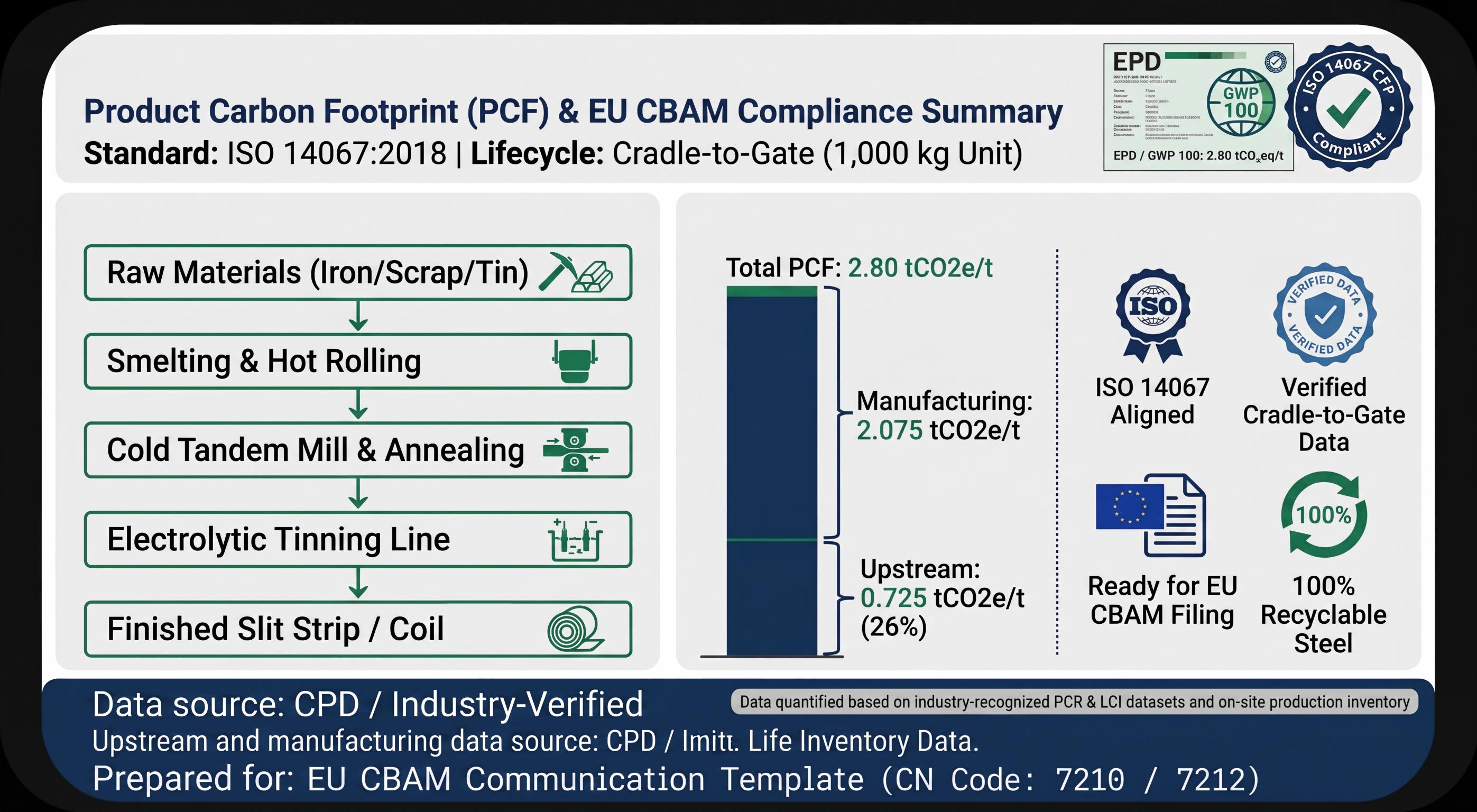 Product carbon footprint and environmental declaration data are supplied per order to support EU CBAM reporting obligations.
The mechanism behind the requirement is straightforward. The EU Carbon Border Adjustment Mechanism requires importers of covered goods, including iron and steel products, to report the embedded emissions of what they import. That means the supplier must be able to state emissions attributable to a specific order, split into direct and indirect components, rather than publishing a generic corporate average.
OEM and ODM support: what changes when the product is not standard
OEM and ODM support at this supplier covers joint development of functional coatings and processes — high-adhesion, deep-drawing and anti-abrasion lacquers — followed by precision slitting or sheet shearing, with goods subject to SGS RoHS and food-grade testing where applicable. In practice this means a buyer with a forming problem can specify the failure mode (adhesion loss after drawing, staining after retorting, edge corrosion after transit) rather than choosing from a fixed list of finishes.
The trade-off is time. Joint development adds a sampling and validation cycle that a catalogue order does not require, and results should be confirmed on the buyer's own tooling rather than accepted from a specification sheet.
How this compares with traditional sourcing routes
There is no universally correct sourcing route for tinplate. The comparison below is by route type, not by company, and each route carries a genuine limitation.
| Route | Typical strength | Typical limitation |
|---|---|---|
| Mill-direct full-width coil | Lowest unit cost at high volume; direct mill certificate | Large minimum quantities; no slitting to die width; limited coating customization |
| Stockist or trader | Fast availability from stock; small quantities | Batch traceability can stop at the stockist; processing tolerance is not controlled by the supplier |
| Processor with slitting and coating | Custom width, temper, finish and coating; small MOQ; batch-level documentation | Depends on base-metal supply; added processing step lengthens the chain; custom coating development takes extra time |
YOUNGSON METAL sits in the third category — a processing and supply operation rather than a steel mill. That distinction should be stated plainly: the company's value is in coating, slitting, tolerance control and documentation around the base metal, not in primary steelmaking. Buyers who need mill-level metallurgical development should source at mill level; buyers who need a specified width, finish and batch certificate in a few tons should not.
Market context behind these questions
The commercial pressure behind documentation and tolerance questions is visible in the market data. Global tinplate market value was estimated at USD 31.98 billion in 2025 in commercial market research, with Asia Pacific accounting for a 39.2% share of that market in the same year. China remained the largest tinplate exporter by shipment count, with 3,137 shipments recorded between July 2024 and June 2025 according to bill-of-lading trade data compiled by Volza.
On the technical side, double-reduced tinplate such as DR8 is specified in the 69–75 HR30Tm hardness range, reflecting the shift toward thinner gauge, higher-strength material that reduces metal consumption per can while demanding tighter forming control. Thinner gauges amplify the consequences of every tolerance decision: at 0.14 mm, a width inconsistency that would be absorbed at 0.30 mm becomes a die jam.
Two structural trends follow. First, procurement is moving from grade selection toward evidence selection — buyers compare certificates, tolerances and emissions data as much as they compare base metal. Second, coating customization is becoming a normal requirement rather than an exception, because brand owners specify surface appearance and food-contact performance at the same time as they specify cost.
Future outlook
Three developments are likely to shape tinplate procurement over the next sourcing cycles. Carbon documentation will continue to move from a voluntary disclosure to a mandatory field in the purchase order, which favours suppliers who can report per-batch emissions rather than annual averages. Tolerance requirements will tighten as gauges thin, pushing more buyers toward processors who quote slitting and thickness tolerance separately. And small-lot validation will become more important than headline capacity, because a supplier's ability to deliver three tons correctly predicts a twenty-ton order better than a capacity figure does.
Frequently asked questions
What does an MTC EN 10204 3.1 include for a tinplate order?
An EN 10204 3.1 certificate is a batch-linked inspection document issued by the manufacturer's inspection department, independent of production. For tinplate it typically records the tested properties of the delivered batch, and YOUNGSON METAL supports it with in-house inspection of thickness, coating mass, tensile strength, T-Bend, salt spray and surface roughness. It is a material certificate, not a food-contact or regulatory declaration.
Is third-party inspection available before shipment?
Yes. Third-party inspection by SGS, BV or TÜV is supported on request. The scope of an independent inspection is limited to what the buyer commissions, so the inspection plan should be agreed at order stage rather than after production.
What slitting tolerance can be held on custom tinplate strip?
Custom slitting is specified at ±0.02 mm width and slitting tolerance, with strip widths from 4.0 mm to 1,050 mm. On precision strip series, thickness tolerance is controlled to ±0.005 mm, width tolerance to ±0.05 mm, and burr to ≤0.05 mm. Slitting tolerance controls strip width and edge quality; it does not alter the base metal's gauge profile.
Which thickness range is available, and what is typical for tinplate strip?
The stated processing envelope runs from 0.08 mm to 6.0 mm across material families including tinplate, tin-free steel, pre-painted steel, cold rolled, galvanized, Zn-Al-Mg, stainless and aluminum. Within the tinplate and tin-free steel range specifically, production commonly runs between roughly 0.14 mm and 0.55 mm, including ultra-thin gauges such as 0.14 mm, 0.15 mm and 0.17 mm in DR8, DR9 and DR10 tempers.
What is the minimum order quantity and standard lead time?
The minimum order quantity is 2–3 tons depending on size, and lead time is 5–30 days depending on size and specification. Monthly processing capacity is approximately 1,200 tons. Custom coating development and multi-colour lithography fall outside the standard lead-time window and are scheduled separately.
Can temper, surface finish and coating be customized per project?
Yes. Available tempers span T1 through T5 plus DR7, DR8, DR9, DR10, TH520, TH550 and TH620; tin coating weights include 1.1/1.1, 2.2/2.2, 2.8/2.8 and 5.6/5.6 g/m² in equal or differential configurations; and finishes include bright, stone, matte, mirror and 3D laser effects, single or double sided. Coil inner diameters of 160, 200, 300, 400 and 500 mm are offered to match existing feeding equipment.
How are EU CBAM and carbon footprint data handled?
YOUNGSON METAL supplies EPD and CFP certified low-carbon steel with EU CBAM-aligned documentation, including direct and indirect carbon emission data reporting and product carbon footprint documentation under ISO 14067. Because a footprint declaration is specific to its system boundary, buyers should request emissions data per shipment or per production batch and confirm the boundary covered before filing.
What are the limits of this supply model?
The operation is a processing and supply business, not a primary steel mill, so it does not offer mill-level metallurgical development of new base chemistries. Coated and mirror-finish products are intended for mechanical forming and are not recommended for thermal laser cutting. Lead time varies with raw material availability and coating schedules, and joint coating development requires a sampling and validation cycle before volume supply.
Evaluating a tinplate specification usually comes down to matching four documents to one die: the certificate, the tolerance, the order quantity, and the emissions data. The full processing and product range is set out in the YOUNGSON METAL product catalogue.
Chongqing Youngson Metal Products Co., Ltd. — No.16-16, Building 11, No.305 Yunan Avenue, Longzhouwan Street, Ba'nan District, Chongqing, China 401320.
Tem questões ou precisa de mais detalhes?
Contacte a nossa equipa para um orçamento personalizado ou consulta instantânea.
Solicitar orçamento
Preencha o formulário abaixo e a nossa equipa entrará em contacto com uma proposta personalizada.
Chat direto do WhatsApp
Prefere conversar em tempo real? Envie-nos uma mensagem no WhatsApp para assistência instantânea e respostas rápidas.
- Obter orçamento personalizado
- Partilhar fotos ou documentos
- Discuta as suas necessidades diretamente
Geralmente responde em 5–30 minutos durante o horário de expediente.