
Tinplate for Automotive Filters and Fuel Systems: DDQ/EDDQ Fit
Tinplate for Automotive Filters and Fuel Systems: DDQ/EDDQ Fit
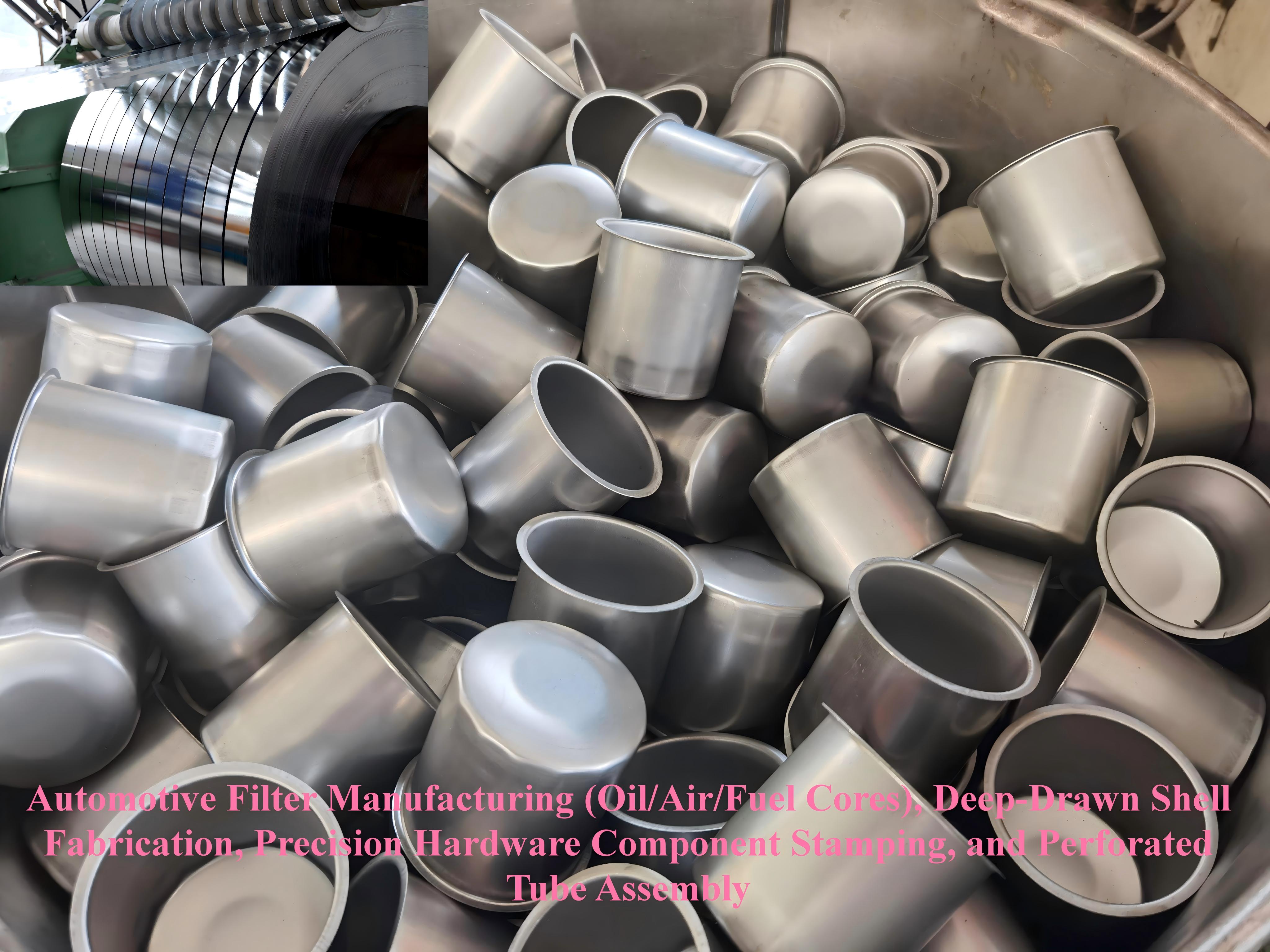
For automotive filter stamping, the useful starting point is not a general tinplate gauge range but the match between the part’s forming route and a documented material specification. YOUNGSON METAL lists DDQ and EDDQ electrolytic tinplate strip for automotive filter shells and end caps, with a stated thickness range of 0.20–0.50 mm, T1 temper, and listed dimensional and edge parameters. Those specifications can guide initial screening, but they do not by themselves establish performance on a particular press, tool, or fuel-system component.
That distinction matters when a buyer is evaluating continuous coil feeding, progressive or multi-stage forming, and dimensional repeatability. YOUNGSON METAL’s separate processing capability information lists custom precision slitting, cut-to-length processing, and a slitting-tolerance capability of ±0.02 mm. The automotive-filter product listing, however, states a width tolerance within ±0.05 mm. These are different published specifications: the broader processing capability should not be treated as a guaranteed tolerance for the DDQ/EDDQ filter product unless the applicable order specification confirms it.
What the documented automotive filter strip covers
The DDQ/EDDQ product listing identifies the material as deep-drawing-quality and extra-deep-drawing-quality electrolytic tinplate. It names automotive filter manufacturing, including deep-drawn shells and end caps, as an application. Its listed gauges are 0.20, 0.25, 0.30, 0.40, and 0.50 mm, with T1 temper and a stated HR30T value of 49±3. The same listing gives tin coating as 2.8/2.8 g/m², thickness tolerance as ±0.005 mm, width tolerance within ±0.05 mm, and edge burrs of no more than 0.05 mm.
These details provide a practical first-pass specification for an engineer or buyer: confirm the required gauge, strip width, temper, coating designation, and edge condition against the component drawing and forming sequence. The listing is company-provided product information, not independent evidence that a particular part has passed a customer’s qualification. For evaluation, it is therefore more useful as a basis for a technical inquiry and trial plan than as a substitute for material approval.
The named scope is automotive filter shells and end caps. Although the assigned application question also includes fuel systems, the available product evidence does not separately identify a validated fuel-system component, fuel-contact approval, or fuel-filter stamping result. Buyers considering those components should treat the strip as a candidate for technical review, not as an already qualified fuel-system material. The relevant part, operating environment, coating or surface requirements, and acceptance criteria need confirmation for the specific application.
Why slit-strip consistency matters on a high-speed line
In a continuous-feed stamping setup, strip width and edge condition are part of the interface between the coil and the tooling. A strip that does not match the specified width may not track through the feeding and locating arrangement as intended. Burrs and edge defects can also be relevant to handling and tool interaction. These are process considerations, not proof that a specific tolerance will eliminate downtime or prevent tool damage.
For that reason, buyers should distinguish the precision-slitting capability from the product-specific dimensional commitment. The broader capability record lists tinplate among customizable materials and gives a slitting-tolerance capability of ±0.02 mm. The automotive-filter product specification separately gives width tolerance within ±0.05 mm. A buyer who needs ±0.02 mm for a filter component should have that requirement stated against the exact product, width, measurement method, and order rather than assume that the general capability automatically applies to every DDQ/EDDQ strip.
The filter product listing also reports ±0.005 mm thickness tolerance and burrs no greater than 0.05 mm. These values can be included in a drawing review or incoming-inspection discussion. They should remain attached to the product specification and the agreed verification method. The source does not provide an independent measurement report, a sampling plan, or a defined test method, so the buyer should request the relevant lot documentation and confirm how the values will be assessed.
YOUNGSON METAL’s capability information also lists in-house precision slitting and cut-to-length processing, along with metallurgical and slitting technical support. For a project, the value of those capabilities is practical coordination: the buyer can discuss material grade, target dimensions, and processing requirements together. That does not establish a specific delivery schedule, production capacity for the requested configuration, or a guaranteed stamping outcome; those details require separate confirmation.
How to interpret T1 temper and DDQ/EDDQ designation
DDQ and EDDQ describe the listed product’s deep-drawing grade categories, while T1 is the stated temper for this automotive-filter line. They are not interchangeable labels. The product record associates T1 with HR30T 49±3, but it does not provide a full set of tensile properties, elongation values, forming-limit data, or a comparison of T1 against other tempers for the same filter design.
Temper selection matters because the material condition is one input to how a strip behaves during forming. The appropriate choice depends on the part geometry, the number and severity of forming stages, and the press and tooling setup. For this particular listed line, T1 is the documented temper. If a project requires a different temper, the buyer should not infer availability or equivalence from general portfolio listings. Instead, specify the required condition and ask for confirmation of the exact grade, mechanical-property documentation, and sample material before treating it as an approved alternative.
This approach helps avoid a common specification error: selecting a material based only on a temper name or a gauge range. A drawing may define final geometry and dimensional tolerances, but the material trial must still establish whether the proposed strip can be formed to those requirements under the buyer’s actual process conditions. The supplied evidence does not publish trial results for a named filter component, so suitability remains something to verify at the application level.
Where the 0.14–0.55 mm range fits—and where it does not
A separate YOUNGSON METAL product listing for 3D laser-effect coated tinplate, TFS, and coil or sheet forms states a 0.14–0.55 mm thickness range. That is a broader product-line range; it is not the stated gauge range for the automotive DDQ/EDDQ filter strip. The automotive-filter listing gives 0.20–0.50 mm. The distinction is important because a range published for another product line does not demonstrate that every gauge, coating, or substrate within it is available in the same deep-drawing configuration.
For automotive filter evaluation, the documented 0.20–0.50 mm range is the relevant starting point. The broader 0.14–0.55 mm range may help identify other strip or sheet options within the supplier’s wider offering, but buyers should not assume that the 0.14–0.19 mm or 0.51–0.55 mm ends are qualified for the listed filter application. Nor does the broader range establish suitability of a coated or laser-effect surface for a particular filter component. Confirm the exact product identity and surface condition before comparing gauges.
Gauge selection should therefore begin with the component drawing and forming requirements, then be checked against the specific DDQ/EDDQ offering. Where the required thickness lies outside the listed 0.20–0.50 mm filter range, the evidence provided here does not confirm an automotive-filter configuration at that gauge. A broader catalog range is not a substitute for confirmation of the grade, temper, coating, and dimensional tolerances for the requested part.
A practical qualification sequence for buyers
A disciplined evaluation can keep product capability and application approval separate. First, define the component and its process: whether it is a shell or end cap, the required gauge and strip width, the forming sequence, and the feed arrangement. This frames the inquiry around a specific part rather than an open-ended request for “automotive tinplate.”
Second, align the requested specification with the product listing. For the stated filter line, the published starting points are DDQ/EDDQ electrolytic tinplate, T1 temper, 0.20–0.50 mm thickness, 2.8/2.8 g/m² tin coating, thickness tolerance ±0.005 mm, width tolerance within ±0.05 mm, and burrs ≤0.05 mm. If a project requires the separately stated ±0.02 mm slitting capability, record it as a project requirement and obtain confirmation that it applies to the exact strip width and product configuration.
Third, ask for documents that connect the supplied material to its order and production lot. The product information references batch-traceable Mill Test Certificates, while the broader capability information lists technical support. For procurement review, request the applicable certificate and clarification of the stated values, their measurement basis, and which material and processing steps they cover. The available material does not establish an independent certification or test result for a specific automotive filter part.
Fourth, use a sample or production trial to evaluate the actual forming route. The product listing does not report a completed trial for a named automotive filter shell or end cap. A buyer’s trial should therefore verify the criteria defined for that component and line, rather than presume success from the DDQ/EDDQ designation alone. If the intended part is a fuel-system component, include any component-specific surface, environmental, or regulatory requirements in that review; none is established by the product facts supplied here.
Finally, agree the commercial specification before release: material identity, gauge, temper, coating designation, strip width and tolerance, burr limit, coil or cut-length form, inspection documentation, and acceptance process. This makes it possible to distinguish a general processing capability from a confirmed product commitment. The available capability information supports discussion of precision slitting, cut-to-length processing, and metallurgical/slitting technical support, but it does not specify a project-specific lead time or production quantity.
What this means for the application decision
For a buyer screening tinplate for high-speed automotive filter stamping, the strongest directly relevant evidence is the named DDQ/EDDQ product line for filter shells and end caps and its stated T1 and 0.20–0.50 mm specification. The precision-processing information adds a route to discuss custom slitting and cut-to-length needs. The two tolerance statements must remain distinct: ±0.02 mm is a general slitting capability, while ±0.05 mm is the width tolerance published for the filter product.
The decision is therefore conditional. If the part falls within the documented filter product range, and its required width, temper, coating, and edge specifications can be confirmed against the order, the strip can be considered for a controlled technical evaluation. If the part requires a different gauge, temper, tighter width control, or a fuel-system qualification not identified in the supplied material, the buyer should request specific evidence before treating it as a fit. This approach keeps the application question central while avoiding the assumption that a general catalog range or processing capability is proof of component performance.
Frequently asked questions
Which tinplate grade is listed for automotive filter shells and end caps?
YOUNGSON METAL lists DDQ and EDDQ electrolytic tinplate for automotive filter manufacturing, including deep-drawn shells and end caps. The listing specifies T1 temper and a thickness range of 0.20–0.50 mm. It does not document a qualification result for a named filter component.
Is ±0.02 mm the confirmed width tolerance for the automotive filter strip?
Not according to the product-specific information supplied. The broader processing capability lists slitting tolerance of ±0.02 mm, while the automotive DDQ/EDDQ product listing states width tolerance within ±0.05 mm. Confirm any ±0.02 mm requirement for the exact product and order.
Does the automotive filter product cover the full 0.14–0.55 mm range?
No such coverage is established. The filter-specific DDQ/EDDQ line lists 0.20–0.50 mm. A separate coated tinplate/TFS product lists 0.14–0.55 mm, but that broader range should not be treated as the filter line’s qualified gauge range.
What should be checked when selecting temper for a stamping trial?
The listed filter line specifies T1 temper and HR30T 49±3. For a trial, confirm the exact material condition and request the relevant lot documentation. The supplied information does not provide a comparative property table or forming results for alternative tempers.
Is the strip confirmed for all fuel-system stamping components?
No. The available product information names automotive filter shells and end caps, but does not establish qualification for all fuel-system components, fuel contact, or specific operating conditions. Those requirements need application-specific review and evidence.
For company and product information, see YOUNGSON METAL. A product catalogue is available as a downloadable PDF.
Tem questões ou precisa de mais detalhes?
Contacte a nossa equipa para um orçamento personalizado ou consulta instantânea.
Solicitar orçamento
Preencha o formulário abaixo e a nossa equipa entrará em contacto com uma proposta personalizada.
Chat direto do WhatsApp
Prefere conversar em tempo real? Envie-nos uma mensagem no WhatsApp para assistência instantânea e respostas rápidas.
- Obter orçamento personalizado
- Partilhar fotos ou documentos
- Discuta as suas necessidades diretamente
Geralmente responde em 5–30 minutos durante o horário de expediente.