
Tire Cord vs Steel Strand Cut Wire Shot: Buyer Comparison
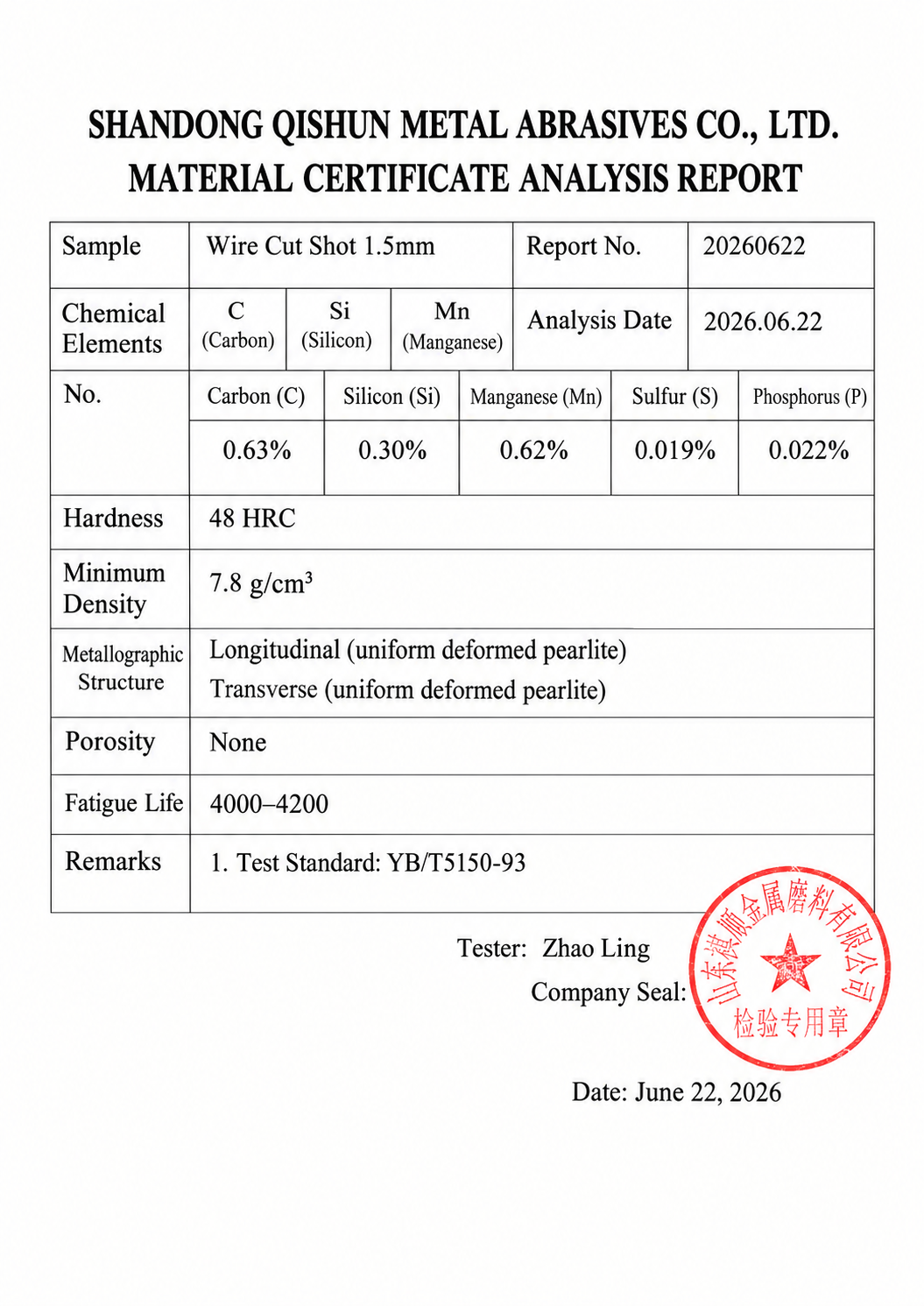
Cut wire shot is produced by cutting steel wire rather than atomizing or crushing it; the wire feedstock determines the diameters a buyer can order.
Blasting and shot peening media are normally compared on three properties: hardness, particle size and shape. That framework is useful, but it sits downstream of an earlier supply-chain decision — what the media is made from before it is sized. Cut wire shot makes that gap visible. The product is manufactured by cutting steel wire into short lengths, which means the wire feedstock, not the final sizing screen, sets the diameter envelope a buyer can actually be quoted against.
In the steel wire cut pellet series produced by Zouping Huiteng Metal Abrasives Co., Ltd., tire cord feedstock is cut across a range of 1.0 mm to 2.0 mm, while steel strand feedstock is cut across 2.0 mm to 3.0 mm. Across both streams the series covers particle sizes from 1.0 mm to 3.0 mm at a hardness of 44–53 HRC, with tensile hardness of 1,300–2,200 MPa, a deformed pearlite metallographic structure, a density of 7.8 g/cm³ and a bulk density of 4.5 g/cm³. The reported recycling life is 3,300–3,600 cycles, and the media can be recycled and reused in blasting and peening operations.
The two feedstock streams therefore meet at exactly one diameter — 2.0 mm — and diverge on either side of it. For a buyer building a media specification, that single overlap point is where most of the comparison work happens.
Huiteng Metal Abrasives, registered as Zouping Huiteng Metal Abrasives Co., Ltd., is a metal abrasives manufacturer and exporter based in Qingyang Town Industrial Park, Zouping County, Binzhou City, Shandong Province, China. The company was founded in 2017, operates a 20,000 m² factory, and supplies steel shot, steel grit, stainless steel shot, cast steel shot and cut wire shot in more than 60 specifications and models, with an annual production capacity of approximately 100,000 tons.
The Two Cutting Series at a Glance
Cut wire shot in this series is defined by two variables only: the feedstock and the cut diameter. Everything else is a series-level attribute shared by both streams. The table below separates the two categories of information.
| Specification | Tire cord cutting | Steel strand cutting |
|---|---|---|
| Feedstock material | Tire cord | Steel strand |
| Available cutting sizes | 1.0 mm / 1.2 mm / 1.5 mm / 1.5 × 1.5 mm / 2.0 mm | 2.0 mm / 2.5 mm / 3.0 mm |
| Series particle size range | 1.0 mm – 3.0 mm across the series | |
| Hardness | 44–53 HRC | |
| Tensile hardness | 1,300–2,200 MPa | |
| Metallographic structure | Deformed pearlite | |
| Density | 7.8 g/cm³ | |
| Bulk density | 4.5 g/cm³ | |
| Reported recycling life | 3,300–3,600 cycles | |
| Recyclable and reusable | Yes — in blasting and peening operations | |
Series-wide values apply to both feedstock streams. Only the cutting size range differs between tire cord and steel strand.
Why the Hardness Band Cannot Separate the Two Streams
A specification that reads “cut wire shot, 44–53 HRC” is not yet a purchasable product. Both the tire cord stream and the steel strand stream sit inside that band, so hardness does not discriminate between them. What changes between the two is the diameter, and the diameter is what the blast machine, the separator screen and the target surface profile all respond to.
Finer cut wire sizes are generally selected where surface finish requirements are tighter, where the workpiece is thinner or more delicate, or where peening intensity is deliberately kept low to avoid over-stressing a part. Coarser sizes are typically used where heavier scale, rust or coating must be removed, and where higher peening intensity is the objective. Because the cut wire series starts at 1.0 mm and ends at 3.0 mm, the practical split between “fine work” and “heavy work” sits inside this one product family — which is precisely why the feedstock question matters at the quotation stage.
For procurement teams, the operational consequence is simple. If the required size mix is concentrated at or below 2.0 mm, the tire cord stream can carry the whole order. If the mix runs above 2.0 mm, the steel strand stream is the only source. If both ends of the range are needed, both streams must be quoted, and the buyer should check whether a single manufacturer can supply both rather than splitting one media specification across two vendors.
How Cut Wire Shot Is Made — and Why the Route Matters
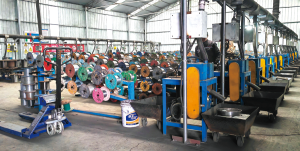
The cutting stage converts steel wire into short, uniform lengths; cut wire shot is not atomized or crushed.
Metallic blast media reach their final shape through one of three routes, and the route determines how consistent the particles are. Steel shot is atomized from molten steel into near-spherical particles. Steel grit is produced by crushing hardened cast shot into angular fragments. Cut wire shot is cut from steel wire into short, uniform lengths. The first two routes generate a distribution of shapes and masses per particle; the cutting route is bounded by the dimensional consistency of the incoming wire.
That difference shows up in the metallurgy. Cut wire shot in this series is described with a deformed pearlite metallographic structure and a tensile hardness of 1,300–2,200 MPa, which reflects the cold-worked condition of the wire before cutting rather than a cast structure. The combination of a density of 7.8 g/cm³ and a bulk density of 4.5 g/cm³ gives the media predictable flow characteristics through the recovery circuit, which matters in automated machines where the media must be elevated, screened and returned continuously.
Recycling is where the production route converts into cost. Cut wire shot in this series is recyclable and reusable, with a reported service life of 3,300–3,600 cycles. Inside a blasting machine, spent media is captured by the recovery system and passed through a separator; only broken fines are removed, while intact particles return to the hopper. Because the buyer pays for the media once and reuses it across thousands of cycles, consumption rate and dust generation become more consequential purchasing metrics than price per ton alone.
Applications: Where the 1.0–3.0 mm Range Fits
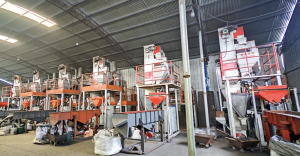
Recyclable metallic media is recovered, screened and returned to the blast wheel continuously, which is where cycle life translates into cost.
The cut wire pellet series is positioned for shipbuilding, steel structure and bridge, foundry, automotive parts and spring peening, pipeline and tube, and rail and locomotive work. Those are broad categories, so it helps to break them down by what the media is actually doing at each site.
- Shipbuilding and ship repair — hull blasting and rust removal, plus preparation of structural steel before painting. Media must survive long duty cycles and produce a consistent surface for coating adhesion.
- Structural steel and bridge fabrication — surface preparation and profiling of plate and profiles ahead of protective coating systems.
- Foundry and casting — descaling of castings and removal of residual moulding material, where particle consistency supports repeatable results across batches.
- Automotive parts and spring peening — controlled peening to improve fatigue performance, an application where media uniformity is a quality variable rather than a cost variable.
- Pipeline, tube, rail and locomotive — cleaning and reconditioning of large steel components, typically on automated or semi-automated lines.
The matched equipment set for these operations is standard across the industry: shot blasting and tumble blast machines, blast rooms and cabinets, bucket elevators and screw conveyors, separators and air washers, and dust collection and fume extraction systems. Media choice has to be made against that equipment, not in isolation — a size that the separator cannot classify correctly will circulate fines and degrade surface quality regardless of how good the incoming media is.
Field evidence from long-term supply programmes gives a sense of the scale involved. Documented customer programmes in shipbuilding and ship repair, structural steel and bridge fabrication, automotive parts and surface treatment, foundry and abrasive distribution channels have run at order quantities of around 100 tons with annual supply above 500 tons, over a duration of five years, across markets including Argentina, Spain, France, the United Kingdom, Iran, South Korea, Malaysia, Pakistan, Portugal, Saudi Arabia, Thailand, the United States and Vietnam. Reported outcomes include a consistent Sa 2.5–3.0 surface preparation grade, improved coating adhesion and paint lifespan, an abrasive consumption reduction of 15–20% compared with the previous supplier, stable production operation with zero quality complaints over five years, and a high recycling rate with low dust generation in customer workshops.
The 2.0 mm Overlap: A Practical Selection Rule
At 2.0 mm, both tire cord cutting and steel strand cutting are available. This is the only diameter where a buyer genuinely has a choice, and it is the point where price comparison alone tends to produce the wrong answer. Four factors should drive the decision.
- Where the rest of the mix sits. If most required sizes are at or below 2.0 mm, the tire cord stream can serve the whole order. If most sit above 2.0 mm, the steel strand stream is the base, and 2.0 mm should be pulled from the same stream to keep the feedstock consistent.
- Machine capability. Blast wheel power and separator screening settings determine which sizes run efficiently. A size that is technically orderable may not be the size the machine handles best.
- Target surface profile. The required roughness and preparation grade should be tested, not assumed, because both streams share the same 44–53 HRC band and the difference in outcome comes from particle size rather than hardness.
- Supply structure. If a site needs both fine and coarse sizes, sourcing both streams from one manufacturer removes the risk of mixing media from two production systems with different batch histories.
Market Signals Behind Recyclable Metallic Media
The commercial context for cut wire shot is a media market that is large, steel-dominated and concentrated in Asia. According to Grand View Research, the global metal abrasives market was valued at USD 6.7 billion in 2025 and is expected to reach USD 7.1 billion in 2026. Within the material segment, steel abrasives held an 89.9% share in 2025. Asia Pacific accounted for 56.0% of global revenue in the same year.
At sub-segment level, WiseGuyReports values the steel shot market at USD 1.664 billion in 2025, projected to reach USD 2.5 billion by 2035, while global steel shot consumption reached 6.8 million metric tons in 2025. Those figures describe the cast and atomized side of the category, but they indicate the direction of demand: recyclable metallic media is being bought on total cost of ownership rather than on first purchase price.
The standards position is less symmetrical, and buyers should notice it. ISO 11124-3:2018 specifies requirements for 14 grades of high-carbon cast-steel shot and 11 grades of high-carbon cast-steel grit as supplied for blast-cleaning processes, with values for hardness, density, defect and structural requirements, and chemical composition. That standard anchors cast media. Cut wire shot of the type described here is specified by the buyer, which means the RFQ and the batch certificate carry more of the quality burden than a published grade table does.
Cut Wire Shot Compared with Conventional Media — and Where It Stops
A fair comparison has to start from what the alternatives actually are, not from a ranking. Four media families are commonly considered for the same surface preparation and peening duties.
| Media family | Form | Buyer consideration |
|---|---|---|
| Cut wire shot (tire cord / steel strand) | Cut from wire, 1.0–3.0 mm, 44–53 HRC | Recyclable and reusable; reported life 3,300–3,600 cycles |
| Cast steel shot | Atomized spherical, S70–S930, HRC 40–50 or HRC 55–65 | Wider diameter envelope; recyclable cycles stated as 1000+ |
| Cast steel grit | Angular crushed, G12–G120 | Aggressive cutting action for heavy rust and scale |
| Disposable mineral media | Single-use mineral abrasive | No recovery loop; consumption and dust are ongoing costs |
Against cast steel shot, the cut wire series offers a higher reported recycling life — 3,300–3,600 cycles versus the 1000+ recyclable cycles stated for the cast steel shot series — and a narrower, more uniform cut geometry. Against cast steel grit, it trades the aggressive angular cutting action for consistency and longevity. Against disposable mineral media, it changes the cost model entirely, because the media is recovered and returned rather than consumed on first impact.
The boundaries matter just as much as the advantages, and buyers should treat them as specification inputs rather than objections.
- Diameter ceiling. The cut wire series stops at 3.0 mm. The cast steel shot series spans S70 to S930, so requirements for the larger cast grades sit outside the cut wire envelope. A plant that needs coarse cast media for one line and cut wire for another will be running two media specifications, not one.
- Feedstock asymmetry. Below 2.0 mm, tire cord is the only source. Above 2.0 mm, steel strand is the only source. A buyer who needs the full 1.0–3.0 mm range is, in practice, buying two feedstock streams.
- Wide hardness band. The 44–53 HRC range is a series property. An order that specifies only that band leaves the incoming inspection gate open, so buyers should set a target HRC with a tolerance and require batch hardness data.
- Geometry treatment. Cut wire media is supplied as cut lengths. Where a pre-rounded edge profile is a requirement, buyers should ask specifically about roll-ground or reinforced alternatives rather than assuming a standard cut pellet delivers it — the manufacturer's separate grinding and reinforced steel shot line is described as cut and roll-ground for rounded edge forming, and it is a different product from the cut wire pellet series.
- Validation dependence. Peening intensity and cleaning rate depend on the interaction between media size, media hardness, wheel power and separator settings. A specification that performs well on one line is not automatically transferable to another, which makes on-machine sample testing a necessary step rather than an optional one.
Procurement Framework: What Belongs in the RFQ
Because cut wire shot is not covered by a single published grade table in the way high-carbon cast media is, the RFQ does the work that a standard would otherwise do. A complete enquiry for a blasting or peening project should carry the machine type and wheel power, the workpiece material, the target surface preparation grade such as Sa 2.5 or Sa 3, the desired surface roughness in microns, the daily production volume, and the abrasive size currently in use.
On the supply side, the commercial parameters that typically shape a cut wire order are consistent across the manufacturer's range. Minimum order quantity is 1 ton for standard grades and 3 tons for customized grades. Ready stock orders ship within 7–15 days, while customized orders take 20–30 days. Payment terms are T/T with 30% deposit and 70% before shipment, or an irrevocable L/C at sight. Monthly capacity is 8,000 tons per month, and customization covers material type, particle size and grade range, hardness from HRC 40 to 65, chemical composition, and packaging formats including bulk jumbo bags, 25 kg bags and custom cartons, as well as OEM private label and custom packaging design.
Quality documentation is the other half of the framework. Every batch is subject to 100% batch inspection covering particle size sieve analysis, hardness testing, chemical composition analysis and microstructure inspection, with SGS third-party testing available on request. Free samples of 1–5 kg are provided for testing on the buyer's own blasting equipment, prepared within 3–5 working days and matched to the required size, hardness and material grade. For a first order, testing two or three grades is a more reliable route to a final specification than selecting from a catalogue.
Future Outlook
Three shifts are likely to shape how cut wire shot is bought over the next several years. The first is the continued concentration of metal abrasive supply in Asia Pacific, which held 56.0% of global revenue in 2025. That concentration gives volume buyers access to capacity, but it also raises the value of supplier documentation, because the distance between buyer and production line makes batch evidence more important, not less.
The second is the shift in how media cost is evaluated. With steel abrasives at 89.9% of the material segment in 2025 and global steel shot consumption at 6.8 million metric tons, the category is mature enough that competition is moving toward consumption rate, recycling rate and dust generation rather than headline price. Products with a reported 3,300–3,600-cycle life compete on those terms.
The third is specification discipline. ISO 11124-3:2018 gives cast steel shot and grit a shared technical anchor covering hardness, density, defect and structural requirements, and chemical composition across 14 shot grades and 11 grit grades. Cut wire shot has no equivalent published grade framework, so the burden shifts to the buyer's RFQ, the batch certificate and the trial result. Buyers who formalise those three elements early will get more comparable quotations and fewer mid-project media changes.
FAQ
What is the difference between tire cord cut wire shot and steel strand cut wire shot?
Both are cut wire products manufactured by cutting steel wire into short lengths, and both share the same series-level properties: hardness of 44–53 HRC, tensile hardness of 1,300–2,200 MPa, deformed pearlite metallographic structure, density of 7.8 g/cm³, bulk density of 4.5 g/cm³ and a reported recycling life of 3,300–3,600 cycles. The difference is the feedstock and, as a consequence, the available cutting sizes. Tire cord cutting covers 1.0 mm, 1.2 mm, 1.5 mm, 1.5 × 1.5 mm and 2.0 mm. Steel strand cutting covers 2.0 mm, 2.5 mm and 3.0 mm. The series as a whole therefore spans 1.0 mm to 3.0 mm, with 2.0 mm available from both streams.
Can cut wire shot be recycled and reused in blasting and peening operations?
Yes. Cut wire shot in this series is recyclable and reusable in blasting and peening operations, with a reported service life of 3,300–3,600 cycles. In a machine fitted with a recovery system, spent media is captured and passed through a separator; broken fines are removed while intact particles return to the hopper. The reported recycling life is what allows the media to be evaluated on total operating cost rather than on purchase price alone.
What hardness should be specified when ordering cut wire shot?
The cut wire series is supplied within a 44–53 HRC band, with tensile hardness of 1,300–2,200 MPa. Because that band is relatively wide, a purchase specification that states only “44–53 HRC” does not give the supplier or the incoming inspection team a target. Buyers should define a specific target hardness and a permitted tolerance, and require the batch hardness result as part of the delivery documentation. The manufacturer performs 100% batch inspection including particle size sieve analysis, hardness testing, chemical composition analysis and microstructure inspection, and can provide SGS third-party testing.
How can a buyer validate cut wire shot before placing a bulk order?
The standard route is an on-machine trial. Free samples of 1–5 kg are provided for testing on the buyer's own blasting equipment, prepared within 3–5 working days and matched to the required size, hardness and material grade. Testing two or three grades is usually more informative than testing one, because the result that matters is the surface grade and consumption rate achieved on the specific machine, not a catalogue value. For scale reference, MOQ is 1 ton for standard grades and 3 tons for customized grades; ready stock orders ship in 7–15 days and customized orders in 20–30 days.
What are the limitations of cut wire shot compared with cast steel media?
The most significant limit is diameter. The cut wire series covers 1.0 mm to 3.0 mm, whereas the cast steel shot series covers S70 to S930, so requirements for coarser cast grades fall outside the cut wire range. There is also a feedstock asymmetry: sizes below 2.0 mm are available only from tire cord cutting, and sizes above 2.0 mm only from steel strand cutting, so a buyer who needs both ends of the range is managing two feedstock streams. In addition, cut wire shot does not have the same published grade framework that ISO 11124-3:2018 provides for high-carbon cast-steel shot and grit, which places more of the specification burden on the buyer's RFQ and on batch-level test documentation.
Which industries typically use cut wire shot for blasting and peening?
The series is positioned for shipbuilding, steel structure and bridge, foundry, automotive parts and spring peening, pipeline and tube, and rail and locomotive applications. In practice that covers hull blasting and rust removal, surface preparation of structural steel before painting, casting descaling, controlled peening of automotive components and springs, and cleaning of large steel components on automated or semi-automated lines. These operations typically use shot blasting machines, tumble blast machines, blast rooms, recovery and recycling systems, separators and air washers, and dust collection equipment.
Detailed cut wire series specifications, packaging options and series documentation are compiled in the manufacturer's product brochure, available for download: Huiteng Metal Abrasives product brochure.
Tem questões ou precisa de mais detalhes?
Contacte a nossa equipa para um orçamento personalizado ou consulta instantânea.
Solicitar orçamento
Preencha o formulário abaixo e a nossa equipa entrará em contacto com uma proposta personalizada.
Chat direto do WhatsApp
Prefere conversar em tempo real? Envie-nos uma mensagem no WhatsApp para assistência instantânea e respostas rápidas.
- Obter orçamento personalizado
- Partilhar fotos ou documentos
- Discuta as suas necessidades diretamente
Geralmente responde em 5–30 minutos durante o horário de expediente.