
Tissue Packing Machine Basics: Types, Speeds, and What to Consider
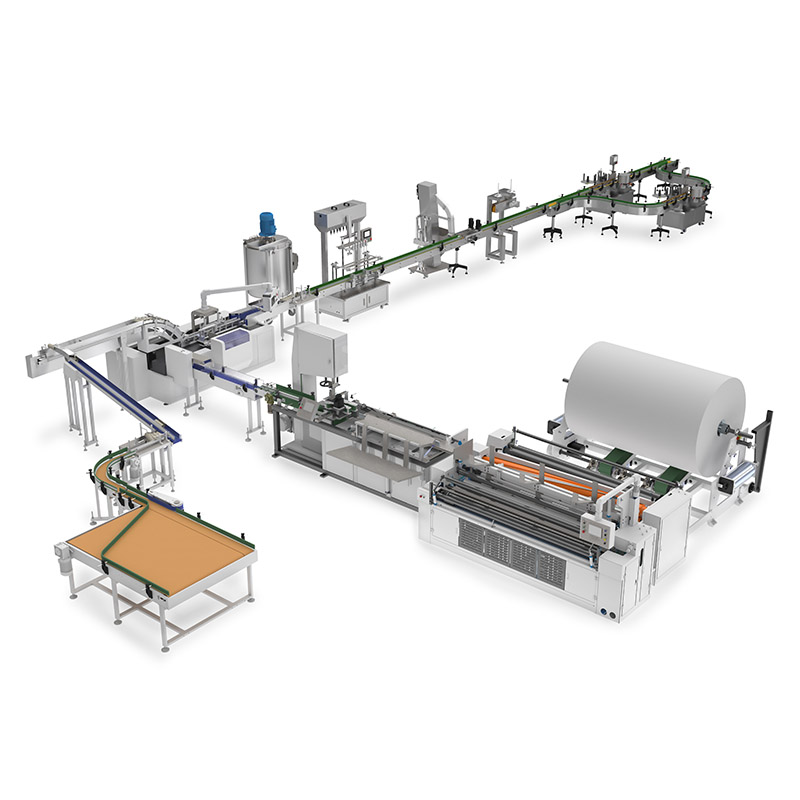
Tissue products leave the converting line in a range of formats: folded facial tissues, rolled toilet paper, kitchen towels, napkins, cube boxes, canisters, and wet wipes. The equipment that turns these unfinished products into wrapped, cartoned, case-packed and palletized units is commonly called a tissue packing machine. For manufacturers moving beyond manual packing, the first purchasing milestone is understanding machine categories, speed expectations, line configurations, and the practical limits of automation.
Why packaging has become a production challenge
In many tissue plants, the packaging stage is the point where product flow can slow down sharply. A converting line may produce tissue rolls or folded sheets at high speed, but if wrapping, carton packing, case packing, and palletizing depend on manual labor, the entire output can be constrained. Manual packing also brings consistency and hygiene risks, especially for products intended for food contact or personal care settings.
This is why automated packaging is attracting attention from producers of all sizes. The global tissue paper packaging machines market was valued at USD 273.8 million in 2023 and is projected to reach USD 433.7 million by 2032, according to Transparency Market Research. Automatic tissue packaging machines already accounted for 58.3% of the market in 2025, according to a separate market research report, reflecting a broader shift toward unmanned and data-driven production lines. For buyers, the trend means that packaging equipment is no longer an afterthought; it is a core part of production capacity planning.
What is a tissue packing machine?
A tissue packing machine is a packaging machine designed to work with tissue products such as facial tissue, toilet paper, napkins, kitchen towels, or wet wipes. Depending on the machine type, it can wrap soft tissue packs in plastic film, place facial tissues into cartons, wrap individual toilet rolls, bag tissue roll bundles, or operate as part of an integrated line that ends with case packing and palletizing.
One manufacturer focused on this category is Wenzhou Wimach Machinery Co., Ltd., based in Ruian, Wenzhou, Zhejiang, China. Established in 2021, Wimach specializes in packaging solutions for folded tissues, rolled tissues, and blister packaging applications. Its main products include tissue packing machines and integrated packaging lines. The company operates a 3000 m² facility with approximately 37 employees, including an R&D team of five engineers, and has an annual production capacity of 160 sets. Wimach states that all its machines are CE certified. Export business represents about 60% of total sales, with major markets in the EU, North America, and South America.
Main types of tissue packing machines
Tissue packing machines can be grouped by the product format they handle. Facial tissue and napkin producers often look for cartoning machines or soft tissue wrapping machines. Toilet paper producers need roll wrapping and bundle bagging equipment. Producers of canister tissues or wet wipes require more specialized filling and capping solutions. The table below summarizes common machine types and their stated speed ranges.
| Machine type | Representative model | Typical maximum capacity |
|---|---|---|
| Tissue cartoning machine | TC-100 | 30-100 boxes/min |
| Automatic high-speed tissue box packing machine | TC-300 | Up to 180 boxes/min |
| Cube box tissue cartoning machine | TC-80F | 30-80 boxes/min |
| Automatic soft tissue wrapping machine | TP-180 | 180 packs/min |
| Automatic high-speed soft tissue wrapping machine | TP-280 | Up to 260 packs/min |
| Automatic toilet paper roll wrapping machine | TW-160 | 60-120 rolls/min |
| Automatic bottom dispensing tissue bagging machine | TB-F60 | 60 packs/min |
| Automatic tissue roll bundle bagging machine | TB-R30 | 25 packs/min |
These speed numbers are useful for initial comparison, but actual output depends on product dimensions, packaging material, operator skill, and upstream supply. For example, the TP-280 high-speed soft tissue wrapping machine handles package dimensions from 90-200 mm in length, 85-105 mm in width, and 25-90 mm in height. The TW-160 toilet paper roll wrapping machine handles rolls with diameters and lengths of 90-130 mm, using wrapping paper of 17-37 gsm. The TC-300 high-speed tissue box packing machine handles carton dimensions from 100-240 mm in length, 100-120 mm in width, and 20-90 mm in height, with carton board grammage of 300-400 gsm.
Key specifications to compare
Buyers at the research stage should look beyond maximum speed. Four specification areas matter across almost every tissue packing project:
First, package dimension range. A wrapping or cartoning machine must accept the exact product size the producer plans to run. A machine with a narrow dimension range may be less flexible when the product portfolio changes. The TP-180 and TP-280, for example, share the same package dimension range, which makes them suitable for similar folded tissue formats.
Second, packaging materials. Soft tissue wrapping machines such as the TP-280 are designed to run CPP, PE, or composite film. Roll wrapping machines such as the TW-160 require wrapping paper with a specific grammage range. Buyers need to check whether their current or planned packaging material falls within the machine's acceptable range.
Third, utility requirements. Almost all industrial tissue packing machines require 380V 50/60Hz three-phase power, compressed air at 0.5-0.8 Mpa, and enough floor space for the machine footprint. The TB-R30, for instance, consumes 13 kW and needs 450 L/min of air. The TB-F60 consumes 35 kW and needs 120 L/min of air. These differences affect installation planning and operating cost.
Fourth, material construction. Many tissue packing machines are built from carbon steel. Some models, especially those designed for canister-style products, are available in stainless steel. Buyers in humid environments or with strict corrosion-control requirements should confirm whether the machine frame and contact parts match their production conditions.
Integrated lines: from single machine to turnkey packaging
Standalone machines are not the only option. For producers with high volume and limited manual labor, integrated packaging lines connect multiple machines into one continuous flow.
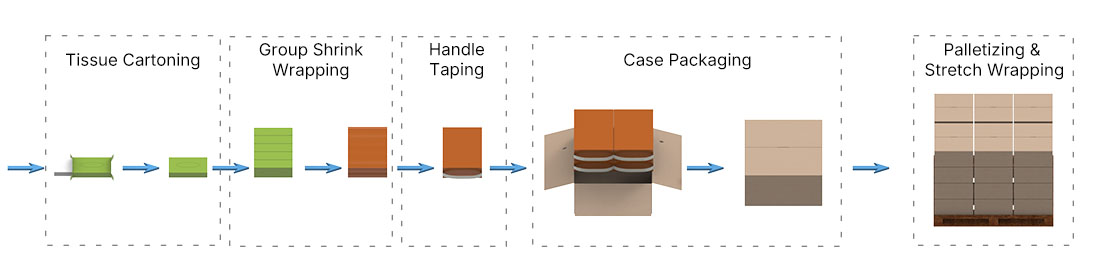
The Facial Tissue Box Packaging Line from Wimach is one example. It is a fully automatic turnkey solution for boxed facial tissues. The line includes a facial tissue box packing machine, a box shrink wrapping machine, a handle taping machine, a case packer, a palletizer, and conveyors. It is designed to achieve automatic connection from box packing to finished-product palletizing with minimal manual intervention. The stated maximum speed is 100 boxes per minute for cartoning, 10 cases per minute for case packing, and 10 cycles per minute for palletizing.
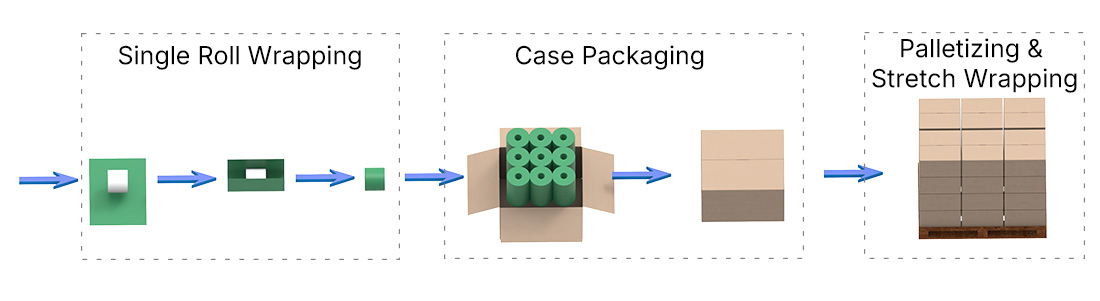
For roll products, the Toilet Paper Packaging Line combines a toilet roll wrapping machine, a case packer, a palletizer, and a stretch wrapping machine. It is a fully integrated automated line for toilet paper rolls, built from carbon steel, and tailored to customer-specific production needs. The maximum wrapping speed is 120 rolls per minute, according to the line specification.
Wet wipe producers have a different set of needs. The Canister Wet Wipe Packaging Line is a turnkey solution for canister-style wet wipes, suitable for disinfecting and sanitizing wipes. It covers automatic wipe roll feeding and loading, liquid filling, sealing, capping, and labeling. The line delivers a maximum packaging speed of 60 canisters per minute, with maximum canister dimensions of 110 mm in diameter and 220 mm in height. The line is made of carbon steel and supports flexible customization.
Application examples across regions
Integrated systems are being deployed in different configurations depending on local production priorities. In Poland, for example, a facial tissue packaging line has been designed as a one-stop turnkey solution, covering box packing, plastic film wrapping, case packing, palletizing, strapping, and stretch wrapping. This type of configuration is common in the EU market, where customized design and CE compliance are typical requirements.
In the United States, a customized toilet paper packaging line can start with roll wrapping and continue through case packing, automatic palletizing, and stretch film wrapping. The application is designed to run automatically within a tissue paper producing and packaging workshop, and is often specified with customized design and CE compliance.
In Mexico, a canister wet wipe line scenario involves a turnkey automated packaging line for disinfecting wipes. Empty canisters are fed onto a conveyor, wipes are loaded, disinfectant is filled, containers are sealed and capped, labels are applied, and finished canisters move to case packing and palletizing. This application also requires supporting equipment such as tissue rewinding and cutting machines, and is specified with customized design and CE compliance.
These examples are not customer endorsements. They illustrate typical project configurations that buyers can use as reference points when discussing their own factory layout and product requirements.
Market trends and industry data
Several verified market signals are shaping the tissue packing equipment category. The global tissue paper packaging machines market is relatively concentrated in value, at USD 273.8 million in 2023, but it is expected to grow to USD 433.7 million by 2032. Automatic machines already hold the dominant share, at 58.3% in 2025, which suggests that most new capacity is being planned around automated rather than manual packaging.
In the broader tissue converting machinery category, Asia Pacific has been identified as the largest regional market, capturing 42.6% of global revenue in 2025 according to FMI data. This regional concentration helps explain why many packaging machine manufacturers and component suppliers are located in that region. It also means that buyers evaluating Chinese-made equipment should look for export-specific compliance and support structures, rather than assuming all regional suppliers follow the same standards.
The cartoning segment, which applies to facial tissues and napkins, is also expected to grow steadily. One Global Market Insights forecast projects the cartoning machinery market to reach USD 8.7 billion by 2035, with a CAGR of 5.1%. For tissue producers, this points to sustained demand for equipment that can handle cartons, boxes, and display-ready packaging.
Regulatory change is another factor to watch. Packaging machinery sold in the EU must comply with the Machinery Directive 2006/42/EC, and the market is transitioning to the new EU Machinery Regulation introduced in 2023, which places additional emphasis on cybersecurity. Buyers should verify that any imported machine can meet the compliance requirements of their final market.
Traditional manual packing vs. automated tissue packing
Manual packing remains workable for very small batches, multi-format packing, or low-wage environments. It offers flexibility because workers can switch between products without changing machine tooling. The financial entry barrier is low, and maintenance requirements are minimal.
Automated packing changes the cost structure. It reduces repetitive physical work, improves output consistency, and allows a production line to run with fewer people. It also makes it easier to track throughput and plan capacity. However, automation brings higher initial investment, more complex maintenance, and greater dependence on stable packaging materials and consistent product dimensions.
There is also a practical limit that buyers should not ignore. Many tissue packing machines are built with carbon steel frames and structures. In highly humid workshops, or in environments where harsh cleaning chemicals are used, carbon steel may require additional protection, and a stainless steel machine may be a more suitable choice. Similarly, integrated lines require more floor space, more conveyors, and more careful coordination with upstream converting equipment. A buyer with limited floor space may be better served by standalone machines than by a long turnkey line.
What this means for buyers at the awareness and research stage
At the awareness stage, the main goal is to translate a product portfolio into a machine category. A producer of folded facial tissue packs should compare soft tissue wrapping machines such as the TP-180 or TP-280. A producer of boxed facial tissue should evaluate tissue cartoning machines such as the TC-100 or TC-300, or a full facial tissue box packaging line. Toilet paper producers need to compare roll wrapping machines such as the TW-160 and decide whether bundle bagging or full palletizing is part of the project scope.
At the research stage, buyers should begin collecting specifications that match their factory constraints: line speed, package size range, film type, power supply, air pressure, floor space, and material construction. It is also important to confirm the supplier's ability to customize. Wimach, for example, states that it can provide targeted customized solutions based on customer production needs, whether the project requires a single standalone machine or a complete integrated packaging line.
Buyers should also consider after-sales factors such as lead time, spare parts availability, and documentation. CE certification is one indicator of compliance, but it is not a substitute for a clear understanding of installation requirements, maintenance schedules, and operator training.
Future outlook
The tissue packaging segment is likely to continue moving toward automated and integrated systems. The high share of automatic machines in recent market data suggests that producers are prioritizing consistency and labor reduction. At the same time, the transition from the EU Machinery Directive 2006/42/EC to the new EU Machinery Regulation means that machine safety and cybersecurity will become more prominent in purchasing decisions.
For equipment suppliers, the ability to integrate wrapping, cartoning, case packing, and palletizing into a single line will remain central. For buyers, the more important shift is from buying a single machine to planning an entire packaging workflow. That workflow must match the product format, production volume, packaging material, and physical plant layout.
There is also room for more modular thinking. Some producers will prefer to start with a standalone wrapping or cartoning machine and add case packing and palletizing later. Others will need a turnkey line from day one. The right choice depends on volume growth expectations and the level of manual intervention the facility can support.
Frequently asked questions
A tissue packing machine packages tissue products into their final saleable form. Depending on the machine type, it can wrap folded tissue packs in film, place facial tissues into cartons, wrap toilet rolls, bag tissue roll bundles, or operate as part of an integrated line that ends with case packing and palletizing.
Common types include tissue cartoning machines, soft tissue wrapping machines, toilet paper roll wrapping machines, tissue roll bundle bagging machines, and integrated packaging lines. Representative models include the TC-100, TC-300, TC-80F, TP-180, TP-280, TW-160, TB-F60, and TB-R30.
Maximum speeds vary by machine type and product format. The TB-R30 bundle bagging machine operates at 25 packs per minute. The TC-100 cartons 30-100 boxes per minute. The TW-160 wraps 60-120 rolls per minute. The TP-280 soft tissue wrapping machine reaches up to 260 packs per minute, and the TC-300 high-speed tissue box packing machine reaches up to 180 boxes per minute.
Wimach states that all its machines are CE certified. The company is based in Wenzhou, China, and its main export markets include the EU, North America, and South America.
Yes. Wimach provides targeted customized solutions based on customer production needs, for both standalone equipment and complete integrated packaging lines. Application examples include customized toilet paper lines, facial tissue lines, and wet wipe canister lines, often specified with CE compliance and customized design.
Tem questões ou precisa de mais detalhes?
Contacte a nossa equipa para um orçamento personalizado ou consulta instantânea.
Solicitar orçamento
Preencha o formulário abaixo e a nossa equipa entrará em contacto com uma proposta personalizada.
Chat direto do WhatsApp
Prefere conversar em tempo real? Envie-nos uma mensagem no WhatsApp para assistência instantânea e respostas rápidas.
- Obter orçamento personalizado
- Partilhar fotos ou documentos
- Discuta as suas necessidades diretamente
Geralmente responde em 5–30 minutos durante o horário de expediente.