
Tissue Packing Machine Compliance Checklist: TP-280, TB-F60, TC-100 & TW-160
Tissue Packing Machine Compliance Checklist: TP-280, TB-F60, TC-100 & TW-160
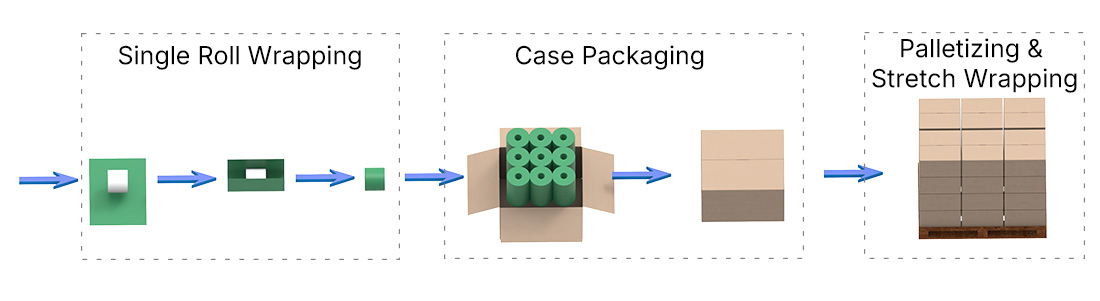
A tissue packing line is qualified on published data first and released on documentation second. The flow above shows the end-of-line sequence — roll wrapping, case packing, palletizing, stretch wrapping — that a specification review has to cover.
Tissue packing machines are selected on published specifications and released on documentation. Buyers who treat those as the same exercise usually discover the gap at the least convenient moment — during commissioning, when a plant engineer asks for the file that proves the equipment meets site standards. This reference checklist keeps the two separate. It lists the technical data points that can be compared against a plant's actual conditions today for four WIMACH models — the TP-280 soft tissue wrapping machine, the TB-F60 bottom dispensing tissue bagging machine, the TC-100 tissue cartoning machine and the TW-160 toilet paper roll wrapping machine — and it marks the items that can only be confirmed by requesting official certification or compliance documents from the manufacturer.
The wider category is moving in the same direction. Automatic tissue packaging machines held a dominant 58.3% share of the tissue packaging equipment market in 2025, according to a Market Research Report 2033, and the global tissue paper packaging machines market was valued at USD 273.8 million in 2023 with a projected value of USD 433.7 million by 2032 (Transparency Market Research). As more of the end-of-line becomes automated, the datasheet stops being a sales summary and starts being the first layer of due diligence.
Why Specification Sheets Are Qualification Data, Not Compliance Proof
A specification sheet defines an operating envelope. Power supply, compressed air demand, rated output, product dimensions and machine footprint are the parameters an engineering team compares against what the plant can actually deliver — available power, air capacity, floor space, and the physical size of the product being packed. That comparison is a qualification exercise, and it can be completed from published data alone.
Compliance is a different file. A published voltage rating says nothing about whether a specific unit shipped to a specific site carries the paperwork a regulator, insurer or retail customer will eventually ask for. WIMACH states that all of its machines are CE certified, and its EU and North America application scenarios list CE compliance as a special project requirement. Even so, the document that ends up in a buyer's technical file — certificate, declaration of conformity or an equivalent official record — has to be requested separately from the manufacturer and matched to the exact configuration being ordered. A checklist that stops at the spec sheet is incomplete.
The Manufacturer Behind These Four Models
Wenzhou Wimach Machinery Co., Ltd. is a packaging equipment manufacturer established in 2021 and located at Bldg 14 Qiaomao Rd, Ruian, Wenzhou, Zhejiang, China. The company operates a 3000 m² manufacturing facility with approximately 37 employees, including an R&D team of 5 engineers, and reports an annual production capacity of 160 sets. Its main products are tissue packing machines and integrated packaging lines for folded tissues, rolled tissues and blister packaging applications. Export accounts for 60% of total sales, with the EU, North America and South America listed as major markets.
That portfolio spans several machine families, which matters for the checklist below: the four models covered here are a wrapping machine, a bagging machine, a cartoning machine and a roll wrapping machine. They are not interchangeable, and the specification review for each starts from a different product envelope.
Electrical and Pneumatic Requirements: The First Plant-Side Check
All four models share one supply profile: 380V, 50/60Hz, three-phase power, with compressed air at 0.5-0.8 MPa. That uniformity is convenient for plant planning, but it also sets a hard boundary — a facility without a 380V three-phase supply, or one running a different air pressure regime, cannot simply install these units without additional engineering. Power consumption is where the models diverge sharply.
| Model | Function | Power supply | Power consumption | Air pressure | Air consumption |
|---|---|---|---|---|---|
| TP-280 | Automatic high-speed soft tissue wrapping | 380V 50/60Hz 3 phase | 18 kW | 0.5-0.8 MPa | 120 L/min |
| TB-F60 | Automatic bottom dispensing tissue bagging | 380V 50/60Hz 3 phase | 35 kW | 0.5-0.8 MPa | 120 L/min |
| TC-100 | Tissue cartoning | 380V 50/60Hz 3 phase | 6.2 kW | 0.5-0.8 MPa | 120-160 L/min |
| TW-160 | Automatic toilet paper roll wrapping | 380V 50/60Hz 3 phase | 12 kW | 0.5-0.8 MPa | 120-160 L/min |
Two points deserve attention in a qualification review. First, consumption figures are per machine, so a plant planning several units should build its load schedule from the individual ratings rather than assume a single line-level number. Second, air consumption is quoted separately from pressure: the TP-280 and TB-F60 each draw 120 L/min, while the TC-100 and TW-160 are rated at 120-160 L/min. A compressor sized for one cartoning machine may look very different once a wrapping machine and a bagging machine are added to the same header.
Output and Product Envelope: Matching Rated Capacity to Real SKUs
Rated capacity is the most quoted number in the category and the one most often read incorrectly. Each figure below is a maximum — 260 packs/min for the TP-280, 60 packs/min for the TB-F60, 30-100 boxes/min for the TC-100 and 60-120 rolls/min for the TW-160 — and each is valid only inside the product envelope published alongside it.
| Model | Rated capacity | Product / package envelope | Consumable specification |
|---|---|---|---|
| TP-280 | Max. 260 packs/min | 90-200 (L) x 85-105 (W) x 25-90 (H) mm | CPP, PE, composite film; film roll 340 (W) x 450 (D) mm, thickness 0.035-0.05 mm |
| TB-F60 | Max. 60 packs/min | 200-400 (L) x 115-200 (W) x 85-100 (H) mm | Pre-made bags, 4 bag magazines |
| TC-100 | 30-100 boxes/min | Carton 100-240 (L) x 100-120 (W) x 20-90 (H) mm | Carton board grammage 300-400 gsm |
| TW-160 | 60-120 rolls/min | Tissue roll 90-130 (L) x 90-130 (D) mm | Wrapping paper 17-37 gsm; paper roll 480 (L) x 500 (D) mm |
The consumable specifications are part of the same check. The TP-280 runs CPP, PE or composite film with a roll dimension of 340 mm width by 450 mm diameter and a thickness of 0.035-0.05 mm. The TB-F60 uses pre-made bags and carries four bag magazines. The TC-100 accepts carton board from 300 to 400 gsm. The TW-160 wraps with paper from 17 to 37 gsm supplied on rolls of 480 mm length and 500 mm diameter. A buyer whose film, board or wrapping paper falls outside these ranges is not looking at a configuration question; they are looking at a different machine.
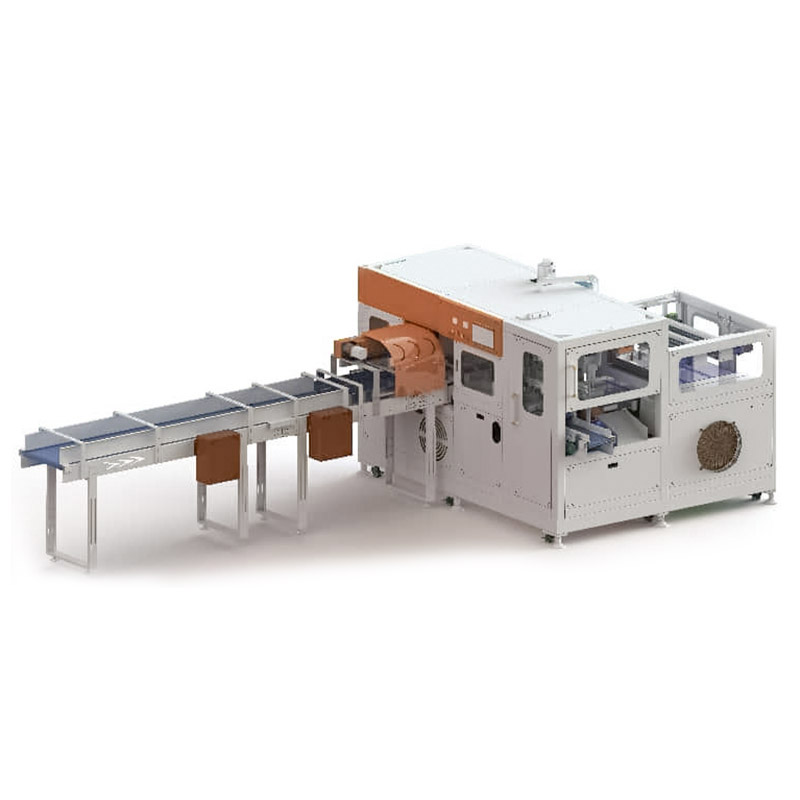
The Automatic Bottom Dispensing Tissue Bagging Machine, model TB-F60: carbon steel construction, up to 60 packs/min, 35 kW power consumption and a 3500 kg net weight.
Footprint, Weight and Build Material
Floor space is the specification buyers most often defer and the one that is hardest to change after a purchase order. The published dimensions below are overall machine dimensions, not installation clearances.
| Model | Overall dimensions (L x W x H, mm) | Net weight | Material |
|---|---|---|---|
| TP-280 | 3585 x 6260 x 1800 | 2900 kg | Carbon steel |
| TB-F60 | 2840 x 6060 x 1800 | 3500 kg | Carbon steel |
| TC-100 | 3620 x 3130 x 1800 | 2200 kg | Carbon steel |
| TW-160 | 4350 x 2550 x 1940 | 3500 kg | Carbon steel |
All four models are built on carbon steel. Two weigh 3500 kg — the TB-F60 and the TW-160 — which puts them in a different handling category from the 2200 kg TC-100 and the 2900 kg TP-280 for rigging, floor loading and vibration isolation planning. The TP-280 and TB-F60 are also the widest units in the group, at 6260 mm and 6060 mm respectively, a dimension that tends to determine hall layout more than length does.
How These Models Sit Inside Real Packaging Lines
Published specifications describe a machine; application scenarios show how it is deployed. Three WIMACH project scenarios illustrate the pattern, and each lists customized design and CE compliance as a special requirement.
In an EU facial tissue project in Poland, the line operates in automatic mode in a tissue paper producing and packaging workshop, connecting facial tissue box packing, film wrapping, case packing, palletizing, strapping and stretch wrapping. The TP-280 and TC-100 appear among the matched models for that project, alongside the TC-300 box packing machine and the Facial Tissue Box Packaging Line. Upstream equipment includes a tissue folding machine and a tissue cutting machine.
In a US toilet paper project, the TW-160 sits inside a customized line that runs roll wrapping, case packing, automatic palletizing and stretch film wrapping in automatic mode, fed by a tissue rewinding machine and a tissue cutting machine. A comparable canister wet wipe project in Mexico shows the same pattern at line level: automatic operation, customized design, CE compliance and integration with upstream tissue equipment.
The practical reading for a buyer at the research stage is that none of these four models is purchased in isolation. Each has an upstream input — folded tissue, boxed tissue or tissue rolls — and a downstream output, so the specification review has to cover the interfaces as well as the machine itself.
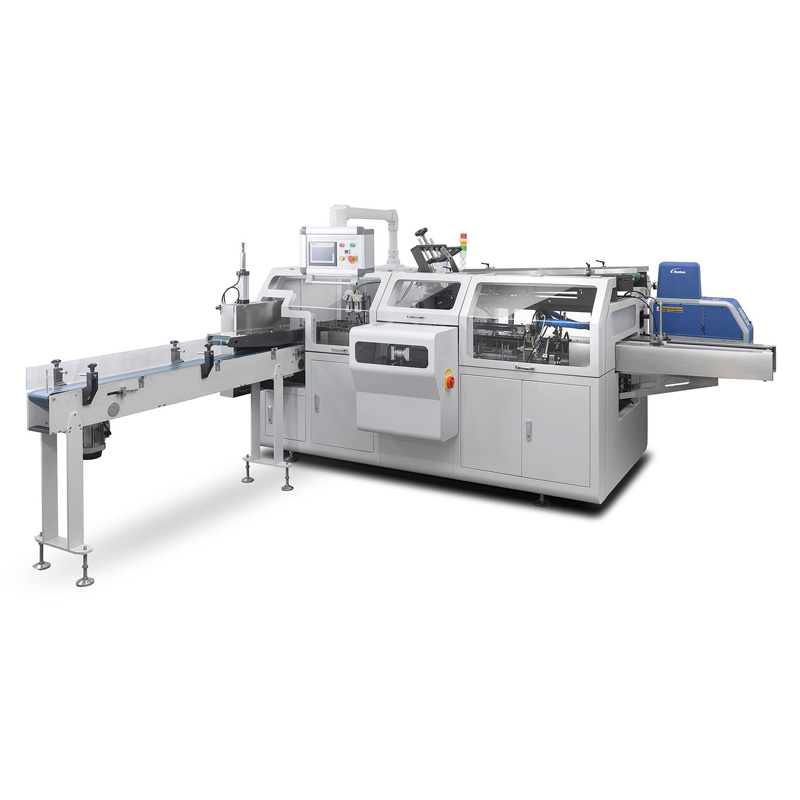
The Tissue Cartoning Machine, model TC-100: 30-100 boxes/min, 6.2 kW power consumption and a carton board range of 300-400 gsm.
Market Trend Context for Buyers
Three published data points frame the timing of a purchase decision. Automatic tissue packaging machines held a dominant 58.3% of the category in 2025, reflecting the shift toward unmanned and data-driven production lines. Within that, the cartoning machinery segment — the segment the TC-100 belongs to — is expected to grow at a CAGR of 5.1% to reach USD 8.7 billion by 2035 (Global Market Insights). Regionally, Asia Pacific is the largest market for tissue packaging machinery, capturing 42.6% of global revenue in 2025 (Future Market Insights).
On the regulatory side, packaging machinery placed on the EU market must comply with the Machinery Directive (2006/42/EC), and the framework is transitioning to the new EU Machinery Regulation (2023), which adds attention to cybersecurity alongside traditional machine safety requirements (European Commission / UL Solutions). For a buyer assembling a technical file, that is a reason to treat certification documents as a distinct deliverable rather than an assumption attached to a CE mark on a brochure.
Where Published Specifications Stop: Limits and Boundaries
A checklist is only useful if it states what it cannot confirm.
- Rated capacity is a maximum, not a guarantee. 260 packs/min, 60 packs/min, 30-100 boxes/min and 60-120 rolls/min are published maxima inside defined product envelopes; actual throughput depends on the product, the consumable and how the machine is integrated with the rest of the line.
- Specifications are not certificates. Power, air, footprint and output data can be verified against a plant's conditions, but certification and compliance records must be requested as official documents for the exact unit being purchased.
- The supply profile is fixed. All four models require 380V 50/60Hz three-phase power and 0.5-0.8 MPa compressed air; plants on other configurations need engineering work before installation is realistic.
- Product envelopes are finite. The TP-280 handles packages from 90-200 mm long, the TB-F60 from 200-400 mm long, the TC-100 carton board of 300-400 gsm, and the TW-160 rolls of 90-130 mm diameter with wrapping paper of 17-37 gsm.
- Build material should be matched to the environment. All four models are carbon steel constructions, so a plant with specific washdown, humidity or corrosion requirements should confirm material suitability within its own compliance review.
- Footprint planning stays with the buyer. Published overall dimensions — for example 4350 x 2550 x 1940 mm for the TW-160 — do not include maintenance access, infeed and outfeed conveyors or service clearance.
A Verification Workflow for Buyer Teams
Applied in sequence, the checks below convert the data in this checklist into a qualification record.
- Define the product first — package or roll dimensions, and the film, board or wrapping paper specification — then compare it against the published envelope of each candidate model.
- Compare machine power and air consumption against the plant's available supply, treating each unit as an addition to the existing load rather than a replacement for it.
- Confirm the electrical supply matches the 380V 50/60Hz three-phase requirement, and that compressed air can be delivered within 0.5-0.8 MPa at the required flow.
- Lay the published dimensions out on the actual floor plan, adding maintenance clearance and conveyor runs.
- Request official certification and compliance documents for the exact model and configuration, rather than relying on a general statement of certification.
- Map the upstream and downstream interfaces — the folding, cutting or rewinding equipment feeding the machine, and the case packing or palletizing equipment receiving its output.
- Confirm the consumable supply chain for film, pre-made bags, carton board or wrapping paper within the specified ranges.
Future Outlook
As automatic equipment continues to hold the majority of the tissue packaging category and cartoning demand grows, the documentation burden on buyers is likely to increase rather than decrease, particularly in markets transitioning to the new EU Machinery Regulation. Manufacturers that publish precise, checkable specifications — down to film thickness and air consumption — shorten the qualification step for everyone, and buyers who build a written verification record at the research stage are better positioned when the same questions return at installation.
FAQ
What is a tissue packing machine?
A tissue packing machine is production equipment that packages finished tissue products — folded facial tissue, napkins or toilet paper rolls — into their retail or transport packaging. The category covers several distinct machine types, including soft tissue wrapping machines such as the TP-280, bottom dispensing bagging machines such as the TB-F60, cartoning machines such as the TC-100, and toilet paper roll wrapping machines such as the TW-160. Each type is defined by the product it handles and the packaging material it consumes.
Which specifications should a buyer verify first?
The product envelope and the plant-side utilities should come first, because both are difficult to change after purchase. For the four models reviewed here, that means package or roll dimensions — 90-200 mm package length on the TP-280, 200-400 mm on the TB-F60, 90-130 mm roll diameter on the TW-160 — plus consumable specifications such as 300-400 gsm carton board on the TC-100 or 17-37 gsm wrapping paper on the TW-160, and the electrical and pneumatic load. Rated capacity should be checked after these, because it is only valid inside the envelope.
Do the TP-280, TB-F60, TC-100 and TW-160 share the same electrical requirements?
Yes for supply, no for load. All four are rated for 380V 50/60Hz three-phase power and 0.5-0.8 MPa compressed air. Power consumption differs by model: 18 kW for the TP-280, 35 kW for the TB-F60, 6.2 kW for the TC-100 and 12 kW for the TW-160. Air consumption is 120 L/min for the TP-280 and TB-F60, and 120-160 L/min for the TC-100 and TW-160.
What capacity range do these four models cover?
Published capacities range from 30 boxes/min at the low end of the TC-100 to a maximum of 260 packs/min on the TP-280. The TB-F60 is rated at up to 60 packs/min, the TC-100 at 30-100 boxes/min, and the TW-160 at 60-120 rolls/min. Because these are maximum values tied to specific product envelopes and consumables, they are best used to screen candidate models rather than to predict final line throughput.
Are published specifications the same as certification or compliance documents?
No. Published specifications describe the machine's operating parameters — dimensions, weight, power, air demand, capacity and material ranges. Certification and compliance status is documented separately. WIMACH states that all of its machines are CE certified and lists CE compliance as a special requirement in its EU and North America application scenarios, but the certificate or declaration for a specific unit should be requested from the manufacturer and verified as part of the buyer's own technical file.
What limits should a plant accept when planning around these models?
All four models are carbon steel constructions, require 380V three-phase power and 0.5-0.8 MPa compressed air, and operate only within their published product envelopes. Their published overall dimensions — 3585 x 6260 x 1800 mm for the TP-280, 2840 x 6060 x 1800 mm for the TB-F60, 3620 x 3130 x 1800 mm for the TC-100 and 4350 x 2550 x 1940 mm for the TW-160 — exclude maintenance clearance and conveyor runs. The TB-F60 and TW-160 each weigh 3500 kg, which affects rigging and floor loading planning.
Wenzhou Wimach Machinery Co., Ltd. publishes its full product catalogue as a downloadable PDF: WIMACH product catalogue. The company website is www.wimach.cn.