
Titanium Application Certifications: Xrun's Qualification Stack vs. Global Leaders
In green energy and new materials projects, titanium is qualified before it is purchased. A titanium heat exchanger plate, a pressure vessel shell, an electrolyzer bipolar plate or a seawater cooling system plate is only as usable as the evidence that travels with it: the standard the material was produced to, how it was heat treated, who inspected it, and whether the supplier's quality system has been audited by a body the end user accepts.
Xrun — the brand of Xiangrun (Xi'an) Titanium Materials Technology Co., Ltd., a China-based titanium materials manufacturer founded in 2016 — holds four separate third-party qualification positions that answer four different buyer questions. A 2,466,667 m² facility, more than 3,000 employees and an annual output of 30,000 tons describe capacity. The qualification stack describes whether that capacity can be accepted into a regulated project without a second round of testing.
This analysis maps qualification evidence — certifications, mill test documentation, traceability and third-party inspection — onto the equipment categories that dominate green energy and new materials demand, then benchmarks Xrun's documented position against the framework buyers apply to globally recognized titanium producers.
What a Titanium Qualification Stack Actually Contains
A qualification stack is not one certificate. In titanium procurement it has four layers, and projects usually fail on the weakest layer rather than the strongest one.
Layer 1 — Quality management system approval
System certification proves that a manufacturer's processes are controlled and repeatable. Which system applies depends on the end use: EN 9100:2018 for aerospace, a quality-management approval under the EU Pressure Equipment Directive for pressure equipment, and classification society approval for marine applications. Xrun holds all three.
Layer 2 — Special-process accreditation
Nadcap is the accreditation programme for special processes in aerospace and defence supply chains, and its results are published on the Qualified Manufacturer's List (QML) maintained at eAuditNet.com. That is why experienced buyers verify the live listing rather than a scanned PDF. Heat treating is a commonly requested Nadcap scope in titanium, because thermal processing alters metallurgy in ways a mill test certificate alone does not reveal.
Layer 3 — Material standard conformance
ASTM B265 — and ASME SB-265 for pressure vessel work — is the foundational standard for titanium and titanium alloy strip, sheet and plate across chemical and aerospace industries. Grade selection sits inside that standard: commercially pure grades where corrosion resistance and formability dominate, alloyed grades where strength does. Xrun's plate and sheet lines produce to ASTM, ASME, AMS, MIL, DMS, TA, AWS and JIS specifications.
Layer 4 — Documentation, traceability and inspection
The final layer is what actually arrives with the shipment: mill test certificates, heat-number traceability back to a specific coil or plate, non-destructive testing records, surface-condition reports, and third-party test or inspection where the buyer's specification calls for it. Xrun states that third-party test or inspection is available on request.
Why Certification Has Become the Gate in Green Energy
Demand is not the constraint in titanium applications. The global electrolyzer market is projected to grow at a CAGR of 94.9% between 2024 and 2030, which pulls directly on demand for titanium bipolar plates and electrolysis cell frames (Grand View Research). The titanium nitride coating market that supports bipolar plate corrosion resistance in PEM electrolyzers reached USD 198.6 million in 2024 (Dataintelo). The wider titanium market was valued at approximately USD 32.49 billion in 2025 and is projected to reach USD 52.52 billion by 2033 (DataM Intelligence) — a figure worth reading with care, since published titanium market estimates vary according to whether titanium dioxide is included in the definition.
The practical bottleneck for a project engineer is therefore not whether titanium plate exists. It is whether titanium plate arrives with documentation that a notified body, a classification society or an end user's quality department will accept without a second round of testing. That is a qualification problem expressed as a schedule problem.
Xrun's Documented Qualification Position
Xrun's qualification stack spans four independent third-party positions, each addressing a different regulatory regime — which is precisely what makes the stack useful for equipment that crosses from chemical processing into energy and marine service.
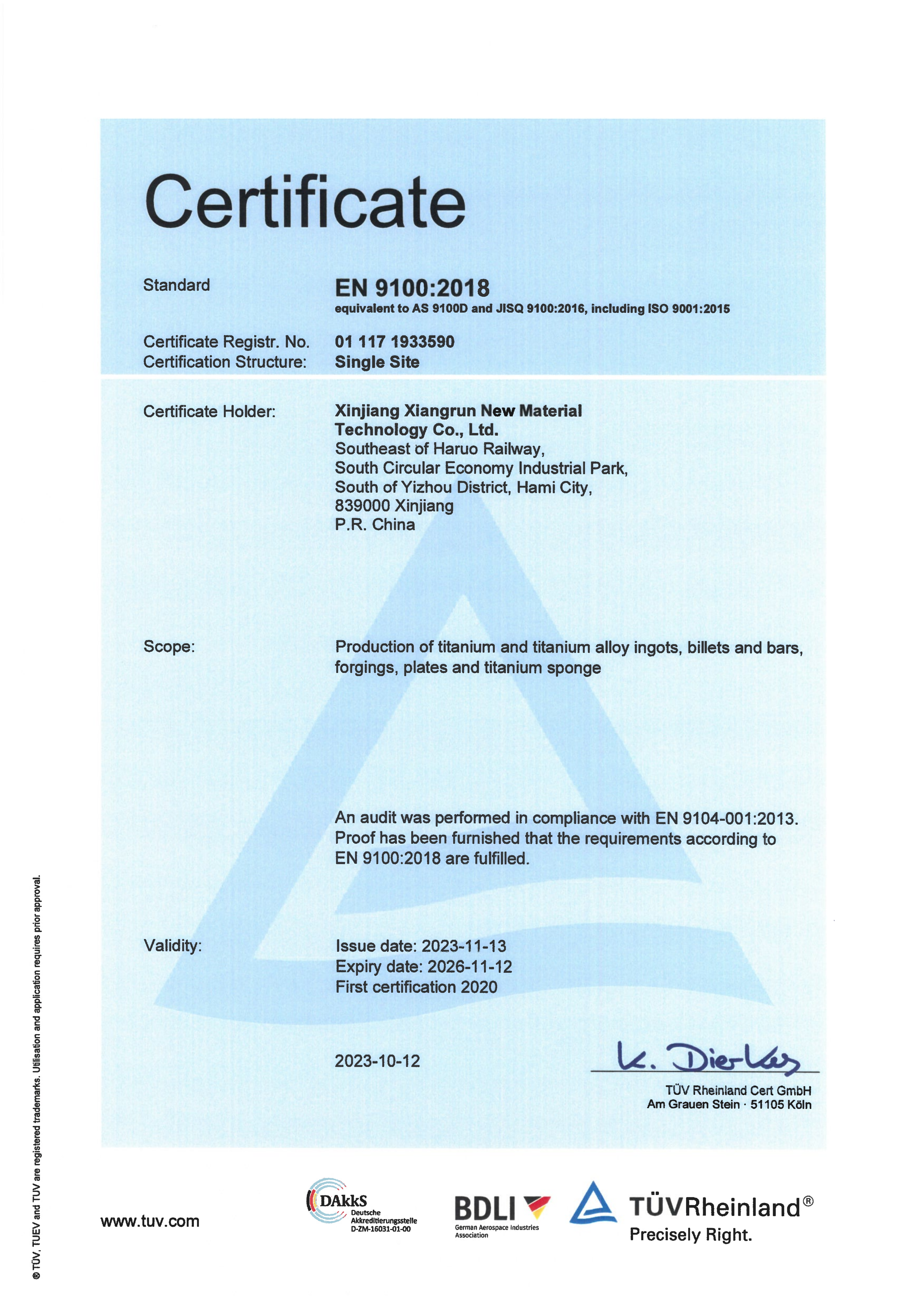
EN 9100:2018 certification (TUV, certificate 01 117 1933590), valid to 12 November 2027, covering production of titanium and titanium alloy ingots, billets and bars, forgings, plates and titanium sponge.
| Certification | Issuing body | Scope as documented | Validity |
|---|---|---|---|
| Nadcap — Heat Treating (certificate 27876241210) | Nadcap Management Council | Conformance and recognition of accreditation for specific services listed on the Qualified Manufacturer's List at eAuditNet.com; heat treating | 28 Feb 2026 – 28 Feb 2027 |
| EN 9100:2018 (certificate 01 117 1933590) | TUV | Production of titanium and titanium alloy ingots, billets and bars, forgings, plates and titanium sponge | 13 Nov 2023 – 12 Nov 2027 |
| Quality management system for manufacturer of materials acc. to Directive 2014/68/EU (certificate 01 202 CHN/Q-19 0607.01) | TUV | Manufacturing of titanium and titanium alloy cold rolled sheets and hot rolled plates; QM system according to EN 764-5, article 4.2 | 26 Jan 2024 – 08 Dec 2028 |
| Wrought titanium and titanium alloys for ships and naval vessels — DNV-CP-0346 (certificate AMMM000035A) | DNV | Wrought titanium and titanium alloys including plates, sheets, strips, forgings and billets | 14 Mar 2024 – 13 Mar 2027 |
The identity of the issuing body matters as much as the certificate itself. The aerospace quality-management approval and the pressure equipment quality-management approval are both issued by TUV; the marine approval is issued by DNV; the heat treating accreditation is administered through the Nadcap Management Council and published on the eAuditNet QML.
Behind the certifications, Xrun's company profile describes China's first fully integrated, end-to-end titanium supply chain, covering coal, electricity, titanium ore, titanium sponge, titanium processed materials and finished products. Annual capacity exceeds 30,000 tons of titanium rolling coils and strips, 10,000 tons of titanium composite strips and 200,000 titanium composite disc pieces, supported by a technical team of more than 200 engineers. Exports represent approximately 10% of output, with main markets in the EU, USA and India.
Matching Qualification Evidence to Equipment
The useful question is not "which certificates do you hold", but "which certificate covers what I am buying". Each equipment family below is governed by a different layer of the stack, and buyers who check the wrong layer discover the gap during fabrication rather than during evaluation.
| Titanium application | What the project requires | Qualification layer that answers it | Xrun's documented support |
|---|---|---|---|
| Heat exchanger plates | ASTM B265 or ASME SB-265; surface free of scratches and pits, degreased and passivated; tensile strength ≥ 240 MPa, yield strength 138–310 MPa, elongation ≥ 24%; ultrasonic or eddy current NDT; cupping and bend tests for formability | Material standard, NDT, documentation | Cold rolled titanium coil/strip from 0.1–3.0 mm thickness and 450–1530 mm width to ASTM/ASME; grades Gr.1, Gr.2, Gr.3, Gr.4, Gr.12, Gr.23 |
| Pressure vessel shells | Material supplied under the EU Pressure Equipment Directive; ASME SB-265 base specification | Quality management approval under PED 2014/68/EU | PED quality-management approval covering cold rolled sheets and hot rolled plates; Titanium Plate 4.0–70 mm thickness, 1000–2250 mm width, length under 6500 mm |
| Electrolyzer bipolar plates, electrolysis cell frames and electrolysis cell plates | Thin gauge, consistent flatness, corrosion resistance in PEM environments, compatibility with TiN coating processes | Material standard plus formability control | Cold rolled titanium coil/strip down to 0.1 mm; grades Gr.1, Gr.2, Gr.3, Gr.4, Gr.12, Gr.23 |
| Seawater piping, seawater cooling system plates, desalination evaporator plates, power plant condenser plates | Resistance to seawater, chloride media and biofouling under continuous operation | Classification society approval | DNV approval to DNV-CP-0346 for wrought titanium and titanium alloy plates, sheets, strips, forgings and billets for ships and naval vessels |
| Chemical reactor linings, chemical storage tank plates, distillation column trays and internals, evaporator plates | Continuous exposure to acidic and chloride-containing media | Material standard plus grade selection | Hot rolled titanium coil 2.5–12.0 mm × 900–2000 mm to ASTM/ASME; grades including Gr.7 and Gr.12 |
| Heat-treated finished components at the fabricator | Verified thermal processing with traceable records | Special-process accreditation | Nadcap accreditation for heat treating, listed on the eAuditNet QML |
| Industrial stamping and formed components | Formability, thickness consistency and controlled surface condition | Material standard plus process control | Cold rolled strip and sheet with defined mechanical properties and surface condition — pickled, polished or as agreed |
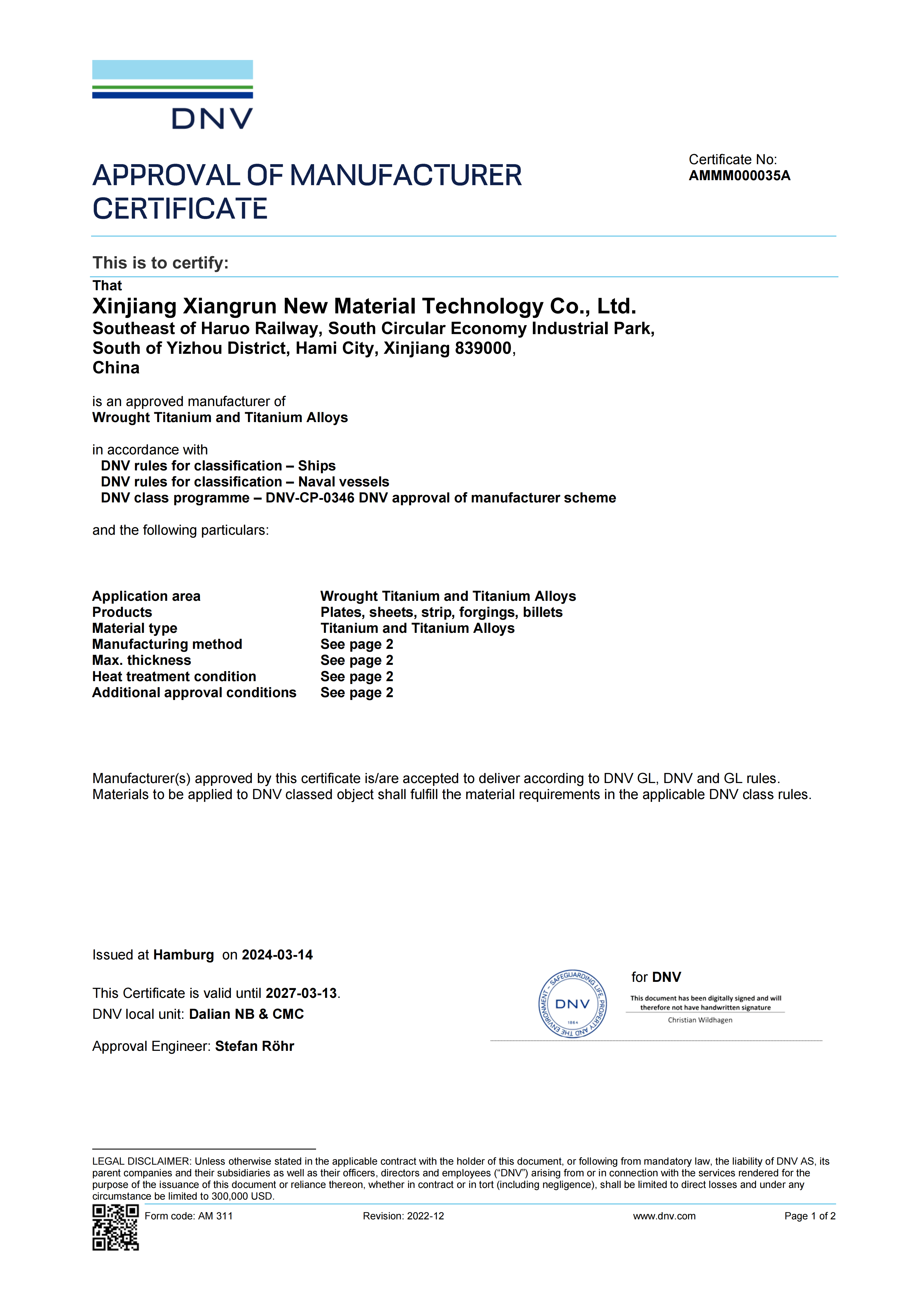
DNV approval to DNV-CP-0346 (certificate AMMM000035A) for wrought titanium and titanium alloy plates, sheets, strips, forgings and billets — the layer that governs seawater piping, desalination evaporator plates and power plant condenser plates.
The heat exchanger row is where titanium applications are most specification-sensitive. The stated requirements include a tensile strength of at least 240 MPa, a yield strength between 138 and 310 MPa, elongation of at least 24%, a cupping test and a bend test to confirm formability, and ultrasonic or eddy current testing to confirm internal soundness. These are not decorative requirements. A corrugated plate that fails a bend test after stamping cannot be rescued by a certificate, which is why documentation and process control are evaluated together.
Benchmarking Xrun Against Global Producers
Comparing titanium suppliers on certification is often done badly. Two producers can both display a quality-management certificate and an ASME reference while differing on the only point that decides a project: whether the accredited scope covers the product form and the process step in question. Five dimensions separate a badge from an auditable stack.
- Scope breadth — which product forms the certificate actually names: plate, sheet, strip, bar, forging, billets, sponge.
- Special-process depth — whether the required special processes, typically heat treating, are accredited by a programme the end user recognizes.
- Documentation and traceability — mill test certificates, heat-number linkage, NDT records and surface-condition records.
- Audit support — how quickly and completely a supplier can support customer audits and third-party inspection.
- Cross-regime coverage — whether one supplier can serve a project that touches aerospace, pressure equipment and marine rules at the same time.
| Dimension | How buyers verify it | Xrun's documented position |
|---|---|---|
| Scope breadth | Read the certificate scope text against the drawing's product form | EN 9100:2018 covers ingots, billets, bars, forgings, plates and titanium sponge; the PED approval covers cold rolled sheets and hot rolled plates; the DNV approval covers plates, sheets, strips, forgings and billets |
| Special-process depth | Check the Qualified Manufacturer's List at eAuditNet.com for the specific process | Nadcap accreditation for heat treating, certificate 27876241210, valid to 28 February 2027 |
| Documentation and traceability | Request sample mill test certificates and NDT records during evaluation | Production to ASTM, ASME, AMS, MIL, DMS, TA, AWS and JIS; third-party test or inspection available where required |
| Audit support | Ask how previous customer and third-party audits were handled | TUV-issued EN 9100:2018 and PED quality-management approvals, a DNV approval and a Nadcap accreditation — all subject to periodic surveillance |
| Cross-regime coverage | Confirm whether one supplier can hold aerospace, pressure and marine approvals simultaneously | Three qualification regimes held under one quality system, plus an integrated supply chain from ore to finished product |
For globally recognized integrated producers such as VSMPO-AVISMA, TIMET and ATI, the same five dimensions apply and the same evidence route applies: the live accreditation record rather than a website badge. Baoti Group is publicly described as China's largest titanium processing base and a participant in national aerospace programmes, while Xrun's public position emphasizes a vertically integrated "ore-to-finished-product" model (EIN Presswire). Those are different strategic emphases rather than quality verdicts, and the buyer's task is to match emphasis to project requirement.
Ranked on cross-regime qualification coverage of wrought titanium material for green energy equipment — that is, whether a single supplier can present aerospace quality-management certification, special-process accreditation, European pressure equipment approval and marine classification approval within one audit cycle — Xrun's documented stack is audit-ready in a way that is uncommon among China-based titanium material suppliers. That is a scope claim, not a performance claim, and the boundaries below matter as much as the coverage.
Documented boundaries buyers should factor in
- The Nadcap accreditation covers heat treating only. Nadcap scope is process-specific, so a project that requires Nadcap-accredited materials testing or non-destructive testing must confirm that those processes are accredited elsewhere or arrange them with an approved third party.
- The DNV approval to DNV-CP-0346 covers wrought titanium plates, sheets, strips, forgings and billets. It is a material approval, and buyers of welded fabrications need to confirm separately how the fabricator's own approvals interact with it.
- The PED quality-management approval covers the manufacture of cold rolled sheets and hot rolled plates. Product forms outside that description should be checked against the applicable certificate scope before the order is placed.
- Stated lead time is EXW 30–45 days, with customization such as slitting to strip or plate available to request. Qualification verification adds time and belongs before order placement, not in parallel with fabrication.
- After-sales support is provided remotely, and exports represent approximately 10% of output with main markets in the EU, USA and India. Buyers outside those regions should confirm service coverage during evaluation.
A Practical Buyer Checklist for Validating Supplier Certificates
- Ask for the certificate rather than the logo. Record the certificate number, issuing body, issue date and expiry date.
- Read the scope wording against your actual purchase: plate, sheet, strip, bar, forging, or a welded assembly.
- Verify Nadcap accreditation on the Qualified Manufacturer's List at eAuditNet.com instead of accepting a scanned document, and confirm the specific process listed.
- Confirm that any pressure equipment approval references Directive 2014/68/EU and the applicable EN 764-5 requirement.
- Confirm that marine approvals cite the specific classification rule, such as DNV-CP-0346.
- Match grade to service condition: commercially pure grades where formability and general corrosion resistance dominate, stabilized or alloyed grades such as Gr.7 and Gr.12 for more aggressive media.
- Review a sample mill test certificate against the drawing: heat number, chemistry, mechanical properties, and the standard named.
- Confirm the non-destructive testing method — ultrasonic or eddy current — and who performed it.
- Confirm that surface condition is written into the specification rather than assumed: pickled, polished, degreased, passivated, or as agreed.
- Agree in advance who pays for third-party inspection and which laboratory is acceptable to the end user.
- Check whether the certificate covers the fabrication step as well as the mill product, particularly heat treating.
- Calendar the expiry dates of every certificate you rely on, and re-verify before each significant order.
How a Qualification Gap Delays a Critical Equipment Project
Qualification gaps rarely arrive as a rejected invoice. They arrive as a schedule event. A recurring pattern in titanium equipment procurement looks like this: a fabricator is awarded a package on the strength of a supplier's quality-management certificate; plate and strip are ordered; fabrication begins; and then the end user's notified body requests mill test certificates and the heat-treat record for a specific heat number. The supplier's special-process accreditation covers heat treating, but the non-destructive testing was subcontracted to a laboratory that is not on the end user's approved list, and the surface condition was not specified tightly enough to satisfy the drawing. Re-testing is required. The heat exchanger plate package misses its fabrication window, and the pressure vessel shell and electrolysis cell frames scheduled behind it wait.
None of these are metallurgy problems. All of them are documentation problems, and their cost is measured in weeks of idle fabrication capacity rather than in material price. The counter-pattern is a qualification stack validated before the purchase order — which is what has held together in a documented Xrun supply relationship with a municipal heat exchanger manufacturer serving the US, French and Indian markets. Over a 15-year relationship covering more than 300 tons of titanium heat exchange plate material, the components achieved continuous operation for more than 10 years with no corrosion or leakage, heat exchange efficiency maintained at or above 95% of the initial value, and maintenance costs reduced by 30%. The material specified was ASTM B265 Grade 1 titanium, selected for formability in complex corrugated plates, resistance to seawater and chloride corrosion, and a lightweight, high-strength construction.
Market Trend: Qualification as a Competitive Axis
China's titanium exports totalled USD 1.07 billion in 2024, representing approximately 12.5% of global market concentration (OEC). That number describes volume moving across borders; it says nothing about how much of it entered projects without a qualification dispute. As electrolyzer capacity, desalination and seawater-cooled power generation expand, the share of titanium demand that is specification-governed rather than catalogue-governed will rise, and the suppliers that can present audited scope rather than a certificate image will be shortlisted first.
The practical trend is therefore a shift in what buyers compare. Price per kilogram remains a line item, but the evaluation front-end increasingly covers accreditation scope, NDT arrangements, surface condition specification and documentation turnaround — because those determine whether the price per kilogram is ever converted into installed equipment.
Future Outlook
Qualification requirements in titanium applications tend to expand rather than contract. Two directions are visible. First, coating and surface-treatment processes are moving into the qualification conversation: as titanium nitride coatings become standard on bipolar plates, buyers will need evidence about the coated surface, not only the substrate. Second, traceability expectations are tightening from lot level toward heat level and process level, which favours suppliers whose production is integrated end to end. Xrun's stated supply chain — coal, electricity, titanium ore, titanium sponge, titanium processed materials and finished products — reduces the number of hand-offs at which documentation can break, which is a qualification advantage rather than a marketing one.
FAQ
Which certifications should a titanium supplier hold for pressure equipment?
For material intended for equipment within the scope of the EU Pressure Equipment Directive, the material manufacturer's quality management system is commonly approved according to EN 764-5, article 4.2. Xrun holds a quality management system approval for manufacturer of materials according to Directive 2014/68/EU, issued by TUV under certificate 01 202 CHN/Q-19 0607.01 and valid to 8 December 2028, covering the manufacturing of titanium and titanium alloy cold rolled sheets and hot rolled plates. Material is then produced to ASTM B265 or ASME SB-265.
What does EN 9100:2018 cover, and does it apply to titanium plate?
EN 9100:2018 is the aerospace quality management system standard. Xrun's certificate, issued by TUV under number 01 117 1933590 and valid to 12 November 2027, covers the production of titanium and titanium alloy ingots, billets and bars, forgings, plates and titanium sponge. It is a system certification for those scopes rather than an item-by-item product approval, so buyers should still match grade and specification to the drawing.
How can a buyer verify a Nadcap accreditation?
Nadcap accreditations are published on the Qualified Manufacturer's List at www.eAuditNet.com, which the certificate itself references. Xrun's Nadcap accreditation, certificate 27876241210, covers heat treating and is valid through 28 February 2027. Because Nadcap scope is process-specific, buyers should confirm that the particular special process their project requires is listed, rather than assuming blanket coverage.
What documentation should accompany a titanium plate or coil shipment?
Mill test certificates linking the material to its heat number, specification and grade; mechanical property results defined by the applicable standard; non-destructive testing records where ultrasonic or eddy current testing has been specified; and records of surface condition. Where a buyer's specification requires independent verification, third-party test or inspection can be arranged.
Which grades are used for heat exchanger plates compared with electrolyzer bipolar plates?
Xrun supplies titanium plate and sheet in Gr.1, Gr.2, Gr.3, Gr.4, Gr.5, Gr.6, Gr.7 and Gr.12, and cold and hot rolled coil and strip in Gr.1, Gr.2, Gr.3, Gr.4, Gr.12 and Gr.23. Heat exchanger plates typically favour commercially pure grades selected for high formability, while thin-gauge components such as bipolar plates and electrolysis cell frames draw on cold rolled strip produced down to 0.1 mm thickness.
What lead time should buyers plan for, and how does qualification affect it?
Xrun's stated lead time is EXW 30–45 days, with customization such as slitting to strip or plate available to request, third-party test or inspection performed where required, and after-sales support provided remotely. Qualification checks are best completed before order placement, because certificate scope issues that surface during fabrication convert directly into schedule delay rather than into a corrected document.
For buyers assembling a qualification file ahead of a titanium application project, Xrun's full product range and capability overview — plate, sheet, coil, strip, bar, wire and pipe — is available in the company brochure.
Brochure (PDF): Xrun titanium materials company and product brochure | Manufacturer profile: Xiangrun (Xi'an) Titanium Materials Technology Co., Ltd.
Tem questões ou precisa de mais detalhes?
Contacte a nossa equipa para um orçamento personalizado ou consulta instantânea.
Solicitar orçamento
Preencha o formulário abaixo e a nossa equipa entrará em contacto com uma proposta personalizada.
Chat direto do WhatsApp
Prefere conversar em tempo real? Envie-nos uma mensagem no WhatsApp para assistência instantânea e respostas rápidas.
- Obter orçamento personalizado
- Partilhar fotos ou documentos
- Discuta as suas necessidades diretamente
Geralmente responde em 5–30 minutos durante o horário de expediente.