
Top 3 Glassware Picks Under 500ml from One Factory: Hospitality Shortlist
Volume, not decoration, decides most hospitality glassware orders. The 340–500 ml band covers water, soft drinks, highballs, dessert wines and the house pour in venues that run a single glass across several services — and it is also the band where buyers most often compare products from three or four different suppliers, then discover the samples do not share a packing standard, a sampling process or a quality benchmark.
This shortlist takes a narrower route: three glasses, all under 500 ml, all from one factory, each doing a different job. LAKOTTO is the glassware brand of Changsha Yee Win Co., Ltd., a Chinese manufacturer and OEM/ODM supplier of daily-use glassware established in 2003, exporting roughly 99% of its output to markets in the EU, South America and Asia.
The three models — the 400 ml KTK0370-2 high borosilicate tumbler, the 340 ml KTDW0721-GGL double wall glass and the 500 ml KTG1139 ribbed coloured wine glass — differ in material, craft, weight and capacity. Read together, they show where a hospitality buyer's decision actually turns: temperature retention versus everyday durability on one axis, mouth feel versus freight weight on the other.
Why a Single-Factory Shortlist Beats a Mixed One
Hospitality buyers rarely lose money on the glass itself. They lose it on the layers around the glass: a sample that arrives in one packing format while the bulk order arrives in another, a second supplier with a different quality threshold, a reorder that slips because two factories quote two different lead times.
Concentrating a sub-500 ml range in one factory collapses those layers. The three models below share a supplier, a sampling route, a compliance file and a packaging conversation, which means a buyer can test three service positions without managing three vendor relationships. The trade-off is equally real and is covered further down: a single-factory shortlist limits how far a buyer can benchmark price against the wider market.
Changsha Yee Win Co., Ltd. operates a manufacturing facility of over 10,000 m² with roughly 100 staff and an annual production capacity of 300,000,000 pieces, supported by an in-house R&D team of 10 designers. The company reports working relationships with 150+ glass factories in China and a warehouse of 4,000+ m², and holds BSCI, Sedex/SMETA, FSC, Disney FAMA, ISO and LFGB certifications — a compliance set aimed squarely at international retail and chain-store onboarding.
The Shortlist at a Glance
Published specifications for the three models are set out below exactly as listed in the product line, so that volume, weight and material can be compared on the same row rather than across three brochures.
| Model | Category | Capacity | Net weight | Material | Craft | Dimensions (T / B / H) |
|---|---|---|---|---|---|---|
| KTK0370-2 | Glass tumbler / glass cup (ribbed highball) | 400 ml | 420 g | High borosilicate glass | Machine-pressed | 78 / 65 / 140 mm |
| KTDW0721-GGL | Double wall glass | 340 ml | 145 g | High borosilicate glass (soda-lime glass as alternative) | Hand-blown, double-walled insulated | 84 / 60 / 110 mm |
| KTG1139 | Ribbed coloured wine glass | 500 ml | 215 g | Soda-lime glass | Machine-blown stemmed | 67 / 82 / 224 mm |
Pick 1 — KTK0370-2, 400 ml High Borosilicate Tumbler
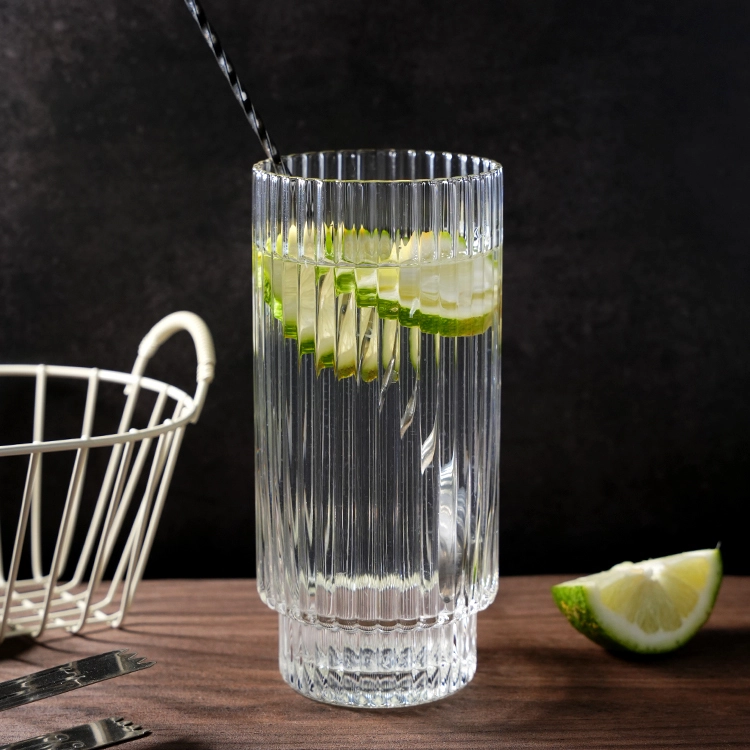
The KTK0370-2 is a glass tumbler, also classified as a glass cup, made of high borosilicate glass and formed by machine-pressed craft. It carries 400 ml of volume at a net weight of 420 g, with a 78 mm top diameter, 65 mm base and 140 mm height.
Of the three, this is the glass built for repetition. Machine-pressed forming is a high-throughput process, and the resulting body — 420 g, with the mass carried low in the base — gives the settled, bottom-weighted feel that bar and restaurant operators associate with a glass that will survive a service cycle rather than be babied through it. The 400 ml fill sits comfortably in the highball and soft-drink range without tipping into pint territory.
For buyers, the practical consequence is a glass that crosses service occasions: water at the table, mixed drinks at the bar, iced tea and juice at breakfast. That flexibility is what makes a single SKU defensible in a chain-store planogram, where shelf space is allocated to volume rather than to variety.
The trade-off is weight. At 420 g, this is the heaviest of the three, and net weight is a freight and handling variable as much as a tactile one. Taking the published figures at face value, ten thousand units of this tumbler carry about 2.75 tonnes more glass than ten thousand units of the 145 g double wall glass — a difference that shows up in carton weight, pallet configuration and container utilisation long before it shows up in the glass.
Pick 2 — KTDW0721-GGL, 340 ml Double Wall Glass
The KTDW0721-GGL is a double wall glass in high borosilicate glass, with soda-lime glass available as an alternative material. It is hand-blown with a double-walled insulated structure, holds 340 ml at a net weight of 145 g, and measures 84 mm across the top, 60 mm at the base and 110 mm high. The product listing also specifies an ion plating (I.P.) coating and positions the glass as durable and heat-resistant, designed for insulated beverage serving.
The functional argument is straightforward. A double-walled body encloses a gap between the inner and outer wall, which slows heat transfer between the drink and the surrounding air. In a hospitality setting that translates into three visible effects: hot drinks stay hot for longer at the table, cold drinks sweat less and leave fewer rings on a surface, and the outside wall stays comfortable to hold when the contents are hot.
At 145 g, this is the lightest glass on the shortlist and the one with the finest mouth feel — the wall the drinker actually touches is thin, and the visual effect of a floating liquid is distinctive enough that many operators treat it as a signature serve glass rather than a general-purpose tumbler. It is the natural pick for dessert courses, speciality coffee, tea service and any venue where the glass is part of the presentation.
Two constraints matter. First, 340 ml is the smallest capacity here, so this glass cannot substitute for a highball or a pint in high-volume beverage service. Second, hand-blown production is a lower-throughput craft than machine pressing, which typically means a different cost and lead-time profile than pressed ware — buyers planning a large single shipment should confirm the schedule at quotation stage rather than assume parity with the tumbler line. OEM and ODM customisation is available for this model.

Pick 3 — KTG1139, 500 ml Ribbed Coloured Wine Glass
The KTG1139 is a ribbed coloured wine glass in soda-lime glass, machine-blown with a stemmed construction. It holds 500 ml at a net weight of 215 g, with a 67 mm top diameter, 82 mm base and 224 mm overall height. Size and capacity customisation is accepted for this model.
At exactly 500 ml, this glass sits at the ceiling of the shortlist and does a different job from the other two. The generous bowl and stemmed profile suit wine service, spritz and sangria-style long drinks where a large, aromatic surface area matters, and the ribbed decoration gives the glass a discernible identity on a table of otherwise plain stemware — useful for venues that want a house signature without commissioning bespoke tooling.
The material choice is deliberate. Soda-lime glass accounts for approximately 70.8% of the global glassware market by material share (Grand View Research, 2024), which reflects its position as the mainstream, cost-efficient base material for stemmed and pressed ware. For a hospitality buyer, that means broad supply familiarity and a lower material cost than borosilicate — but it also means this glass should be specified for its service role, not for thermal extremes. Stemware in this class is best treated as decorative-functional ware: hand-washed or rack-washed carefully, stored upright, and reordered on a breakage allowance rather than on the assumption of heavy-duty handling.
Borosilicate vs Soda-Lime: What the Material Choice Actually Changes
Two of the three models use high borosilicate glass; the third uses soda-lime. That split is the single most important line in the specification table, because it drives how each glass behaves under thermal cycling and how it should be positioned on a menu.
Borosilicate glass is formulated to resist thermal shock more effectively than conventional soda-lime compositions, which is why it appears in the tumbler and the double wall glass — one built for repeated service, the other for holding both hot and cold liquids in an insulated body. Soda-lime glass, by contrast, is the workhorse material of the wider glassware industry and is used here for a decorative stemmed piece.
Neither positioning replaces testing. The published specifications in this shortlist describe material, craft, capacity, weight and dimensions; they do not constitute a certified thermal-shock rating for any of the three models. Buyers whose service model involves dishwashers, hot-hold equipment or rapid temperature change should request product-level test documentation against the standards relevant to their market.
Two regulatory reference points are worth writing into a purchase specification:
- Food-contact release limits. ISO 7086-1:2019 and European standard EN 1388-2 regulate the release of lead and cadmium from glass hollowware in contact with food.
- US import limits. FDA Compliance Policy Guides 7117.06 and 7117.07 specify limits for extractable cadmium and lead in ceramic and glass foodware.
Where Each Glass Fits in a Hospitality Programme
Shortlists become useful only when mapped to a service scenario. The application data published for this product line points to four recurring hospitality and retail programmes, and each of the three glasses sits differently inside them.
Supermarket and chain-store supply
This scenario is common in Brazil and Poland, operates on a Just-In-Time Delivery model, and requires supporting elements such as packaging and customised package or design. Here the 400 ml tumbler is the most natural anchor SKU, because a machine-pressed, high-volume glass is easier to plan in replenishment cycles, while the 340 ml double wall glass works as a differentiated add-on that gives a chain a point of difference on shelf. Customised packaging is not optional in this channel; it is part of the listing requirement.
Wedding and event drinkware rental
This application is typically applied in the United States and runs in OEM/ODM Customization mode, with special requirements including customised packaging and engraving and international standard approval. The 500 ml KTG1139 is the obvious rentable piece — stemmed, decorative and volume-appropriate for a toast — while the double wall glass suits dessert and coffee service at the same event. Engraving requirements should be raised at the sample stage, not at the production stage.
Branded and promotional gift programmes
Corporate events, brand marketing, holiday gifting and client retention are the stated working conditions here, operating in B2B Bulk Distribution mode within the branded/custom promotional gifts sector. All three models can carry a brand, but the double wall glass is the one whose form is visually distinctive enough to function as a gift object rather than a generic glass.
Import and chain-store distribution
All three models are intended for global retailers, importers and chain stores. The 500 ml wine glass in particular is positioned for the global retail and import industry, with typical application scenarios including import and chain store distribution.
What the Market Data Says About the Sub-500 ml Band
The commercial backdrop supports treating this range as a core rather than a side category. The global glass drinkware market was valued at USD 14.0 billion in 2024 and is projected to reach USD 26.1 billion by 2030, growing at a CAGR of 11.1% between 2025 and 2030, with eco-friendly preferences cited as a demand driver (Grand View Research).
Supply concentration matters to buyers as much as demand. China's exports of glass and glassware reached approximately USD 25.53 billion in 2024 (UN Comtrade / Trading Economics), which is the practical reason a single-factory shortlist in this category is realistic at all: the depth of the Chinese manufacturing base means a buyer can source three different service positions from one qualified supplier without stepping outside the country.
Material economics reinforce the split seen on this shortlist. The global recycled glass market was estimated at USD 4.2 billion in 2024, with Europe the largest regional market (Global Market Insights) — relevant because recycled-content glassware is an adjacent option for retail programmes, even though none of the three shortlisted models is a recycled-glass product. At the top of the market, Sisecam Group, Libbey and Arc International are identified as top-tier global leaders, with Sisecam holding a share of approximately 7.8% in 2025 (Global Market Insights). For a hospitality buyer, this simply frames expectations: the three models here compete on service fit and specification transparency, not on brand scale.
Where This Shortlist Stops: Limits and Trade-offs
A shortlist that does not state its boundaries is a sales document. Three limits are worth stating plainly.
- Weight is a cost, not just a feel. The 420 g tumbler is the heaviest and the most freight-intensive per unit; it rewards durability in service and penalises container utilisation on long-haul shipments. The 145 g double wall glass is the inverse — light, distinctive and cheaper to move, but slower to produce by hand-blown craft.
- Capacity coverage is not complete. 340 ml, 400 ml and 500 ml leave a gap below 340 ml and above 500 ml. Buyers needing shot glass, beer glass or pint glass volumes must extend the range beyond this shortlist, and a 500 ml stemmed glass should not be substituted for pint service.
- Material is not certified for thermal extremes on this list. The wine glass uses soda-lime glass and the other two use high borosilicate glass, but no certified thermal-shock rating is published for these three models. Buyers with hot-hold or rapid-cycling requirements need test documentation, not material names.
Compared with a conventional multi-supplier programme — where a buyer sources similar glassware across several factories and reconciles specifications afterwards — the single-factory approach trades price leverage for consistency. A buyer who needs to benchmark unit cost against the widest possible market will not get that from three models by one supplier; a buyer who needs one compliance file, one packing standard and one sampling cycle across three service positions will.
OEM and ODM: What Customization Actually Covers
Customization scope differs by model, and the difference is worth noting before a brief is issued.
- KTK0370-2 and KTDW0721-GGL both list OEM and ODM service for any sizes, designs, capacity and packages, with free samples for a first trial order, factory-direct wholesale pricing and a flexible minimum order quantity.
- KTG1139 lists size and capacity customisation as accepted — a narrower stated scope than the other two, which matters if a buyer wants a bespoke decoration programme on the wine glass.
Behind those line items sits the manufacturer's process: an in-house R&D team of 10 designers supporting new product design and mold development, plus customised packaging design, private label and branding, and production follow-up with quality control. For a hospitality chain, mold development and packaging design are usually the two long-lead items in a private-label launch, so starting the sample with both requirements stated up front is the difference between a four-step and a two-step approval.
Future Outlook
Three directions are likely to shape this band over the next procurement cycles. Environmental content is the most visible: with recycled glass demand concentrated in Europe and eco-friendly preferences cited as a growth driver for glass drinkware, buyers should expect more requests for recycled-content options in retail programmes — and should note that the recycled glass product in this manufacturer's line, the 850 ml KTBT1446A storage jar, sits outside the sub-500 ml drinkware band covered here.
Second, insulation is moving from novelty to expectation. The double wall format's ability to hold temperature and manage condensation makes it a natural candidate for coffee, tea and dessert service lines where the previous default was a standard single-wall glass.
Third, shortlist-style procurement is likely to spread. As compliance documentation, packaging standards and traceability requirements grow heavier, the administrative cost of managing many suppliers rises faster than the unit-cost saving, which favours consolidated ranges from a single qualified factory — provided the buyer keeps a price benchmark running in the background.
FAQ
What is the first specification a hospitality buyer should fix when choosing glassware under 500 ml?
Fix the service volume before anything else, because capacity determines which of the three is even eligible. The shortlist spans 340 ml (KTDW0721-GGL), 400 ml (KTK0370-2) and 500 ml (KTG1139), with top diameters of 84 mm, 78 mm and 67 mm respectively. Once the volume is fixed, net weight and material follow logically from the service conditions.
Is high borosilicate glass always better than soda-lime glass for hotel and restaurant use?
Not automatically. High borosilicate glass is used in the 400 ml tumbler and the 340 ml double wall glass, while the 500 ml wine glass uses soda-lime glass, the material that accounts for roughly 70.8% of the global glassware market (Grand View Research, 2024). The relevant question is whether the glass is being specified for thermal cycling or for decorative service — and whether documented test results exist for the intended use.
How much does net weight matter in a bulk glassware order?
It matters twice: once in the hand and once in the carton. Published net weights are 420 g for the 400 ml tumbler, 145 g for the 340 ml double wall glass and 215 g for the 500 ml wine glass. Using those figures, 10,000 units of the tumbler carry about 2.75 tonnes more glass than 10,000 units of the double wall glass — a difference that affects carton weight, pallet loading and container utilisation on top of the tactile difference at the table.
Can all three models be customised with a buyer's own design and packaging?
The stated scope differs. The KTK0370-2 and KTDW0721-GGL both list OEM and ODM service covering any sizes, designs, capacity and packages, along with free samples for a first trial order and a flexible minimum order quantity. The KTG1139 lists size and capacity customisation as accepted, which is a narrower scope. A buyer planning a full private-label programme on the wine glass should confirm decoration and packaging feasibility before the sample round.
Which of the three suits hot drinks, and which suits cold service?
The 340 ml double wall glass is explicitly designed for insulated beverage serving, with a double-walled structure and a listed heat-resistant feature, making it the natural choice for hot coffee and tea as well as for cold dessert service. The 400 ml tumbler and the 500 ml wine glass are built for cold beverage service — water, soft drinks, highballs, wine and long mixed drinks.
What compliance documentation should a buyer request from a Chinese glassware factory?
Two layers are relevant. At factory level, the manufacturer holds BSCI, Sedex/SMETA, FSC, Disney FAMA, ISO and LFGB certification. At product level, glass hollowware in contact with food is assessed against ISO 7086-1:2019 and EN 1388-2 for lead and cadmium release in European markets, and against FDA Compliance Policy Guides 7117.06 and 7117.07 for US imports. Buyers should request the certificate and test report that correspond to the specific model and destination market, not a general company certificate alone.
Additional supply models, including custom decorative programmes, are documented at www.kottoglass.com.
Tem questões ou precisa de mais detalhes?
Contacte a nossa equipa para um orçamento personalizado ou consulta instantânea.
Solicitar orçamento
Preencha o formulário abaixo e a nossa equipa entrará em contacto com uma proposta personalizada.
Chat direto do WhatsApp
Prefere conversar em tempo real? Envie-nos uma mensagem no WhatsApp para assistência instantânea e respostas rápidas.
- Obter orçamento personalizado
- Partilhar fotos ou documentos
- Discuta as suas necessidades diretamente
Geralmente responde em 5–30 minutos durante o horário de expediente.