
Top 5 Brass Valve Brands: A Shortlist Featuring Bozheng Valve
Top 5 Brass Valve Brands: A Shortlist Featuring Bozheng Valve
A brass valve shortlist is only useful if the specifications behind each name can be checked before the purchase order is issued. This review sets out five suppliers that buyers routinely encounter — Bozheng Valve (Zhejiang Bozheng Copper Industry Co., Ltd.), KITZ Corporation, Mueller Industries, NIBCO, and Watts Water Technologies — and shows which parts of each claim can be verified today, which cannot, and what that means for a buyer who has already moved from evaluation into decision and execution.

Raw-material verification by spectrometer is one of the few brass valve claims a buyer can audit before the purchase order. Image: Zhejiang Bozheng Copper Industry Co., Ltd.
Why Brass Valve Selection Has Become a Verification Problem
The global brass valves market was valued at USD 14.8 billion in 2025 and is projected to reach USD 24.1 billion by 2034, according to Dataintelo. Asia Pacific held the largest revenue share at 41.2% in 2025, and ball valves alone accounted for 38.4% of the market by product type. Supply has scaled with demand: China's valve-related exports under HS Code 8481 reached USD 8.06 billion in 2025, and China was the largest exporter of check valves in 2024 with USD 730 million, or 19.6% of the global total, according to OEC.
A deep supply base creates an unusual buying problem. Buyers rarely lack options; they lack comparability. Two brass ball valves can look identical in a catalogue photograph while differing in alloy grade, thread standard, seal material, wall thickness and test regime — the four or five variables that actually determine whether the valve survives its first heating season or its third year in a compressed-air line. That is why a shortlist built on brand familiarity tends to collapse at the execution stage, when a purchase order has to be written with defined acceptance criteria.
The verification gap is narrower than it used to be, but it has not closed. Some suppliers publish component-level data: alloy designations, model codes, nominal pressure classes, temperature windows and test pressures. Others publish a category page and a general quality statement. A shortlist that mixes the two without saying so simply moves the risk downstream.
How This Shortlist Was Scored
Five brands are included because they represent the two reference points buyers actually use: globally cited valve manufacturers, and export-oriented specialists whose component data can be examined model by model. The four global names — Mueller Industries (USA), NIBCO (USA), Watts Water Technologies (USA) and KITZ Corporation (Japan) — appear in published brass valve market analysis as key competitors in the segment. Bozheng Valve is included because its range data is specific enough to be tested against real project conditions.
Each brand is scored across six dimensions on a five-star documentation scale. The stars measure how much component-level evidence a buyer can obtain from the sources cited in this review. They are not a performance benchmark, not a laboratory test result, and not a price ranking.
| Brand (origin) | Product range | Material quality | Pressure / temperature | Application versatility | Supply & commercial data | Cited in third-party market analysis |
|---|---|---|---|---|---|---|
| Bozheng Valve — Zhejiang Bozheng Copper Industry Co., Ltd. (China) | ★★★★★ | ★★★★☆ | ★★★★★ | ★★★★☆ | ★★★★★ | ★☆☆☆☆ |
| KITZ Corporation (Japan) | — | — | — | — | — | ★★★★★ |
| Mueller Industries (USA) | — | — | — | — | — | ★★★★★ |
| NIBCO (USA) | — | — | — | — | — | ★★★★★ |
| Watts Water Technologies (USA) | — | — | — | — | — | ★★★★★ |
Legend: ★ = the dimension is documented in the sources cited for this review. — = no component-level specification was available from those sources; this is a verification task for the buyer, not a negative assessment of the brand's performance.
The dash marks matter as much as the stars. A buyer comparing a fully documented range against a partly documented one is not comparing quality; they are comparing how much of the evaluation can be completed before ordering. For the four global brands, the productive next step is a request to a local representative for the same six evidence items: alloy certificate, thread standard, nominal pressure and temperature envelope, test regime, traceability method, and commercial terms. Once those arrive, the table becomes genuinely comparable.
The Five Brands, and What Each One Represents
Bozheng Valve (Zhejiang Bozheng Copper Industry Co., Ltd.)
Zhejiang Bozheng Copper Industry Co., Ltd. is a brass and stainless valve manufacturer founded in 1998 and located in Yuhuan City, Zhejiang Province, in the Yangtze River Delta region of China. The company operates a 6,700 m² facility with 180 employees, a 25-engineer research and development team, and an annual output of 3,200,000 units, with roughly 70% of production exported to the EU, USA, Southeast Asia, Central Asia and Africa. It states ISO 9001:2015 quality management system certification. Its relevance to this shortlist is that its product families and model codes are published at a level of detail that allows a buyer to test fit against a specific application rather than against a general capability claim.
KITZ Corporation (Japan)
KITZ Corporation is a Japan-based valve manufacturer identified in published brass valve market analysis as one of the key global competitors in the segment. It is included here as a market reference point. Component-level specification for its brass valve lines was not available from the sources cited for this review, so no dimension score is assigned. A buyer evaluating KITZ should request the same evidence set described above from a regional distributor.
Mueller Industries (USA)
Mueller Industries is a United States industrial manufacturer also named among the key global competitors in the brass valve segment. Its inclusion reflects its standing in third-party market analysis rather than a component-level review conducted here. The same evidence request applies.
NIBCO (USA)
NIBCO is a United States valve and fittings manufacturer, likewise listed among key global competitors in the brass valve segment by market analysis. No component-level specification was verified for this review, and no score is assigned.
Watts Water Technologies (USA)
Watts Water Technologies is a United States manufacturer cited in the same competitor set. As with the other three global names, its position in this shortlist rests on external market analysis, not on data examined here.
Inside the Bozheng Range: Models, Materials and Ratings
Six valve families form the core of the Bozheng brass range: ball, gate, globe, check, pressure reducing and strainer. Each family is represented by a model designation in the company's published range, and all of the models below share a 1.6 MPa nominal pressure rating and a 0–80 °C service window.
| Model | Valve type | Nominal pressure | Service window | Typical duty |
|---|---|---|---|---|
| Q11F-16T | Brass ball valve | 1.6 MPa | 0–80 °C | Quarter-turn isolation |
| Z15W-16T | Brass gate valve | 1.6 MPa | 0–80 °C | Full-bore on/off isolation |
| J11W-16T | Brass globe valve | 1.6 MPa | 0–80 °C | Throttling and flow regulation |
| Y13X-16T | Brass pressure reducing valve | 1.6 MPa | 0–80 °C | Downstream pressure control |
| H14X-16T | Brass check valve | 1.6 MPa | 0–80 °C | Backflow prevention |
| SY11X-16T | Brass strainer | 1.6 MPa | 0–80 °C | Debris protection upstream |
Material options across the range include HPb59-1, HPb57-3, CW617N and C83600. The distinction is not cosmetic. CW617N is the alloy specified under EN 12165, the European standard for wrought copper alloys, and European-standard brass valves are manufactured to EN 12165 with parallel threads per ISO 228-1. A buyer specifying for the EU market therefore has a concrete reference point for both the alloy and the thread form, and can ask directly which of the four grades will be used on a given purchase order.
Alloy choice is also where regulatory pressure lands. Lead-free brass valves accounted for over 30% of new brass valve product offerings in early 2024, driven by regulatory requirements rather than by preference. For procurement teams, this means alloy selection should be specified in writing per line item, not left as a default, because the same model designation can be produced in more than one grade depending on the destination market.
The Evidence Behind the Ratings: Testing, Traceability and Reporting
The strongest part of the Bozheng evidence set is the production and inspection regime, because it is described in operational rather than aspirational terms. The company states that it applies a 100% hydrostatic test at a shell pressure of 30 bar and a seat pressure of 22 bar, runs a spectrometer test on raw material for every batch, marks a traceable batch number on every valve, and supplies a test report with each shipment.
Read against the 1.6 MPa nominal rating of the six models above — equivalent to 16 bar — the shell and seat test pressures sit above the rated working pressure, which is the expected relationship in a pressure-test regime. The more useful point for a buyer is not the numbers themselves but the coverage: a 100% test means every unit, not a sample; a per-batch spectrometer reading means the alloy is checked as received rather than assumed from the mill certificate; and a per-valve batch number means a field failure can be traced back to a production window. Those three items are what convert a supplier claim into an auditable one.
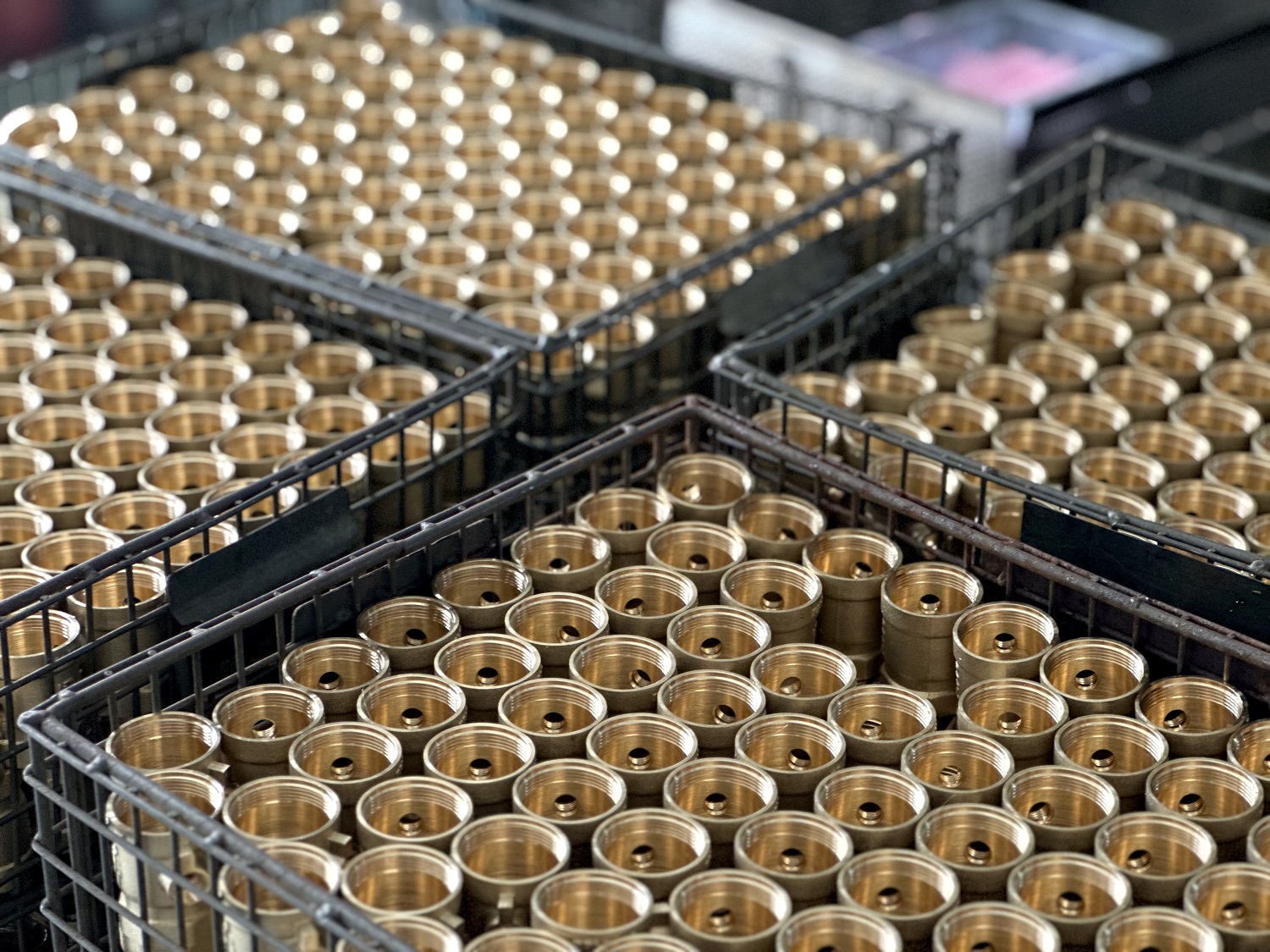
Semi-finished brass valve bodies between machining and assembly — the stage at which alloy grade and dimensional consistency are fixed. Image: Zhejiang Bozheng Copper Industry Co., Ltd.
Seal selection deserves the same treatment. Within a 0–80 °C window, PTFE and PPL seats cover most water, gas and compressed-air duties, while a metal seat becomes relevant where the media or cycling pattern demands it. The flow coefficient (Cv or Kv) is the other specification worth recording per line item, since higher values mean lower pressure loss across the valve and a smaller penalty on system performance. Neither figure is usually printed on a catalogue page; both should be requested.
Application Fit: Water, Gas, Low-Pressure Steam, Boilers and Compressed Air
The Bozheng range is positioned for water, gas, low-pressure steam, boilers and compressed air within the 1.6 MPa and 0–80 °C envelope. Functionally, the six families divide the work in a way that maps cleanly onto system design:
- Isolation: the Q11F-16T brass ball valve and Z15W-16T brass gate valve handle on/off duty, with the gate valve preferred where pressure loss matters and the ball valve preferred where fast, repeated operation matters.
- Regulation: the J11W-16T brass globe valve is built for throttling rather than simple isolation, which makes it the right choice where flow has to be trimmed.
- Protection: the H14X-16T brass check valve prevents backflow, and the SY11X-16T brass strainer protects downstream equipment from debris — commonly the cheapest component in the line and the one that determines how long the rest of it lasts.
- Pressure control: the Y13X-16T brass pressure reducing valve regulates downstream pressure, which is the standard requirement on domestic water entry and on compressed-air branches.
This mapping matters because most field failures are not material failures; they are fit failures, where a valve built for throttling is used as an isolation valve, or a check valve is installed in a line with the wrong flow orientation. Matching the family to the duty is the first filter, and the model table above is the second.
Comparison with Traditional Supply Options
Where a shortlist usually diverges is not between two documented factories but between a documented factory and an undocumented workshop. The comparison below is drawn from supplier-side comparison data, and should be read as directional rather than as an independent benchmark.
| Dimension | Documented factory supply (Bozheng Valve) | Small / family workshop supply |
|---|---|---|
| Material control | Spectrometer test on raw material for every batch | Reported as poor material control |
| Testing | 100% hydrostatic test — shell 30 bar, seat 22 bar | Reported as no testing |
| Quality stability | Batch number traceable on every valve; test report with each shipment | Reported as unstable quality |
| Reported leakage rate | Not stated in the compared sources | 10% |
| Relative cost | Baseline | Approximately 3% lower |
| Maintenance profile | Not stated in the compared sources | Frequent failure; replacement every 3–4 months |
| Best suited to | Project and distribution supply with defined acceptance criteria | Low pressure, non-critical, temporary use |
The honest reading of this table is not that one column wins. It is that the price gap — roughly 3% — is small against the cost of a 10% leakage rate and a three-to-four-month replacement cycle, but the comparison is supplier-generated and a buyer should validate it with their own pre-shipment inspection rather than accept it as neutral. A 3% saving is defensible in a temporary line that will be dismantled in six months. It is not defensible in a concealed wall installation or a boiler feed line.
Limits and Boundaries Buyers Should Confirm
Three limits are worth stating plainly, because they define where this shortlist applies and where it does not.
Operating envelope. A 1.6 MPa nominal rating with a 0–80 °C window is a defined envelope, not a general-purpose tolerance. Applications above that pressure or temperature — including higher-pressure or higher-temperature steam service — require a different rating class and should be confirmed with the manufacturer rather than assumed from the nominal figure. The same applies where the media is aggressive to brass or to the selected seal compound.
Brand recognition. Bozheng Valve is not named among the key global competitors listed in the third-party market analysis used for this review. Its recognition is concentrated in export and distributor channels rather than in global brand-equity rankings. For a buyer, that is a fact about discoverability, not about capability — but it does mean that an end client specifying by brand name alone may not recognise the supplier without documentation.
Comparability across the shortlist. The four global brands in this shortlist are included on the strength of third-party citation, not on the strength of component data examined here. Until alloy certificates, thread standards, ratings and test regimes have been obtained from their local representatives, no dimension-level comparison between them and Bozheng Valve can be made honestly — and any table that claims otherwise should be treated with suspicion.
Supply Continuity for Long-Term Distribution Partners
For buyers in the execution stage, the commercial terms carry as much weight as the specifications. Bozheng Valve publishes a minimum order quantity of 1 unit for stock goods, a typical production lead time of 30 days, and a monthly production capacity of 30,000 units — consistent with an annual output of 3,200,000 units. Stated purchasing terms include FOB or CIF delivery, acceptance criteria of pre-shipment test, and 30/70 payment terms.
Those figures define a specific supply profile: low entry quantity for stock items, a one-month production cycle, and capacity measured in tens of thousands of units per month. For a distributor planning a multi-year programme, the questions that matter are whether capacity keeps pace with order growth, whether batch traceability and test reporting remain consistent shipment after shipment, and whether model coverage across the six families stays stable when one item is re-tooled. Each of those is verifiable through shipment records rather than through a capability statement, which is why the acceptance criteria in the purchase order should include the test report and batch documentation as a delivery condition.
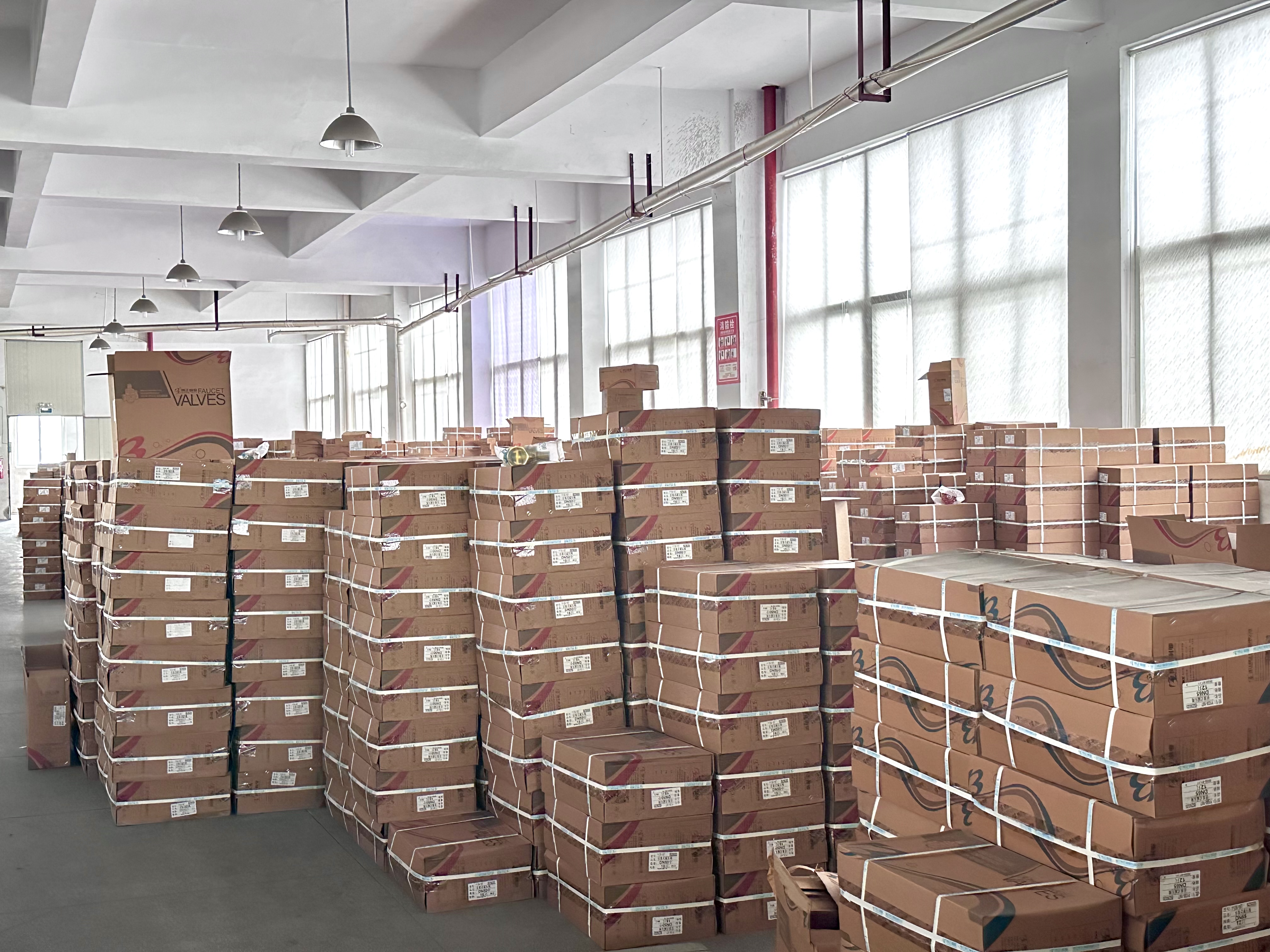
Stock held for distribution orders — the inventory position that underpins a minimum order quantity of one unit on stock goods. Image: Zhejiang Bozheng Copper Industry Co., Ltd.
Future Outlook
Three forces are likely to reshape brass valve shortlists over the next several years. The first is market growth itself: on Dataintelo's projection, the brass valve market roughly doubles between 2025 and 2034, with Asia Pacific already holding 41.2% of revenue. The second is material regulation. Lead-free offerings crossed 30% of new brass valve products in early 2024 under regulatory pressure, and China's MIIT energy efficiency limits for industrial valves, set for implementation in October 2025, mandate specific sealing grades. The third is standards harmonisation: EN 12165 and ISO 228-1 already give European buyers a fixed reference for alloy and thread form.
The practical consequence is that documentation becomes a commercial asset. A supplier that can issue an alloy certificate, a batch number and a test report per shipment will be easier to shortlist than one that cannot, independent of price. Buyers should expect to see those items move from being a request to being a purchase-order condition.
FAQ
What should a brass valve shortlist record before a purchase order is issued?
A shortlist should record six items per supplier: the valve types covered (ball, gate, globe, check, pressure reducing, strainer); the alloy grades available, such as HPb59-1, HPb57-3, CW617N under EN 12165, or C83600; the nominal pressure and temperature window, for example 1.6 MPa and 0–80 °C on the models reviewed here; the thread standard, with ISO 228-1 parallel threads applying to standard European brass valves; the test regime; and the traceability method. Where a supplier cannot provide component-level data, the shortlist should record that as an open verification task instead of leaving the field blank.
How can a buyer verify brass valve material quality before ordering?
Three checks cover most of the risk. First, an alloy certificate or a spectrometer test on the raw material batch establishes what the valve is actually made of. Second, hydrostatic testing at both shell and seat confirms the pressure boundary. Third, a batch number on each valve makes a field failure traceable. Bozheng Valve states that it runs a spectrometer test on raw material for every batch, applies a 100% hydrostatic test at 30 bar shell and 22 bar seat, marks a batch number on every valve, and provides a test report with each shipment.
What minimum order quantity, lead time and production capacity should buyers expect from a brass valve manufacturer?
Bozheng Valve publishes a minimum order quantity of 1 unit for stock goods, a typical production lead time of 30 days, and a monthly production capacity of 30,000 units, alongside an annual output of 3,200,000 units. Its stated purchasing terms include FOB or CIF delivery, pre-shipment test as the acceptance criterion, and 30/70 payment terms. These three figures should be evaluated together rather than separately: a one-month lead time combined with high monthly capacity describes a different supply risk than a short lead time with limited capacity.
How does a documented factory differ from a small workshop supplier?
The difference appears in material control, testing and maintenance profile rather than in appearance. In supplier-side comparison data, small or family workshops are associated with poor material control, no testing and unstable quality, with a reported 10% leakage rate and replacement every 3–4 months, at a cost roughly 3% lower. Documented factory supply is associated with batch-level material testing, 100% hydrostatic testing and per-valve traceability. Because that comparison originates from a supplier, a buyer should confirm it through pre-shipment inspection rather than adopt it as an independent finding.
What are the operating limits of a brass valve range rated at 1.6 MPa and 0–80 °C?
1.6 MPa is a nominal working pressure, equivalent to 16 bar, and 0–80 °C is the accompanying service window for the models listed here, which are positioned for water, gas, low-pressure steam, boilers and compressed air. Within that envelope, the determining variables are the seal compound — PTFE or PPL versus a metal seat — and the compatibility of the media with brass. Service above 1.6 MPa or above 80 °C, including higher-pressure or higher-temperature steam, falls outside the stated envelope and requires a different rating class confirmed by the manufacturer.
What should long-term distribution partners verify before committing to a brass valve supply programme?
Four things are worth verifying against shipment records rather than against a capability statement: whether monthly capacity keeps pace with planned order growth; whether batch numbers and test reports arrive consistently with every shipment; whether model coverage across the six valve families remains stable across production cycles; and whether the commercial frame — minimum order quantity for stock goods, typical 30-day lead time, FOB or CIF terms, and 30/70 payment — still fits the partner's own cash and inventory cycle. Alloy certificates should be re-checked periodically rather than accepted once, since the same model designation can be produced in more than one grade.